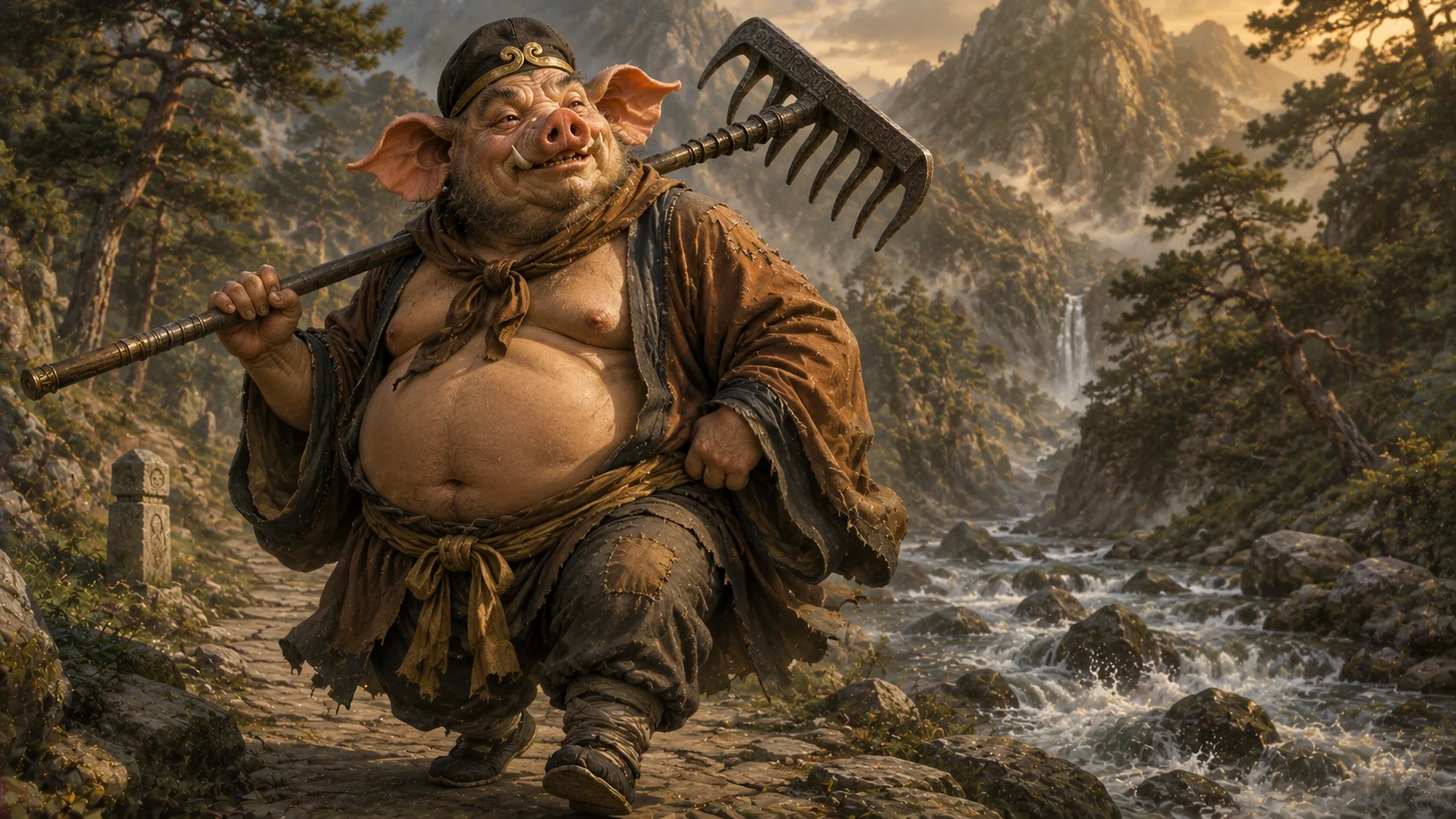
Zhu Bajie, the Pig of the Eight Precepts, is one of the three principal disciples of the monk Tang Sanzang in the sixteenth-century novel Journey to the West, traditionally attributed to Wu Cheng'en. He is a fallen heavenly marshal reborn in a pig's body, a figure whose comic surface conceals a real and unresolved struggle between appetite and discipline. Of the three disciples who walk beside the pilgrim monk, Zhu Bajie carries the novel's most human failing, and the tradition has never asked him to be anything other than that.
The Marshal of the Heavenly Reeds
Before he wore a pig's face, he was Marshal Tianpeng, commander of one hundred thousand naval and marine troops of the Milky Way in the court of the Jade Emperor — a post of real rank, not a footnote to someone else's story. He stood among the ranking generals of Heaven, trusted with the discipline of a great celestial host. At a banquet of the gods, drunk on heavenly wine, he made unwanted advances toward Chang'e, the goddess of the moon. The offense was not a private lapse; it was committed in the sight of Heaven's own court, and Heaven's justice fell accordingly. He was banished from Heaven and cast down from the celestial halls he had commanded.
A Womb Entered by Mistake
Banishment was meant to return him to human life, a hard but survivable sentence. Instead, in the confusion of his fall, his spirit entered the womb of a sow rather than a woman, and he was born with the body and head of a pig while keeping the intelligence, memory, and speech of the marshal he had been. This is the detail the tradition returns to again and again: he did not choose the shape he carries, and the mismatch between his mind and his form is the wound underneath every joke told about him. He is not a beast who learned to talk. He is a person trapped inside a punishment that outlived its own logic.
Terror of Gao Village
Grown to size and strength in his new body, he settled at Gaolaozhuang, Gao Village, and for a time lived there as a son-in-law, taking a wife from the Gao family by force of presence rather than by right. What began as an uneasy arrangement curdled into terror for the household, and the village came to know him as a monster to be rid of, not a neighbor to be tolerated. It is a measure of how far he had fallen that a former marshal of Heaven's navies was, by this point in his story, simply the thing frightening a farming family in the dark.
The Subduing at Gao Village
His conversion did not arrive as a private revelation but as a defeat. Guanyin, the Bodhisattva of Compassion, had already marked him during her journey to find disciples for the scripture pilgrim, and it was Sun Wukong, the Monkey King, who arrived at Gaolaozhuang and forced the confrontation to its end. Bested in combat and cornered by a strength greater than his own, Zhu Bajie yielded — not gently, and not without the theatrical protest that would define him from then on, but he yielded. Guanyin gave him the religious name Zhu Wuneng, marking the moment his old life as a monster ended and his new life as a pilgrim's disciple began, even if the awakening she named for him would prove only partial.
Eight Prohibitions, One Nature
It was Tang Sanzang himself who gave him the name history remembers, Bajie — Eight Prohibitions, or Eight Precepts — a direct reference to the Buddhist dietary and behavioral restraints his master hoped would reshape him: restraints meant to curb the comforts of the flesh that had undone him as Marshal Tianpeng and undone him again at Gao Village. The name is not a compliment. It is a prescription, handed to a man whose entire character is the difficulty of following it. That the novel keeps his given name and his failing in the same two syllables is not an accident of translation; it is the joke and the tragedy folded into a single word, repeated every time anyone addresses him.
The Nine-Toothed Rake
His weapon is the jiuchi dingpa, the nine-toothed rake, and there is no better emblem of who he is. It is a farming implement remade into a weapon of war, just as he is a farmer's terror remade into a pilgrim's guardian. In his hands it becomes a formidable weapon, and it carries the memory of his days commanding naval troops even as it looks, to any village onlooker, like something pulled from a field. Few weapons in the tradition say as much about their bearer with so little ornament.
Brother to the Monkey, Shadow to the Sand Monk
Among the pilgrimage's company, Zhu Bajie stands second in seniority as a disciple, behind Sun Wukong and ahead of Sha Wujing, and his relationships with both men are drawn with real texture rather than as mere plot arrangement. Sun Wukong is his frequent tormentor and his frequent rescuer in the same breath — the one who bested him at Gao Village, the one who mocks his appetite without mercy, and the one who nonetheless fights beside him against every demon the road produces. Sha Wujing, steadier and quieter, absorbs Zhu Bajie's complaints and cowardice without matching them, providing the ballast that keeps the trio's dynamic from tipping entirely into farce. Above them both stands Tang Sanzang, the master whose gentleness Zhu Bajie tests more than any other member of the company dares to.
Guanyin's Long Reach
It is worth remembering that none of the pilgrimage's three disciples chose their master by accident; Guanyin arranged the recruitment of each one, matching flawed and formidable beings to a mission that needed exactly their mixture of strength and imperfection. For Zhu Bajie, her intervention was not a single scene but a continuing thread — she had marked him for reform before Sun Wukong ever arrived at Gao Village, and the vows he took were vows made under her design, not his own initiative. Her compassion in this story is patient rather than sentimental: she chooses beings capable of great harm and gives them, without guarantee, a chance to become otherwise.
Comedy as the Vessel of Consequence
The novel is frank about his character and never softens it into charm alone: he is gluttonous to the point of endangering the group's stores, lustful in ways that repeatedly nearly derail the quest, lazy when labor is asked of him, and quick — at the first sign of real danger — to propose that the pilgrims abandon Tang Sanzang, divide the luggage, and go their separate ways. These are not incidental flaws played for a laugh and then forgotten; they recur across the journey with enough consistency that the comedy becomes a form of characterization rather than a distraction from it. Every time he proposes surrender, the story is asking its audience to notice how ordinary that impulse is, and how far short of heroism it falls.
Strength the Comedy Almost Hides
And yet the same figure who whines about hunger and threatens to quit possesses real and considerable power. He commands thirty-six transformations, fewer than Sun Wukong's seventy-two but formidable in their own right, and his physical strength — inherited from his days as a naval marshal — makes him a genuine combatant rather than a comic bystander. Across the pilgrimage's eighty-one tribulations, he repeatedly turns the tide against demons that Sun Wukong alone cannot finish, diving into battles other members of the company hesitate to enter. The tradition asks its audience to hold both truths about him at once: he is a coward who talks of quitting, and he is a fighter whose rake has ended more than one monster's ambitions.
The Altar That Was Never Fully Cleared
When the pilgrimage reaches its end and the scriptures are won, the reward given to each disciple measures precisely how far each one traveled. Sun Wukong and Sha Wujing attain full Buddhahood and arhatship, their transformations judged complete. Zhu Bajie is granted only the lesser title of Jingtan Shizhe, Cleanser of the Altars — a position of honor, certainly, but explicitly a lesser one, and the text does not disguise why: his hunger and his desire were never fully purified, and the reward fits the incompleteness of the man who receives it. It is one of the most quietly honest endings in the tradition. Not every flawed being who walks the whole of a difficult road is transformed by the end of it, and the story does not pretend otherwise for the sake of a tidier close.
The Body's Long Argument With the Spirit
Read as allegory, the three principal disciples divide the human condition between them: Sun Wukong stands for the restless, brilliant, often unruly mind; Sha Wujing for steadfastness and quiet endurance; and Zhu Bajie for the body itself — its hunger, its desire, its need for comfort, all the appetites that must be disciplined, not eliminated, if a person is to walk a spiritual path at all. His incomplete reform at the novel's end is not a failure of the allegory but its most honest conclusion: the body's appetites are not something a pilgrimage simply cures. They can be walked alongside, restrained, even redeemed in part, but the text declines to promise they can be erased. That refusal to oversimplify is, in its own way, a form of respect for how difficult the discipline actually is.
The Face Every Later Age Remembers
No figure from the pilgrimage has traveled further into popular culture than Zhu Bajie. He is a fixture of Chinese opera, where his comic timing has been a stage tradition for generations, and he recurs constantly across television and film adaptations, almost always played for laughter even when the source material intends something more layered underneath it. It is worth noting, in the spirit of the tradition's own care for accuracy, that many of the broader comic embellishments audiences now associate with him belong to these later adaptations rather than to Wu Cheng'en's original text — the novel gives him real depth and real consequence, and the purely buffoonish version many now picture is, in large part, an inheritance from the stage and screen rather than the page. Beneath every later exaggeration remains the same original figure: a fallen marshal, a farmer's terror turned pilgrim, a body still arguing with a spirit it has not yet finished disciplining.
Sources & traditions
- EncyclopediaWikipedia — Zhu Bajie
- TraditionChinese texts, oral tradition and village tellings (China)
Myths change from area to area and from time to time. This chronicle follows the most widely told versions; tellings in other villages, regions and eras may differ.