The Jade Emperor is the supreme ruler of Heaven in Chinese mythology and Daoist religion: the celestial emperor who governs the entire cosmos from his court in the highest heaven, presiding over the vast bureaucracy of gods, immortals, and spirits.
The August Sovereign of Heaven
Known to worshippers as Yù Huáng (玉皇) or Yùdì (玉帝), the Jade Emperor carries a full liturgical title of striking length in formal Daoist usage: Haotian Jinque Zhizun Yuhuang Dadi, the "Most Honored Sovereign of the Jade Emperor of the Golden Portal of the Vast Heaven." Such titles were not casual honorifics. They were court language, and that is precisely the point of the figure they describe: the Jade Emperor is a ruler whose heaven is imagined as an extension, or a mirror, of the earthly imperial state. He reigns from the highest court, and beneath him serves a bureaucracy as vast and as ranked as any dynasty's civil service.
A Throne Confirmed by an Earthly Court
The Jade Emperor's prominence as supreme ruler of Heaven solidified from the Tang-Song period onward, and his cult received deliberate, high-level sponsorship from the Song court itself. Emperor Zhenzong, who reigned from 997 to 1022, promoted his worship as part of state religious policy, and Emperor Huizong afterward conferred upon him a grand imperial title. This is a rare case in religious history where a scholarly, textual trail shows a deity's rank being formally elevated by decree, much as a living official might be promoted. The parallel was not incidental. A dynasty that governed through titles, seals, and hierarchical appointment recognized its own logic in the god it was elevating.
The Bureaucracy Beyond the Throne
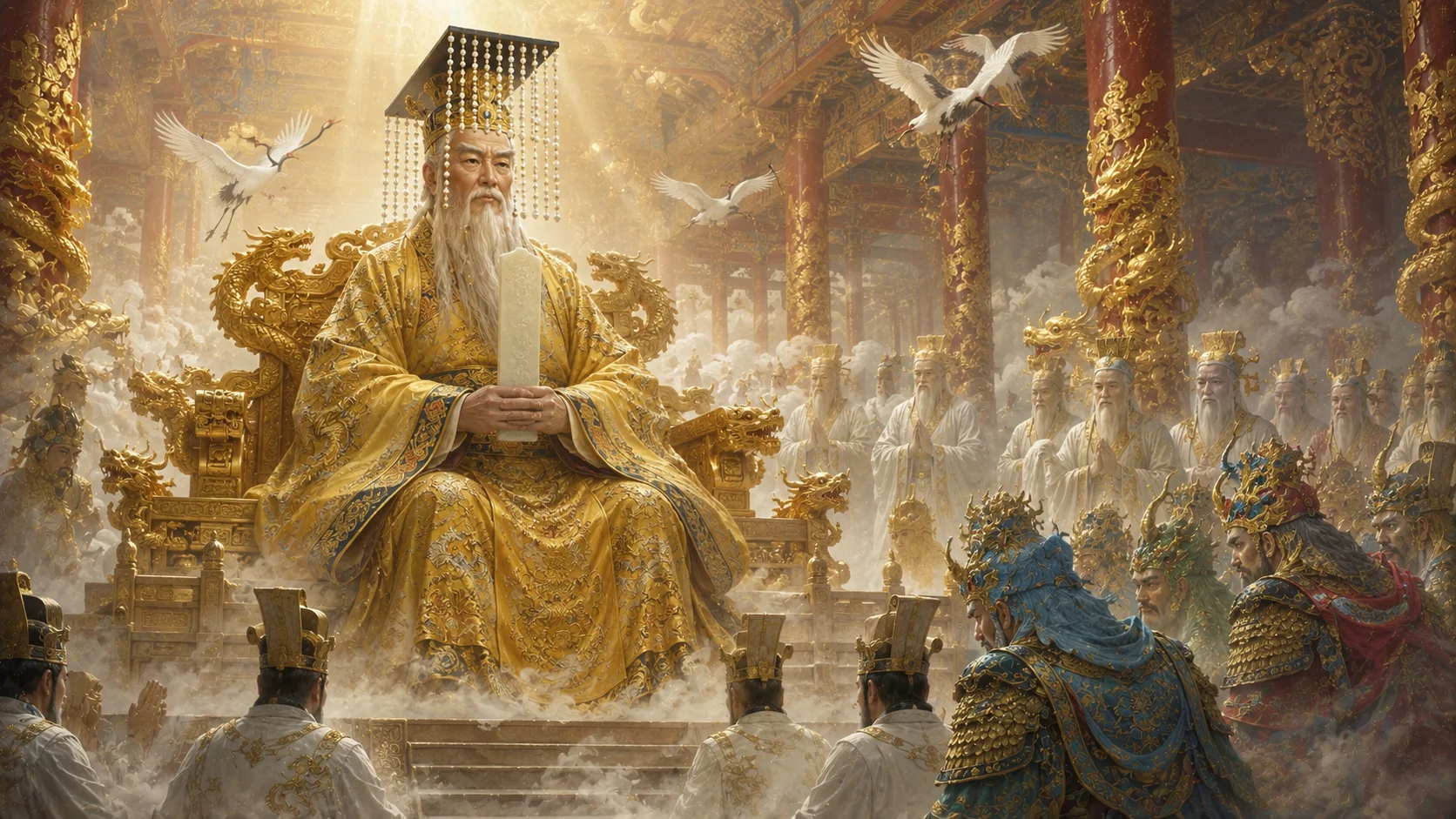
In popular religious imagination, the Jade Emperor does not rule alone or by pure fiat. He presides over the Celestial Bureaucracy, an administrative apparatus of ministries and offices that mirrors, department for department, the machinery of the imperial civil service on earth. Separate offices govern weather, wealth, longevity, and the ledgers of human fate. Petitions rise, decrees descend, and appointments are made and revoked. This vision of heaven as paperwork and protocol, rather than as pure transcendence, is one of the most distinctive features of Chinese folk religion, and it is why the Jade Emperor is often described less as a mystical absolute than as heaven's chief administrator.
A Prince Who Earned the Throne
Folk tradition offers an origin story for the Jade Emperor, though it is not told in a single uniform version across all sources. In one widely circulated account, he began as a prince known as the Pure Virtue Bright King, who attained the Dao only after enduring eons of self-cultivation and trials before ascending to become Jade Emperor. The story matters less for its details, which vary by telling, than for what it establishes: even the ruler of Heaven's throne is framed as something achieved through immense, patient spiritual effort rather than simply possessed from the beginning of time.
Beneath the Three Pure Ones
Elite, liturgical Daoism draws a hierarchy that popular worship does not always observe with the same precision. In philosophical and priestly Daoism, the Jade Emperor ranks below the Three Pure Ones, the Sanqing, who represent the ultimate metaphysical source of the Dao itself. The Jade Emperor, by contrast, functions as a high administrative deity, the manager of the manifest cosmos rather than its ultimate origin. This is a genuine and long-acknowledged point of divergence between temple priesthood and popular devotion, not a contradiction to be smoothed over. Ordinary worshippers overwhelmingly encounter him as heaven's supreme sovereign; ordained Daoist clergy hold a more layered cosmology in which he is exalted but not final.
The Court That Sun Wukong Could Not Leave Alone
No literary work has shaped popular imagination of the Jade Emperor more than Journey to the West, the sixteenth-century novel in which his heavenly court becomes the setting for one of Chinese literature's great acts of rebellion. The Jade Emperor presides over the court that the irrepressible Sun Wukong, the Monkey King, repeatedly disrupts. In an attempt to manage the troublesome newcomer, the court grants Wukong the post of Bimawen, a minor stable-keeper charged with tending the celestial horses. Wukong, once he realizes how low and unglamorous the position truly is, takes it as a calculated insult, and the humiliation becomes the spark for his open rebellion against Heaven itself.
The Peach Banquet and Its Reckoning
Wukong's rebellion escalates further when he wrecks the Peach Banquet and steals Laozi's elixir pills, an act of chaos that could not be allowed to stand unanswered in a heaven organized around order and rank. The Jade Emperor responds by ordering Erlang Shen, alongside the assembled celestial forces, to subdue him. The ensuing confrontation is one of the novel's most vivid set pieces, and it casts the Jade Emperor in his most essential narrative role: not a warrior himself, but the sovereign authority whose command sets heaven's enforcers into motion against disorder.
A Consort Drawn from an Older Tradition
In later syncretic tradition, the Jade Emperor's consort is Xi Wangmu, the Queen Mother of the West. It is worth noting, however, that this pairing is a later development rather than an original feature of her mythology. Xi Wangmu appears in earlier tradition as an independent and considerably older figure in her own right, worshipped and imagined on her own terms long before she was drawn into a marital pairing with the Jade Emperor. Their eventual union reflects the way Chinese folk religion often draws separately evolved figures together into a single coherent cosmological household over time.
The Kitchen God's Annual Report
Few customs illustrate the bureaucratic character of the Jade Emperor's heaven as intimately as the tradition surrounding Zao Jun, the Kitchen God. Each year, before Chinese New Year, the Kitchen God is believed to ascend to Heaven to report on the conduct of the household he has observed from his post beside the stove. That report goes to the Jade Emperor himself, the ultimate recipient of the year's accumulated record of a family's behavior. This is not a custom confined to old texts; it remains practiced in households today, a small domestic echo of the same administrative worldview that structures the entire celestial bureaucracy: everything observed, everything eventually reported upward.
Offerings Before Dawn
The Jade Emperor's birthday, Tian Gong Dan, falls on the ninth day of the first lunar month and is observed with particular devotion among Hokkien communities. The distinguishing feature of the celebration is its timing: offerings are made before dawn, households and temples alike marking the occasion in the dark hours before daybreak rather than during ordinary daylight worship. The practice underscores the reverence in which the Jade Emperor is held even among the many deities of the Chinese folk pantheon — a sovereign whose birthday warrants observance at an hour set apart from all others.
Dragon Robes and the Flat-Topped Crown
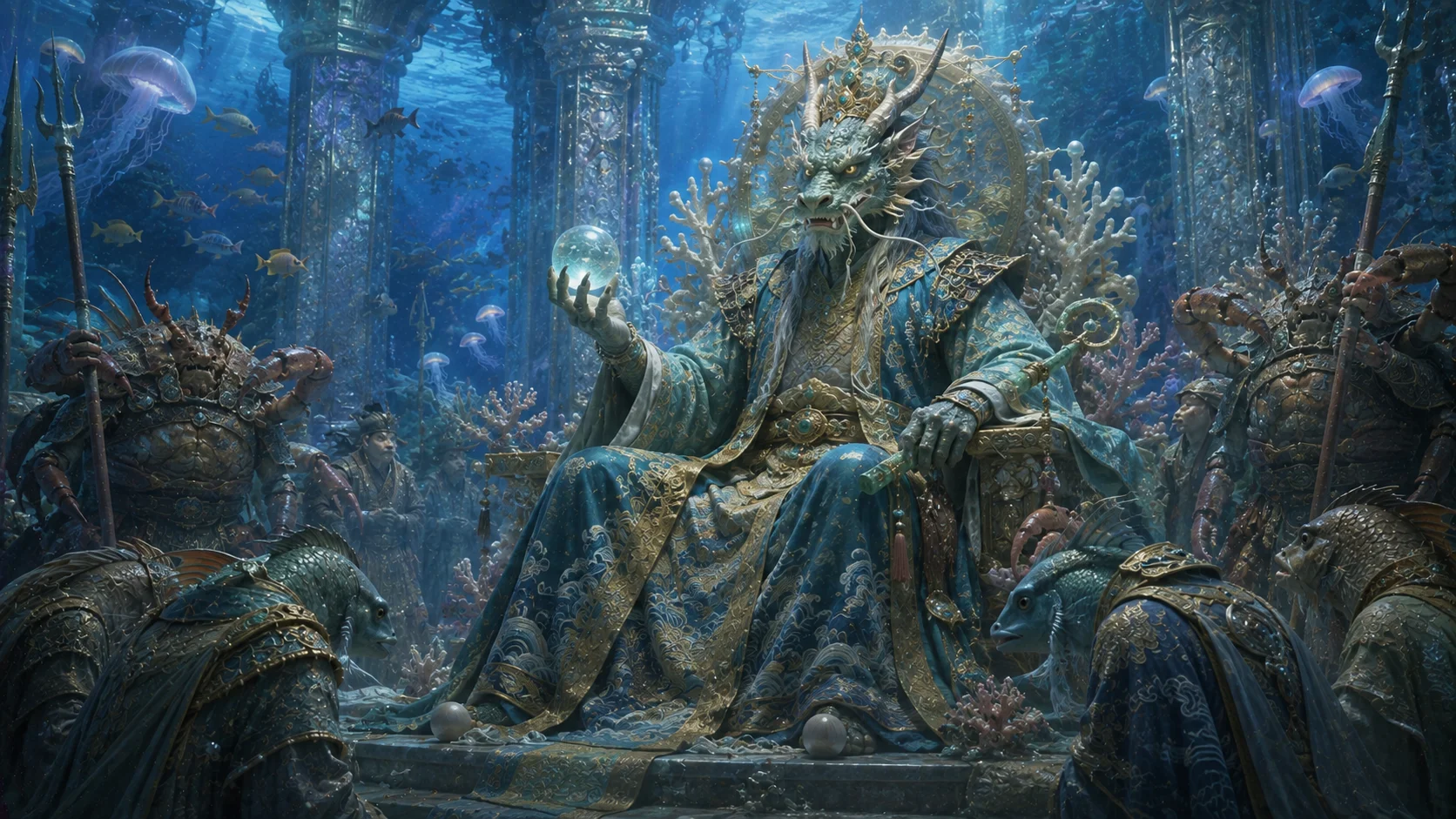
Temple imagery renders the Jade Emperor in the unmistakable visual language of imperial authority: dragon robes of the kind worn by China's actual emperors, topped by the flat-topped mian crown that was itself a mark of the highest sovereign rank on earth. Many temples place his altar in the top hall, physically as well as symbolically situating him above the other deities housed within the same complex. Nothing about the iconography asks to be read metaphorically. It is a direct visual claim that heaven's government looks like, dresses like, and is organized like the empire that worshippers themselves lived under.
Order Mirrored in Heaven
Taken together, the Jade Emperor's titles, his court, his bureaucracy, and even the small yearly ritual of the Kitchen God's report all point toward the same underlying idea: cosmic order imagined as bureaucratic justice, and earthly imperial authority projected onto the heavens as its highest and most complete expression. He is worshipped widely across Chinese folk religion and in Daoist temples, a sovereign whose throne, won through eons of cultivation according to his origin legend and confirmed by imperial decree in recorded history, continues to anchor how an entire tradition pictures the shape of the world above.
Sources & traditions
- EncyclopediaWikipedia — Jade Emperor
- TraditionChinese texts, oral tradition and village tellings (China)
Myths change from area to area and from time to time. This chronicle follows the most widely told versions; tellings in other villages, regions and eras may differ.