Nuwa (女媧, Nǚwā) is the great mother-goddess and creator of humankind in Chinese mythology — the serpent-bodied deity who shaped the first people from yellow earth and, when the heavens themselves were torn open, mended the sky with stones of five colors. She stands among the oldest and most revered figures in the Chinese mythic imagination, attested in sources as early as the Songs of Chu (Chuci) and the Huainanzi of the 2nd century BCE, and she is remembered today not as a distant abstraction but as a living presence in regional temple worship across northern China.
A Body of Serpent, a Heart of Making
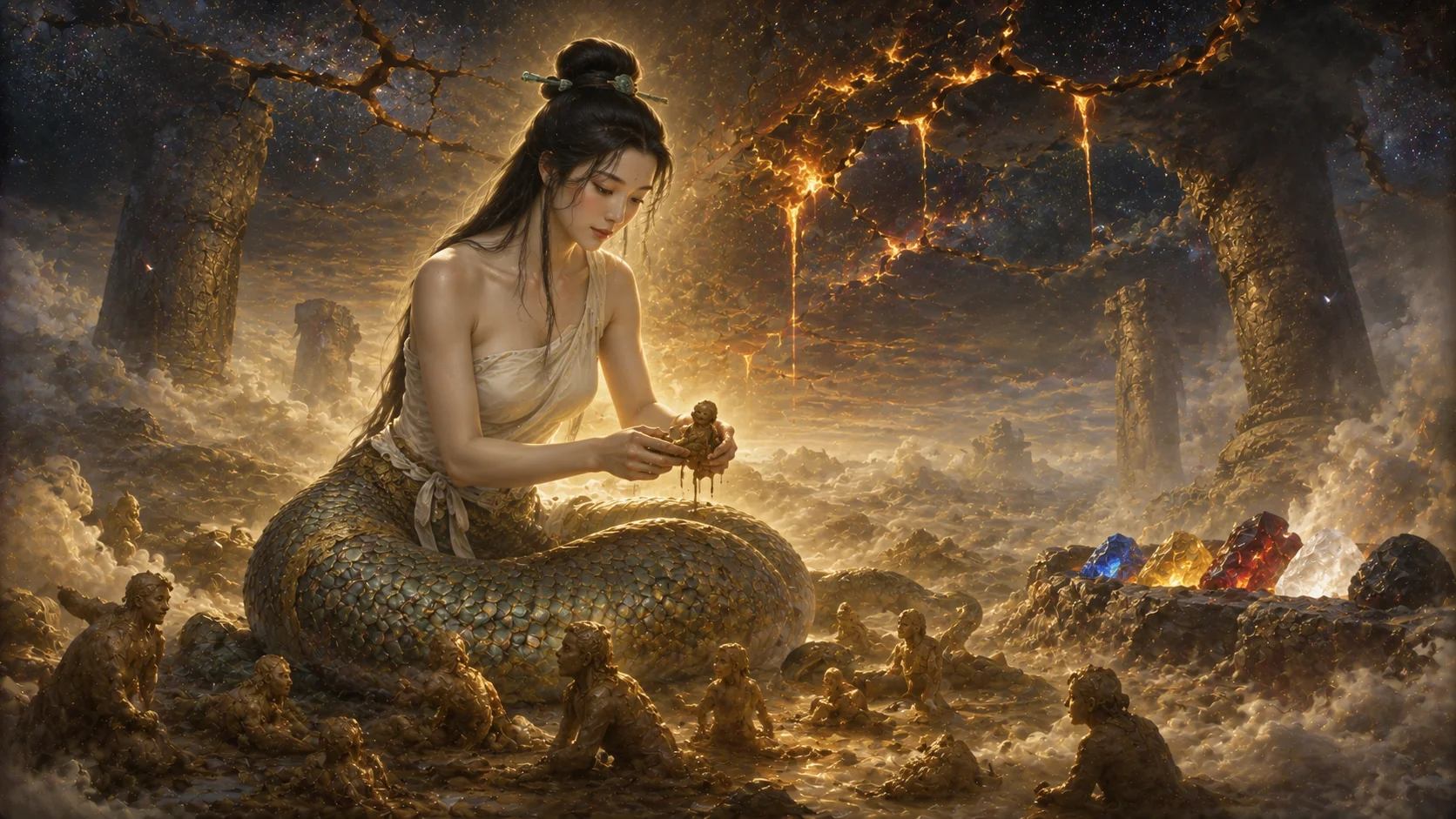
Nuwa is consistently described and depicted with a human upper body and the sinuous, coiling lower body of a serpent or dragon — an image that recurs across centuries of art, most famously in the carved stone reliefs of the Han dynasty. In these images she is often shown intertwined with Fuxi, her counterpart, in a mirrored composition where their serpentine tails cross and interlace. This hybrid form marks her as a being of the primordial age, before the world had settled into its familiar order — neither fully human nor fully something else, but a bridge between the raw material of creation and the people who would eventually walk upright upon the earth she helped complete.
Clay, Rope, and the First Multitudes
The myth for which Nuwa is best known tells of a world that was whole in its landscapes and skies but empty of people. Alone, she is said to have knelt by a riverbank and taken up yellow earth, working it in her hands and shaping it into small figures in her own likeness. Breathed into being, these figures rose and walked, and so humanity came into the world through her hands, one figure at a time.
Some versions of the story add a second, more practical chapter: as the work of hand-molding proved slow, Nuwa is said to have dipped a length of rope into the mud and swung it, flinging droplets that themselves became people. In certain tellings this distinction was later used to explain the divide between nobility and commoners — the carefully hand-shaped figures becoming the elevated, the flung droplets becoming the many — though it is worth noting this is an interpretive layer added onto the core creation story rather than a fixed, universal detail, and different sources treat the social implications differently or not at all.
When the Pillar of Heaven Broke
The second great episode associated with Nuwa is a story of catastrophe and repair. According to the Huainanzi, the water god Gonggong, having lost a great contest of power against Zhuanxu, flew into a rage and struck his head against Buzhou Mountain — the pillar that held up one corner of the sky. The mountain shattered. With its support gone, the heavens themselves tilted, tearing open in places, and the world beneath was thrown into ruin: fires that could not be extinguished, floods that would not recede, and a sky no longer whole enough to shelter the earth it covered.
It fell to Nuwa to set the world right again. She is described gathering stones of five colors and smelting them until they could be worked like a great patch, using this molten material to seal the broken places in the sky. To replace the fallen pillar, she is said to have taken a giant turtle, cut away its four legs, and set them upright as new supports at the four corners of the heavens — a labor that is as much engineering as it is miracle, holding up the physical structure of the cosmos with the very body of a living creature.
The Work That Followed the Repair
The mending of the sky is often remembered as the climax of Nuwa's story, but many tellings continue past it, describing the aftermath she had to set right on the earth below. The floodwaters that had risen while the sky lay open needed to recede; the fires needed to be quenched; the disordered land needed to be made habitable again for the people she had shaped. In this reading, Nuwa's role is not a single heroic act but a sustained labor of restoration — creation and repair treated as two expressions of the same maternal, world-tending power, rather than as separate and unrelated feats.
Sister, Consort, Survivor: Nuwa and Fuxi
In later tradition, particularly from the Tang dynasty onward, Nuwa is paired closely with Fuxi, sometimes as sibling, sometimes as consort, and in some tellings as both at once. One strand of myth casts the two of them as the sole survivors of a catastrophic flood that destroyed the rest of humanity, leaving them to repopulate the world together. Because this framing raises the difficulty of siblings becoming the progenitors of a new humanity, some versions resolve the tension through a divine sign — smoke rising from two separate fires that drifts together and merges, understood as heaven's sanction for their union. This is a distinct strand from the yellow-clay creation myth rather than a simple continuation of it, and the two traditions coexist in the wider corpus without fully reconciling into one single, linear story — a reminder that Nuwa's mythology, like much of early Chinese cosmology, is composite, drawn from multiple regional and textual currents rather than handed down from one canonical source.
Ordering the Bonds Between People
Beyond shaping bodies from clay, Nuwa is credited in some texts with establishing the institution of marriage itself, appearing under the title Gaomei, a matchmaker goddess charged with regulating how humans would pair and reproduce in an orderly way. Where the creation myth explains how people came to exist, this tradition addresses how their continuation was to be governed — reproduction not left to chance but placed under divine oversight, an extension of her role as the one who first brought humanity into being and who remained responsible for its continuity.
The Breath of the Reed Organ
A quieter thread of tradition credits Nuwa with the invention or regulation of the sheng, a reed mouth organ whose bundled pipes and breathy, chord-like voice made it a distinctive presence in early Chinese music. Placed alongside her acts of cosmic repair and human creation, this attribution is modest by comparison, yet it fits a broader pattern in her mythology: Nuwa is remembered again and again as an originator, the figure credited with bringing new things — bodies, unions, even instruments — into a world that did not yet have them.
A Disputed Place Among the Three Sovereigns
Some enumerations of the Sanhuang, the Three Sovereigns of high antiquity, include Nuwa among their number. This is, however, a genuinely unsettled point in the textual record — different sources name different figures for the Three Sovereigns, and Nuwa's inclusion is far from universal across them. Rather than resolving this into a single tidy answer, it is more accurate to hold the dispute openly: Nuwa's stature in Chinese mythology does not depend on occupying a fixed seat in any one formal list, and her prominence as creator and restorer stands on its own regardless of how any particular classical enumeration happens to be drawn.
Traces in the Classic of Mountains and Seas
Nuwa also appears among the figures referenced in the Classic of Mountains and Seas (Shanhaijing), one of the great compendiums of early Chinese mythic geography and strange phenomena. As with much of that text's material, the details surrounding her vary from passage to passage and do not always align neatly with the fuller narratives preserved in sources like the Huainanzi. This variation is itself informative: it shows a goddess whose story was being told, retold, and reshaped across different regions and periods long before any single account came to dominate, leaving modern readers with a composite figure assembled from many partial glimpses rather than one authoritative portrait.
Stone Reliefs and the Interlaced Image
The visual record of Nuwa is as important as the textual one. Han dynasty tomb reliefs carved in stone repeatedly return to the image of her paired with Fuxi, their serpent bodies twisted around one another in a double-tailed composition that mirrors itself from side to side. This artistic convention persisted across a wide span of Chinese funerary and religious art, suggesting that the image of the intertwined serpent-bodied pair carried meaning well beyond any single written myth — a visual shorthand for cosmic origin and ordered union that audiences would have recognized even without a text in hand.
Temples, Festivals, and Living Devotion
Nuwa's worship did not end with antiquity. Regional folk religion in parts of northern China continues to honor her at dedicated temples, among which the Nüwa Temple, known as Wa Huang Gong, in Shexian, Hebei, stands as a notable center of devotion. Associated festivals in these regions keep her story in active practice rather than confining it to old texts, with communities marking her role as creator and restorer through ritual observance that has continued across generations. This living tradition is a central part of who Nuwa is: not merely a mythic figure preserved in classical literature, but a goddess still approached, still honored, and still meaningful to people today.
The Enduring Weight of Her Name
Across every strand of her mythology — the molding of humanity from clay, the mending of a broken sky, the ordering of marriage, the shared survival with Fuxi — Nuwa embodies a single, coherent idea rendered in many forms: that creation and restoration are acts of the same maternal, generative power. She is the goddess who makes people out of earth and the goddess who repairs the heavens when they fail; the one who begins humanity and the one who ensures its bonds hold. It is this combination — origin and repair, generation and governance — that has kept her story alive across millennia of retelling, carved in stone, sung through reed pipes, and still spoken of at temple gates in Hebei today.
Sources & traditions
- EncyclopediaWikipedia — Nüwa
- TraditionChinese texts, oral tradition and village tellings (China)
Myths change from area to area and from time to time. This chronicle follows the most widely told versions; tellings in other villages, regions and eras may differ.