Fuxi (伏羲), also known as Paoxi, stands at the very head of Chinese civilisation's remembered time — one of the Three Sovereigns (Sanhuang), a culture hero credited not with conquest but with gift: the arts by which scattered, hungry people became a people at all. Tradition places his reign in the twenty-ninth century BCE, a date offered by the old chronologies rather than by verifiable record, and reverence for him has never depended on the difference. He is remembered as the one who first looked at the patterns of the world and found in them a shape that could be taught.
The Serpent Coil at the Dawn of Order
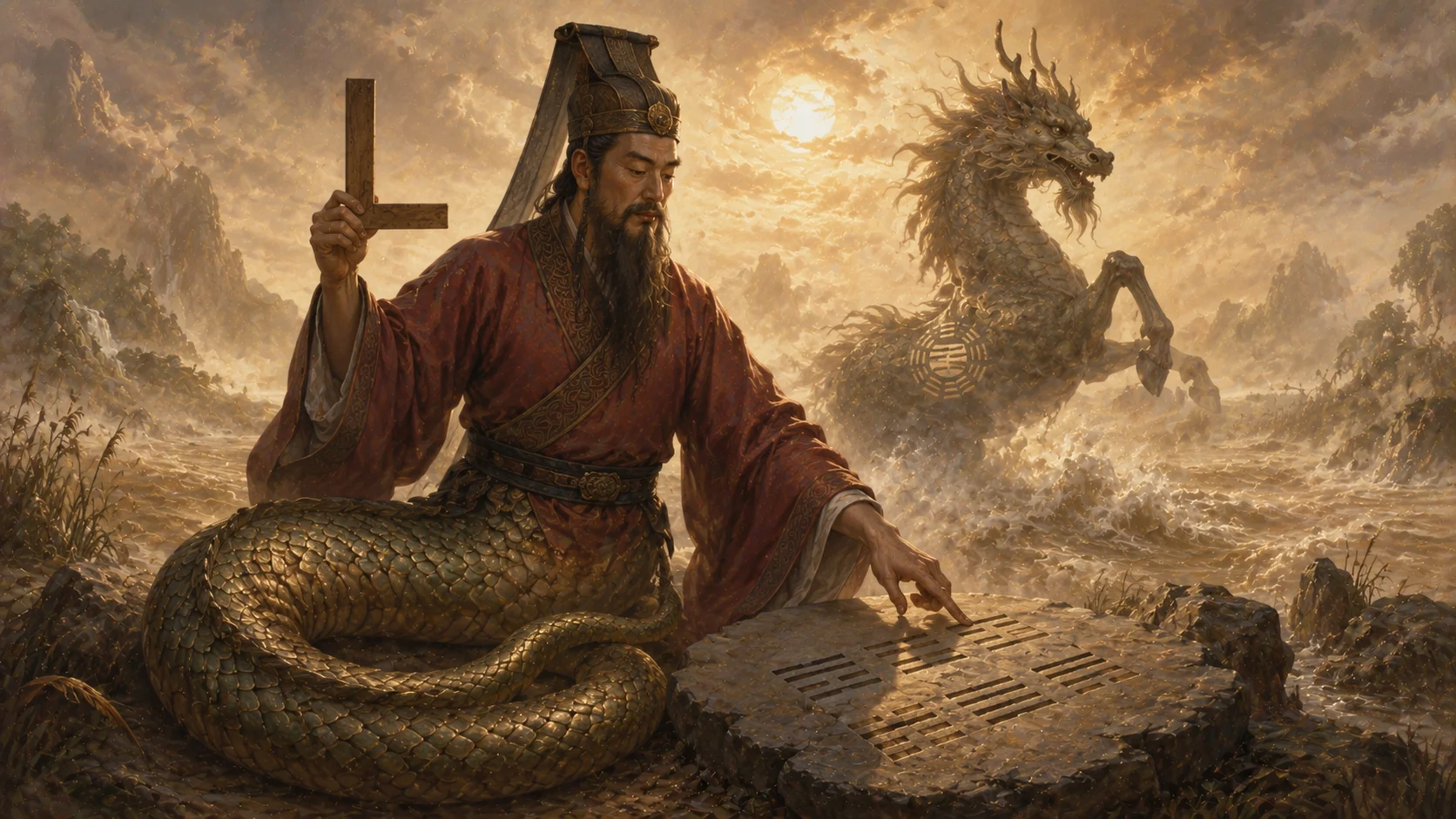
In the imagery that has carried Fuxi across millennia, he is not drawn as an ordinary man. From the waist up he is human; below, his body tapers into the coiled form of a serpent or dragon. This is the shape shared by his sister-spouse Nuwa, and the two are most famously rendered together on Han-dynasty tomb reliefs, their serpentine lower bodies wound around one another in an intertwining that has struck viewers for two thousand years as a picture of union itself — of two halves of a single order joined. In these reliefs Fuxi is typically shown holding a carpenter's set-square, Nuwa a compass, the pair of instruments together evoking the measuring-out of a world that did not measure itself before they arrived.
Sibling, Spouse, and the First Household
Later syncretic myth binds Fuxi and Nuwa together as brother and sister who also become husband and wife, an arrangement that unsettled even the tradition that preserved it and was explained, in some tellings, as a necessity of a world otherwise empty of people. In certain flood narratives the two are remembered as the sole survivors of a great inundation, left to begin humanity over again — an origin story that folds cosmic catastrophe and human continuity into a single pair. Whatever the precise telling, Fuxi and Nuwa together form one of the most enduring images in Chinese myth: order and generation, measurement and creation, standing side by side.
The Rites That Made Kinship Possible
Fuxi is also credited with something less visually dramatic than the serpent coil but no less foundational: the institution of marriage rites and the surname system. Before his intervention, tradition holds, unions among people followed no regulating principle, and confusion of kinship followed naturally from it. By establishing surnames and the customs that governed who might marry whom, Fuxi is remembered as having given human relationships their first grammar — a way of knowing who belonged to whom, and on what terms a family could be built. It is a quieter gift than fire or writing, but the tradition treats it as no less civilising: a people cannot organise itself, generation after generation, without first knowing how it is related.
Nets Cast Upon the Water
Among the practical skills attributed to Fuxi, the invention of fishing nets holds a particular place. Before nets, the tradition implies, people took what fish and game they could by chance and by hand; Fuxi's net turned an occasional catch into a reliable one. Paired with his teaching of hunting more broadly and the domestication of animals, this places him at the threshold between foraging and something more deliberate — a way of drawing sustenance from the world that did not simply hope for abundance but planned for it. Cooking, too, is numbered among his teachings, the transformation of raw sustenance into food fit for a settled people rather than a wandering one.
The Dragon-Horse and the River's Message
The most celebrated of Fuxi's gifts begins, in tradition, not with an idea but with a vision. A dragon-horse — a creature of the water, part dragon and part horse — is said to have emerged from the Yellow River bearing markings upon its back. Fuxi studied these markings, and from them derived the pattern that would become known as the Yellow River Map, the Hetu. It is a story in which revelation arrives from the river itself, as though the natural world had offered its own diagram and asked only that someone reads it carefully enough to understand what it showed.
Eight Lines That Hold the World
From the Hetu, tradition credits Fuxi with deriving the Eight Trigrams, the Bagua — eight configurations of broken and unbroken lines that became the foundation of the I Ching, the Yijing, one of the oldest and most consulted texts in the Chinese tradition. The trigrams are not merely a divinatory device in this telling; they are presented as a compressed picture of the world's own workings, a set of symbols capacious enough to hold change, relation, and possibility within a handful of strokes. That a sovereign remembered for teaching people to fish and cook is also remembered as the author of so abstract and enduring a system says something about how the tradition understands civilisation: practical skill and cosmological insight are not separated but given to humanity by the same hand.
East, Wood, and the Trigram Zhen
In the correlative cosmology that grew up around the Bagua system attributed to him, Fuxi came to be associated with the direction east and with the element wood, tied to the trigram Zhen. This placement situates him within a larger cosmological architecture — one where directions, elements, seasons, and trigrams answer to one another — and it is a testament to how thoroughly the system he is credited with originating came to organise later Chinese thought about the structure of the world, well beyond the act of divination itself.
Strings Drawn Across Silence
Fuxi is also remembered as the inventor of the guqin, or in some accounts the se, the zithers whose plucked strings would carry Chinese music and poetry for centuries afterward. To credit a mythic sovereign with an instrument is to say something about what that instrument means to the culture that plays it: not a mere amusement, but part of the same civilising inheritance as fire, marriage, and the trigrams — a way of shaping breath and silence into something ordered, the way the Bagua shaped chaos into pattern.
Marks Before Words
Alongside the guqin, tradition attributes to Fuxi elements of early record-keeping and the beginnings of writing, placing him before or alongside the other cultural heroes who would later be credited with refining the Chinese script. In this telling, the impulse to record — to fix something in a durable mark rather than trust it only to memory — belongs to the same civilising moment as the trigrams themselves: both are ways of making the world legible.
A Disputed Company of Sovereigns
The classical sources are not united on exactly who belongs among the Three Sovereigns. The Huainanzi, the prefatory material of the Records of the Grand Historian, and other compilations name Fuxi consistently, but the company around him shifts: sometimes he stands with Nuwa and Shennong, sometimes with Shennong and the Yellow Emperor. The tradition preserves this disagreement rather than resolving it, and it is worth stating plainly rather than smoothing over — the enumeration of the Three Sovereigns has always been a live question within Chinese textual history, not a settled fact awaiting rediscovery.
Tianshui's Temple and the Living Memorial
Fuxi is not remembered only in ancient texts and tomb reliefs; he is venerated still. The Fuxi Temple, Fuxi Miao, in Tianshui, Gansu, stands as a site of ongoing devotion, and an annual memorial ceremony there honours him as a human-cultural ancestor — a figure to whom a living community continues to pay respect, rather than a name preserved only in scholarship. This continuity matters: Fuxi's story is not a closed chapter of antiquity but a thread that connects present observance to a very old reckoning of where civilisation began.
The Hand That Joined Sky and Craft
Across every strand of his legend, Fuxi occupies a singular position: he bridges cosmology and craft, the abstract and the practical, in a single figure. He is credited with the Bagua, a system for reading the deep pattern of change itself, and in the same breath with nets, cooking fires, and the rites of marriage — the unglamorous machinery of daily survival and social order. The tradition does not treat these as separate gifts from separate sources; it treats them as one gift, civilisation entire, handed down by a sovereign whose lower body was still a serpent's coil, as if to say that order, however lofty its expression in the trigrams, remains rooted in something ancient, coiled, and close to the earth from which it rose.
Sources & traditions
- EncyclopediaWikipedia — Fuxi
- TraditionChinese texts, oral tradition and village tellings (China)
Myths change from area to area and from time to time. This chronicle follows the most widely told versions; tellings in other villages, regions and eras may differ.