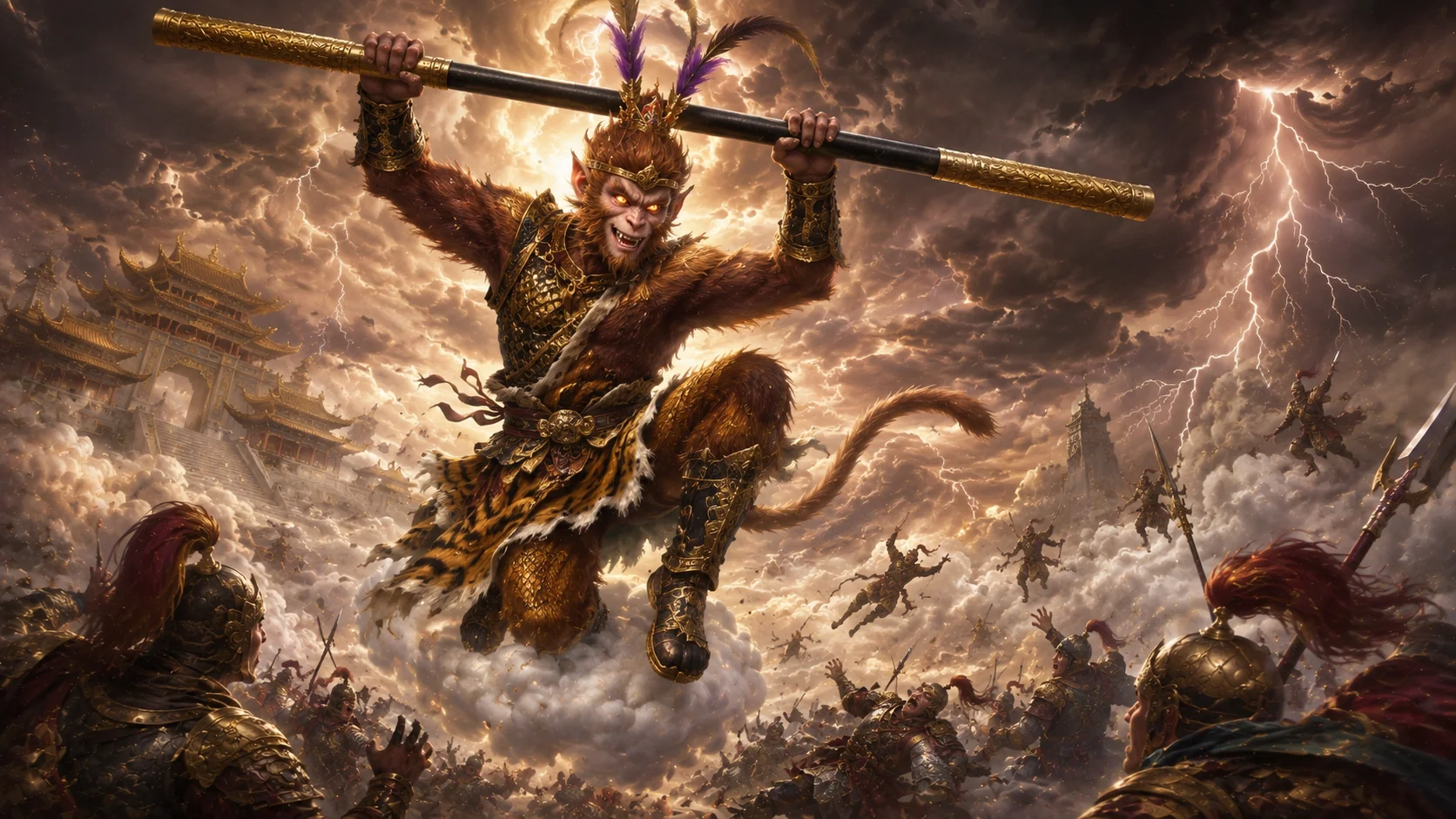
Sun Wukong, the Monkey King, is the most celebrated hero of Chinese literature: the immortal, shape-shifting trickster of the sixteenth-century novel Journey to the West (Xiyou Ji), attributed to Wu Cheng'en. Born of stone rather than flesh, he mastered the arts of the immortals, rose in open rebellion against Heaven itself, and was finally humbled into becoming the fierce protector-disciple of the pilgrim monk Xuanzang. Few figures in the Chinese storytelling tradition carry so much at once — comedy, cosmic defiance, and hard-won discipline — and fewer still have stepped so completely out of the page and into living worship.
A Stone Splits Open on the Mountain of Flowers and Fruit
Sun Wukong's origin marks him from birth as something outside the ordinary order of living things. Atop the Mountain of Flowers and Fruit stood a magical boulder, said to have absorbed the nourishing essence of Heaven and Earth since the beginning of the world. In time the stone cracked open of its own accord and released a stone egg, which the wind transformed into a fully formed stone monkey. He was born of neither human mother nor animal parent, owing his existence instead to the raw creative force of the cosmos itself — an ancestry that sets him apart from every other creature in his story and foreshadows the scale of the disruption he will cause among gods who assumed the natural order was settled.
Sovereign of the Water-Curtain Cave
Among the monkeys of the mountain, it was Sun Wukong who found the courage to leap through a waterfall and discover the hidden cave behind it, a dry and sheltered hall fit for a kingdom. For this daring the other monkeys crowned him their king, and for a time he ruled contentedly over his troop. But contentment did not last: the thought of his own eventual death, and the injustice of mortality itself, unsettled him so deeply that he resolved to leave his kingdom and go in search of the secret of immortality — a search that would set the entire remainder of his story in motion.
Apprenticeship Under the Patriarch Subhuti
Sun Wukong's search led him to the Daoist Patriarch Subhuti (also rendered Subodhi), a reclusive master of the deepest arts of longevity and transformation. Under Subhuti's instruction he learned the seventy-two transformations (qishi'er bian), the power to reshape his body into nearly any form he wished, and the technique of the cloud-somersault, a single leap capable of carrying him 108,000 li across the world. These gifts, granted by patient discipline rather than seized by force, would later stand in stark and deliberate contrast to the immortality he chose instead to steal.
The Staff Drawn from the Dragon King's Treasury
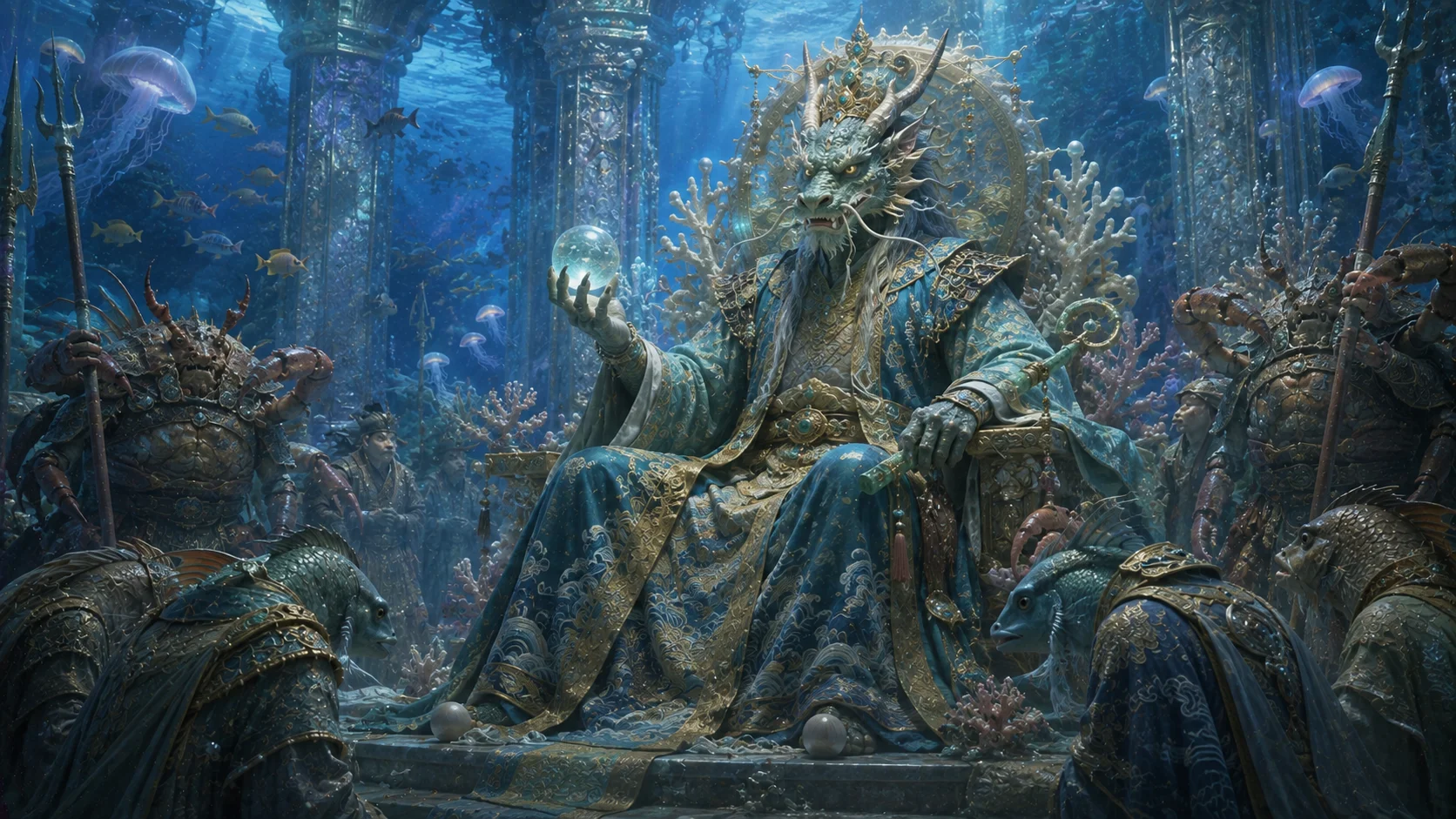
Not satisfied with mere skill, Sun Wukong sought a weapon worthy of his new powers and travelled to the undersea palace of the Dragon King of the Eastern Sea. There, among treasures no ordinary hand could lift, he claimed the Ruyi Jingu Bang — the As-You-Will Golden-Banded Staff. The staff obeys its master's will absolutely: it can swell to a towering pillar capable of battering armies, or shrink down to the size of a sewing needle small enough to be tucked behind his ear when not needed. It remains his signature weapon throughout the whole of his story, an extension of his own untamed will made solid.
Striking His Name from the Book of Life and Death
Sun Wukong's hunger for immortality did not stop at borrowed weapons. Descending into the Underworld, Diyu, he confronted the ledgers by which Yama and the judges of the dead record the lifespan allotted to every living being. Rather than petition for mercy, he seized the Book of Life and Death and struck out his own name and the names of his monkey subjects, declaring by his own hand that death itself no longer applied to him. It was an act of defiance against the fundamental bookkeeping of the universe — not earned transcendence, but immortality claimed by force, and Heaven took notice.
Insulted by the Post of Bimawen
Word of the stone monkey's growing power reached the celestial court, and Heaven's ministers, hoping to bring him quietly to heel, offered him a post in their bureaucracy. He was given the title Bimawen, keeper of the heavenly stables — a menial position whose smallness he did not at first recognize. When he learned how minor and demeaning the office truly was, his fury was total. He renounced Heaven's service, returned to his mountain, and proclaimed himself Qitian Dasheng — the Great Sage Equal to Heaven — a title that placed him, by his own declaration, on level footing with the gods themselves.
Ruin at the Peach Banquet of the Queen Mother
The conflict between Sun Wukong and Heaven reached its most audacious point at the Peach Banquet held by Xi Wangmu, the Queen Mother of the West. He made his way into the celebration and devoured the peaches of immortality meant to nourish the assembled gods for ages, then went on to consume Laozi's own alchemical pills of longevity. The banquet meant to honor Heaven's order became instead the scene of its open humiliation, and what had been simmering defiance now became outright war between the stone monkey and the whole of the celestial bureaucracy.
The Furnace of Laozi and the Weight of Five Elements Mountain
Heaven answered with everything it had. Celestial armies were sent against Sun Wukong and broken; even Laozi's alchemical furnace, into which the rebel was cast in hope of burning him to nothing, failed to destroy him. It took the intervention of the Lord Buddha himself to end the rebellion. In a final contest of power, the Lord Buddha proved that Sun Wukong could not even leap beyond the reach of his own palm, and pinned the defeated Great Sage beneath Five Elements Mountain (Wuxing Shan). There he remained imprisoned for five hundred years, an era of stillness imposed on a being defined until then entirely by restless motion.
Freed to Walk the Road to India
Five centuries beneath the mountain ended when the monk Xuanzang, journeying west toward India to retrieve the Buddhist sutras, came to free him and accept him as his first and most formidable disciple. From that point on Sun Wukong walked the long pilgrimage road as chief protector of the party, standing alongside two other reformed spirits, Zhu Bajie and Sha Wujing. The rebel who had once warred against the whole of Heaven now bent his enormous strength toward guarding a single vulnerable monk against the demons and trials that filled the road to the west.
The Golden Headband and the Discipline of the Tightening-Crown Spell
Sun Wukong's immense power made him as dangerous to command as he was valuable to have beside oneself, and so the bodhisattva Guanyin gave Xuanzang a quiet safeguard: a golden headband, the jinguzhou, which she placed upon the monkey's brow. Whenever Xuanzang recited the Tightening-Crown Spell, the band constricted painfully around Sun Wukong's skull, a check on his temper and his pride that no display of strength could break. It is a small, almost domestic detail set against his cosmic origins — proof that even the Great Sage Equal to Heaven could be bound, not by force of arms, but by a spoken word he could not silence.
The Restless Mind Made Still
Buddhist readers of the novel have long seen in Sun Wukong's arc an allegory of the mind itself — his unruliness, his cleverness, his refusal to accept limits standing for the untamed ego that must be disciplined before it can be liberated. The pilgrimage does not erase his nature so much as train it: mischief becomes vigilance, defiance becomes protection. At its conclusion, Sun Wukong's transformation is recognized formally, and he is granted the title Dou Zhan Sheng Fo — the Victorious Fighting Buddha — an ending that honors the fire of his origins while marking how thoroughly it has been brought into harmony with a larger purpose.
Incense Still Rising for the Great Sage
Sun Wukong's presence in Chinese life extends well beyond the pages of the novel that made him famous. In parts of southern China, Hong Kong, Taiwan, and Southeast Asia, he is honored as a folk deity in his own right, worshipped under the title Qitian Dasheng by devotees who bring incense and offerings to temples raised specifically in his name, with a notable concentration of such shrines in Fujian. This religious cult stands as a distinct and attested tradition in its own right, separate from — though certainly nourished by — his enormous popularity in literature, theatre, and popular culture. Few literary heroes anywhere have crossed so completely from story into shrine, still asked, centuries later, to lend their strength to those who call on them.
Sources & traditions
- EncyclopediaWikipedia — Sun Wukong
- TraditionChinese texts, oral tradition and village tellings (China)
Myths change from area to area and from time to time. This chronicle follows the most widely told versions; tellings in other villages, regions and eras may differ.