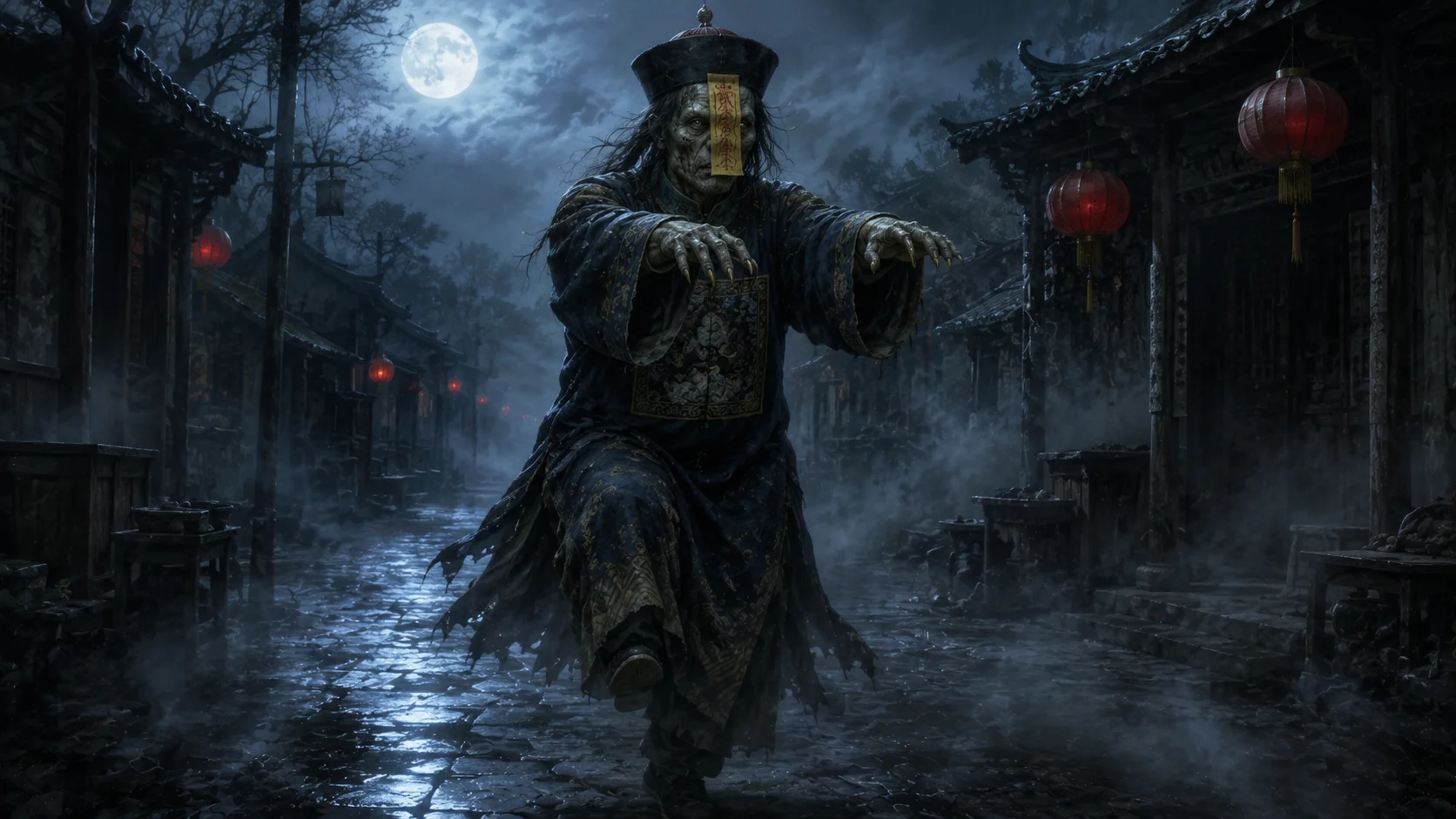
The Jiangshi — literally the "stiff corpse" — is one of the most distinctive revenants in Chinese folk religion: a body that refuses to lie down. Catalogued at length in Qing-dynasty zhiguai ("strange tale") literature, most famously in Yuan Mei's Zi Bu Yu and Ji Yun's Yuewei Caotang Biji, the jiangshi is not a ghost in the disembodied sense, nor a Western-style zombie hungry for flesh. It is a corpse whose lower soul never departed, moving upright through the dark by hopping, arms outstretched, hunting not meat but the life-breath of the living.
The Soul That Would Not Leave
Chinese folk cosmology divides the human soul into two aspects: the hun, an ethereal component that ascends after death, and the po (魄), a corporeal soul bound to the body itself. Under proper conditions — correct funerary rites, timely burial, the attentive observance of descendants — the po eventually disperses along with the hun, and the body is permitted to become simply a body again. The jiangshi exists because that process failed. Improper burial, unfilial neglect by the family who should have overseen the rites, a death by suicide, or a corpse struck by malevolent qi or lightning could all trap the po inside the flesh, refusing to release its grip. What results is not a soul without a body, but a body that a soul has not finished leaving — animated, but only barely, only wrongly.
A Body That Forgot How to Walk
The jiangshi's signature motion — the hop, tiaoshi (跳尸) — is one of Chinese folklore's most immediately recognizable images. Folklorists trace it to a grim practicality: rigor mortis stiffens every joint, and burial robes, often bound at the ankles or wrapped tightly around the legs, prevent anything like a natural stride. What remains is a corpse whose knees will not bend, whose arms lock forward at the shoulder as though still reaching for something, and whose only means of covering ground is a rigid, bounding hop. It is a horror built from anatomy rather than invention — the shape of the monster is the shape of what death actually does to a body, exaggerated only slightly by the storyteller's hand.
The Colour of the Grave
Where it is described physically, the jiangshi is rendered in the palette of decay rather than of blood: skin gone green-white, stretched tight or beginning to slough, eyes clouded, the whole figure carrying the pallor of something that has been in the ground rather than something freshly killed. This matters for what it signals about the creature's nature. It is not a predator dressed in a corpse's clothing; it is the corpse itself, decayed exactly as far as its unnatural animation allows, betraying at a glance that whatever moves inside it has no business being upright.
Breath as Prey
The jiangshi's hunger sets it apart from nearly every other reanimated-dead figure in world folklore. It does not eat flesh and does not, in the standard folkloric account, drink blood. What it takes is qi (氣) — the vital breath and life-force of the living — drawing it from victims the way a drowning man might draw air, leaving them weakened, sickened, sometimes dead, but rarely devoured. This is a monster built entirely from the logic of Chinese medicine and cosmology: qi is what animates a living body, and a jiangshi is a body with none of its own left to spend, forced to steal what it needs from anyone unlucky enough to cross its path after dark. Encountering one is less like meeting a predator than being drained by proximity to something that should not exist.
The Talisman on the Brow
Folklore and fiction alike converge on one image as the jiangshi's great weakness: a strip of yellow paper, a fu (符) talisman, inked in cinnabar with sacred script and pasted directly to the corpse's forehead. Properly applied by someone with the authority to write it, the talisman can freeze a jiangshi in place or bind its movements entirely, holding it as still as the grave it climbed out of. The image endures because it condenses the entire cosmology into a single object — a piece of paper, inscribed with the right words by the right hand, exerting authority over death itself. Remove the talisman, and whatever animated the corpse is loose again.
Rice, Roosters, and Mirrors
Beyond the talisman, a body of smaller countermeasures accumulated around the jiangshi over generations of retelling. Sticky, glutinous rice scattered in its path is said to repel it — some versions hold that it is compelled to stop and count each individual grain, a small and almost comic superstition layered onto genuine dread. A rooster's crow, announcing the arrival of dawn, drives it back toward whatever resting place it came from, since a jiangshi's activity belongs to the night the way its stillness belongs to daylight. Mirrors are cited too, said to trouble it by showing it what it has become, and the blood of a black dog appears in some tellings as a further ward. None of these carries the doctrinal weight of the cinnabar talisman, but together they form a folk toolkit — the kind of practical, half-remembered advice a village would pass down for surviving a night on the wrong road.
The Priest Who Walks the Corpse
Where there is a jiangshi, Chinese storytelling almost always places a Daoist priest, the daoshi, as its natural counterpart. Armed with talismans, a peachwood sword, and ritual bells, the daoshi is the figure with the training and spiritual authority to recognize an unsettled po, to write a fu with real binding power, and to perform the rites the deceased's own family failed to provide. This is meaningfully different from Buddhist exorcism traditions elsewhere in Chinese religious life — the jiangshi belongs specifically to the Daoist ritual vocabulary of talismans, register-writing, and command over spirits, and the priest's role is not merely to destroy the corpse but to finish the funerary work that was left undone, giving the trapped po the release it never received.
The Corpse-Walkers of Xiangxi
One of the most evocative explanations for how a jiangshi might come to be walking the roads at all belongs to the folklore of Xiangxi, in Hunan — the legend of the corpse-walking trade. The story holds that itinerant Daoist priests, hired by migrant laborers' families to bring their dead home for burial rather than let them be interred far from the ancestral plot, would not carry the bodies at all. Instead, so the tale goes, they animated the corpses to walk upright through the night, moving in that same rigid hop, robes bound and arms out, following the priest's bell and chant back toward home soil. It is important to hold this story at the right distance: Republican-era folklorists recorded the belief as a genuine piece of regional legend, but its historicity as an actual profession is disputed and unverified. It survives as a folk explanation for the jiangshi's origin — vivid, morbidly practical, and never confirmed as practice rather than story.
A Wrong Death Made Visible
Beneath the hopping gait and the paper talismans lies a cultural anxiety that the jiangshi expresses more directly than almost any other figure in Chinese ghost lore: the fear of a death handled wrongly. In a culture where filial piety and correct funerary observance are central obligations binding the living to their dead, the jiangshi is what happens when that obligation is not met — when a family fails its ancestor, when rites are skipped or garbled, when a body is buried in haste or not buried in the right place at all. The monster is, in that sense, a form of moral accounting made flesh: proof that the dead do not simply vanish when the living neglect them, and that improper burial does not stay a private failure but becomes a threat to the whole community.
Kin to Ghosts, Yet Apart
Within the broader taxonomy of Chinese supernatural belief, the jiangshi sits inside the wide category of gui (鬼), ghosts, and guai (怪), anomalies and strange phenomena — but it occupies a specific and separate niche within that world. A gui in the ordinary sense is a disembodied spirit, wandering without the flesh it once wore. The jiangshi is defined by the opposite condition: a spirit-fragment that never achieved separation from the body at all. This distinction matters to the folklore's internal logic — a jiangshi cannot simply be exorcised the way a wandering ghost might be, because the problem is not a spirit haunting a place but a soul still lodged inside decaying matter, and the remedy has to address the corpse itself, not merely the disturbance it causes.
When the Hair Turns White
Later vernacular fiction, expanding on the earlier zhiguai accounts, introduced a darker trajectory for a jiangshi left unresolved. The longer such a corpse goes without proper rites — without a daoshi finding and finishing the interrupted funeral — the more it is said to change. Its hair is described turning white, its capacities growing: greater leaps, greater speed, in some tellings the beginnings of something like flight. Left uncured long enough, a jiangshi in these later stories does not stay static in its danger but escalates toward a more powerful demonic entity altogether. This upgraded lore is a layer added mainly by vernacular fiction rather than a fixture of the earliest classical accounts, and it reads as a natural extension of the underlying premise: the failure that created the jiangshi does not resolve itself, and time only compounds a rite left undone.
The Robes of a Later Century
The image most people now associate with the jiangshi — a stiff figure in Qing official court robes, arms held rigidly forward, hopping through moonlit courtyards with a talisman fluttering on its brow — owes an enormous amount to twentieth-century Hong Kong cinema, above all the 1985 film Mr. Vampire and the wave of "hopping vampire" films it inspired. This cinematic form standardized and popularized the jiangshi for a mass audience, giving it a costume, a silhouette, and a set of visual rules that are now inseparable from the figure in popular imagination. It is worth being precise about what this layer is and is not: it is a genuine and influential piece of twentieth-century popular culture, built on top of the older Qing zhiguai motifs, but it is a later reinterpretation rather than an ancient attestation in its own right. The corpse in the official robes is a modern costume placed on a much older frame — the frame of the po soul that would not leave, the priest with his talisman, and the fear of a death handled wrong.
What the Hopping Corpse Still Guards
Strip away the paper talismans and the sticky rice, the peachwood sword and the rooster's crow, and what remains at the center of the jiangshi is a very old, very specific unease: that the boundary between the dead and the living depends on ritual care being done correctly, and that a broken rite does not simply fail quietly. It returns, upright, hungry for the breath of anyone still living to draw it. The jiangshi endures across three centuries of retelling — from scholarly zhiguai collections through regional Hunan legend into modern cinema — because it keeps restating that same warning in a new guise each time: bury your dead properly, or something will come looking for what it is owed.
Sources & traditions
- EncyclopediaWikipedia — Jiangshi
- TraditionChinese texts, oral tradition and village tellings (China)
Myths change from area to area and from time to time. This chronicle follows the most widely told versions; tellings in other villages, regions and eras may differ.