Niutou Mamian — Ox-Head and Horse-Face — are the fearsome guardian-officers of the Chinese underworld who fetch souls and torment the wicked. They stand among the most recognizable figures in Chinese Buddhist-Daoist folk cosmology: not gods to be prayed to, not ancestors to be honored, but tireless functionaries of a bureaucracy that never sleeps and never forgets a debt of karma.
The Ox-Headed and the Horse-Faced
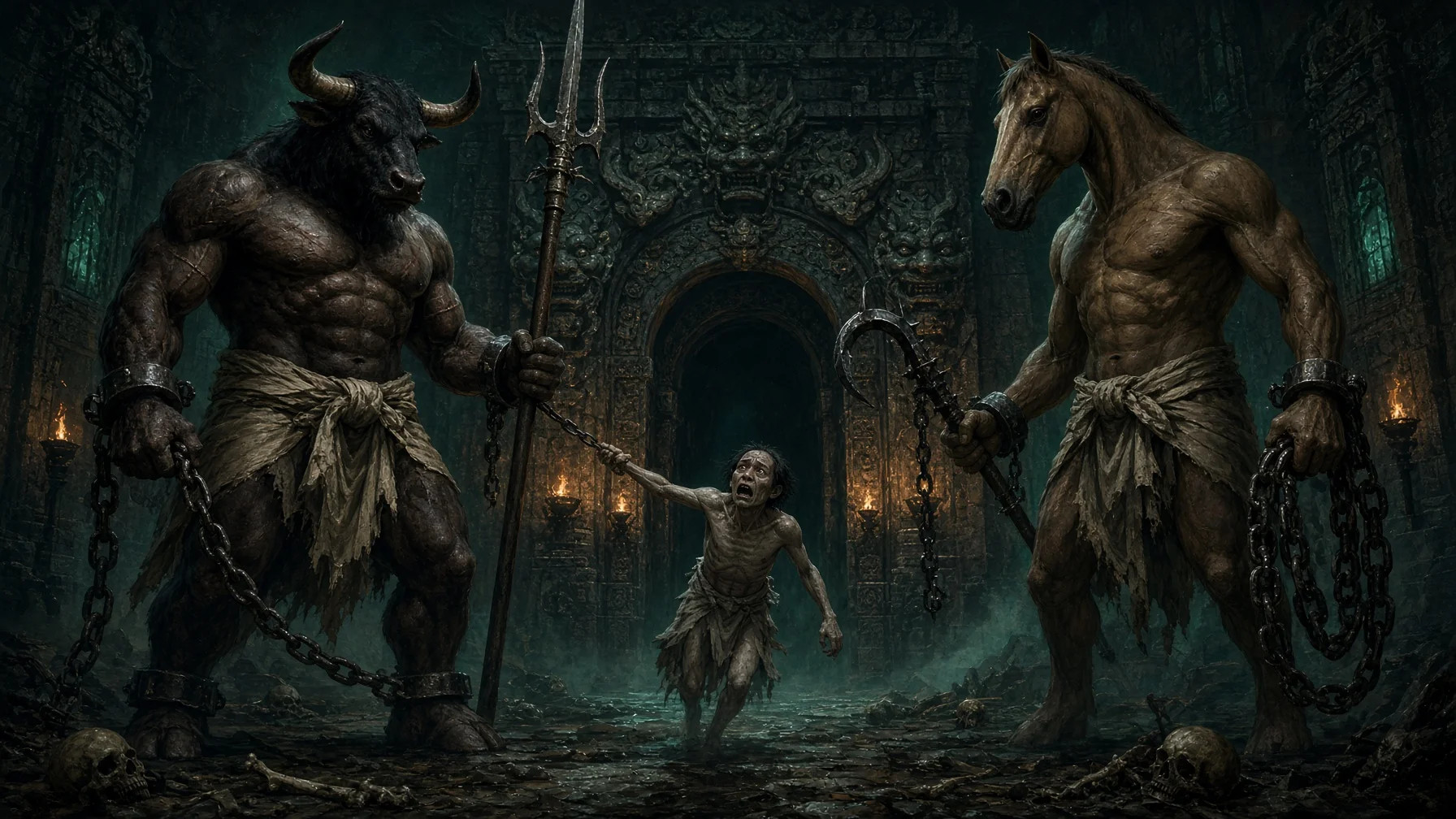
Niutou wears the head of an ox set upon a human body; Mamian carries the long face of a horse on a frame otherwise like our own. Neither is beautiful, and neither is meant to be. In temple murals and hell-scroll paintings they are drawn heavy-shouldered and grim, their animal faces fixed in the same impassive expression whether the soul before them weeps, pleads, or curses. Folk classification places them as guishi — ghost-attendants or demon-servants — a rank below the gods proper. They do not rule the underworld; they staff it.
Forms Born of Buddhist Sutra and Daoist Record
The pair first appears with any clarity in Tang-dynasty Buddhist transformation texts, the illustrated bianwen that preachers used to render the torments of hell vivid for lay audiences who could not read scripture. From there the imagery migrated into Daoist and folk-religious hell literature, most systematically into the Yuli Baochao, the "Precious Records of the Jade," a widely circulated moral tract that mapped the courts of hell, their punishments, and their staff in exacting, almost administrative detail. Niutou and Mamian belong to both traditions and to neither exclusively — they are Buddhist in their transformation-text origin, Daoist in their bureaucratic elaboration, and thoroughly Chinese folk religion in the form ordinary people actually encountered them: as painted terrors on a temple wall.
A Lazy Cowherd's Reckoning
One strand of Buddhist sutra commentary offers an origin story for Niutou's monstrous head: a cowherd, given charge of a temple's ox, mistreated the animal in life and was reborn as a hell-demon wearing the very head of the beast he had wronged. It is a moralizing etiology, not a universally accepted doctrine — variant traditions differ or say nothing at all about how Niutou came to his form — but it fits the underworld's larger logic perfectly. In Diyu, punishment is not arbitrary. It answers the crime in its own shape, and even a guardian's monstrous face can be read as a sentence already served.
Servants of Diyu, Not Gods of Diyu
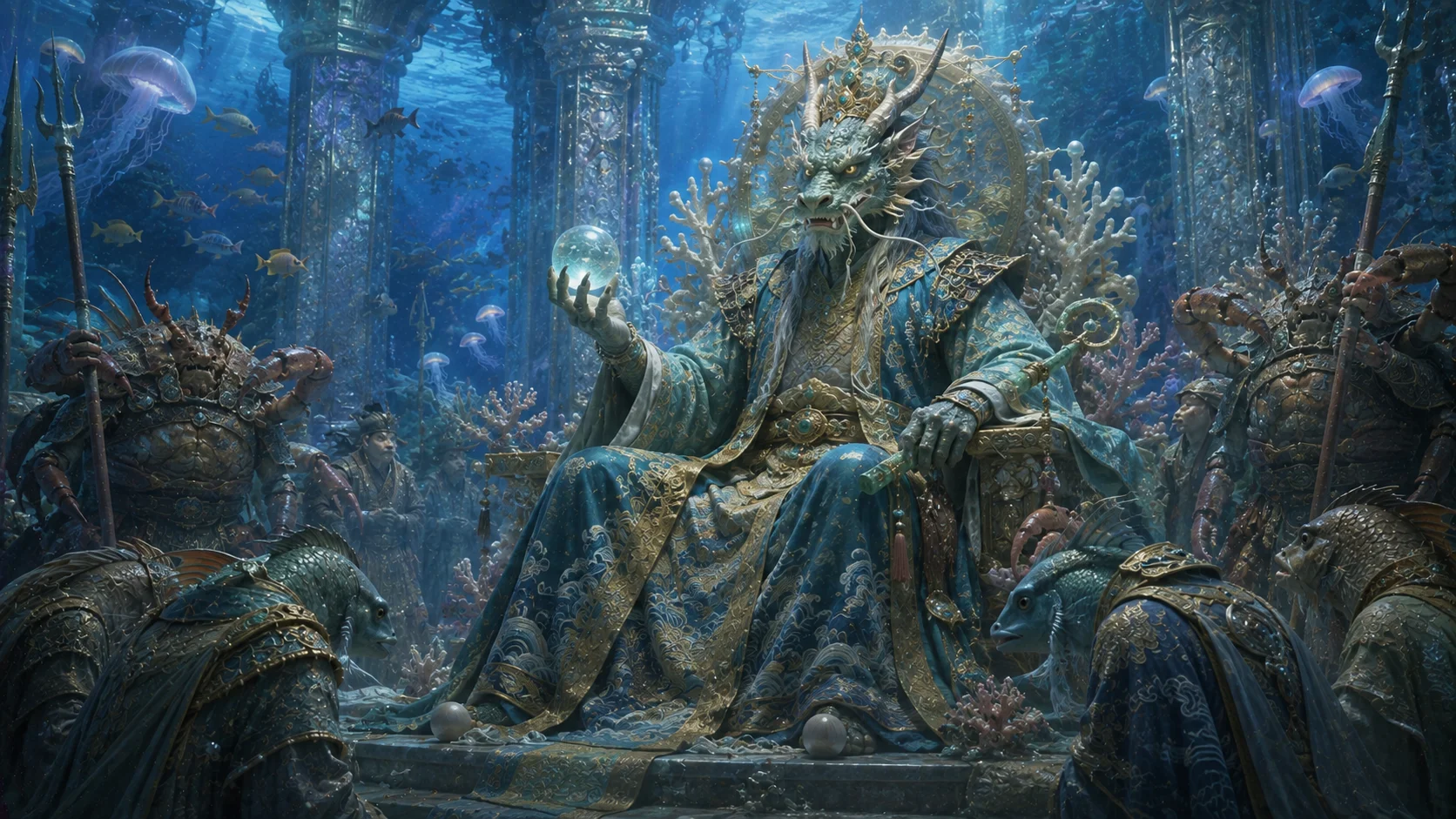
It matters that Niutou and Mamian are demons rather than deities. Yanluo Wang, King Yama, presides over judgment with the authority of a magistrate; the Ten Kings who share his courts hold comparable rank. Niutou and Mamian hold none of it. They are enforcers — the underworld's runners and jailers, dispatched to do the physical work that judgment requires: the seizing, the dragging, the binding, the delivering. Nothing in the folk record asks devotees to burn incense to them or petition them for favor. They are feared the way a bailiff is feared, not the way a magistrate is revered.
The Seizing of the Soul
Their principal and defining task is to fetch the dead. When a person's allotted span ends, Niutou and Mamian — sometimes named alongside other underworld messengers — are sent to seize the departing soul and bring it before Yanluo Wang and the Ten Kings for judgment. Vernacular telling does not soften this moment into a gentle escort. The soul is seized, sometimes described as dragged, and the resistance of the dying or the wicked changes nothing about the outcome. Hell-scroll paintings show exactly this: chains looped around a struggling figure, an ox-head or horse-face official hauling it forward while the soul's mouth is open in protest that goes unheard.
Across the Naihe Bridge
Among the underworld's landmarks is the Naihe Bridge, the span that souls must cross on their way toward reincarnation. Hell-scroll depictions place Niutou and Mamian at such crossings and gates, tridents and clubs in hand, driving the reluctant forward and holding back those who have not yet been judged fit to pass. The bridge itself is a threshold of consequence — cross it wrongly, or before your account is settled, and worse awaits — and the two guardians are precisely the figures who decide, by force if needed, that no soul slips across out of turn.
Wardens of the Ten Courts
Chinese hell cosmology, as elaborated in the Ten Courts tradition, is not a single chamber but a bureaucracy of ten tribunals, each presided over by one of the Ten Kings and each handling different categories of sin and punishment. Niutou and Mamian recur across this system as attendant guardians, appearing in shiwang tu — the "Ten Kings" paintings — again and again rather than being confined to one gate alone. They are, in effect, the underworld's most itinerant officials: wherever a soul is being processed, dragged, or held, one of the two is likely close by.
Kin to Black and White, Yet Harsher
Chinese folk religion knows another famous pair of death-messengers, Heibai Wuchang, Black and White Impermanence, who serve under the City God and carry out a comparable task of collecting souls. The two pairs are often set beside each other in comparison, and the contrast is instructive. Heibai Wuchang are human in origin, and folklore treats them with a measure of sympathy — tragic backstories, a wry dark humor, even moments of reluctant mercy. Niutou and Mamian receive none of that softening. They are non-human demon-wardens bound directly to Yanluo Wang's court and to Diyu's punishment apparatus, and where Heibai Wuchang can feel almost companionable in their darkness, Ox-Head and Horse-Face are written and painted as instruments of a colder, more mechanical justice.
Minor Devils, Major Literature
Their fame outran their rank. Niutou and Mamian appear throughout Chinese vernacular literature, most famously in Journey to the West, where hell's bureaucracy is rendered with satirical precision, and in Pu Songling's Strange Tales from a Chinese Studio, where they surface as minor but memorable figures processing the newly dead or delivering the wicked to their torments. In neither work are they protagonists. They are furniture of the underworld made vivid enough to be remembered — proof that a story does not need to center a figure to make that figure unforgettable.
The Ghost City of Fengdu
Nowhere is their didactic purpose clearer than at Fengdu, the "Ghost City" on the Yangtze in Chongqing, a major site of folk pilgrimage built almost entirely around the mythology of the underworld bureaucracy. Its temple grounds stage the courts of hell as walk-through dioramas, and fearsome statues of Niutou and Mamian flank these tableaux, positioned exactly where a visitor must pass to understand what they are seeing. The intent is not decorative. Fengdu exists to teach karmic retribution through spectacle, and Ox-Head and Horse-Face are cast as its most immediate, most physically imposing lesson: this is what waits for the soul that thinks it will escape account-keeping.
Chains, Tridents, and the Weight of Judgment
Symbolically, the pair stands for something distinct from any single god or king of hell: the impartial, mechanical cruelty of cosmic bureaucracy itself. A magistrate can be petitioned, a king's judgment can in principle be argued before him, but the officers who physically enforce a sentence do not negotiate. Niutou and Mamian's chains and tridents are not weapons wielded in anger — they are instruments of process, applied with the same indifference to a petty thief as to a murderer, because the underworld's justice is understood as inescapable rather than personal. Where other hell-figures might carry a trace of individual character, folklore rarely grants Ox-Head and Horse-Face a sympathetic interior. They are what karmic law looks like when it has hands.
In the Rites for the Dead
Their presence extends beyond myth and mural into practice. Certain Daoist ritual traditions invoke or depict Niutou and Mamian during funerary rites — including zuo qi, "doing the sevens," the sequence of memorial observances performed across the weeks following a death. Hell-scroll ritual paintings used in these mortuary ceremonies show the two guardians as part of the visual apparatus meant to guide the deceased's soul safely through the underworld's process, a reminder to mourners that the dead do not simply vanish but pass, under escort, through a court that will hear their case.
A Hierarchy No Text Agrees On
It would be tidy to draw a single organizational chart placing Niutou and Mamian, Heibai Wuchang, Panguan the Judge, and the Ten Kings each at a fixed rung beneath Yanluo Wang. No such chart holds everywhere. Chinese hell cosmology was never doctrinally unified — it grew across centuries, regions, and competing Buddhist and Daoist elaborations, and the exact relationship between these underworld staff varies significantly from text to text and locality to locality. Any single fixed hierarchy should be read as one regional or textual synthesis among several, not as universal canon binding the whole tradition.
What They Guard Against Forgetting
Ox-Head and Horse-Face endure in the popular imagination not because they are loved but because they are believed, in the deepest folk sense, to be doing necessary work. They give karmic consequence a face — two faces, animal and unyielding — and a pair of hands willing to do what judgment requires without hesitation or favor. In temple, in scroll, in story, and at the gates of Fengdu, they remain what they have always been: the underworld's proof that no soul crosses unaccounted for.
Sources & traditions
- EncyclopediaWikipedia — Ox-Head and Horse-Face
- TraditionChinese texts, oral tradition and village tellings (China)
Myths change from area to area and from time to time. This chronicle follows the most widely told versions; tellings in other villages, regions and eras may differ.