Chenghuang, the City God, is the divine protector and spiritual magistrate of a city or town in Chinese religion: the tutelary god who guards the walls and moat of his city, governs its spiritual affairs, judges the souls of its dead, and serves as the local administrator in the celestial bureaucracy. The guardian-magistrate of every walled Chinese city, the Chenghuang is the divine counterpart of the earthly mayor, seated in his temple as surely as the magistrate once sat in his yamen.
Wall and Moat Made Divine
The name itself is a piece of architecture turned into a god. Cheng (城) is the city wall, the rammed-earth and brick rampart that defined where a Chinese city began and ended; huang (隍) is the dry moat that ran beside it, the ditch that would flood with water in siege and stand empty in peace. Chenghuang is, quite literally, "the god of the wall and the moat" — the fortification itself, personified and given a will to protect what it encloses. This is not a late invention grafted onto an old idea; it is the natural extension of protective cults that had guarded city defenses since antiquity, the wall's stones and the moat's earth understood to have a spirit worth propitiating, later crystallizing into a single deified guardian rather than a diffuse animism of ramparts and ditches. To worship the Chenghuang was, in its oldest sense, to thank the city's own bones for holding.
Last updated .
From Frontier Rite to Dynastic Cult
Worship of a city's protective spirit is attested from at least the Northern Qi and early Tang period, the sixth and seventh centuries of the common era, when scattered local cults honored the guardian of this or that town's walls. What began as a regional practice, uneven in its spread and its formality, was gradually drawn into the machinery of the state. By the Song dynasty the cult had been formalized as part of official religion, no longer merely tolerated folk devotion but recognized and regulated from above. It was under the Ming founder, Zhu Yuanzhang, that the office of Chenghuang reached its fullest institutional expression. He ranked Chenghuang temples according to the administrative tier of the city they served — provincial capitals, prefectures, counties — mirroring the hierarchy of human government precisely in the hierarchy of its unseen counterpart. Scholarship on Ming religious policy, notably that of Romeyn Taylor, documents how thoroughly this was woven into statecraft: a newly appointed official was required to report to the local City God upon taking office, formally announcing his arrival to a colleague who happened to be a god.
The Yamen Beyond the Veil
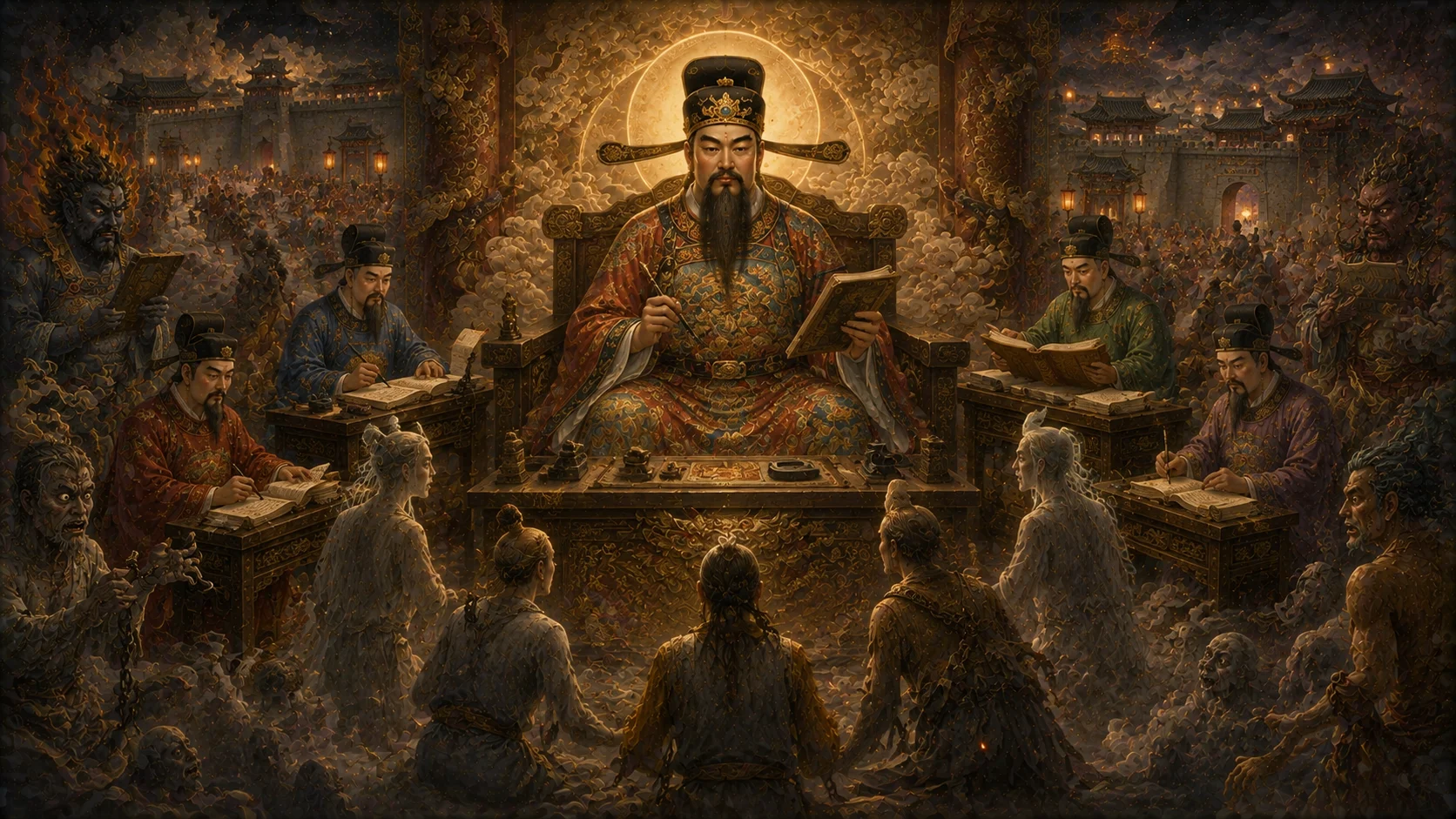
What makes the Chenghuang distinctive among Chinese deities is how completely his role was modeled on a specific, mundane office: the magistrate. Where many gods answer prayers as needed, the Chenghuang held a post, with jurisdiction, docket, and duty. He was understood as the judicial and administrative overseer of both the dead and the living within his city's bounds, a supernatural mirror standing exactly where the human magistrate stood, governing the same streets and the same households from the other side of the ledger. When someone in his jurisdiction died, it was the Chenghuang's court that reviewed the case first: the merits and sins of the recently deceased were weighed and recorded before the judgment was forwarded onward to the greater bureaucracy of the underworld, to Yanluo Wang and the Ten Kings who would render final sentence. The city's living magistrate handled taxes, disputes, and crime; its Chenghuang handled the moral accounting of every soul who had lived and died under his watch.
A Worthy Raised to Office
Unlike deities born of myth or cosmogony, a city's Chenghuang was very often the apotheosis of an actual historical person — a virtuous official, a loyal general, an upright figure whose conduct in life earned him a posthumous appointment to guard the place he had served. Tradition credits the Han-dynasty general Ji Xin as Chenghuang in some accounts, remembered for a sacrifice made on behalf of Liu Bang, the founding emperor of the Han. This is not an isolated curiosity but a documented pattern across the cult as a whole: scholars are explicit that the identity of a city's Chenghuang genuinely varies from place to place, because the office was filled locally, by whichever worthy that city's people and its rulers chose to honor. The Shanghai City God Temple illustrates the pattern vividly, having venerated more than one historical figure as its Chenghuang across different periods, among them Qin Yubo, a scholar-official who bridged the Yuan and Ming eras. A Chenghuang, in other words, is an office as much as an identity — a seat that a city's own history fills.
Beneath the Wall, the Ward
The Chenghuang did not stand alone in the celestial administration; he presided over a chain of command reaching both down into the neighborhoods below him and up into realms far beyond his city gates. The Tudigong, the earth gods who watch over individual villages and urban wards, answered upward to the city's Chenghuang, reporting the affairs of their smaller jurisdictions the way a ward officer reports to a county seat. The Chenghuang, in turn, answered to Dongyue Dadi, the great regional god seated at Mount Tai and keeper of the registers of life and death for a far wider territory, and beyond Dongyue Dadi the chain continued to Yanluo Wang and the Ten Kings of the underworld courts, and ultimately to the celestial administration under the Jade Emperor. Scholars of Chinese popular religion, David Johnson and Stephen Teiser among them, have documented this layered structure in detail: a bureaucracy of the sacred that recapitulates, level by level, the bureaucracy of the empire itself, from village to county to region to the throne of heaven.
The Mandarin's Robe and Judgment Throne
Iconography made the Chenghuang's rank legible at a glance. He is depicted in the official robes and hat of a mandarin magistrate, garments of senior administrative rank that set him visibly apart from the humbler Tudigong, whose modest local station calls for no such finery. He is typically shown seated upon a judgment throne, the posture of a presiding official rather than a wandering spirit, flanked in some regional traditions by fearsome attendant enforcers — the paired Heibai Wuchang, the Black and White Impermanence, whose duty is to escort souls to their reckoning. Where the Tudigong is approachable, almost neighborly, the Chenghuang is formal, robed, and enthroned: a god dressed for court because a court is exactly what he holds.
The Temple as Civic Institution
A Chenghuang temple, the Chenghuang Miao, was never merely a shrine tucked into a corner of town. These temples stood as major civic institutions on par with Confucian temples, centrally located within the walled city they served, built to a scale and prominence befitting a magistrate's own court. They functioned as judicial-symbolic and moral-instructive spaces as much as places of worship, sites where the boundary between civic order and sacred order all but disappeared. During droughts, epidemics, or before executions, public rituals were held there, the community turning to its divine magistrate in moments when the human one alone was not enough. To stand inside a Chenghuang temple was to stand, in a real sense, inside a second city hall — one whose authority extended past the grave.
Welcoming the God Through His Own Streets
Among the most vivid expressions of the cult were the City God processions, known as yíng chénghuáng, "welcoming the Chenghuang," in which the deity's image was carried out of his temple and paraded through the streets of the very city he protected. The procession served as an inspection tour in miniature, the god surveying his jurisdiction in effigy, and as a rite believed to ward off epidemics from the community he passed through. The practice is not merely historical; it continues today in parts of Taiwan, most notably in the procession of the Xiahai City God Temple in Taipei, where the old rhythm of a magistrate-god touring his streets still draws crowds through the modern city.
Paperwork for the Dead
The Chenghuang's judicial role extended into the intimate rituals of mourning. In some traditions, the family of someone recently deceased would visit the Chenghuang temple to formally register the death, or to pray that the god's court would judge their loved one leniently before forwarding the case onward. Paper effigies and offerings were burned as a kind of bureaucratic paperwork, submissions to the god's tribunal in the same spirit that a petition might be filed with a human court. Temples historically reinforced this atmosphere with tribunal statuary — clerks, judges, and record-keepers arrayed around the central image, a courtroom rendered in painted plaster, so that a grieving family stepping inside was stepping, quite deliberately, into the appearance of an actual hearing room.
A Cult Tied to the Dynasty's Own Legitimacy
Under the Ming and the Qing, the Chenghuang cult carried a weight beyond popular devotion: it was formally sanctioned as part of the state religion, its temples and rankings tied directly to dynastic legitimacy. A dynasty that could organize the unseen bureaucracy of city gods, tier for tier, alongside its own administrative map was a dynasty asserting that its authority reached into realms no census could count. This official standing did not survive the fall of the Qing in 1912 intact, and it eroded further through the upheavals of the twentieth century, the formal state role receding as the empire that had sustained it disappeared. Yet the cult itself did not vanish with the throne that had once ranked it. Popular and Daoist worship of the Chenghuang persists today, especially in Taiwan, Hong Kong, and communities of the diaspora, where the City God's temple still stands, robed in memory if no longer in imperial rank.
The Divine Bureaucrat of a Living City
What endures in the Chenghuang is a particular way of imagining protection — not as a distant, abstract force but as an office, held by a real and remembered person, doing for the spirit world exactly what a good magistrate does for the living one: keeping the registers, hearing the cases, guarding the wall and the moat that mark where a city's care for its own people begins. Every city that ever raised a Chenghuang temple was making the same claim in stone and incense: that governance itself, done well enough and long enough, might outlast the grave and keep watching over the streets it once served.