Tudigong, the Earth God or Lord of the Soil, is the humblest and most intimate deity of Chinese folk religion: a kindly old guardian bound not to a temple of empire but to a single small place — a village, a field, a household compound, a shop, a grave. Formally titled Fude Zhengshen (福德正神), the "Correct God of Fortune and Virtue," he sits at the very bottom of the celestial bureaucracy and, for that reason, closer to ordinary life than almost any other god.
A God for Every Small Place
Where most deities of the Chinese pantheon preside over broad domains — a whole trade, a whole ocean, a whole moral category — Tudigong's authority is deliberately narrow. Each village, each street, each field, each household compound traditionally has its own Tudigong, distinct in identity from his neighbor one field or one lane over. He is also distinct from the older, more abstract earth-god She (社), the ancient altar-deity of soil and grain worshipped since the Zhou dynasty and before. Tudigong is not She himself but the later, personified, folk-religious descendant of that same territorial earth cult — scholars of Chinese religion, among them Wolfram Eberhard and David Johnson, trace his figure directly back to the She altar tradition, the abstract sacred ground gradually taking on a face, a name, a beard, and a title.
Last updated .
The consequence of this localism is scale: there is not one Tudigong but countless thousands, a deity for nearly every bounded piece of land that people care enough about to protect. No other figure in the pantheon is so numerous, and none is so evenly distributed through the texture of daily life.
The Lowest Magistrate in Heaven's Ledger
Folk religion in China has long imagined the spirit world as mirroring the earthly bureaucracy of magistrates, prefects, and governors, and within that mirrored order Tudigong occupies the lowest formal rank — the local magistrate-equivalent, responsible for the smallest administrative unit imaginable. He reports upward to the Chenghuang, the City God who governs the walled city or county, who in turn answers to Dongyue Dadi, and ultimately to the Jade Emperor at the apex of the whole celestial order. This graduated hierarchy — household and field, to street and village, to city, to the mountain lord, to the supreme sovereign of Heaven — gives Tudigong's modest post real weight: he is not outside the bureaucracy but its foundation, the point where the machinery of divine administration actually touches the ground people live on.
Zhang Fude and the Memory of a Just Official
Popular legend, widespread but never fixed into a single canonical account, often holds that Tudigong began as a mortal official or servant of the Zhou dynasty, commonly remembered by the name Zhang Fude. He is recalled in these regional tellings for benevolence and fairness in his dealings with the people under his charge — qualities so esteemed that after his death he was elevated to watch over the land he had once served in life. The story varies from place to place, as folk hagiography always does, and no single version claims final authority over the others; what stays constant across the tellings is the character it assigns him: a good man, honest in small matters, remembered by his community and rewarded for it. That memory shapes how Tudigong is imagined today — not a cosmic force but a person, once ordinary, whose virtue outlived him.
Witness at the Threshold of Death
Tudigong's duties are not limited to fields and fortune. Within his jurisdiction he holds a solemn ritual role at the threshold of death: he is traditionally the first deity notified when a person dies in the land under his watch. It falls to him to escort or report the departing soul upward to the Chenghuang for judgment, the beginning of that soul's passage through the layered courts of the afterlife before it reaches the tribunals of Yanluo Wang in the underworld of Diyu. In this office the gentle grandfather of the local soil becomes something more solemn — a local registrar of the dead, the first hand to receive a soul leaving its home ground, and the one who ensures it does not simply vanish unrecorded from the world it belonged to.
Guardian of Furrow and Grave
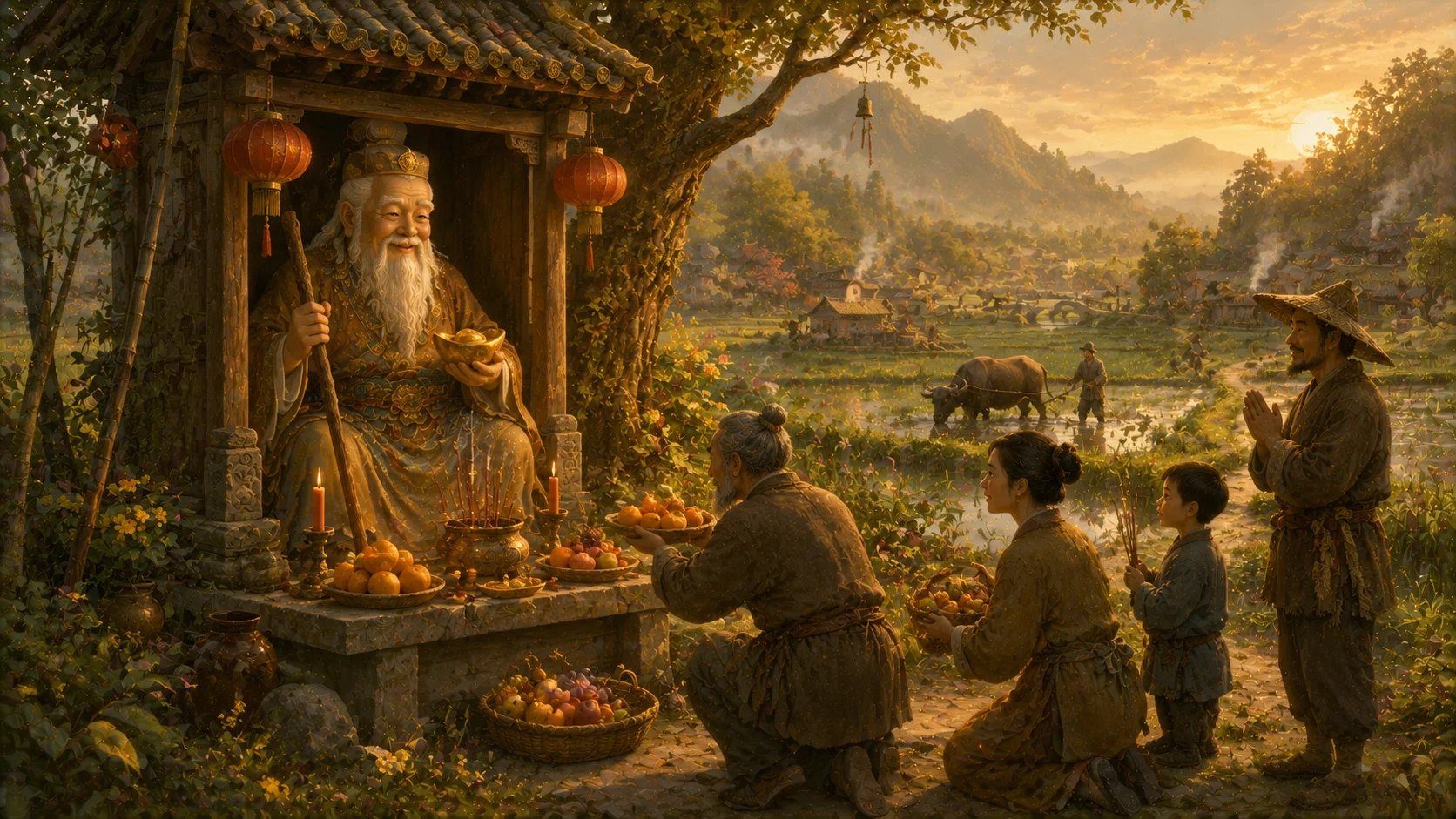
As guardian of a bounded piece of land, Tudigong's oldest and most constant concern is the soil itself. Farmers worship him before planting, asking his blessing on the seed about to enter the ground, and again after harvest, offering thanks for what the earth produced under his watch. His protection extends to grave sites as well, which places him, quietly, at both ends of the agricultural and human cycle: the field that feeds the living and the plot that holds the dead both fall within a Tudigong's keeping. This dual guardianship is not treated as a contradiction. To the people who worship him, land is land — the same soil that grows rice can hold a grave, and the same modest deity watches over both without distinction.
The Merchant's Quiet Patron
Beyond the fields, Tudigong is just as devotedly worshipped by merchants and shopkeepers, who look to him as a bringer of business fortune. A small shrine to Tudigong at the back or threshold of a shop is a common sight, tended with the same regularity as a household altar. Worship typically falls on the 1st and 15th of the lunar month, days shared with offerings to other household deities, when incense and small gifts mark the shopkeeper's ongoing relationship with the god of the ground his business stands on. This pairing of soil and commerce is not incidental — in a worldview where prosperity flows from the health of one's land, a shop's daily fortune is simply another kind of harvest, and Tudigong its keeper.
The Face of a Benevolent Elder
Tudigong's iconography is immediately recognizable and deliberately unthreatening: a smiling elderly man with a long white beard, dressed in an official's robe and hat that mark his rank as a minor magistrate rather than a great lord. He is typically shown holding a ruyi scepter or a gold ingot (yuanbao), symbols of blessing and wealth, and often leans on a walking staff, the posture of an old man who has walked his small territory for a very long time and knows every furrow of it. Nothing in his appearance suggests grandeur. He looks, deliberately, like someone's grandfather — approachable, familiar, entirely without the awe that surrounds the higher gods of the celestial court.
Tudipo, the Grandmother of the Land
Tudigong is commonly said to have a wife, Tudipo (土地婆), the Earth Grandmother, though her worship is far less consistent across regions than his own. In some places she is honored beside him as a matter of course; in others her shrine is absent altogether, and local folk tales sometimes explain her absence in their own way, differing from village to village. This unevenness is itself telling — Tudigong's cult is not a single uniform system handed down from above but a patchwork of local practice, each community keeping the parts of the tradition that matter to it and letting others fall away without concern for consistency elsewhere.
Shrines No Grander Than the Land They Guard
Fitting a god of his rank, Tudigong's shrines are famously humble: small roadside or field-corner structures, often little more than a niche of brick or stone barely large enough to hold an incense pot, standing at field edges, crossroads, and village boundaries throughout the countryside. Their modesty is not neglect but propriety — a shrine grander than a village magistrate's post would misstate the god's place in the order of things. That said, larger urban Tudigong temples do exist in cities such as Hong Kong and in Taiwan, where dense populations and long-settled neighborhoods have in some cases built him proper temple halls. And in certain temple complexes dedicated to greater gods, a Tudigong shrine is deliberately sited near or within the grounds — a subordinate guardian watching over the very earth the larger temple stands on, rank still respected even in proximity to the divine.
The Second Day of the Second Month
Tudigong's birthday is traditionally marked on the 2nd day of the 2nd lunar month, a date that falls in early spring, close to the season when fields are being prepared and planted — an apt time to honor the god whose blessing the coming harvest will depend on. Some traditions additionally observe a second commemoration around the 8th lunar month, though this second date varies by region and is not universally kept. On his festival day, his countless small shrines throughout the countryside and city streets alike receive their fullest attention: incense, offerings, and the quiet gratitude of people who consider him not a distant power but a neighbor.
The Bureaucracy's Foundation Stone
To understand Tudigong fully is to see him as the base tier of a graduated territorial hierarchy that structures the entire Chinese folk-religious cosmos. He governs the smallest recognized unit, the village or street; the Chenghuang above him governs the walled city or county; and further tiers rise from there toward the Jade Emperor's court. Nothing in this system treats his low rank as unimportant. A bureaucracy, divine or earthly, is only as sound as its lowest office, and it is Tudigong who does the actual, daily work of watching over the ground where people are born, plant, trade, and are eventually buried. He is not a lesser god so much as the god nearest at hand — the first to know a village's fortunes, and, when a life ends, the first to mark its passing.