Houtu (后土), sometimes rendered Hou Tu, and in her fuller ceremonial title Houtu Huangdiqi (后土皇地祇) — Sovereign Earth, Imperial Earth Spirit — is among the oldest and most consequential deities of the Chinese earth cult. Her name reaches back through the ritual and classical literature of the Zhou era and earlier, into the deep stratum of Chinese religious thought where the soil itself was understood not as inert ground but as a sovereign presence, entitled to sacrifice, oath, and reverence.
The Sovereign Earth Beneath Heaven's Vault
To speak of Houtu is to speak of the Earth as a ruling power, not merely a place. In the architecture of classical Chinese cosmology, existence unfolds between two great poles: Heaven above and Earth below. Houtu stands as the presiding sovereign of the latter — dominion over soil, landform, mountain and river, the very substance from which the myriad things of the world are said to take their shape and their sustenance. Where Huangtian, Sovereign Heaven, governs the vault above, Houtu governs everything beneath it: the ground a person stands on, the fields that are ploughed, the mountains that anchor the horizon, the earth into which the dead are lowered. This pairing of Heaven and Earth as complementary sovereignties, rather than as a single ruler and a subordinate realm, is one of the oldest organizing ideas in Chinese religious and political thought, and Houtu's identity cannot be separated from it.
Last updated .
A Deity Whose Sex the Centuries Rewrote
Few figures in Chinese religion carry so openly documented a transformation in their own identity. In early and classical sources — including readings drawn from the Classic of Rites (Liji) and the Zuozhuan — Houtu appears as a masculine or gender-ambiguous cosmic Earth God, spoken of without the settled femininity that later ages would take for granted. Beginning roughly in the Song dynasty, and accelerating through Daoist ritual and popular devotion thereafter, Houtu underwent a documented shift into female identity: the Empress of Earth, paired in cosmic rulership with the Jade Emperor (Yudi) of Heaven. Scholars of Chinese religion treat this not as a contradiction to be resolved in favor of one "true" version, but as a genuine historical transformation — two authentic phases of the same tradition, each attested in its own textual and ritual record. A chronicle of Houtu that insisted on a single fixed gender across all periods would misrepresent the religion itself; the honest account holds both truths in their proper sequence.
Son of the Flood, Kin to the Earth-Bound Giants
Certain classical genealogical traditions — surviving in commentary layers on the Shan Hai Jing and in the Discourses of the States (Guoyu) — place Houtu within a lineage tied to Gonggong, the great flood and water deity of Chinese myth, naming Houtu as his son or descendant. From this same genealogical thread, later figures associated with the earth and its upheavals, including the legendary giant Kuafu, are sometimes drawn as descendants or kin in turn. These genealogies are not uniform; different texts assign different chains of descent, and no single authoritative family tree can be extracted from them. What the variation does preserve is a consistent instinct in the tradition: that the power governing water's flood and the power governing solid earth belong to the same mythic family, flood and ground being two faces of the same elemental order that a settled people had to reckon with.
The Altars of Soil and Grain
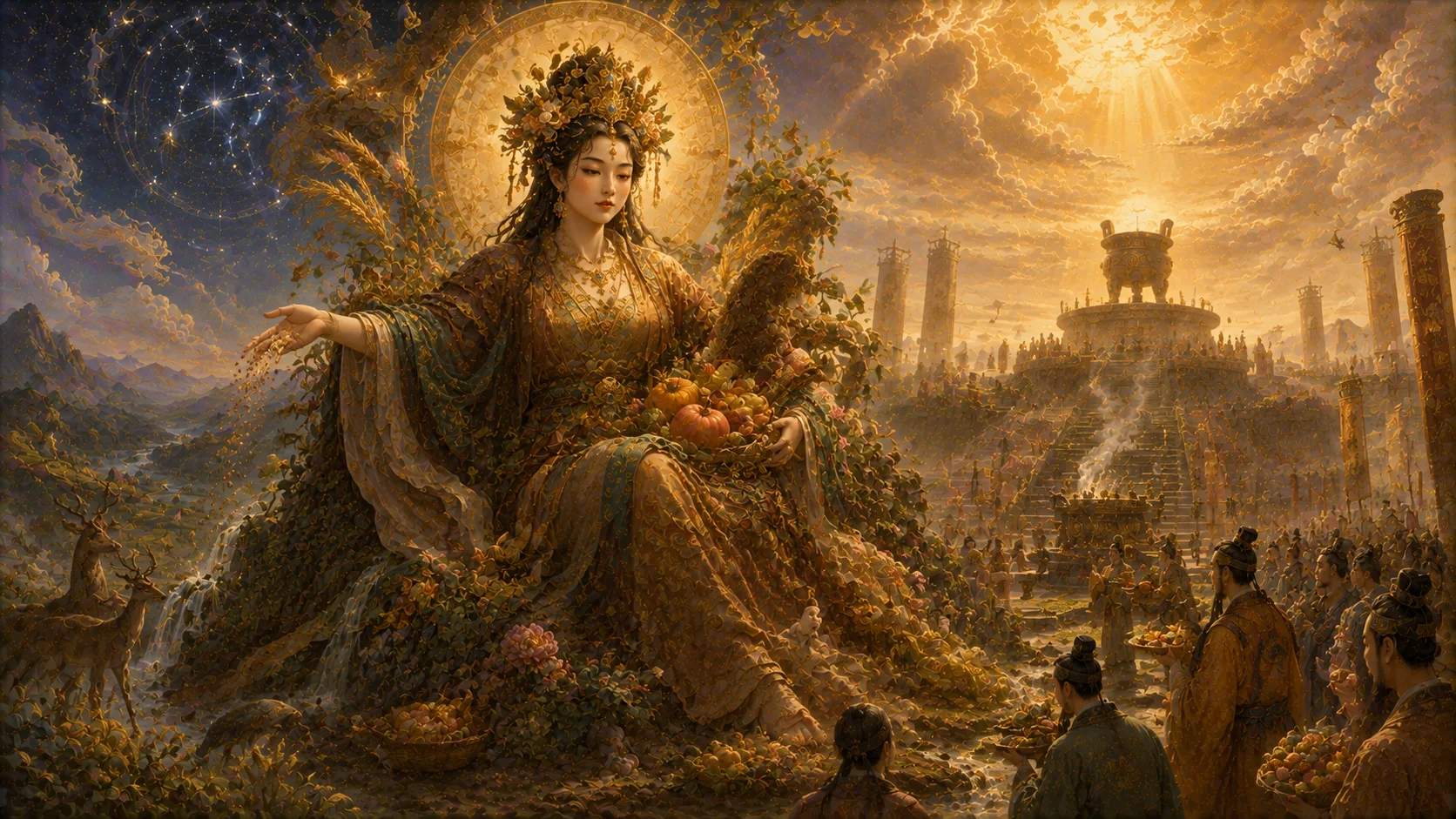
No institution reveals Houtu's centrality to Chinese statecraft more plainly than the sheji (社稷) — the paired altars of soil and grain that stood at the heart of the ancient and imperial state cult. At these altars, rulers offered sacrifice to She, the soil, embodied by and associated with Houtu, and to Ji, the grain god associated with Houji. The pairing was so fundamental to the self-understanding of Chinese kingship that the term "sheji" itself passed into the language as a byword for the state, the nation, the dynasty — a metonymy that persists in classical and literary Chinese to this day. To lose the sheji was to lose the realm; to maintain sacrifice at the sheji was to maintain the mandate itself. Houtu, as the Earth of that pairing, was therefore never a peripheral figure in folk devotion alone — she stood at the constitutional center of what it meant for a Chinese state to exist and endure.
Where Han Emperors Knelt: The Rites at Fenyin
Imperial devotion to Houtu found enduring physical form at Houtu Ci (后土祠) in Wanrong County, Shanxi, near the ancient site of Fenyin — one of the oldest and most important temples dedicated to Earth-sacrifice in Chinese history. Records preserve the sacrifices performed there by Emperor Wu of Han, part of a continuous thread of imperial devotion to Houtu at that site stretching from the Han dynasty onward. These rites sat alongside the grander Fengshan (封禪) sacrifices, the ceremonial acknowledgment by which emperors reported their stewardship to Heaven and Earth together — Fengshan proper directed to Heaven at sacred peaks, and parallel dedications directed to Houtu as Earth's sovereign counterpart. That an emperor of Han would travel to a specific site to honor Houtu by name, and that his successors would continue the practice for centuries, marks Houtu's cult as one of sustained, official, dynastic weight rather than a devotion confined to village shrines.
Heaven Above, Earth Below: An Oath Older Than the State
The idiom huangtian houtu (皇天后土) — "Sovereign Heaven, Sovereign Earth" — survives in the Chinese language as an invocation of the most solemn kind, called upon when a person swears an oath or asks for cosmic witness to the truth of a statement. That the phrase pairs Houtu with Heaven as joint guarantor of moral order is itself a measure of her standing: she is not merely honored with sacrifice but trusted as witness, a power before whom a lie cannot be safely told. This role as guarantor of oaths sits naturally beside her governance of the sheji — the deity who anchors the state's legitimacy is the same deity invoked when an individual's word must be proven true, earth and soil standing as the silent, unmovable witness beneath every human claim.
Guardian of the Grave and the Boundary Stone
Because the earth receives the dead, Houtu's dominion extends naturally into funerary and geomantic practice. Across China, stelae and inscriptions dedicated "to Houtu" (后土之神位) are commonly placed beside tombs and within cemeteries, a request that the sovereign of the ground itself watch over and protect the deceased resting within it. This is not a marginal folk custom but a continuing living practice, visible in Chinese burial grounds today as it was in earlier centuries — a quiet, durable expression of the same reverence that once filled the grand altars of the imperial sheji, now offered privately at the threshold of a single grave.
Robes of an Empress, Throne of the Four Sovereigns
Where Houtu is depicted anthropomorphically, particularly in her post-Song female aspect, she is shown seated in state in the manner of an empress: court robes, a mianguan or phoenix crown, the visual language of sovereignty rather than of a nurturing folk spirit. Within the organized Daoist pantheon, Houtu Huangdiqi holds rank as one of the Four Sovereigns (四御) — in some schemes counted among Five — bearing dominion over the mountains, rivers, and every landform of the earth as the female-gendered ruler standing opposite Heaven. It bears stating plainly, because the iconography invites the assumption: this pairing with the Jade Emperor is one of complementary cosmic rulership, Heaven's sovereign beside Earth's, and not a marital bond. Houtu is not depicted in canonical Daoist theology as the Jade Emperor's spouse; her throne is her own, granted by her office over the earth rather than by any consort's claim.
Kin to Mount Tai and the Princess of the Azure Clouds
The cult of sacred mountains and the cult of the earth overlap naturally in imperial ritual practice, since a mountain is, after all, the earth lifted toward Heaven. Houtu's devotion accordingly touches the broader wuyue, the Five Sacred Mountains, and Mount Tai above all. In some regional traditions, Houtu is linked with or even locally subordinated to Bixia Yuanjun, the Princess of the Azure Clouds who presides over Mount Tai itself. These associations are explicitly local and syncretic rather than a single fixed doctrine binding every region of China — one temple's tradition may draw the two goddesses close together, while another maintains Houtu entirely apart from Bixia Yuanjun's mountain cult. The variation itself is characteristic of how Chinese popular religion has always worked: a shared vocabulary of sacred power, arranged differently from place to place.
From Village Shrine to Cosmic Throne
Houtu's cult did not spring into being at the scale of empire; it reflects instead the broader Chinese pattern by which the earth-shrine, or she (社) — the ancestor of today's ubiquitous Tudigong (土地公) local earth-god worship — scaled upward into a cosmic, empire-wide sovereignty. This is a matter of rank, not of unrelated invention: Houtu and the local Tudigong found in nearly every Chinese village and neighborhood share the same underlying concept of earth veneration, but they are not interchangeable figures. Houtu is the supreme Earth sovereign, honored at the level of the imperial sheji and ranked among the Four Sovereigns of Daoist cosmology; Tudigong is a modest, local land spirit, tending a single locality's fortune rather than the earth entire. Popular usage sometimes blurs the two together, but the tradition itself preserves the distinction of rank clearly, much as a village shrine and an imperial altar were never mistaken for one another even as both served the same fundamental reverence for the ground underfoot.
The Feast Day at the Earth-God's Door
Houtu is honored within the Daoist liturgical calendar by a designated commemoration, observed in many regional traditions on the eighteenth day of the third lunar month. On this day, temples associated with her cult — Houtu Ci among them — hold ceremonies of thanksgiving and renewal, the same impulse that drove Han emperors to Fenyin now sustained in a fixed yearly observance. As with so much of Houtu's cult, the precise dating and the customs surrounding it vary by region and by temple lineage; no single script governs every community's celebration. What remains constant is the underlying gesture — a yearly return to the altar of the earth, an acknowledgment that the ground beneath a community's feet is owed its due.
What Endures in Soil and Stone
Across the long arc of her cult — from a Zhou-era Earth God complementing Heaven, through the imperial sheji that gave "state" its very name, through the Han sacrifices at Fenyin, to a Song-era transformation into the crowned Empress of Earth among the Four Sovereigns — Houtu remains recognizable as a single enduring idea even as her form has changed: the earth as sovereign, not servant. She is invoked in the oath that must not be broken, inscribed on the stone that guards a grave, and enthroned in the temple hall beside Heaven's own ruler. Whether approached as ancient god or later goddess, Houtu holds a place in Chinese religious life granted to few deities — not merely worshipped, but trusted, the ground itself standing witness to the truth of every solemn word spoken upon it.