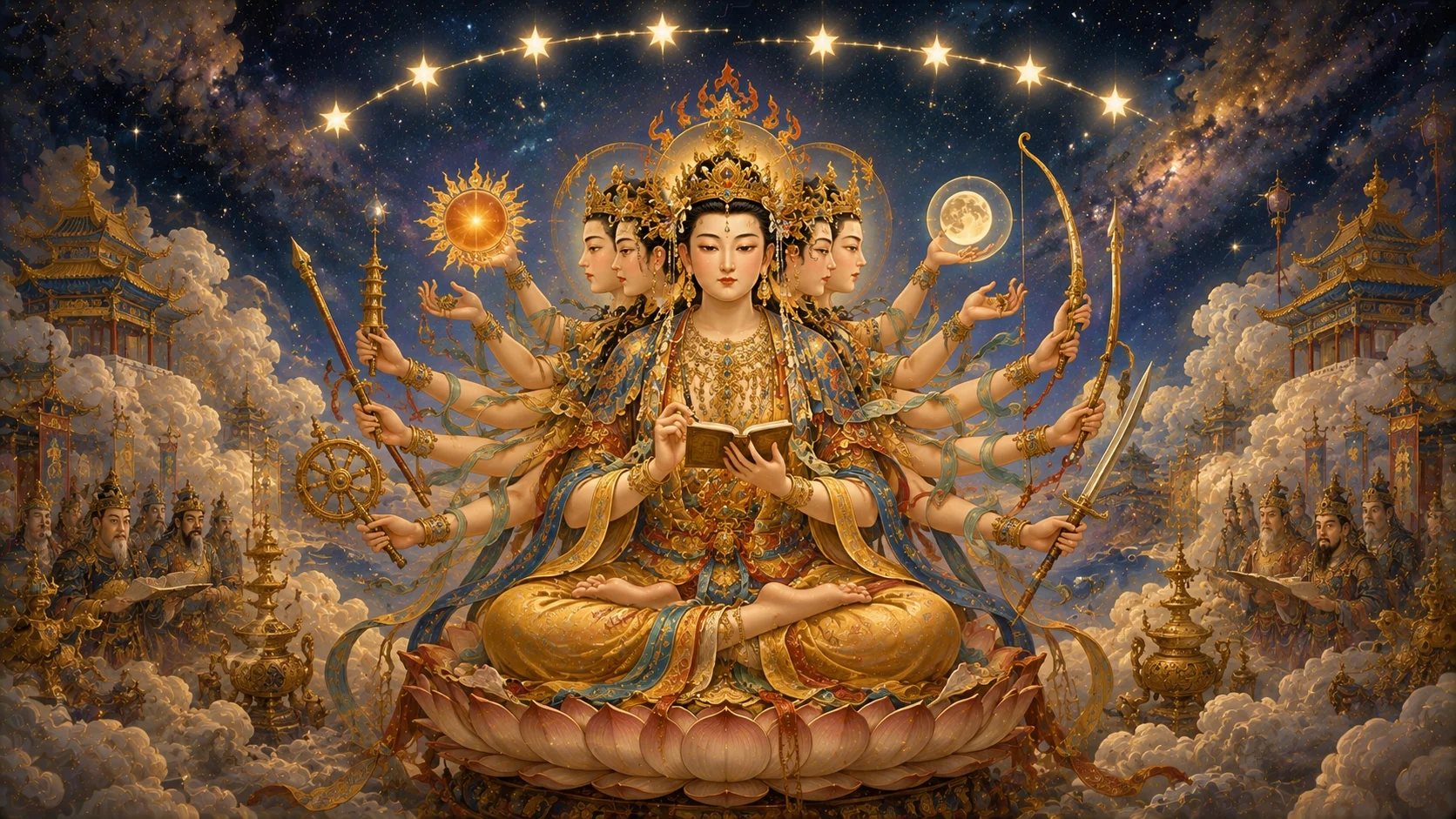
Doumu — Dǒumů (斗母), “Mother of the Great Chariot (the Big Dipper)” — is the great mother-goddess of the stars in Chinese Daoism: a powerful, many-armed celestial goddess who governs the stars of the Big Dipper (and so the heavens, fate, and the registers of life and death), and who is the divine mother of the star-gods. The Daoist goddess of the heavens and the constellations, Doumu is the Mother of the Dipper.
The Mother of the Big Dipper
Doumu (“Dipper Mother”) is a great goddess of Chinese Daoism and the stars, especially associated with the constellation of the Big Dipper (the Northern Dipper, Beidou) — one of the most important star-groups in Chinese astronomy and astrology, regarded as the celestial governor of fate, time, and the cosmos. Doumu is the divine mother of the nine star-gods of the Dipper (the seven visible stars and two hidden ones), and through them she governs the heavens, the movements of the stars, and the fate and lifespan of all beings. She is a goddess of immense cosmic power and high rank in the Daoist pantheon.
Last updated .
The Many-Armed Star-Goddess
Doumu is depicted in a striking, powerful form clearly influenced by the iconography of the Buddhist goddesses (she is often syncretised with the Buddhist/Hindu goddess Marici, the goddess of light and the dawn): she is shown with many arms (often eighteen, or four faces and eight arms), each hand holding a sacred implement or weapon — the sun and moon, a bow, a spear, a bell, a seal, a sword, and other emblems of cosmic power — and sometimes with multiple faces and seated on a lotus throne or riding a chariot drawn by boars. This many-armed, many-faced form expresses her vast power over the heavens and her ability to act in all directions at once.
The Governor of Fate and the Registers
Through her dominion over the Big Dipper — which in Daoist belief governs the registers of life and death, the allotted lifespans, and the fate of all beings — Doumu is a goddess of destiny, longevity, and salvation. The Dipper-gods keep the records of who shall live and who shall die and for how long; Doumu, as their mother and the goddess of the Dipper, can be petitioned to extend life, avert disaster and death, and bestow blessing and salvation. She is invoked for long life, for deliverance from peril and from the underworld, and for the salvation of souls. Many-armed and many-faced, the celestial mother of the Dipper-stars, the Daoist goddess who governs the heavens, fate, and the registers of life and death — Doumu is the great star-mother goddess of Chinese mythology, the Mother of the Big Dipper.
Before She Had a Face: The Dipper as the Emperor's Chariot
Centuries before anyone prayed to a many-armed mother of the stars, Chinese skywatchers were already staring at the same seven points of light and reading them as a wheel that never stopped turning. The astronomical treatise of the Han-dynasty Records of the Grand Historian states the idea flatly: the Dipper is the chariot of the celestial emperor, revolving about the centre and regulating the four quarters. Its handle swept around the pole through the course of a year and pointed, season by season, to the direction that governed the world below — where the handle pointed at dusk told you whether it was spring or winter. The Dipper's slow rotation was the clock and compass by which an empire that claimed to mirror Heaven set its calendar. This is the oldest layer under Doumu's cult: a sky that was already sacred, already a seat of government, centuries before it acquired a mother.
A Goddess Who Arrived on a Chariot of Boars
Doumu's most distinctive image — a being who rides ahead of the light itself, invisible to anyone who might do her harm, in a chariot drawn by boars — did not originate in China at all. It belongs first to Marici, an Esoteric Buddhist goddess of Indian origin whose name means something close to “ray of light” or “mirage,” and who travelled into China with the esoteric scriptures that flourished at the Tang court. Marici was a goddess of dawn and concealment: she moves faster than the sun, cannot be seen, seized, or harmed by anyone who cannot see her, and was invoked above all by soldiers who wanted to pass through an enemy line unnoticed and unhurt.
Daoism did not borrow a detail here and there; it took the whole figure. The boar-drawn chariot, the multiplied arms, the stacked faces, the aura of a being who moves through the world unseen — all of it was folded into Doumu almost intact. Some of it fitted the new setting so neatly that the seam is hard to see: Marici's chariot already carried a team of seven, and seven is exactly the number of visible stars in the Northern Dipper, so a goddess borrowed from the dawn arrived pre-fitted to the constellation she was about to mother. The same root produced a second, quite different descendant in Japan, where Marici became Marishi-ten — not a mother of fate but a warrior's talisman, invoked by fighters for that same old gift, the ability to move through danger unseen. One goddess, two destinies: a mother in China, a bodyguard in Japan.
Nine Sons in the Night Sky
To call Doumu a mother is not a metaphor within the tradition. Daoist scripture gives her a life before the stars: she was a royal consort, the Lady of Purple Radiance, who bore nine sons, and it is those nine sons who became the sovereigns of the Dipper. Together they are venerated as the Jiuhuang, the “Nine Sovereigns” or Nine Emperor Gods — and the count of nine, rather than the seven anyone can see, is the point. Daoist star-lore holds that two more stars attend the Dipper, too faint or too purely spiritual for ordinary sight, paired as the Left Assistant and the Right Assistant. When a ritual specialist performs the rite known as “pacing the Dipper,” treading the constellation's own pattern out on the floor of the ritual space, he is walking a diagram of that family.
This genealogy is not confined to scripture. It is the founding story behind a festival still kept today: over the first nine days of the ninth lunar month, Hokkien and Teochew communities in Malaysia, Singapore, Thailand and elsewhere in Southeast Asia hold the Nine Emperor Gods festival, welcoming Doumu's nine star-sons ashore in procession, keeping a strict vegetarian diet for the festival's duration, and carrying the gods through streets thick with incense smoke. The nine themselves are commonly honoured with no statues at all — an urn of incense and rows of lamps stand in for them — so in a great many of these temples it is the mother's image that actually presides over the festival named for her children.
The Lamp Lit for a Stranger's Life
Doumu carries the honorific Yuanjun, “Primordial Sovereign,” a title reserved for a small company of senior goddesses in the Daoist pantheon, and temples that keep her image usually give her a hall of her own, a Doumu hall set apart from the main shrine. Popular practice assigns every person, by birth year, a private “natal star” among the seven of the Dipper — so whichever star happens to be yours, Doumu, as mother of them all, is the one relationship that applies to everyone regardless of which star governs their year.
That belief still takes a very concrete, everyday form. In temples that keep the custom of the Dipper Lamp, a devotee's name is written on a small lantern and set burning among rows of others, each one standing for a life the goddess is being asked to watch over and extend. It is a small, practical piece of theology: fate is a record kept somewhere, and a lit lamp is a way of asking, respectfully, for an amendment to the file.
Reading a Doumu Image
A Doumu statue rewards a close look rather than a quick one. Temple images commonly give her frontal face a third eye set vertically above the two ordinary ones — a wrathful, protective marker that comes with her from Marici's iconography rather than from any native Chinese source. Her seat, when it is not a lotus, is that chariot of boars. In a Doumu hall she is rarely alone: her image is typically the largest and most central, flanked by smaller figures of the star-lords — her sons arranged around her the way children are arranged around a mother in a family portrait, which is exactly the relationship the whole hall is built to declare.
Why a Mother, and Not Just a Mechanism
The distance between the Han-dynasty Dipper — an emperor's chariot, wheeling through the seasons with total indifference — and Doumu, a mother who can be petitioned, wept to, and bargained with, is the whole reason the goddess exists. A mechanism cannot be reasoned with; a register of the dead, however precisely it is kept, cannot be moved by grief. A mother can be. Doumu's cult persists because it takes the single most frightening idea in Chinese cosmology, that your death is already written down and dated, and gives it a face capable of mercy. The stars did not change. What changed is that someone, eventually, gave the sky a mother to ask.