Wenchang Wang — 文昌王, more properly Wenchang Dijun (文昌帝君) or Zitong Dijun (梓潼帝君), the "Emperor-Lord of Culture and Prosperity" — is the great Daoist and popular-religion deity of literature, culture, and examination success: patron of scholars, students, and the countless civil-service candidates who once staked their entire future on a single set of written papers. For over a thousand years, before China's imperial examination system was abolished in 1905, his was the name whispered in the incense smoke of temple courtyards on the eve of the provincial and metropolitan exams, and his name is still invoked today, in Wenchang temples across China, Taiwan, and the diaspora, by students preparing for the gaokao and other modern entrance examinations.
A God Assembled from Two Older Powers
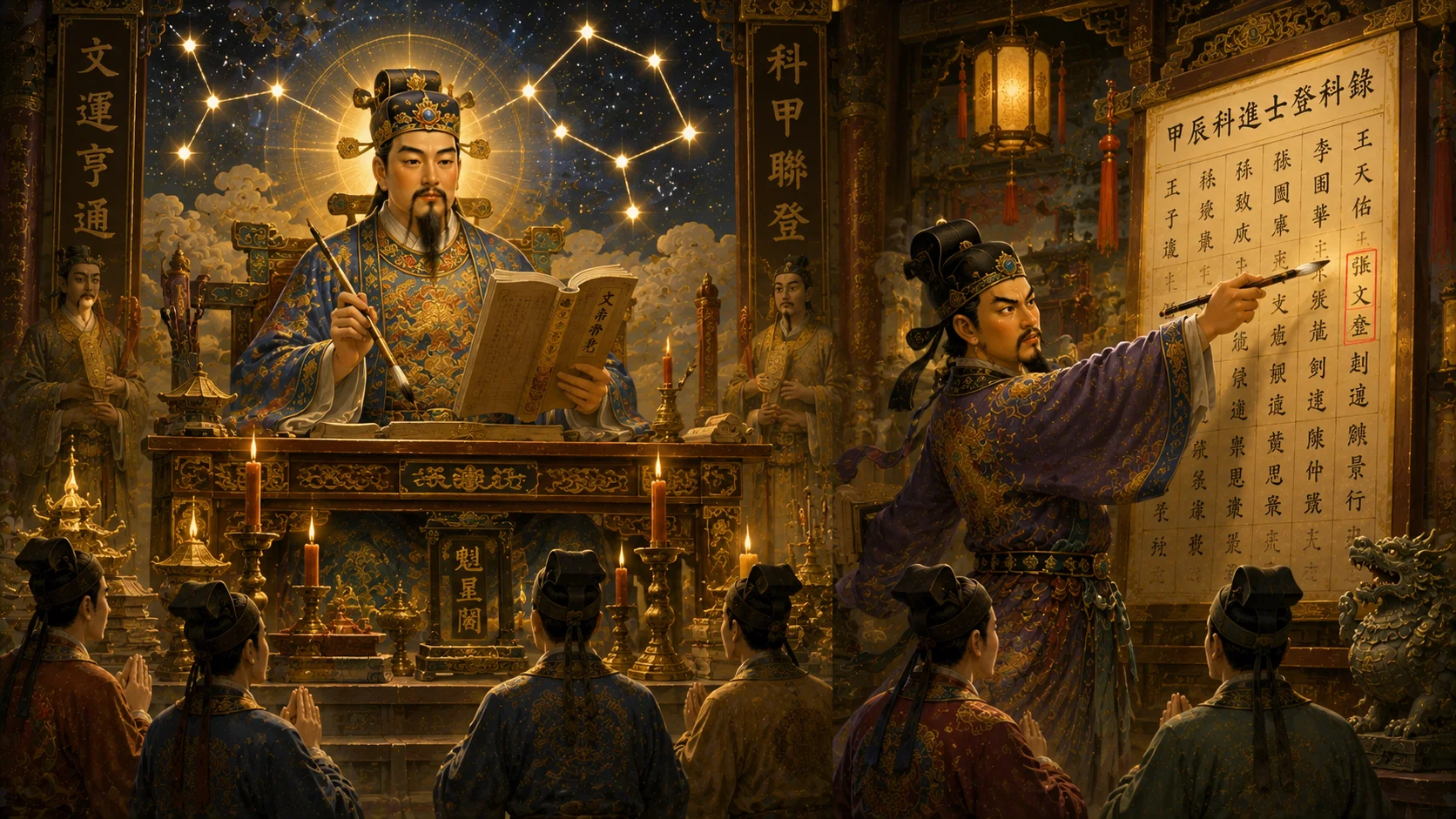
Wenchang Wang is not a single, originally unified figure. His cult is the historical fusion of two separate and much older strands of devotion. The first is the astral cult of the Wenchang star-group itself — six stars clustered near the Big Dipper in traditional Chinese astronomy, long held to govern literary fortune and the destinies of the learned. The second is the cult of Zitong Shen (梓潼神), a local deity of Zitong in Sichuan, originally venerated as a snake or thunder god of that region, and later identified with a specific human figure, Zhang Yazi (張亞子, also written 張惡子). Over centuries these two currents — one cosmic and abstract, one local and personal — grew together, until the star that ruled literary destiny and the local hero-god of Zitong were understood to be one and the same power, worshipped under a single name.
Last updated .
Seventeen Lives on the Road to Godhood
The standard hagiographical account of how this fusion came to be told is preserved in the Song–Yuan text known as the Wenchang Dijun Huashu, the "Book of Transformations of the Lord of Wenchang." According to this scripture, the deity did not arrive at his final divine station in a single lifetime but passed through a long chain of successive reincarnations — seventeen in the most common telling, though some versions extend the count to seventy-three — each incarnation across the centuries adding to the accumulated merit and moral authority that would eventually be recognized as the completed godhood of Wenchang. Zhang Yazi of Zitong is named among these incarnations as one of its pivotal episodes, the life in which the local Sichuan cult and the eventual national deity were most directly bound together. The transformation narrative casts the god not as a being who simply appeared, but as one who was, in a sense, earned — refined through repeated mortal existence before ascending to preside eternally over the fortunes of scholars.
Loyalty Unto Death at Zitong
Within this chain of lives, the episode of Zhang Yazi carries particular weight. He is said to have died in battle — in some tellings fighting against Fu Jian of the Former Qin, in others in earlier conflicts — and to have been deified afterward specifically for his loyalty and his filial piety, virtues that sat at the very center of the Confucian moral order his later cult would come to bless. A god of letters whose founding mortal story is one of loyal death in arms fused the martial virtue of unwavering fidelity with the civil virtue of learning, so the deity who would one day watch over examination halls carried within his legend the same loyalty scholar-officials were expected to show their emperor.
Emperors Who Owed Him Their Escape
The cult's rise from a regional Sichuan devotion to something the imperial court itself took seriously is tied to specific moments of dynastic crisis. Tang Emperor Xuanzong, fleeing during the An Lushan rebellion, was said to have received the aid of this Zitong deity along his flight, and the Tang court's gratitude translated into new honors for the god. Later, Emperor Xizong of Tang, forced into a comparable flight from rebellion, reported similar divine assistance. Each such episode of imperial deliverance became an occasion for the granting of further honorific titles, so that the god's official standing grew in direct correspondence with the crises of the throne he was believed to have helped survive — a pattern common to many Chinese deities, whose formal titles read almost as a record of the court's debts.
The Yuan Court Makes Him Official
The fusion of the star cult and the Zitong cult was given final, state-sanctioned form in 1316, when the Yuan Emperor Renzong formally canonized the deity under the lengthy title Fudao Fuwen Kaihua Wenchang Dijun (輔元開化文昌司祿宏仁帝君). This act closed the long process by which two once-distinct objects of devotion — a constellation and a local Sichuanese hero-god — became, officially and permanently, a single recognized deity of the Chinese state religious order. It is this canonized, unified Wenchang Dijun, rather than either of his two constituent cults taken separately, who is worshipped today.
Keeper of the Registers, Judge of Merit
As the presiding power over literary fortune, Wenchang Wang was understood to hold authority over the destinies of scholars in a very direct, almost bureaucratic sense — determining, in concert with the wider structure of Heaven, who among the empire's countless examination candidates would be permitted to pass and rise into office. For a society in which the examinations were the primary channel of social mobility, in which a single set of results could elevate a family for generations or condemn a gifted man to obscurity, this was no small or ceremonial power. It made Wenchang Wang, in practical terms, one of the most consequential deities a young scholar could hope to have on his side, and explains why devotion to him was so widespread and so earnestly performed rather than merely nominal.
Two Silent Attendants at His Side
Wenchang Wang's iconography presents him as a scholar-official seated in the formal robes of a Confucian mandarin, holding a ruyi scepter or ceremonial tablet, the very image of the successful literatus he empowers others to become. He is commonly flanked by two child-attendants, Tianlong (天聾, "Heaven-Deaf") and Diya (地啞, "Earth-Mute"). Their names are not incidental decoration but doctrine made visible: an examination candidate's fate, once set, must not be leaked or gossiped about, and the god's own attendants are deaf and mute so that the secrets of destiny they might otherwise overhear or repeat can never escape them. It is a striking piece of religious logic — the god of literature and communication is guarded by servants who can neither hear nor speak.
The White Mule of Zitong
Temple statuary and popular prints frequently show Wenchang Wang accompanied by a white mule, sometimes rendered as a horse, referencing the animal on which Zhang Yazi — and by extension the god himself — was said to have traveled. Alongside the seated, robed figure and his two silent attendants, the white mule completes a visual tableau immediately recognizable to worshippers entering a Wenchang temple: a settled, dignified procession of scholarly authority, discretion, and steady, sure-footed movement toward one's destination.
Kuixing, His Constant Companion in the Temple Hall
Closely associated with, yet carefully distinguished from, Wenchang Wang is Kuixing (魁星), the star-deity most directly tied to examination success itself. Kuixing is depicted in a strikingly different register from Wenchang's composed dignity: a demon-like figure, standing balanced on the back of a fish, one hand gripping a writing brush and the other an ink measure, poised as though at any moment to mark or select a name from among the candidates. The two deities are frequently worshipped side by side in Wenchang temples, known as Wen Miao or Wenchang Gong, functioning together as complementary patrons — Wenchang the presiding, bureaucratic authority over literary destiny in the broad sense, Kuixing the sharper, more immediate power over the pass-or-fail moment of the examination hall itself.
A Grouping of Five, Loosely Held
In some regional traditions, Wenchang Wang is counted among a broader assembly sometimes called the Five Literary Emperors, grouped alongside Kuixing, Zhu Yi (朱衣, the "Red-Robed One"), Lü Dongbin, and Guandi — the deified Guan Yu. Petitioners might appeal to this fuller company collectively for literary and career success. It should be said plainly that the exact composition of this grouping varies considerably by region and has never been fully standardized; it represents a flexible regional custom of collective petition rather than a fixed pantheon, and different localities have assembled the "five" from somewhat different figures.
A Morality Text Revealed Through the Brush
Among Wenchang Wang's most consequential legacies is the Yinzhiwen (陰騭文), the "Tract of the Quiet Way" or "Silent Recompense," also known in circulation as the Wenchang Xiaoji. This morality text was transmitted, according to tradition, through spirit-writing — fuji (扶乩) — attributed directly to the god's own revelation. It became one of the most widely copied and circulated of all Chinese morality books, the shanshu genre, and its teaching is direct and consequential in exactly the terms Wenchang's worshippers cared most about: that good deeds accumulate merit, and that accumulated merit is rewarded, in due course, with examination success and worldly fortune. The text bound ethical conduct and worldly ambition into a single continuous chain — virtue was not simply its own reward, but the very currency by which the god who governed literary destiny was believed to work.
Pilgrimage to the Mountain Where the Story Begins
The god's principal temple complex stands at Qiqu Mountain (七曲山) in Zitong County, Sichuan — the Wenchang Palace, or Wenchang Gong, together with the associated Dayunsi grotto complex. This site is traditionally regarded as the very ground of the deity's origin story, the place where the local cult of Zitong Shen and its eventual identification with Zhang Yazi first took root before growing into the empire-spanning cult recognized by the Yuan court. It remains today a major pilgrimage destination, drawing worshippers who trace the god's history back to the specific mountain landscape from which his legend first arose, rather than to the more abstract stars that would later be identified with him.
Incense Before the Exam Hall, Then and Now
The central ritual life of the Wenchang cult has always centered on the moment of examination itself. Historically, students and their families burned incense, hung wishing plaques inscribed with their hopes, and offered prayers to Wenchang Wang in the days before the imperial examinations — rites performed with the gravity due an event that could determine the whole shape of a family's future. That same devotional pattern continues in the present day, translated onto modern terms: students preparing for the gaokao and other university entrance examinations still visit Wenchang temples across China, Taiwan, and Chinese communities abroad, still burn incense and hang their wishing plaques, carrying forward a continuous line of practice that predates the very examination system it was first built to bless, and that has simply found a new set of exams to watch over.
Where Stars Meet the Scholar's Desk
Taken as a whole, Wenchang Wang stands as one of Chinese religion's clearest examples of the fusion between astral and nature worship and Confucian scholar-official ideals — a deity bridging Daoist cosmology and the secular meritocratic examination system that structured Chinese elite society for well over a millennium. He is, in the fullest sense, a bureaucratic god for a bureaucratic society: born of stars and a local hero's loyal death, refined through seventeen lives, canonized by imperial decree, and still today the one to whom a nervous student, before a temple altar the night before results are due, quietly addresses their hope.