Bai Suzhen, the White Snake, is the heroine of the Legend of the White Snake (Baishe Zhuan) — one of the Four Great Folktales of China, spoken of in the same breath as the Butterfly Lovers, Lady Meng Jiang, and the Cowherd and the Weaver Girl. She is a snake spirit who loved a mortal man, and whose story has been told and retold on stage, in print, and on screen for centuries as one of the most enduring romances in Chinese folk literature.
A Thousand Years Beneath the Water
Long before she ever set foot on the shores of West Lake, Bai Suzhen was baishe jing — a white snake spirit who had spent a thousand years in solitary, disciplined cultivation, refining herself along Daoist lines toward the kind of spiritual power that lets a creature step outside the shape it was born into. A thousand years is not a poetic round number in this tradition; it is the measure of patience the story asks its audience to hold in mind before judging anything Bai Suzhen does afterward. She did not stumble into humanity. She earned the human form she wears, breath by breath, across a span of time no mortal life could contain, and the transformation that follows is the reward of that discipline rather than a trick or a theft. When she finally rises from the water as a woman, she carries the whole of that cultivation with her — grace, power, and a hunger to know, at last, what it is to love as a human loves.
An Umbrella Shared in the Rain
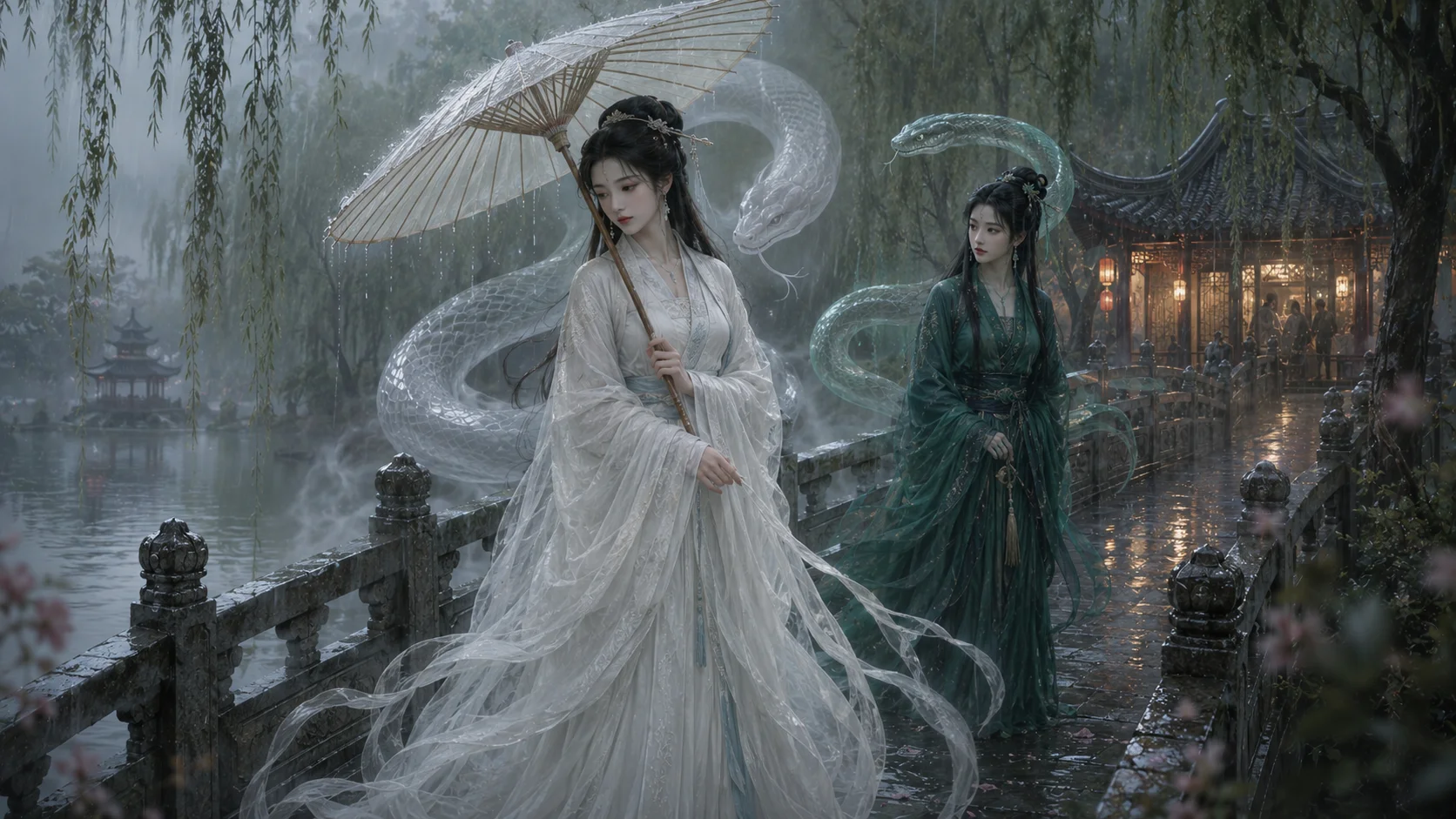
The meeting that begins everything is deliberately small. At West Lake in Hangzhou — in some tellings, Suzhou — rain begins to fall, and a young scholar named Xu Xian finds himself sharing his umbrella with an elegant woman who has just stepped from the water in human form. It is Bai Suzhen. Of all the images the legend has given Chinese art, opera, and folk memory, this is the one that returns most often: two strangers under one umbrella, the sound of rain, a lake that will later swallow a temple in its own kind of flood. The gentleness of the scene is the point — nothing supernatural announces itself, nothing warns Xu Xian that the woman beside him has crossed a thousand years to reach this particular rainy afternoon. Love, in this story, begins at the most ordinary possible register, and only later reveals how extraordinary its origin truly was.
The Sister Who Never Left Her Side
Bai Suzhen does not walk into her human life alone. Xiaoqing, a green snake spirit, is her sworn sister and constant attendant, and she too takes on a woman's form to follow Bai Suzhen into the mortal world. Where Bai Suzhen is composed, patient, and inclined to hope for reconciliation even with those who oppose her, Xiaoqing is quicker to anger and readier to fight — a counterweight that gives the legend its emotional range. Xiaoqing's loyalty is unconditional and it is tested at every turn: she stands beside Bai Suzhen through courtship, through catastrophe, through imprisonment, and in the story's most hopeful endings, it is her continued cultivation and her own hard-won power that eventually breaks the seal holding her sister captive. She is proof, within the legend itself, that devotion between women — sisterly, sworn, chosen rather than given by blood — can outlast even a sentence pronounced by a monk who claims to speak for cosmic order.
A Monk Who Believed He Was Right
Fahai, a Buddhist monk of Jinshan Temple, is the antagonist of the legend, but the tradition is careful — and has grown more careful with each retelling — not to paint him as merely villainous. Fahai does not hate Bai Suzhen out of cruelty. He is certain, with the certainty of a man who has spent his life inside doctrine, that a union between a human and a snake-spirit is a violation of the order that separates the realms of being, and that separating Xu Xian from Bai Suzhen is not persecution but correction. This is what gives the legend its lasting moral weight: it is not a simple contest between good and evil but a collision between a love that crosses a boundary and a law that insists boundaries exist for a reason. Audiences across centuries have overwhelmingly sided with Bai Suzhen, but the story keeps Fahai's conviction intact rather than reducing him to spite, because the tragedy only lands fully if his righteousness is sincere.
Wine That Reveals What Wine Cannot Undo
During the Duanwu Festival — the Dragon Boat Festival — tradition calls for the drinking of realgar wine, xionghuang jiu, a substance believed since ancient times to reveal or repel evil spirits. In most versions of the legend, Fahai's influence reaches Xu Xian and persuades him, out of love and worry rather than malice, to offer his wife a cup of it. Bai Suzhen knows what the wine will do to her and hesitates, caught between the wish to protect her secret and the wish to share fully in her husband's customs and festivals as any wife would. She drinks. The wine forces her back into her true serpentine form, and Xu Xian, catching sight of the enormous white snake coiled where his wife had been standing, is overcome with a terror severe enough, in some versions, to kill him outright. A single cup, offered out of love and consumed out of love, becomes the hinge on which the entire second half of the legend turns.
The Climb Up Mount Emei
Rather than accept what the wine has undone, Bai Suzhen sets out to reverse it. She travels to Mount Emei in search of the lingzhi, the fungus of immortality, said to be capable of restoring life and health beyond what ordinary medicine could manage. The herb is guarded — divine cranes and deer stand between her and the plant she needs — and Bai Suzhen fights them with the full supernatural martial skill her centuries of cultivation have given her. This episode is where the legend lets its heroine be more than a devoted wife; she is shown here as a warrior, capable of taking on guardians of a sacred mountain and prevailing, driven by nothing but the need to undo the harm a festival custom and a monk's whispering caused the man she loves. She returns from Mount Emei with the herb, and Xu Xian is revived — but the peace does not last, because Fahai has not finished with either of them.
The Temple That Learned to Fear the Lake
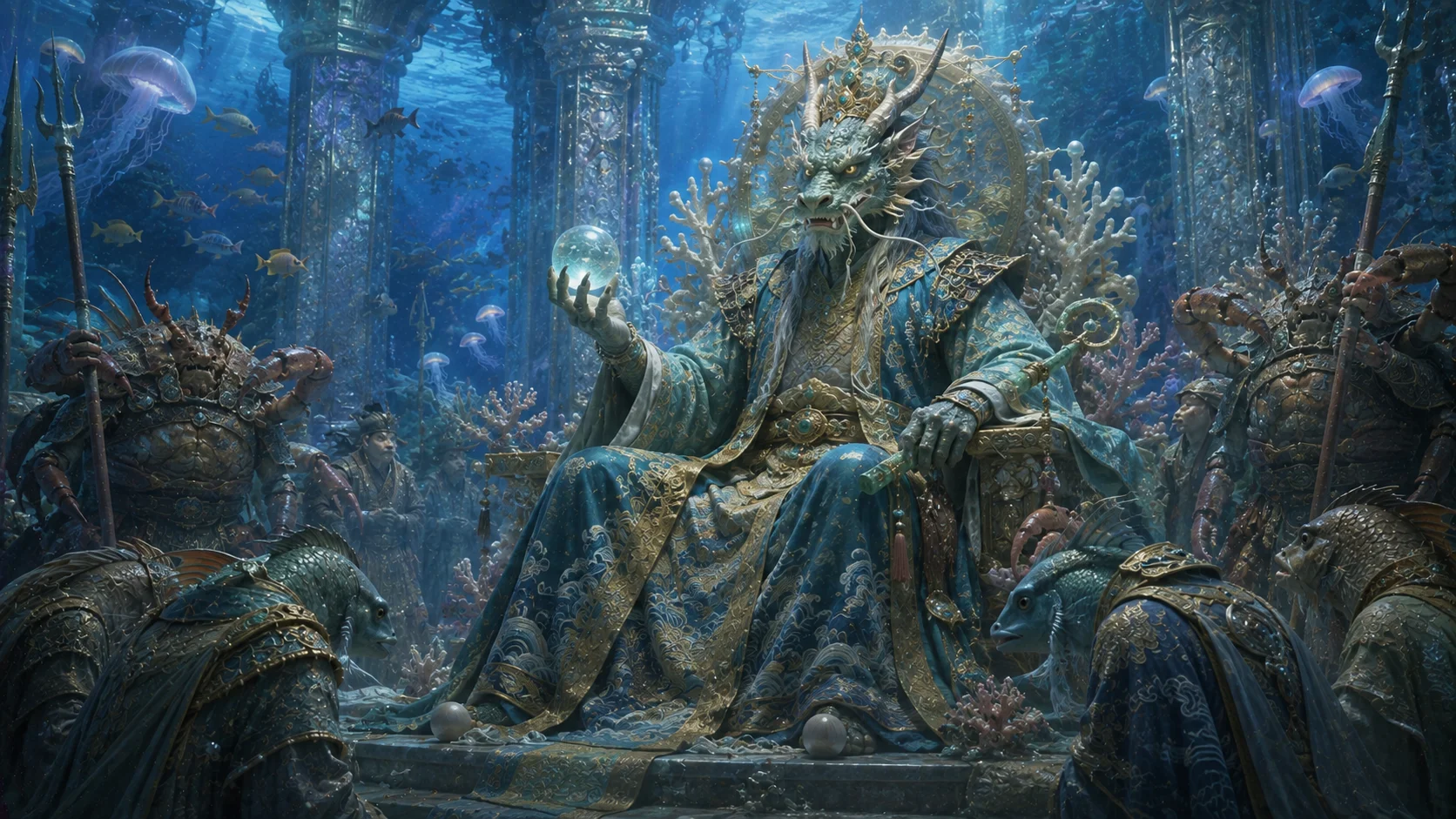
Fahai's interference does not end with the wine. He sequesters Xu Xian inside Jinshan Temple, effectively holding him apart from his wife under the monk's own authority, and Bai Suzhen's patience finally gives way to open confrontation. She summons shrimp soldiers, crab generals, and the aquatic spirits of the lake and rivers she commands, and floods Jinshan Temple in the episode known as Shui Man Jinshan — the flooding of Jinshan Temple. It is the legend's great set-piece battle, staged again and again in Chinese opera with rolling blue silk and acrobatic combat between Bai Suzhen's spirit army and Fahai's defenders. But the tradition does not let her walk away from this victory clean. The floodwaters she raises to reclaim her husband also cause real, indiscriminate harm beyond the temple walls, and many tellings frame this act as Bai Suzhen's own transgression — the one moment where her cause, however just, tips over into a wrong that the story will hold her accountable for. It is this moral ambiguity, more than anything Fahai does, that keeps the legend from collapsing into simple melodrama.
What the Flood Was Made to Answer For
The consequence of Jinshan Temple's flooding is imprisonment. Fahai seals Bai Suzhen beneath Leifeng Pagoda at West Lake — the very shoreline where she first shared an umbrella with Xu Xian, now the site of her confinement instead of her courtship. Different tellings give different lengths to her sentence, some fixed, some open-ended, but the underlying shape is constant: a punishment framed as restoring cosmic order, delivered against a woman whose worst offense was defending a marriage too fiercely. In many versions she is already pregnant with Xu Xian's son when the pagoda closes over her, or has already given birth to him, so that the imprisonment separates not only wife from husband but mother from infant son — a cruelty the legend does not shy away from naming, even as it insists on Fahai's sincerity throughout.
A Pagoda That Could Not Hold Forever
The legend's most beloved endings refuse to let the imprisonment be permanent. In the most widely told version, it is Bai Suzhen's own son who secures her release — grown to manhood, he passes the imperial examinations with distinction and prays at Leifeng Pagoda for his mother's freedom, and filial devotion succeeds where confrontation once failed. In other tellings it is Xiaoqing who never stopped cultivating her own power in the years of her sister's confinement, returning at last with strength enough to break the pagoda's seal herself. Either ending carries the same verdict: the story's sympathy has always rested with Bai Suzhen, not with the monk who imprisoned her, and it will not let her captivity be the last word. Freedom, when it comes, is earned by the people who loved her rather than granted by the one who judged her.
A Real Tower and a Story That Outlived It
Leifeng Pagoda is not an invention of the legend; it is a real structure that once stood, and did stand, at West Lake for centuries before it collapsed in 1924 — reduced, popular memory says, by locals who chipped away at its bricks in the belief that they carried protective power, itself a piece of folk belief about the physical building rather than part of the legend's original narrative. It was rebuilt in 2002, so that a visitor to West Lake today can stand where the story places Bai Suzhen's confinement and where, before that, Xu Xian first offered her shelter under his umbrella. Few Chinese folktales are anchored this literally to a landmark still walkable today, and the pagoda's own history — collapse, absence, reconstruction — has folded itself into the legend's afterlife almost as if the building were performing the story's own arc of loss and restoration.
Why She Has Never Stopped Being Told
Bai Suzhen endures, across opera, film, and television, because she carries a contradiction that never resolves and never needs to: a spirit who wanted nothing more than an ordinary human love, punished by a moral order that could not accept a devotion it did not recognize as legitimate. She is read as an emblem of romantic self-sacrifice, of loyalty that survives transformation, exposure, and confinement alike, and as a quiet, sustained critique of rigid orthodoxy — Fahai's certainty is never mocked, but the legend makes plain that certainty and righteousness are not the same thing. A snake spirit's thousand years of discipline earned her a woman's form; her devotion to the man she found under a shared umbrella earned her, in the end, the sympathy of every generation that has told her story since.
Sources & traditions
- EncyclopediaWikipedia — Bai Suzhen
- TraditionChinese texts, oral tradition and village tellings (China)
Myths change from area to area and from time to time. This chronicle follows the most widely told versions; tellings in other villages, regions and eras may differ.