Xi Wangmu, the Queen Mother of the West, is one of the oldest deities attested in Chinese religious history — a goddess whose long life in the textual record shows her changing shape across the centuries, from a fearsome mountain spirit of the wild frontier to the serene, supreme sovereign of the immortals enthroned above Mount Kunlun.
A Goddess with Tiger's Teeth
The earliest surviving portrait of Xi Wangmu comes from the Classic of Mountains and Seas (Shanhaijing), and it is startling to readers who know only her later, courtly form. There she is described as dwelling in the far west with tiger's teeth, a leopard's tail, and disheveled hair — an appearance closer to a wilderness spirit than a queen. She is not a benevolent guardian in this earliest layer of myth but a power over plagues and punishments, a deity whose domain includes calamity and correction as much as blessing. This half-human, half-beast figure was a mountain deity in the fullest sense: untamed, dangerous, and bound to the remote geography of the west where the ordered world of human settlement gave way to wilderness.
The Long Road to the Queenly Form
What makes Xi Wangmu so significant to historians of Chinese religion is that her evolution is documented rather than assumed. The fierce mountain spirit of the Shanhaijing did not vanish so much as transform, layer by layer, into the composed, radiant queen-goddess familiar from later art and literature. By the time of the Han dynasty, the transformation was substantially complete: the deity of plagues and punishments had become a supreme goddess of immortality, her fearsome attributes receding as her cosmic authority expanded. This is not a case of two different goddesses being confused for one another — it is a single figure whose portrayal deepened and softened as her cult grew, a pattern worth handling with care rather than flattening into a single fixed image.
Sovereign of the Kunlun Mountains
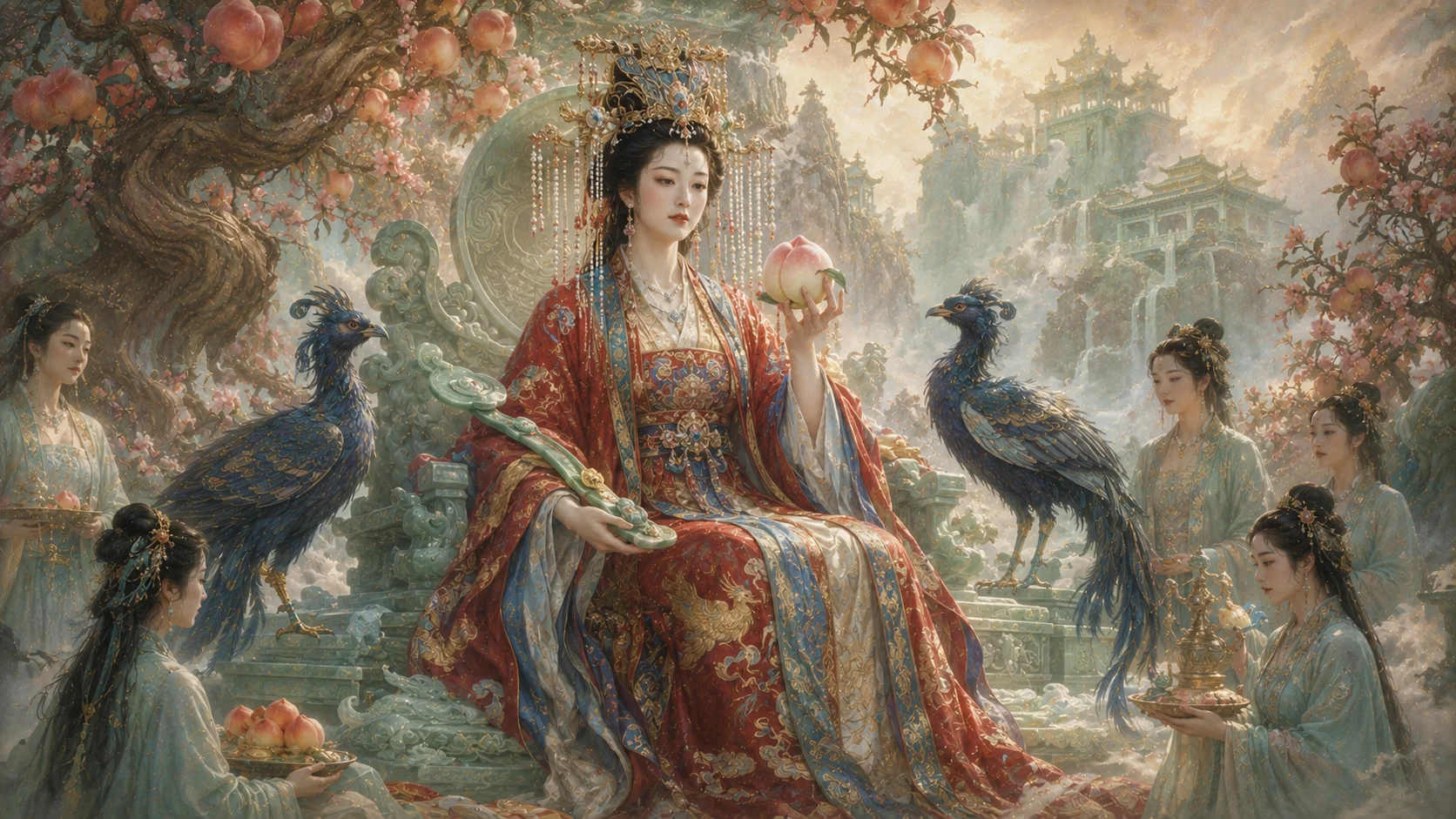
In her mature form, Xi Wangmu presides over the Kunlun Mountains, understood in Chinese cosmology as the western axis of the world — a point where the earthly and celestial realms draw close together. Later art renders her enthroned in a palace upon this sacred mountain, attended by female immortals in a court that mirrors, and in some tellings surpasses, the splendor of any earthly dynasty. She is often accompanied by a nine-tailed fox or by a blue bird, the qingniao, which serves as her messenger — winged intermediary between her distant paradise and the world of mortals and lesser immortals who seek her favor.
The Peaches That Ripen Once in Millennia
Xi Wangmu's most celebrated possession is her orchard of Peaches of Immortality, the pantao, trees that bear fruit only once every several thousand years. To eat one of these peaches is to receive eternal life, and their extraordinary rarity is precisely what makes them the most coveted prize in the entire pantheon. The peaches are not simply magical food; they are the material form of the immortality she governs, harvested on a timescale that dwarfs any human lifespan and reserved, in principle, for those she judges worthy of receiving them.
The Banquet That Was Crashed
Xi Wangmu hosts the Peach Banquet, the Pantao Hui, a gathering of immortals and deities convened to share in the fruit of her orchard when it finally ripens. This banquet is best known today through its most famous disruption: in Journey to the West, it is precisely this celebration that the trickster Sun Wukong crashes, gorging himself on peaches meant for honored guests and turning what should have been a solemn feast of the immortals into chaos. The episode has become one of the most widely retold moments in Chinese literature, but it is worth remembering that the banquet itself belongs to Xi Wangmu's older, more dignified tradition of hospitality among the transcendent — an institution far older than the tale of the monkey who disgraced it.
Teacher to an Emperor
Xi Wangmu's legend reaches directly into human history through her association with Emperor Wu of Han. In the account known as the Han Wudi Neizhuan, she is said to have visited the emperor's court in person, presenting him with peaches of immortality and imparting Daoist teachings. This narrative placed a mortal ruler — one of the most consequential emperors in Chinese history — into direct contact with the goddess of the western paradise, and it helped cement her role not only as a distant cosmic sovereign but as a figure who could, on rare occasion, cross into the affairs of the human world to instruct those who sought transcendence.
Yin to the Eastern King's Yang
As Daoist cosmology matured, Xi Wangmu was given a cosmic counterpart: paired sometimes with the Jade Emperor and, in a parallel tradition, with the Eastern King Father, Dong Wanggong. In these pairings she embodies yin, the receptive, feminine cosmic principle, set against a masculine yang counterpart who governs the east. This symmetry gave Xi Wangmu a structural place within the broader architecture of Daoist metaphysics — not simply a powerful individual deity but one half of a balanced cosmic order, her western paradise mirrored by an eastern one.
Keeper of the Register of Immortals
Beyond her mythic narratives, Xi Wangmu occupies a formal administrative role within Daoist religious practice. She is understood to oversee a register, or record, of the immortals — a celestial ledger of those who have achieved transcendence. Daoist adepts seeking to move beyond mortal limitation petition her directly, and she holds particular significance for female practitioners of Daoism, who looked to her as patroness and exemplar in the transmission of esoteric texts and techniques. Her authority in this respect is bureaucratic as much as it is mythic: she does not merely grant immortality through peaches in a single legendary episode, but administers the status of the transcendent as an ongoing cosmic office.
The Elixir, the Archer, and the Moon
One of the most enduring threads connecting Xi Wangmu to other figures in Chinese mythology runs through the story of the archer Hou Yi, who obtained the elixir of immortality directly from her. The elixir was not consumed by Hou Yi himself; it was later taken — in some tellings stolen, in others drunk to keep it from falling into the wrong hands — by his wife Chang'e, whose consumption of it caused her ascent to the moon, where she remains a central figure of her own enduring legend. Xi Wangmu's role here is that of original source: the elixir at the heart of the Chang'e myth exists only because she possessed and dispensed it, making her indispensable to a story that is, on its surface, about someone else entirely.
An Empire's Mass Pilgrimage
Xi Wangmu's cult was not confined to court literature and philosophical texts; it took organized, popular form. The Book of Han (Hanshu) records a documented mass movement of worship devoted to her in 3 BCE — a wave of popular pilgrimage and devotion significant enough to be recorded by imperial historians. This episode stands among the earliest attested organized religious movements in Chinese history, evidence that Xi Wangmu's appeal extended well beyond the elite Daoist adepts and court chroniclers who preserved her myths, reaching into a genuinely popular religious consciousness during the Han dynasty.
The Paradise Beyond the Mortal World
Across every phase of her long development, Xi Wangmu has remained fixed to a single symbolic register: she represents immortality itself, a cosmic femininity untouched by mortal decay, and a paradise so remote from ordinary human life that reaching it — whether through petition, worthiness, or the rare gift of a peach — stands as one of the highest aspirations a Daoist adept could hold. Her far-western mountain palace, ringed by female immortals and watched over by her fox and her blue-bird messenger, endures as one of the most vivid images of transcendence in the Chinese religious imagination — a destination that is not merely distant in geography but altogether outside the reach of ordinary time.
Sources & traditions
- EncyclopediaWikipedia — Queen Mother of the West
- TraditionChinese texts, oral tradition and village tellings (China)
Myths change from area to area and from time to time. This chronicle follows the most widely told versions; tellings in other villages, regions and eras may differ.