The Three Pure Ones (Sānqīng, 三清) are the supreme triad of Daoist deities: personifications of the Dao itself in its highest, most abstract manifestations, dwelling above even the Jade Emperor in the formal celestial hierarchy of orthodox and philosophical Daoism.
A Throne Above the Jade Emperor
In the liturgical structure of Daoism, the Three Pure Ones occupy the summit of the pantheon, ranked above the Jade Emperor himself. This is a distinction that elite, scripture-based Daoism draws sharply but that ordinary devotional life often blurs. Where the Jade Emperor presides over the bureaucratic cosmos familiar from folk religion — the deity most temple-goers pray to, petition, and picture as ruler of heaven — the Three Pure Ones stand a tier above that entire administrative structure, closer to abstract principle than to court and command. It is a documented and long-standing divergence: the Jade Emperor is by far the more prominent figure in popular worship, while the Three Pure Ones remain the deities of highest formal rank, invoked at the opening of major rites and enshrined at the most exalted point of temple architecture, even when they are not the images a lay worshipper first approaches.
Three Emanations of the Nameless
The trinity comprises three Celestial Venerables (Tianzun): Yuanshi Tianzun, the "Celestial Venerable of the Primordial Beginning"; Lingbao Tianzun, the "Celestial Venerable of the Numinous Treasure"; and Daode Tianzun, the "Celestial Venerable of the Way and Its Power," more commonly known by his other name, Taishang Laojun. Each represents not a separate god competing for followers in the ordinary sense, but a successive stage in the Dao's own unfolding — the way a single source can be spoken of in three necessary aspects without ceasing to be one. They are conventionally understood as manifestations or emanations of the same underlying reality rather than three independent origins.
The One Who Precedes Heaven and Earth
Yuanshi Tianzun is generally regarded as the most senior of the three, the first in sequence and dignity. Tradition holds that he existed before the separation of heaven and earth, prior to the division of the cosmos into the paired forces and forms that would come to structure the world. He is also credited with a recurring, salvific role across cosmic time: periodically revealing sacred scriptures to save humanity as vast cycles of time — kalpas — turn over. This casts him less as a distant creator who acts once and withdraws, and more as a source who returns, age after age, to offer teaching precisely when the world needs it.
The Bridge of the Numinous Treasure
Lingbao Tianzun, also known as Taishang Daojun, occupies the middle position of the triad both in rank and in function. He is associated with the transmission of the Lingbao — "Numinous Treasure" — scriptures, a body of sacred texts that gave their name to an entire major branch of Daoist scripture and ritual. Structurally, he is often understood as a mediator: the figure who carries what begins as pure, formless principle in Yuanshi Tianzun down into a form that can be taught, transmitted, and eventually practiced by the third of the three, Daode Tianzun, and from him by human seekers. In this sense Lingbao Tianzun is the crucial middle rung of a ladder that connects the unspeakable origin to the teachable path.
Laozi Made Cosmic
The third of the Celestial Venerables, Daode Tianzun, is the deified form of Laozi, the semi-legendary sage credited with authoring the Daodejing. Beginning around the Han dynasty, religious Daoism elevated Laozi from a philosopher-author into a cosmic deity in his own right, worshipped under the title Taishang Laojun — "Grand Supreme Elderly Lord." This transformation is one of the more striking developments in Chinese religious history: a text's putative author becoming, over centuries, one of the three highest gods of an entire tradition, his teachings on the Way and its Power (Dao and De) understood no longer merely as philosophy to be read but as a cosmic principle to be venerated.
The Elixir Furnace of Journey to the West
Taishang Laojun's most widely known appearance to general audiences is not in scripture or ritual but in the classic novel Journey to the West, where he appears as "Laozi," keeper of a heavenly furnace and the alchemical elixir pills prized above almost anything else in the celestial court. In one of the novel's most memorable episodes, Sun Wukong steals and eats these pills, is thrown into Laozi's furnace as punishment, and — rather than being destroyed — survives the ordeal, emerging with fiery golden eyes as a permanent mark of having passed through the flame. The scene draws directly on Taishang Laojun's established identity as a master of alchemy and immortality-craft, folding the deified philosopher into popular literary imagination in a way that has shaped how millions encounter him even without formal religious instruction.
Three Heavens, Three Purities
Each of the Three Pure Ones is said to reside in his own heaven, and these three heavens are the origin of the name "Three Purities." Yuanshi Tianzun dwells in Yuqing, the Jade Purity; Lingbao Tianzun in Shangqing, the Upper Purity; and Daode Tianzun in Taiqing, the Great Purity. These are not simply three addresses in a cosmic geography but three degrees or qualities of purity itself, each heaven corresponding to a stage of the Dao's own self-differentiation as it moves from the utterly formless toward the manifest world.
One Becomes Two Becomes Three Becomes the Myriad Things
The theological shape of the trinity echoes one of the most famous lines in the Daodejing: that the Dao produced One, One produced Two, Two produced Three, and Three produced the myriad things. The Three Pure Ones can be read as a devotional and cosmological embodiment of exactly this sequence — the Dao's own capacity to differentiate itself into a structured triad before that triad, in turn, generates and sustains the entire proliferating cosmos of "the ten thousand things." Rather than three separate creators, they represent one process of emanation viewed from three successive vantage points, each stage necessary before creation can proceed to the next.
A Trinity Shaped in Dialogue with Buddhism
The concept of a threefold supreme deity did not spring into being fully formed; it developed gradually over centuries and was significantly formalized during the Tang and Song dynasties. Scholars have documented that this formalization did not occur in isolation — it was partly influenced by, and structurally parallels, the Buddhist doctrine of the Trikaya, or "three bodies" of the Lord Buddha, which likewise distinguishes an ultimate formless truth-body from more accessible manifest and transformation bodies. This is a well-attested instance of cross-tradition influence in Chinese religious history, in which Daoism, engaging seriously with Buddhist thought after its arrival and spread in China, arrived at its own triadic solution to a related theological problem: how a single ultimate reality can also appear, teach, and be approached.
Seated Together at the Highest Altar
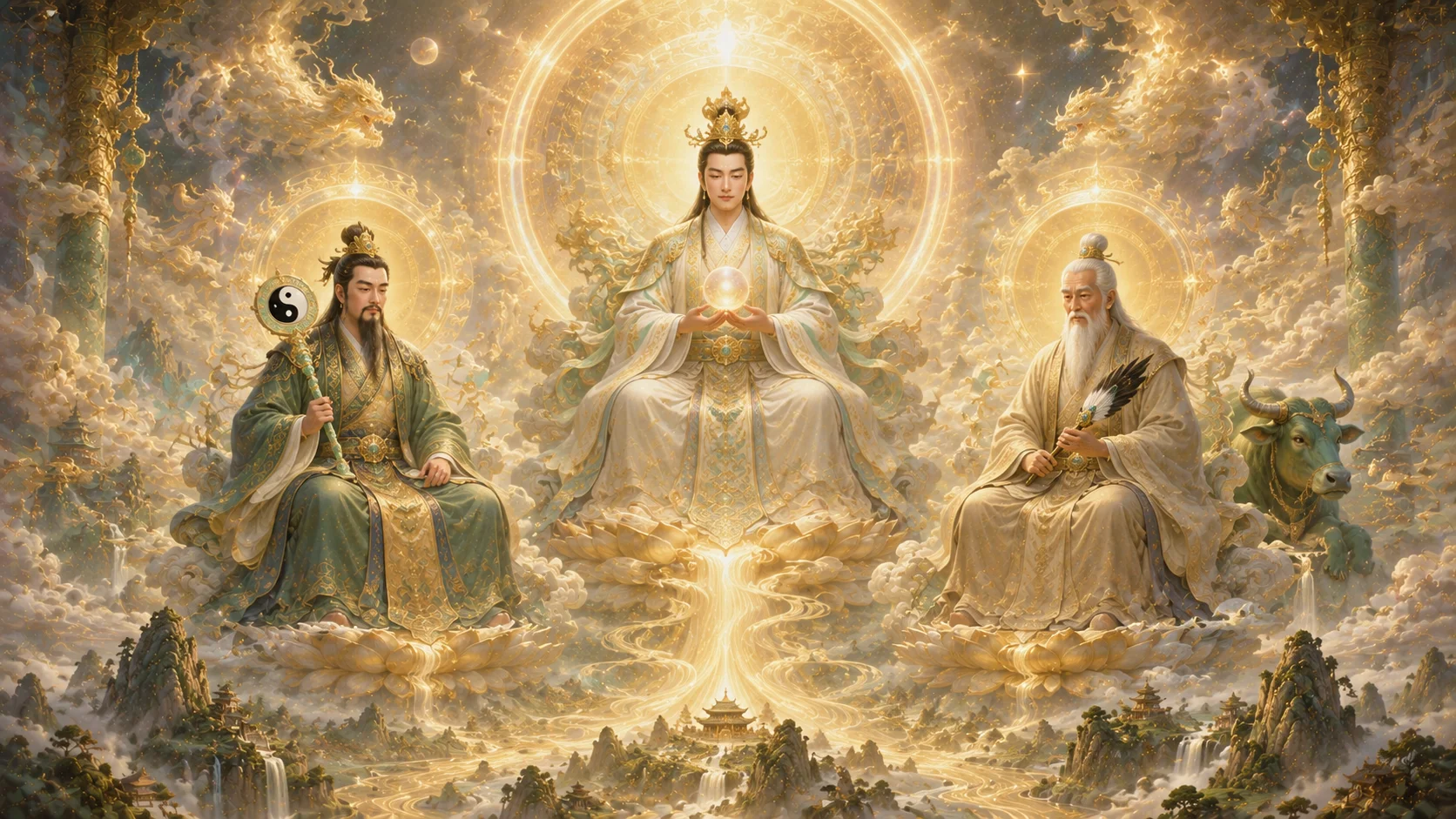
In Daoist temple architecture, the Three Pure Ones occupy the most exalted position available: the main hall of major temples typically enshrines them together as the highest altar in the building. The White Cloud Temple (Baiyun Guan) in Beijing, one of the most important centers of Daoist practice, follows this pattern. The three are conventionally depicted seated side by side, each holding a distinct emblem: a pearl, or an orb representing the void from which all things emerge; a ruyi scepter, a symbol of authority and the granting of wishes; and a fan or a scripture, representing teaching and transmission. These attributes give worshippers a visual key to the theological roles each figure plays, even without reading a single line of doctrine.
Highest Address at the Opening of the Rite
Beyond architecture and iconography, the Three Pure Ones hold a defined place in Daoist liturgical practice. They are venerated in ordination rites and major temple ceremonies, and they are invoked at the very opening of formal Daoist rituals — the jiao (offering) and zhai (purification) rites that structure communal Daoist religious life. In this liturgical role, they function as the highest-ranking recipients of ritual address: the rite begins by acknowledging the summit of the sacred hierarchy before descending, in sequence, to other deities. This placement at the start of ritual speech is itself a statement of rank, reinforcing in practice what temple architecture already states in stone and paint — that among all the beings venerated in the Daoist tradition, the Three Pure Ones stand first.
The Abstract Summit of a Living Cosmos
Taken together, the Three Pure Ones represent something distinct from the more anthropomorphic, court-and-bureaucracy imagery that characterizes much of Chinese folk religion. They are the abstract summit toward which that entire visible cosmos points: three faces of a single, ultimate principle, differentiated just enough to be approached, named, and venerated, while still pointing back toward the wordless unity from which — according to the tradition they crown — everything else has emerged.
Sources & traditions
- EncyclopediaWikipedia — Three Pure Ones
- TraditionChinese texts, oral tradition and village tellings (China)
Myths change from area to area and from time to time. This chronicle follows the most widely told versions; tellings in other villages, regions and eras may differ.