Pangu is the primordial giant of Chinese cosmogony: the first being to take shape within the formless chaos before heaven and earth existed, the one who forced sky and ground apart with his own growing body, and whose death, in the myth's most striking image, became the raw material of the world itself — his breath the wind, his eyes the sun and moon, his blood the rivers, his bones the mountains.
A Being Formed Before Days Had Names
The myth begins before there was a heaven to look up at or an earth to stand on. All that existed was hundun — a formless, undifferentiated chaos, likened to the inside of an egg, in which the substance of everything to come was mixed together without shape or direction. Within this egg, over eighteen thousand years, something began to take form: Pangu, gestating in the dark the way a chick gestates inside a shell, growing without anyone to witness it, in a world that did not yet have witnesses to spare.
The number itself — eighteen thousand years — recurs twice in the myth, once for this incubation and once again for the labor of separation that follows, and that doubling is part of the story's shape: nothing about the making of the world happens quickly. Creation here is not a single utterance or a single day's work. It is closer to geological patience, stretched across a span of time so large it stops being a measurement and becomes a way of saying "longer than can be reckoned."
The Egg Splits, and Substance Sorts Itself
When the egg finally opened, what emerged was not simply Pangu but a division: the heavy, turbid elements — yin — sank downward and thickened into the earth, while the light, clear elements — yang — rose and thinned into the sky. This is one of the clearest and most literal expressions in Chinese cosmological thought of yin and yang as physical substances rather than only abstract principles — dense matter settling low, subtle matter drifting high, sorting themselves by their own nature the moment they were free to move.
Pangu stood at the center of that sorting, neither pulled down with the earth nor risen with the sky, but positioned exactly at the seam between them — which is precisely why what happens next requires him at all. Two elements that separate on their own can also drift back together, and something has to hold the gap open while it sets.
Ten Feet a Day, for as Long as It Takes
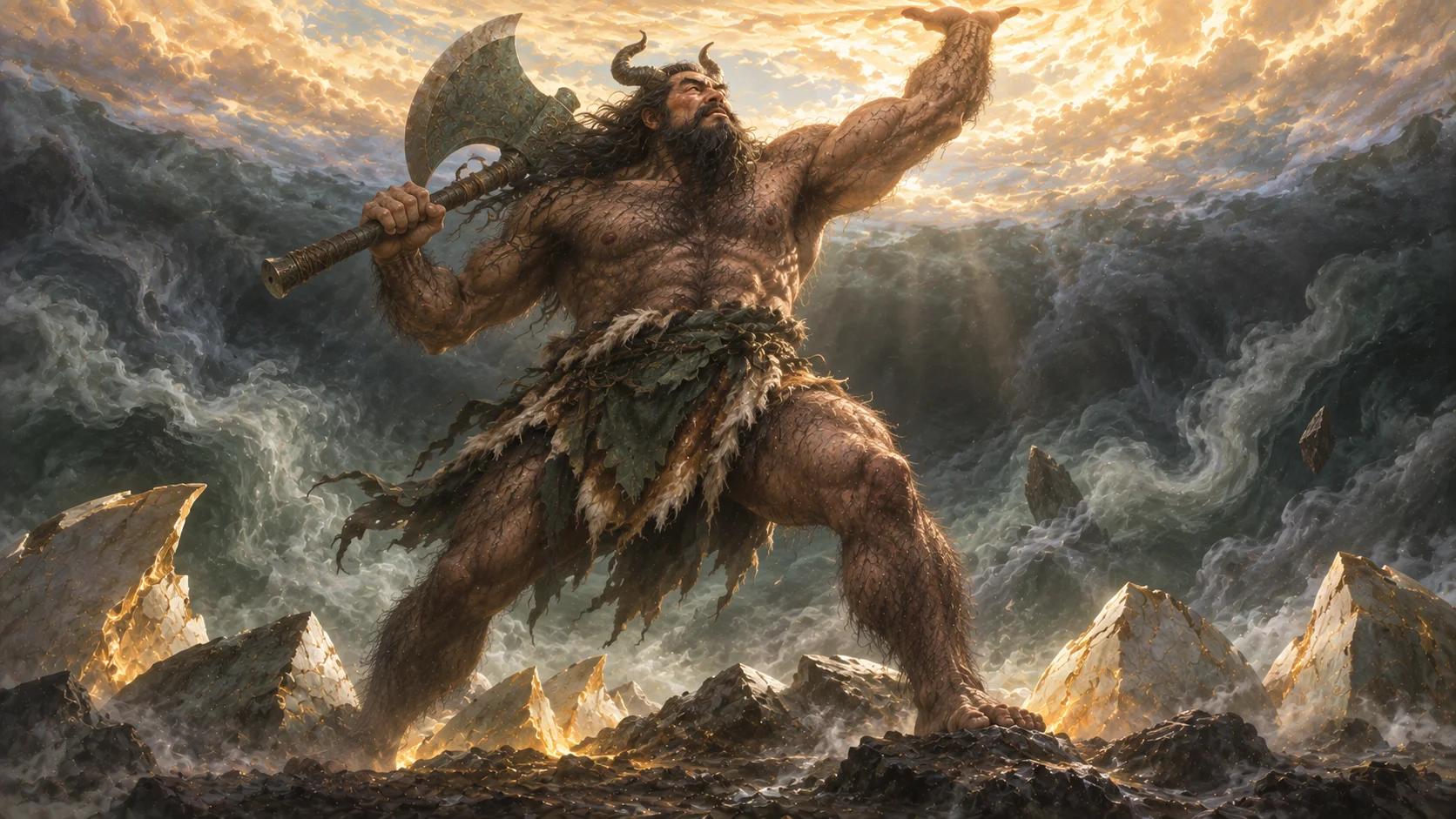
That is the labor of the next eighteen thousand years: Pangu growing taller, and heaven and earth being pushed correspondingly farther apart, by ten feet with every day that passed. The image is deliberately unglamorous — no single decisive act, no thunderclap of creation, just a giant lengthening a little at a time, day after day, until the distance between sky and ground becomes what it is now and stays there.
Some later folk retellings gave Pangu an axe or a chisel, showing him actively hacking the chaos apart rather than simply growing to hold it open — a vivid embellishment that entered popular art and storytelling well after the earliest written version of the myth, and worth noting as a later layer rather than the core image. The oldest form of the story is quieter than that: not a demiurge striking with a tool, but a body doing the work by the plain fact of getting larger, for as long as the task demanded.
The First Written Trace of a Myth Far Older in Feel
For a story that reads like it should sit at the very start of Chinese mythological tradition, Pangu's myth is, by the written record, a surprisingly late arrival. It is not found in the earlier canonical texts that shaped Chinese cosmology and historiography, and its first known telling comes from Xu Zheng's Sanwu Liji — the Historical Records of the Three Sovereigns and Five Emperors — compiled in the third century CE. Pangu is also notably absent from the classical Sanhuang Wudi schema itself, the traditional lineup of sovereigns and emperors that framed the earliest stretch of Chinese history; he stands outside that schema, a cosmogonic figure layered onto the tradition rather than woven into its original king-list.
That lateness does not make the myth any less serious to the tradition that holds it — many foundational stories are only set down in writing long after they circulate — but it does mean Pangu should be understood as one identifiable strand within a much larger and older weave of Chinese creation thought, rather than as the single ancient source from which everything else descends.
A Body That Becomes the World It Once Stood Inside
The most enduring image in the myth arrives with Pangu's death: his body does not simply end, it transforms, piece by piece, into the physical world around the people who would come to tell his story. His breath became the wind and the clouds. His voice became thunder. In some versions of the myth, his left eye became the sun and his right eye became the moon. His limbs and his torso became the mountains that anchor the land, his blood became the rivers that run through it, and his hair — the hair of his head and the fine hair of his body alike — became the plants that cover the earth and the stars that cover the sky.
This is a macranthropic creation myth in its purest form: the cosmos is not made by Pangu so much as it is made of him, his death and the world's furnishing happening as the same event rather than one causing the other at a distance. The giant who once stood as the boundary between sky and earth becomes, in the end, everything that fills the space he held open.
A Contested Line to Human Beings
Some later elaborations of the myth extend the transformation one step further, claiming that the small creatures living on Pangu's body — the parasites he carried — became human beings once he died. It is worth being precise about where this idea sits: it is a later addition, not the dominant account, and it exists alongside rather than in place of the far more established Chinese tradition that credits human creation to the goddess Nuwa, who is said to have shaped people from yellow earth. These are two distinct cosmogonic traditions that coexist in the wider body of Chinese myth rather than one displacing the other — Pangu's story explains the shape of the physical world, Nuwa's explains the origin of people, and the occasional overlap between them is a later graft rather than an original unity.
Echoes That May, or May Not, Cross a Border
Scholars examining Pangu's myth have long noted its resemblance to cosmic-giant creation stories found elsewhere in the world — the Norse account of Ymir, whose body likewise becomes the raw material of the world after death, is the comparison most often drawn. Closer to home, researchers have also pointed to possible influence from, or genuine kinship with, cosmogonic traditions among southern non-Han peoples, including Miao and Yao narrative traditions, which carry their own giant- and egg-centered creation stories.
None of this is settled fact. The direction of influence, or whether the resemblance reflects influence at all rather than the kind of story that different peoples arrive at independently when they reach for the same metaphor — the body as the shape of the world — remains a genuinely open question among those who study the myth's origins. It is presented here as a live scholarly conversation, not a solved lineage.
A Myth Without a State Cult
Despite how central Pangu has become to popular ideas about Chinese creation, he was not, historically, the object of major state-sponsored ritual worship in the way some other cosmological forces were — there was no imperial sacrifice to Pangu comparable to the great state rites offered to Heaven and Earth themselves. His role in the tradition has been primarily narrative and cosmogonic: a story told to explain how the world came to have its present shape, rather than a deity petitioned or propitiated through formal court ritual.
That distinction matters for understanding what kind of figure Pangu is. He belongs to the realm of cosmological explanation more than to the realm of active cult worship, even as, at the local and folk level, that boundary has been crossed in places where communities built their own devotional practices around him.
Shrines Claimed at the Edges of the Map
Local and folk traditions in various parts of China have, at different times, claimed sites connected to Pangu — shrines and tombs said to mark his resting place or his origin, in regions including Guangxi and Henan among others. These sites have supported a modest tradition of origin-myth tourism, drawing visitors interested in touching a physical place to an otherwise cosmic story.
It is worth being clear-eyed about what these sites represent: folk traditions of varying age and local character, not remnants of a single unified ancient cult that once worshipped Pangu across China. Each shrine tends to reflect its own regional history and its own reasons for claiming the connection, rather than all of them descending from one shared, organized religious practice.
One Cosmogony Among Several, Elevated by Time
Modern popular culture frequently treats Pangu as the definitive first being of Chinese mythology, the singular starting point from which the rest of the cosmological story unfolds. That centrality, however, is very much a later popularization. Chinese tradition, across its long history, held several competing and coexisting creation narratives at once — Nuwa-centered accounts of the world's shaping and repair, hundun-centered accounts of primal chaos in its own right, and Pangu's account of separation and bodily transformation among them.
Pangu's myth did not erase these other traditions; it grew, over the centuries and especially in more recent popular retelling, into the version most widely recognized outside specialist circles, while the others continued — and continue — to hold their own place in the broader tradition.
What the Giant Still Stands For
Stripped back to its core, the myth of Pangu is an answer to some of the oldest questions a cosmology has to ask: why is there a sky above and ground below, why are they separated by the distance they are, and what is the relationship between the substance of a living body and the substance of the world. Its answer is unusually direct — the world is shaped the way it is because something enormous once stood in the gap and grew, and when that being died, it did not vanish but became the very materials — wind, thunder, mountain, river, star — that make up the world as it is known.
It is that image, more than any ritual or shrine, that has carried the myth of Pangu forward: creation understood not as command from outside the world, but as a body's long, patient, and finally total gift of itself to the making of everything that would come after.
Sources & traditions
- EncyclopediaWikipedia — Pangu
- TraditionChinese texts, oral tradition and village tellings (China)
Myths change from area to area and from time to time. This chronicle follows the most widely told versions; tellings in other villages, regions and eras may differ.