The Eight Immortals — Baxian — are the best-loved company in Chinese folk religion: eight wonder-workers who roam the mortal world in the guise of beggars, drunkards, and eccentrics, and who together stand for the promise that transcendence is not reserved for emperors or sages. Long before they were fixed as a set of eight, each had already lived a separate legend — some traced to the Tang dynasty, some gathered from later folk memory — and it was only in the Yuan and Ming periods that storytellers and playwrights settled on this particular company of eight names and let the earlier, looser groupings fall away.
A Company Assembled Slowly
The membership Chinese households now take for granted — Zhongli Quan, Zhang Guolao, Han Xiangzi, Li Tieguai, Cao Guojiu, Lan Caihe, He Xiangu, and Lü Dongbin — was not handed down whole from any single scripture. It crystallized gradually out of vernacular drama and popular storytelling, and the list itself was not always identical from one telling to the next before it hardened into its familiar Yuan-Ming form. Some of the eight, Zhongli Quan and Lü Dongbin especially, had already accumulated whole story cycles of their own, appearing in other vernacular fiction in roles quite separate from their place in this fixed company. That the eight were eventually harmonized into one traveling band says less about any original unity among them than about how thoroughly Chinese audiences wanted them together — eight strong personalities folded into a single, endlessly retold fellowship.
Every Rank of Life, Answered
What makes the company more than a convenient headcount is what each figure is understood to represent. Read together, the eight sketch a cross-section of the whole human condition: old age in Zhang Guolao, youth in Lan Caihe or He Xiangu, poverty set against the wealth and pedigree of Cao Guojiu — said to belong to the family of a Song-dynasty empress — nobility beside plain masculinity and femininity, and marginality itself in Li Tieguai, who is drawn as a lame beggar leaning on an iron crutch. None of this is incidental decoration. It is the entire point of the group's popularity: immortality, in this telling, is not gated behind rank or fortune. A beggar can attain it as surely as an official's brother-in-law, and a girl can attain it as surely as a graybeard. The Eight Immortals exist, collectively, as proof that the Dao does not check a person's station before opening to them.
Each One's Own Wonder
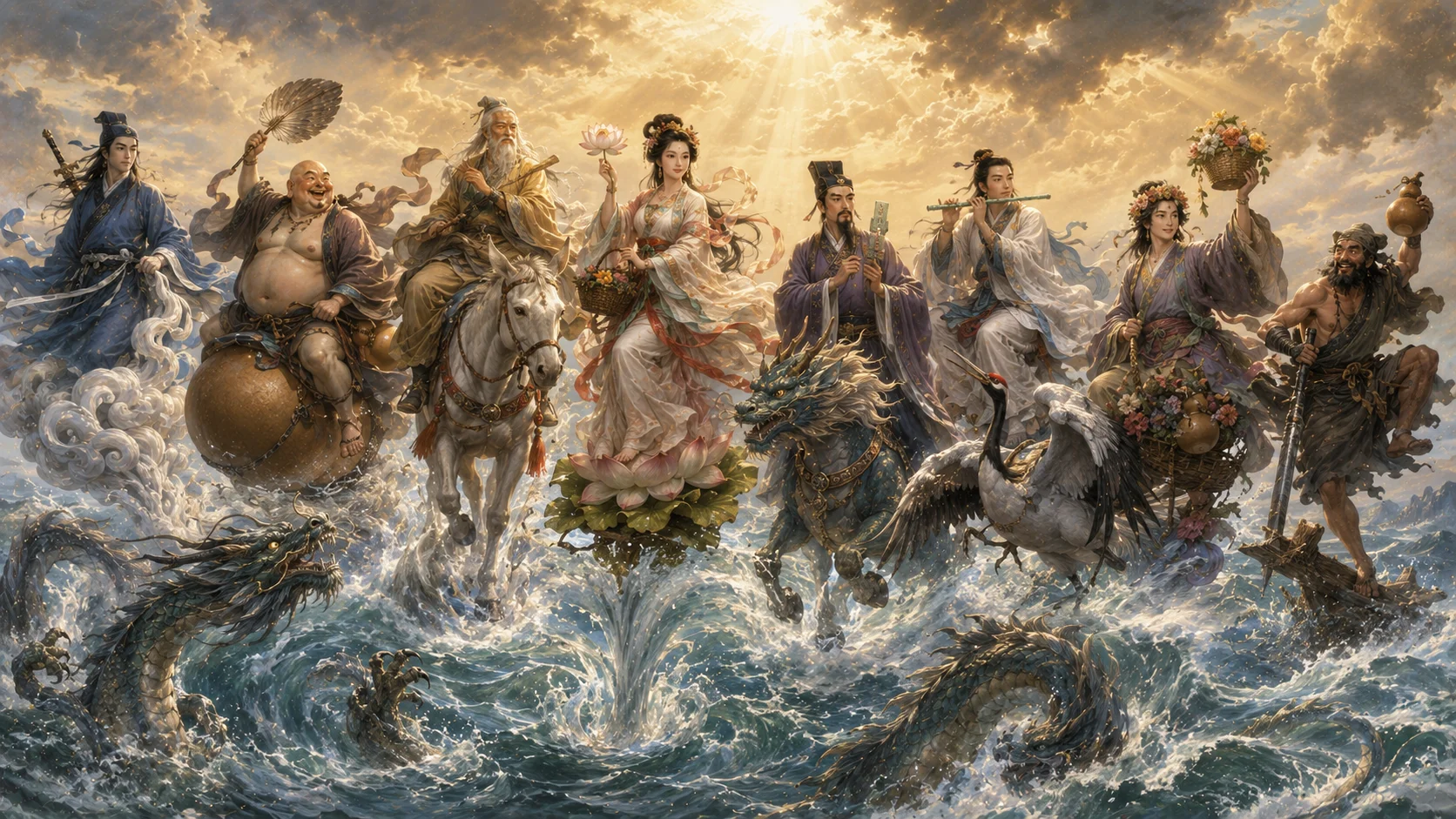
Long before porcelain painters and mural artists began filling temple walls with all eight figures together, they had already given each immortal a single object that could stand in for the whole person — an attribute so consistent across centuries of art that it functions almost as a name. Zhongli Quan carries a fan said to revive the dead or fan a fire back to life. Zhang Guolao keeps a fish drum, sometimes rendered as a hollow bamboo tube. Han Xiangzi is known by his flute. Li Tieguai never appears without his iron crutch and the gourd slung at his side. Cao Guojiu holds the jade tablet or castanets that mark his old rank at court. Lan Caihe carries a flower basket. He Xiangu is shown with a lotus in hand. And Lü Dongbin bears the sword that has become nearly synonymous with him in art. Collectors and painters call these the "Covert Eight Immortals" — the objects alone, painted without the figures who own them, understood by any viewer to summon the whole company regardless.
The Elder Who Taught a Swordsman
Tradition places Zhongli Quan first among the eight, both by age and by a kind of seniority within the group's own internal lore: later legend makes him the teacher of Lü Dongbin, giving the company something like a lineage rather than a mere assembly of equals. He is usually pictured as a stout, good-humored figure, his fan always close at hand, and tradition roots him in the Han dynasty — older by centuries than several of the companions he would eventually travel with.
The Beggar Who Wore Another Man's Body
Of all eight, Li Tieguai's origin is the strangest and the most poignant. He was, by legend, a serious practitioner of meditation whose spirit could leave his body and wander freely — until one such journey went wrong. While his spirit was away, a disciple, believing him dead, cremated the body he had left behind. Returning to find no home left to return to, his spirit had no choice but to take shelter in the only corpse available: that of a lame beggar who had just died. He rose in that stranger's broken form and never left it again, and it is this borrowed, crippled body — steadied ever after by his iron crutch — that identifies him instantly in every shrine and print where he appears. Few immortality stories in the tradition carry so plain a lesson about the difference between the self and the shape it happens to wear.
The Girl Who Chose the Lotus
He Xiangu holds the singular place among the eight as their principal, and in many tellings their only true, female immortal. The stories of how she came to it vary — in some she is a Tang-dynasty girl who eats a peach or a piece of mother-of-pearl offered by an immortal and finds herself transformed; in others her immortality is earned more slowly, through a life of unbroken filial devotion and a vegetarian discipline maintained without wavering. Whichever path the telling favors, the image that survives every version is the same: a young woman with a single lotus blossom held in her hand, serene among seven companions who are, without exception, men.
The Old Man Riding the Wrong Way
Zhang Guolao supplies the company's clearest note of comic strangeness alongside its wisdom. He is inseparable from his white mule, which he insists on riding backward — facing the road he has already traveled rather than the one ahead — and which he can fold flat like a sheet of paper and tuck away in his pocket or bag whenever he has no need of it. When the road calls for him again, a splash of water is enough to unfold the animal back into a living mule, ready to carry him on. The image of an old immortal ambling backward on a paper-thin donkey has made him, alongside He Xiangu's lotus, one of the most immediately recognizable figures in the group.
The Tablet He Would Not Put Down
Cao Guojiu's story carries a harder moral edge than most of his companions'. Tradition ties him by blood to the Song imperial house — a brother-in-law, in the usual telling, of a reigning Song emperor — and it was precisely that closeness to power that he came to renounce. Disgusted by the corruption and crimes his own family had fallen into, he turned his back on rank and comfort to pursue Daoist cultivation instead, choosing discipline over the privilege he had been born to. That he is still shown holding his old court tablet, even after walking away from everything it once represented, gives his image a quiet tension: the emblem of the world he refused has become, paradoxically, the mark by which the world still knows him.
Crossing the Sea Without a Boat
No single story carries the Eight Immortals further into popular imagination than "The Eight Immortals Cross the Sea" — Baxian Guo Hai. Faced with open water, the eight do not build or board any vessel. Each simply sets their own treasure upon the waves — the fan, the flute, the iron crutch, the lotus, the sword, and the rest — and rides it across, unaided, by whatever private power that object holds. The tale gave Chinese speech one of its most familiar idioms, ge xian shen tong, "each immortal shows their own powers" — words still reached for today whenever a group of people facing one shared problem each solve it their own way, by their own particular gift, rather than by any single agreed method. Few images from Chinese legend have traveled further into decorative art: the eight scattered across a churning sea, each alone on their own emblem, appears again and again on textiles, ceramics, and temple friezes as an emblem of good fortune and of the plain fact that talents differ and each is enough on its own.
Company Kept With the God of Longevity
Within the broader devotional world of Chinese folk religion, the Eight Immortals belong less to formal, scriptural Daoism than to its living popular practice — the faith expressed in temple murals, New Year woodblock prints, and the porcelain that filled ordinary households. They are painted and carved again and again as bringers of good fortune, long life, and protection, and are frequently shown paying homage to, or simply keeping company with, Shou Xing, the God of Longevity — an association that binds the group's individual attainments to the wider hope every household held for a long and fortunate life.
A Fellowship Still Being Told
What endures about the Eight Immortals is not any single miracle but the shape of the company itself: eight very different lives — old and young, rich and poor, whole and broken, male and one deliberate female voice among them — each finding the same road to transcendence by entirely different means, and each still recognizable centuries later by nothing more than the object they carry. The sea-crossing they are remembered for was never really about the water. It was about eight people refusing to wait for a boat that would have made them the same, when each already had, in hand, exactly what they needed to cross alone.
Sources & traditions
- EncyclopediaWikipedia — Eight Immortals
- TraditionChinese texts, oral tradition and village tellings (China)
Myths change from area to area and from time to time. This chronicle follows the most widely told versions; tellings in other villages, regions and eras may differ.