Long Wang — Lóng Wáng (龍王), the Dragon Kings — are the divine dragon-rulers of the waters: a category of Chinese water deities who govern seas, rivers, and lakes, and who command the rain, ruling from crystal palaces beneath the waves.
Lords Beneath the Waves
Long Wang are not a single figure but a whole class of gods — dragon-formed sovereigns who preside over bodies of water great and small. Popular religion standardized the tradition into the Four Dragon Kings, the Si Hai Longwang, who together govern the four seas and, by extension, the movement of rain across the earth. This scheme was popularized above all through Ming-dynasty vernacular fiction, which gave the older, looser cult of dragon-worship a bureaucratic shape ordinary worshippers could picture: a court of kings, an undersea capital, and a chain of command reaching all the way up to Heaven.
The Dragon Before the King
Long Wang worship grew out of a much older Chinese reverence for the dragon, or long, an indigenous symbol tied from antiquity to rain, weather, and the rivers that fed the fields. Long before there were "Dragon Kings" as such, there was the dragon itself — the creature invoked when the sky refused to open and the crops began to fail. Over centuries this diffuse dragon-veneration was drawn into the more organized structure of Daoist and folk religion, and the dragon was given a throne, a title, and a place in the celestial hierarchy: no longer only a natural force, but a minister of Heaven with a specific portfolio.
Ministers of the Jade Emperor
Within that hierarchy, the Long Wang are subordinate to the Jade Emperor, who sits above the entire Daoist celestial bureaucracy. Their rule over water is real, but it is not sovereign — it is delegated, and it comes with obligations. When rain is needed, the order does not originate with the Dragon Kings; it descends from the Jade Emperor's court, and the kings are expected to see it carried out, sometimes passing the instruction on to subordinate rain-officials beneath them. This is bureaucracy as cosmology: rainfall as a filed order, drought as a stalled one, and flood as an order badly executed.
When a King Answers for the Weather
The bureaucratic structure carries real consequences for the kings who serve within it. A Dragon King who errs — who releases too much rain, too little, or none at all — is answerable to the Jade Emperor and can be punished or removed from his post. This is dramatized memorably in the rain-quota episode of Journey to the West, where a Dragon King's miscalculation of a decree becomes a mortal crisis and a matter of celestial law. The image this leaves is not of a distant, untouchable sea-god but of a magistrate who can be called to account — which is precisely what made the Dragon Kings feel reachable to the farmers who prayed to them.
Four Kings, Four Seas
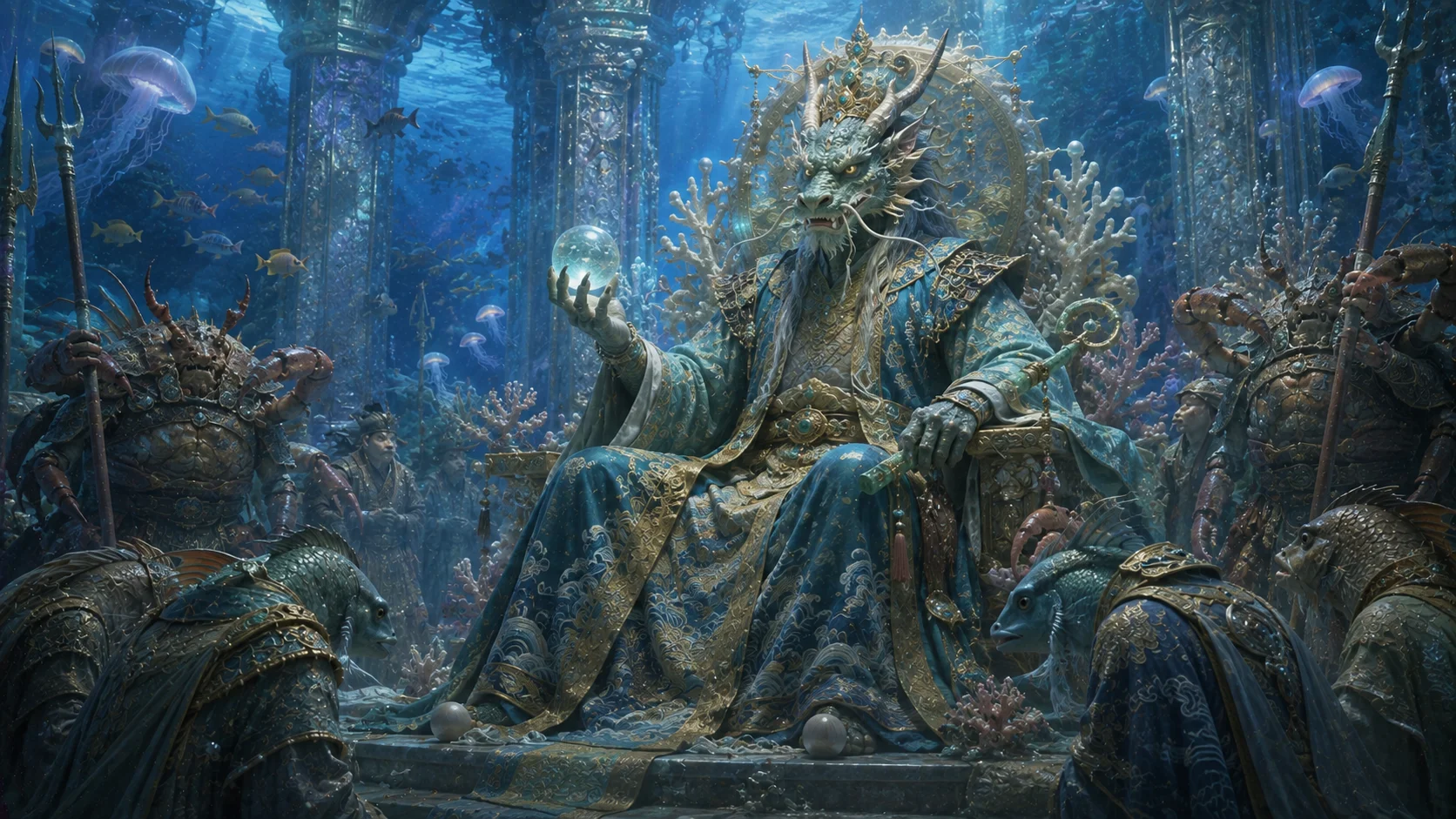
By convention, the Four Dragon Kings are Ao Guang of the East Sea, Ao Qin of the South Sea, Ao Run of the West Sea, and Ao Shun of the North Sea. Ao Guang is generally reckoned foremost among them, and it is his palace and his court that appear most often in the great vernacular novels. The four are understood as brothers, each sovereign over his own quarter of the ocean, together forming a complete map of the waters that ring the Chinese world. It is worth noting that this precise four-part scheme is most fully elaborated in fiction — above all in Journey to the West — rather than laid out in that form in the earlier canonical religious texts; the novels gave popular imagination a structure that older ritual practice had left more fluid.
The Raid on Ao Guang's Treasury
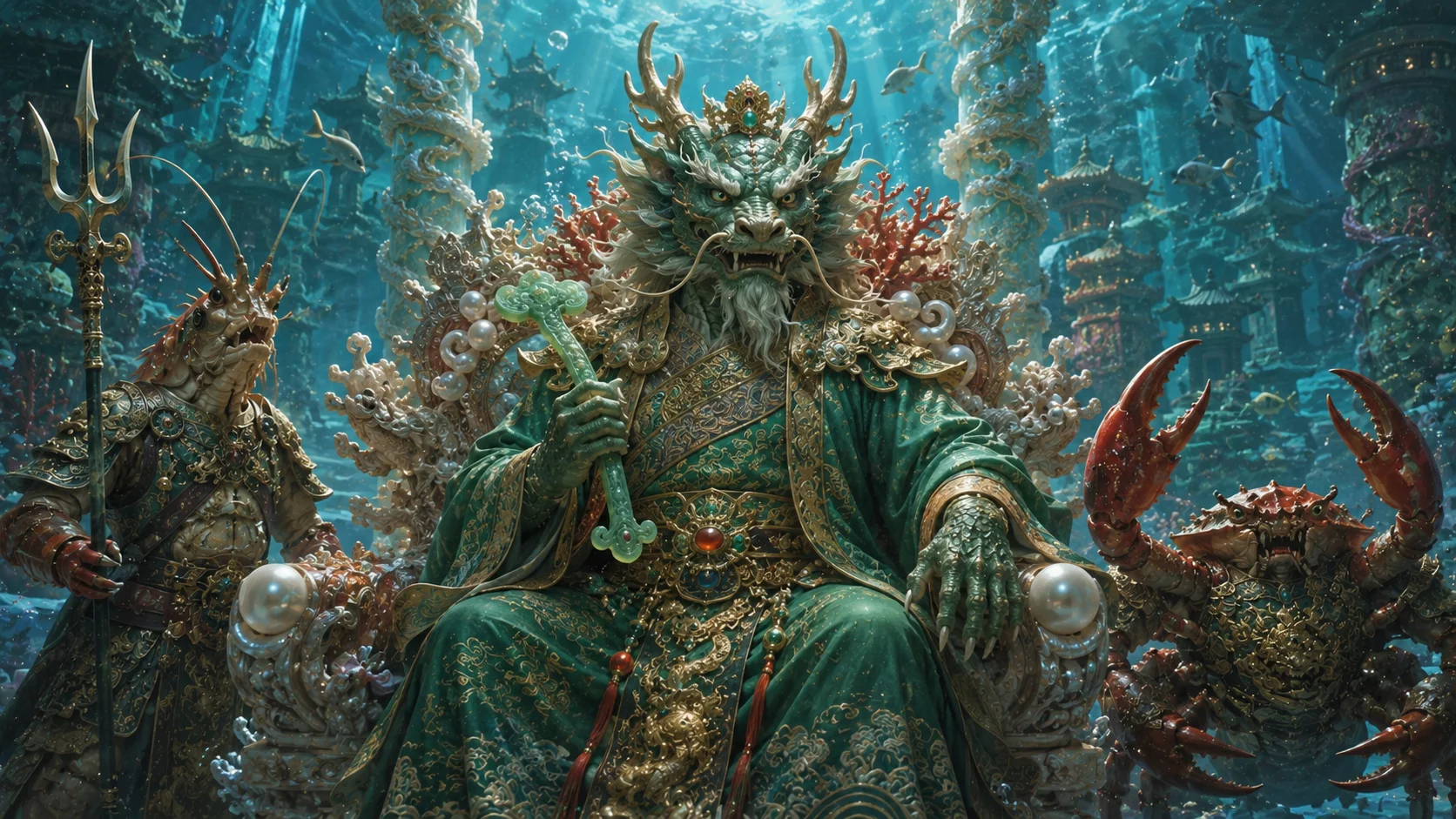
Of all the Long Wang episodes in Chinese literature, none is better known than Sun Wukong's raid on the undersea palace of Ao Guang. Journey to the West tells of the Monkey King descending into Ao Guang's crystal domain and coming away with weapons and armor from the Dragon King's own treasury — most famously the Ruyi Jingu Bang, the staff that would become Sun Wukong's signature weapon throughout the novel. The scene fixes Ao Guang's palace in the popular imagination as a vault of wonders: a longgong, a dragon-palace of crystal walls and undersea light, holding treasures no mortal hand should easily reach.
The King Who Opposed Nezha
Ao Guang appears again as a central figure in the novel Fengshen Yanyi, the Investiture of the Gods, where he stands as a major antagonist to the young hero Nezha. This confrontation between Dragon King and boy-god is one of the most celebrated episodes in the whole Long Wang literary tradition, pitting an ancient, wrathful sovereign of the sea against a headstrong young figure whose conflict with Ao Guang has echoed through Chinese storytelling and stage tradition ever since. Between the two great novels, Ao Guang emerges as the single most vividly drawn of all the Dragon Kings — foremost in rank, and foremost in the stories told about him.
A Son Transformed
The Dragon Kings' family extends beyond the four brothers themselves. In Journey to the West, the White Dragon Horse who carries the monk Tang Sanzang on his pilgrimage is revealed to be a transformed son of Ao Run, the Dragon King of the West Sea. The horse's true dragon nature, hidden beneath the horse's form for most of the journey, is a quiet reminder that the Long Wang's bloodline runs through the story's company even when it is not on obvious display — one more thread tying the undersea courts of the Dragon Kings to the mortal pilgrimage unfolding above the waves.
Absorbing the Older River Gods
The rise of Long Wang worship did not happen in an empty religious landscape. Chinese communities had long maintained cults to localized water spirits, among them the He Bo tradition — the River Earl, a god tied to a specific river rather than to the sea in general. From the Song dynasty onward, the Long Wang cult gradually absorbed and superseded many of these older, more localized water-spirit traditions, drawing them into its broader, more systematized frame. It was not a clean replacement so much as a layering: the newer, bureaucratic Dragon Kings settling over older currents of belief that had honored the rivers long before there was a Jade Emperor's court to answer to.
A God for Every River and Lake
Even after the Four Dragon Kings of the seas became the dominant popular scheme, the tradition never fully consolidated into just those four figures. Distinct regional cults persisted for individual Long Wang tied to specific rivers or lakes, each with its own local following, its own temple, and its own understanding of that particular king's temperament and history. This genuine regional variation is easy to overlook beside the tidy symmetry of "four seas, four kings," but it reflects how deeply local the actual practice of Dragon King worship remained — a farmer's nearest Long Wang temple was as likely to honor the god of a nearby lake as one of the four great sovereigns of the ocean.
Praying Against the Drought
The devotional heart of the Long Wang cult was agrarian and urgent. Chinese farming communities depended on rainfall arriving on something like a predictable schedule, and when it failed to come, Long Wang temples became the focus of communal appeal. Long Wang temples were common fixtures in agrarian villages precisely because the god's domain — rain, rivers, weather in general — was the single variable most capable of making or breaking a harvest. To pray to the Dragon King during drought was not a peripheral devotional act but one of the most consequential a farming community could undertake, a direct appeal to the deity understood to hold the sky's mercy in his hands.
Water's Two Faces
What gives the Long Wang tradition its lasting symbolic depth is the way it holds together water's contradictions in a single figure. The same rain that Long Wang sends to save a drought-stricken field is, in excess, the flood that destroys it; the same seas his kings rule as calm, orderly domains are also the seas of storm and shipwreck. Long Wang mediates the entire, unstable relationship between agrarian human society and the power of water — a power that gives life and takes it away by the same hand, and that no purely benevolent or purely fearsome god could adequately represent alone.
Crystal Halls and Scaled Crowns
In art and popular imagination, the Dragon Kings are rendered as anthropomorphic figures — robed kings enthroned in majesty — yet marked as more than human by dragon features worked into their bodies: scaled skin, horns, a bearing that recalls the creature beneath the crown. They hold court in undersea palaces of crystal, the longgong, vast halls of light refracted through water where a king's audience chamber might be found fathoms beneath the waves a fisherman sails over. It is an iconography built to hold both halves of the god at once — sovereign and serpent, minister and dragon — never letting the viewer forget that beneath the royal robes is the ancient, elemental force the whole cult first arose to honor.
Sources & traditions
- EncyclopediaWikipedia — Dragon King
- TraditionChinese texts, oral tradition and village tellings (China)
Myths change from area to area and from time to time. This chronicle follows the most widely told versions; tellings in other villages, regions and eras may differ.