Mazu is one of the most widely venerated deities of Chinese popular religion — a goddess of the sea, protector of fishermen and sailors, and, unusually among China's great deities, a figure whose worship can be traced back to a specific, semi-historical woman rather than to myth alone. Across Fujian, Taiwan, Macau, Hong Kong, and Chinese communities scattered along the world's trade routes, she is invoked wherever people put out onto open water.
A Daughter of Meizhou Island
Devotional tradition and local gazetteers place Mazu's origin in a real time and a real place: Meizhou Island, off the coast of Putian in Fujian province, during the Song dynasty, traditionally dated to 960 CE. There she was born Lin Moniang — Lin Mo — into a family whose life, like that of everyone on the island, was bound to the sea. Few of China's major deities carry this kind of documented human anchor. Where other gods emerge fully formed from cosmology or scripture, Mazu begins as a girl in a fishing village, and the temple steles and local records that preserve her story treat her, at least at the outset, as a person who once breathed the same salt air as her worshippers.
The Vision That Could Not Be Reached in Time
The story most often told of her mortal life concerns a storm. Her father and brothers were out at sea when the weather turned violent, and Lin Moniang, at home, fell into what devotional accounts describe as a trance or a deep sleep. In that state she reached toward them — spiritually, not physically — and worked to hold them safe against the waves. The tradition varies in its particulars from one regional telling to another, but the shape of the story is constant: a young woman's spirit doing at a distance what no ordinary hand could do at sea, and her family surviving a storm that might easily have drowned them.
A Life Cut Short, Ascending From the Water She Watched Over
Lin Moniang did not live to old age. Devotional chronology gives her twenty-seven years, unmarried, and holds that her death was not an ending in the ordinary sense but a departure — that she ascended to heaven from Meizhou itself, the same island that had raised her. It is this detail, as much as the storm-rescue, that transformed a locally admired young woman into a goddess: someone who died young, without a family of her own, and who was said to leave the world from the very shoreline where her legend began. Scholars of Chinese popular religion are careful to note that such hagiographic specifics — dates, the exact nature of the ascension — differ across regional gazetteers and temple traditions, and are best understood as devotional memory rather than uniform doctrine.
Two Spirits Bound Into Her Service
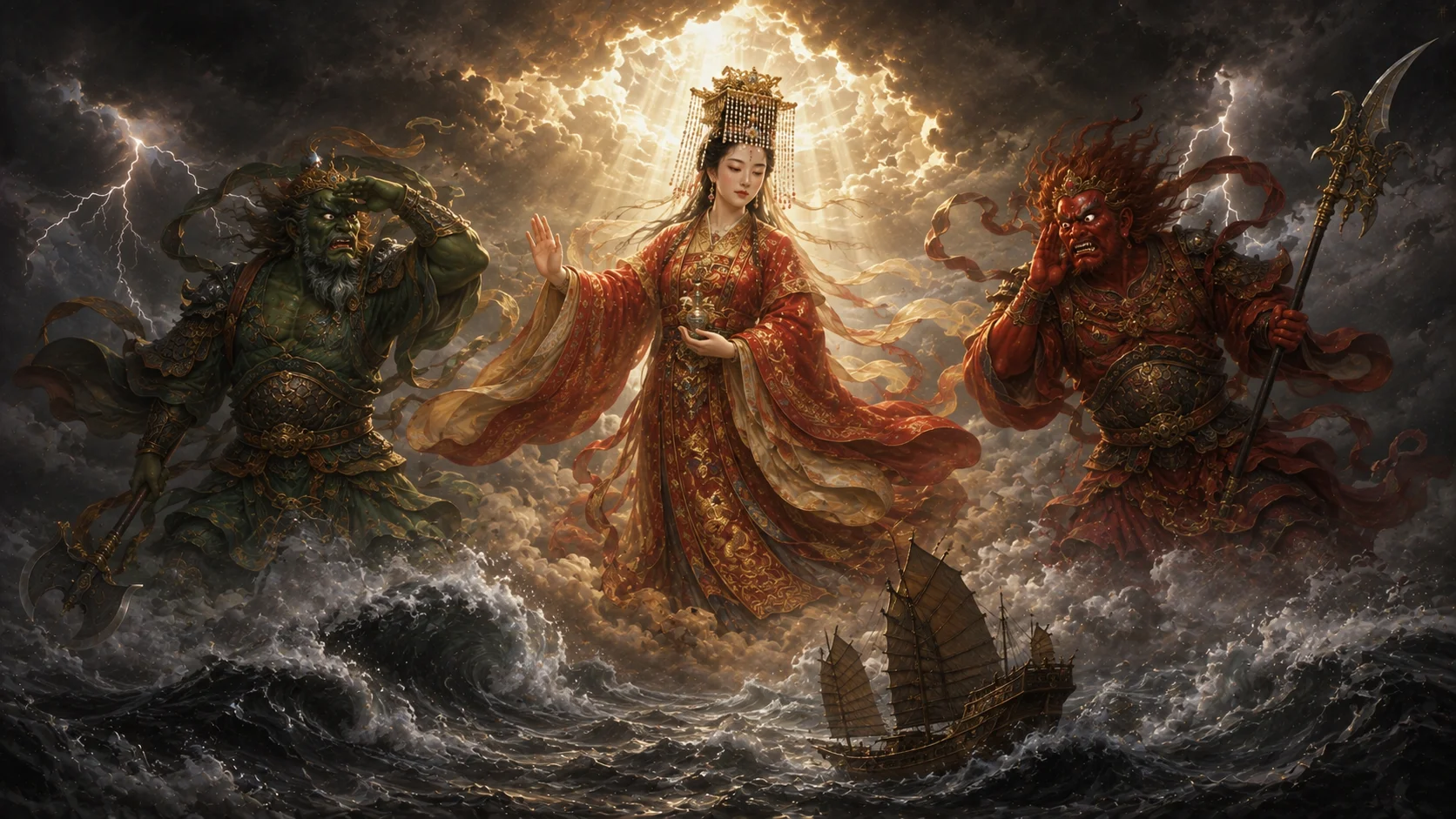
Mazu's temple iconography almost always includes two flanking guardian figures: Qianliyan, "Thousand-Mile Eyes," and Shunfeng'er, "Ears that Hear the Wind." Tradition holds that these were once demon-generals, formidable and dangerous in their own right, until Mazu subdued them and bound them to her service rather than destroying them. Having been defeated, they became her instruments instead of her enemies — one seeing across vast distances, the other hearing on the wind — so that together they extend her watch over the sea far beyond what any single pair of eyes or ears could cover. Their presence at her altars is a visual reminder that her protection is not passive: it reaches outward, actively scanning the water for the ships and sailors under her care.
From Local Cult to Register of the State
What makes Mazu's history distinctive is how visibly the imperial state built her into an instrument of policy. Successive dynasties did not merely tolerate her worship — they formally elevated it. Under the Song she was titled Furen, "Lady." The Yuan raised her to Fei, "Consort" or "Princess." By the Qing she had been elevated further still, to Tianhou, "Empress of Heaven," and she is also known honorifically as Tianshang Shengmu, the "Holy Mother in Heaven," alongside the affectionate colloquial name by which most people know her: Mazu, "grandmother" or "ancestral mother." Each of these titles was entered into official state sacrificial registers, meaning the imperial court did not simply permit her cult but actively sponsored it.
Securing the Loyalty of the Coast
This was not devotion for its own sake on the part of the court. Coastal and maritime populations were essential to trade, tax revenue, and naval power, and a goddess already beloved by fishermen and sailors was a natural vehicle for binding those communities to the throne. By granting Mazu ever-higher titles, emperors legitimized sea-based commerce and naval activity in terms the coastal population already believed in — and in return, her cult gained the weight and reach of imperial endorsement. The pairing of local devotion with state sanction is part of why her worship spread as widely and as durably as it did.
Invoked at the Prow of Empire
Nowhere is that fusion of faith and statecraft clearer than in the great Ming-dynasty maritime expeditions of Zheng He, whose fleets are said to have invoked Mazu's protection as they sailed into open and unfamiliar water. A goddess whose founding legend was a rescue from a storm was the obvious protector to call upon before a fleet committed itself to months at sea, and her invocation on voyages of state placed her, however quietly, at the center of some of the most ambitious maritime undertakings in Chinese history.
The Ancestral Flame of Meizhou
Every daughter temple to Mazu, wherever it now stands, traces its incense back to one place: the Meizhou Ancestral Temple, the Meizhou Mazu Miao, on the island of her birth. Worship in Chinese popular religion is often propagated through a practice called fenxiang, the "division of incense," in which a new temple's censer is ritually lit from an existing one, carrying forward a living connection to the source. From Meizhou, this incense was divided outward across Fujian, then across the strait to Taiwan, and further still to overseas Chinese communities wherever trade and migration carried them. The ancestral temple remains the symbolic root from which the entire, vast network of Mazu worship still draws its identity.
Nine Days on the Roads of Taiwan
Taiwan today stands as one of the great living centers of Mazu devotion, and nowhere is that more visible than in the Dajia Mazu pilgrimage, based in Taichung and ranked among the largest annual religious processions on the island. For roughly nine days, an image of the goddess is carried in procession along a route that draws enormous crowds of devotees, some walking the entire distance as an act of faith and endurance. The pilgrimage is not a solemn, static ceremony but a moving, days-long event that pulls entire communities along its path — a modern expression of the same devotion once carried by fishing families on Meizhou Island a millennium earlier.
Beside the Bodhisattva of Compassion
In many temple complexes, Mazu is worshipped alongside Guanyin, the Bodhisattva of Compassion, and the two are sometimes approached by the same devotees within the same halls. It is worth being precise about what this means and does not mean: Mazu is not a Buddhist figure. She is a deified human being, a local deity risen from a specific ancestry and a specific island, while Guanyin belongs to Buddhist doctrine as a bodhisattva. Their frequent proximity in temple architecture reflects the syncretic, layered character of Chinese popular religion, which readily houses distinct traditions under one roof — but it does not collapse the two figures into one another. Mazu's identity remains rooted in her human origin and her maritime domain, doctrinally separate from Guanyin's Buddhist nature even where their altars share the same building.
The Twenty-Third Day of the Third Month
Mazu's birthday, traditionally observed on the twenty-third day of the third lunar month, is the calendar's great occasion for her worship. Temples across Fujian, Taiwan, Macau, Hong Kong, and the Chinese diaspora of Southeast Asia mark the day with festivals, processions, and pilgrimages, the Dajia procession among them. The date functions as a kind of tide that draws communities together each year, renewing the same devotion that has moved along these coasts and across these waters for centuries — a reminder that her cult is not a historical relic but an ongoing, actively practiced tradition.
Recognized Before the World
In 2009, "Mazu belief and customs" were formally inscribed on UNESCO's Representative List of the Intangible Cultural Heritage of Humanity. The recognition acknowledged what her worshippers had long known by practice: that the beliefs, rituals, and communal customs surrounding Mazu constitute a living cultural heritage of global significance, not confined to any one nation but carried by Chinese maritime communities wherever they settled. It is a rare honor for a tradition that began with one girl on one island, and it marks the distance her cult has traveled — from a local rescue story on the Fujian coast to a heritage recognized as belonging to humanity as a whole.
A Grandmother Watching Over Every Departing Boat
What endures across all of this — the imperial titles, the vast pilgrimage crowds, the UNESCO listing — is the intimacy of the original story. Mazu is called, above every grand title, simply "grandmother": a term of family warmth rather than distant majesty. For the fishing and trading communities who built her cult from Meizhou outward across the world, she is not a remote cosmic power but a protector whose watch feels personal, extended through Qianliyan's far sight and Shunfeng'er's far hearing to every boat that leaves harbor. That a goddess of empire-scale devotion is still addressed with the language of family is, perhaps, the truest measure of how completely Lin Moniang's story became everyone's story.
Sources & traditions
- EncyclopediaWikipedia — Mazu
- TraditionChinese texts, oral tradition and village tellings (China)
Myths change from area to area and from time to time. This chronicle follows the most widely told versions; tellings in other villages, regions and eras may differ.