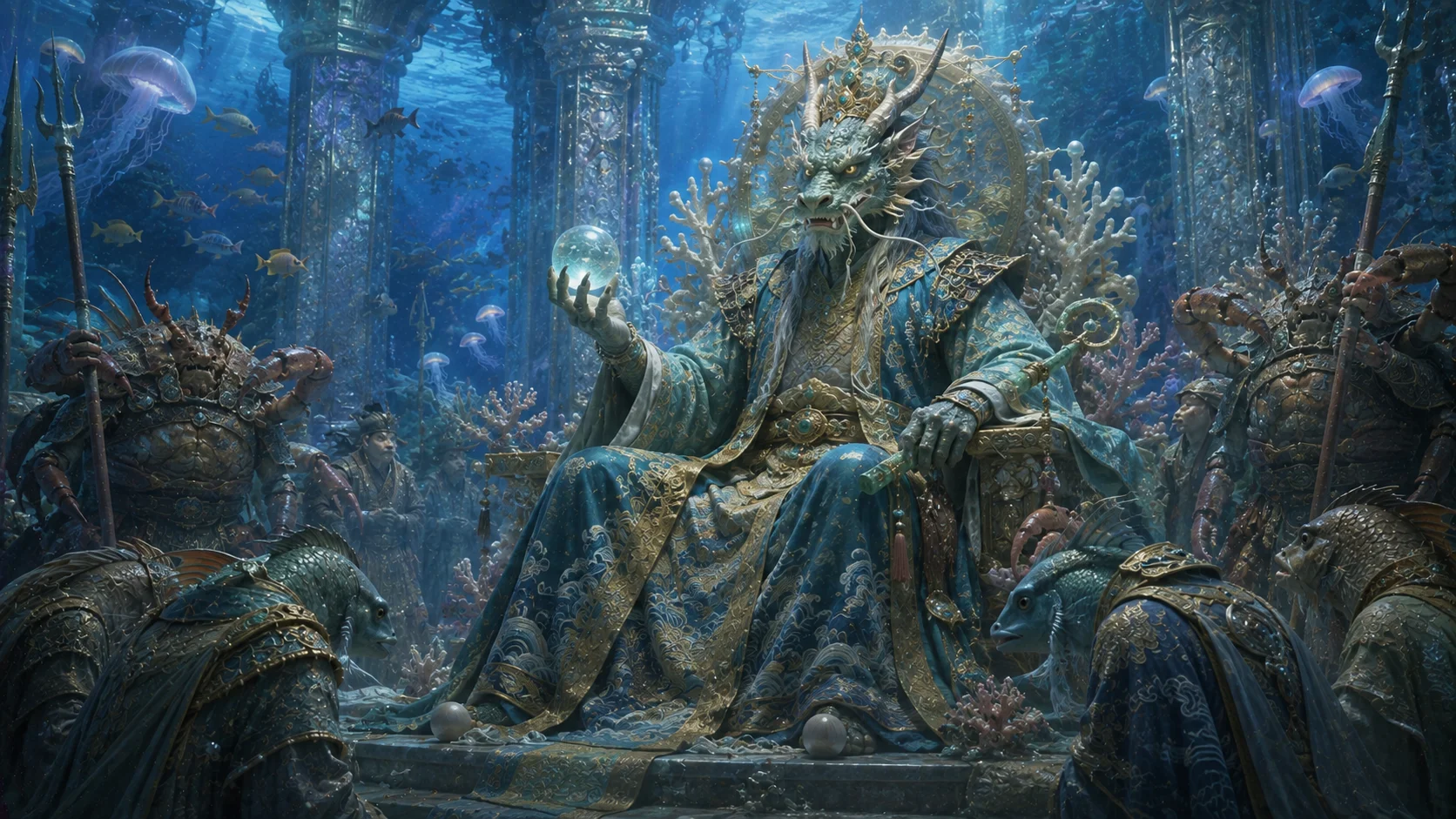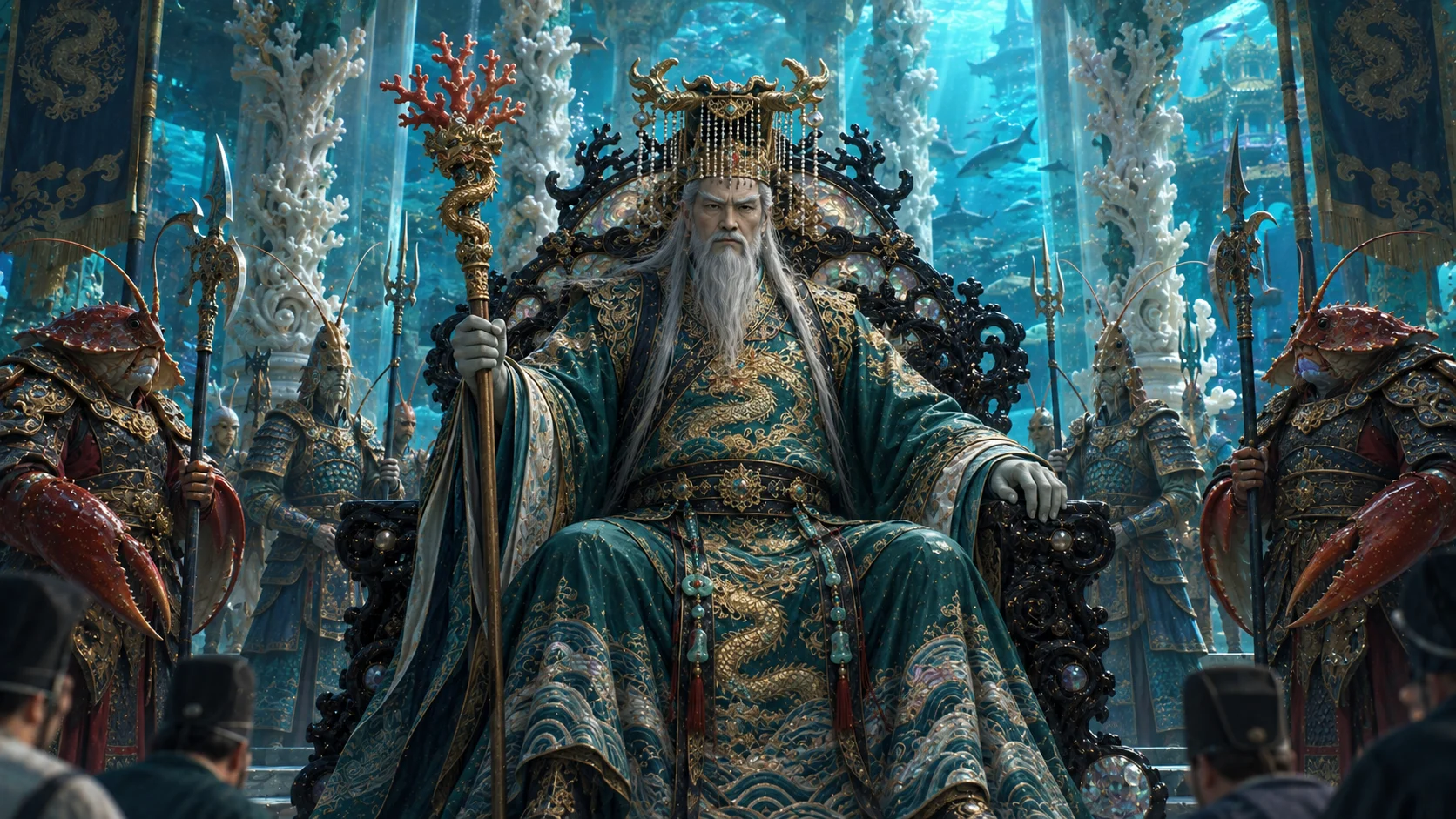
Ao Guang (敖廣, also rendered Ao Kuang) is the Dragon King of the East Sea, the foremost of the Four Dragon Kings of Chinese popular religion and the most vividly drawn of the four in vernacular fiction. Where his brothers who govern the southern, western, and northern waters remain comparatively shadowy figures in the great Ming-dynasty novels, Ao Guang is given a face, a temper, and a story — twice over, in two of the most widely loved works in the tradition.
The Sovereign of the Eastern Deep
Among the Si Hai Longwang, the Dragon Kings of the Four Seas, Ao Guang holds dominion over the Eastern Sea and everything within it — its currents, its creatures, and above all its treasures, the countless magical weapons and relics that vernacular storytellers imagined resting on the ocean floor. He answers, as every dragon king does, to the Jade Emperor's celestial bureaucracy, a sea-lord who is nonetheless a subject, a monarch who still must petition a higher throne when wronged. That double status — absolute at home, subordinate above — shapes both of the stories for which he is remembered.
The Crystal Palace Beneath the Waves
Ao Guang's court is the Donghai Longgong, the East Sea Dragon Palace, imagined in the storytelling tradition as a fortress of crystal and coral sunk beneath the waves, its halls lit by luminous pearls, its armories stacked with weapons no mortal smith could forge. It is a place of wonder and of hoarded power at once — the kind of treasury a hero might be tempted to raid, and in the most famous episode of all, one is.
The Pillar That Measured the Sea
Long before it became a weapon, the object at the heart of that episode had a humbler and more monumental history: an iron pillar used by Yu the Great, the legendary tamer of the floods, to measure and fix the depth of the sea. Having served its purpose, it came to rest in the treasury of the East Sea Dragon Palace, an artifact of cosmic engineering rather than war — until Ao Guang's undersea order was disturbed by an uninvited visitor with an appetite for exactly this sort of thing.
A Reluctant Gift to an Uninvited Guest
In the story cycle later gathered into Journey to the West, Sun Wukong descends to Ao Guang's palace and demands a weapon worthy of him. Ao Guang, playing the gracious host under obvious duress, offers up one impressive arm after another — halberds, tridents, blades of every description — and each proves too light for the Monkey King's strength, tossed aside or shattered. Only after every other weapon in the treasury has failed him does Ao Guang finally give up the old measuring-pillar from Yu the Great's flood-taming days: the Ruyi Jingu Bang, the As-You-Will Golden-Banded Staff, which shrinks or grows at its wielder's whim. Ao Guang parts with it not out of generosity but because he has run out of alternatives — a dragon king out-argued and out-lasted in his own treasure room.
Armor, Cap, and Boots Given Under Duress
The indignity does not end with the staff. Once armed, Sun Wukong presses further, and Ao Guang — after Sun Wukong's threats of force make plain that refusal carries a cost — sends word to his brother kings. It is at their urging, and to keep the peace among all four seas rather than out of any warmth toward their guest, that Ao Guang outfits him further: a suit of golden armor, a phoenix-feather cap, and a pair of cloud-walking boots, so that the intruder who arrived demanding a stick leaves resembling a small, ill-gotten god. The episode fixes Ao Guang's character in the tradition as a somewhat put-upon figure — proud, wealthy, and entirely unable to stand his ground against a force he cannot match, generous only because generosity has become the cheaper option.
The Brotherhood of the Four Seas
Ao Guang is not a solitary monarch but one of four royal brothers who divide the world's oceans between them: Ao Guang of the East, Ao Qin of the South, Ao Run of the West, and Ao Shun of the North. Together they form a single ruling house of the waters, bound by kinship and by shared subordination to the Jade Emperor above. The East Sea episode with Sun Wukong shows this brotherhood functioning as a kind of council — Ao Guang does not act alone even in his own palace, and it is the collective weight of his brothers' counsel, not his own authority, that finally resolves the standoff.
A Son's Cruelty and a Father's Fury
Ao Guang's second great appearance, in the Fengshen Yanyi — the Investiture of the Gods — casts him in a far darker role: the primary antagonist of the boy-hero Nezha. The conflict begins with Ao Guang's own son, often named Ao Bing, who terrorizes a coastal town under his father's dominion. When Nezha, still a child himself but already touched by extraordinary power, kills Ao Bing in the course of defending the townspeople, the personal becomes political. A dragon king's grief for a dead son and a ruler's fury at a slain heir arrive in the same moment, and Ao Guang's response is total: he holds the human town, Nezha's family, and ultimately Heaven itself responsible for what one impulsive boy has done to his line.
The Dragon King's Petition to Heaven
True to the double nature of his office — sovereign below, subject above — Ao Guang does not simply take revenge with his own hands. He carries his grievance upward, bringing the matter before the Jade Emperor and demanding justice, and threatening Nezha's parents with the full weight of his authority as one of the Four Dragon Kings if satisfaction is not given. It is a court case as much as a vendetta, waged through petition and threat rather than open war, and it places Nezha's family — and eventually Nezha alone — under a pressure they cannot simply fight their way out of.
The Price of Nezha's Mercy
The resolution is one of the most pivotal and best-loved episodes in all of Chinese popular religion and opera: to spare his parents from Ao Guang's wrath and the ruin the Dragon King threatens to bring down on them, Nezha performs an act of total self-sacrifice, returning his flesh and bones to the parents who gave them to him, severing the debt of birth entirely so that his family owes the dragon king nothing further. Ao Guang's demand for justice, in other words, does not simply end a conflict — it drives one of the tradition's most searing images of filial devotion and renunciation, an outcome that later opera and shadow-puppet retellings return to again and again. Ao Guang himself remains, in this telling, an aggrieved father whose legitimate loss sets in motion a sacrifice far more permanent than the one he suffered.
Marriages, Alliances, and Regional Variance
Beyond these two central narratives, regional folk and opera traditions have woven Ao Guang into further entanglements — marriage alliances binding his family to other dragon-king houses, plots of kinship and obligation that vary considerably from one retelling to the next. These details are not fixed canon; they shift by region and by performer, part of the living, still-evolving fabric of oral and theatrical retelling rather than a single settled genealogy. What stays constant across every version is Ao Guang's rank and role — East Sea sovereign, proud father, reluctant host — even as the surrounding family ties remain fluid.
The Character Beneath the Crown
Taken together, the two defining episodes give Ao Guang a consistent symbolic charge: he embodies the volatile, easily-offended power of the sea, a force of nature translated into royal temperament. He is proud of his domain and his treasures, quick to feel injury, and quick to escalate — whether the injury is the loss of a legendary staff or the death of a son — yet in both cases he is ultimately answerable to something above him, whether the physical superiority of a monkey he cannot defeat or the celestial court he must petition rather than simply avenge himself upon. Across the Ming-dynasty vernacular novels in which he appears, Ao Guang functions as the recurring obstacle whose hoarded treasures or wounded family become the very thing the human or semi-divine hero must pass through — a stock Dragon King antagonist, but one rendered with enough particularity, enough wounded dignity, to feel like more than a type.
A Name That Outlasted Its Rivals
Of the Four Dragon Kings, Ao Guang's name and his East Sea title have proven the most durable across both regional temple worship and the long afterlife of vernacular fiction in translation — more consistently invoked than Ao Qin, Ao Run, or Ao Shun, even as minor variant spellings such as Ao Kuang persist across different renderings of his name. It is a fitting kind of permanence for a figure whose stories are, in the end, about the friction between draconic pride and the human or heroic claims that keep breaching it: the sea-lord remembered less for the treasure he kept than for what was taken from him, and less for the vengeance he sought than for what it cost the family that had to answer him.
Sources & traditions
- EncyclopediaWikipedia — Ao Guang
- TraditionChinese texts, oral tradition and village tellings (China)
Myths change from area to area and from time to time. This chronicle follows the most widely told versions; tellings in other villages, regions and eras may differ.