Nezha is one of the most vivid figures in Chinese mythology: a child born already able to walk and speak, a slayer of a dragon king's son, a boy who returned his own flesh and bones to his parents to shield them from divine retribution, and a god reborn from lotus root and lotus flowers to fight again. His story, preserved above all in the Ming-dynasty novel Investiture of the Gods (Fengshen Yanyi) and in Journey to the West (Xiyou Ji), fuses Daoist folk elaboration with currents that trace, through a long chain of transmission and transliteration, back toward Indian Buddhist material. Today he remains one of the most widely loved protective deities of Taiwan and southern China, worshipped as a youthful "Third Prince" watched over by mediums, martial processions, and temple drums.
A Ball of Flesh Given Breath
Nezha's birth is itself the first sign of his exceptional nature. He is the third son of Li Jing — a military commander later deified as the Pagoda-Bearing Heavenly King, Tuota Tianwang — and his wife, Lady Yin. In the account preserved in Investiture of the Gods, Lady Yin does not deliver an ordinary infant but a ball of flesh, round and unbroken. When it is finally opened, a boy steps out already able to walk and talk, marked from his first breath as something more than human. Nothing about his arrival follows the expected order of things, and that departure from the ordinary becomes the pattern for everything that follows in his life: Nezha is a figure who is never quite contained by the roles — son, disciple, subject of Heaven — that are built to hold him.
Waters Disturbed Beneath the Waves
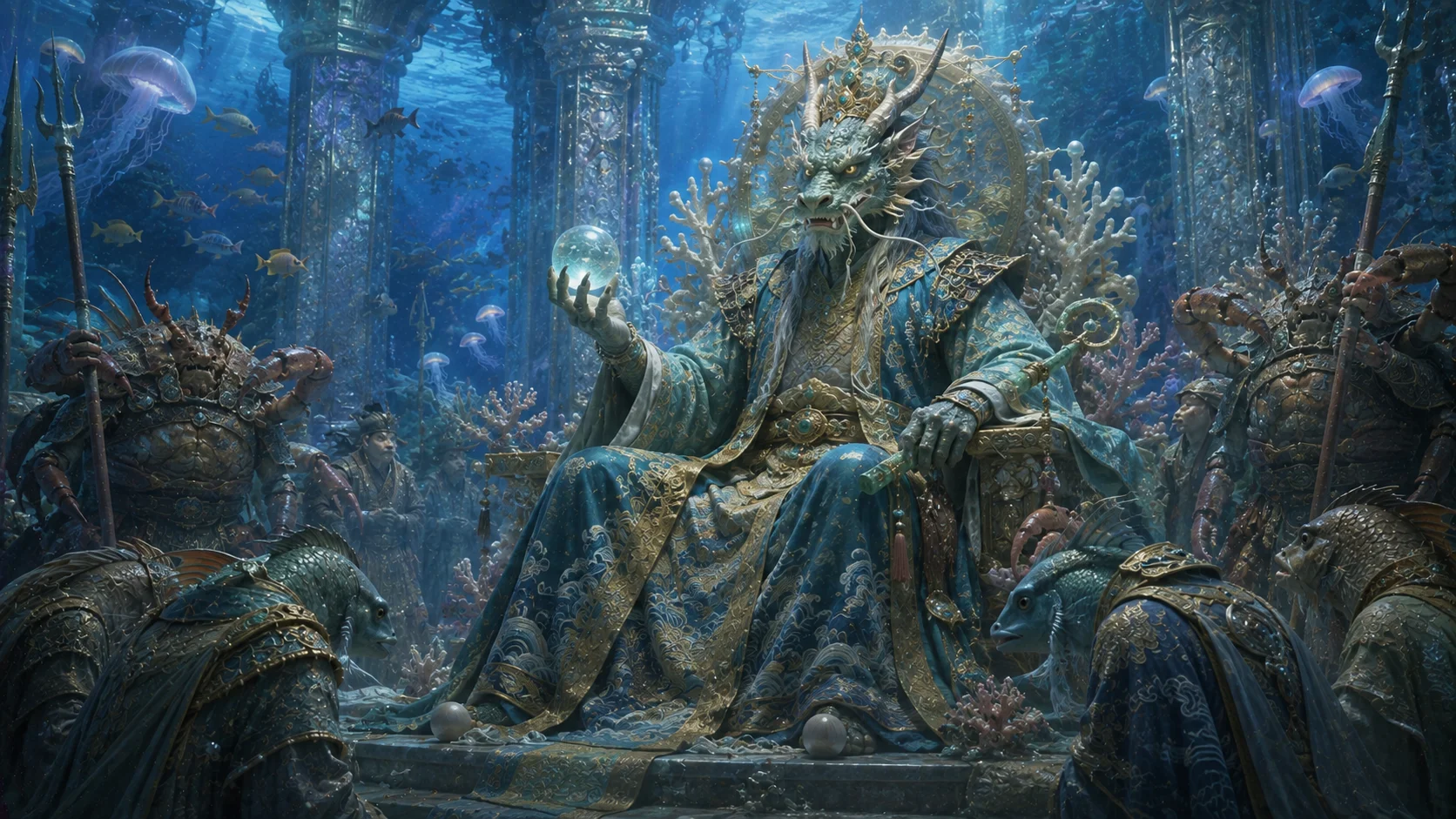
The episode that first reveals Nezha's danger to the world above and below the water begins with something almost innocent: a child cooling himself in the sea. Using his magic sash to bathe, young Nezha unwittingly disturbs the underwater palace of the Dragon King Ao Guang, ruler of a domain that was never meant to register a mortal child's presence at all. What follows escalates quickly and irreversibly. Nezha kills the dragon king's son — named Ao Bing in some tellings — and in some versions goes further still, skinning the dragon prince or drawing out his sinews. It is an act of overwhelming, almost thoughtless power for a child, and it provokes exactly the response such power invites: the wrath of the Dragon Kings descends not on Nezha alone but on his entire family and village, who had no part in what happened beneath the waves.
The Gift of Flesh and Bone
Confronted with the prospect that his parents and his village will bear the cost of a violence he alone committed, Nezha makes the defining choice of his story. Rather than let the Dragon Kings' retaliation fall on those he loves, he takes his own life — in some versions cutting his own flesh from his bones with his own hand, returning his body, piece by piece, to the parents who gave it to him. It is an act framed as both filial and terrible: a son unmaking himself to settle a debt his family did not incur, choosing self-destruction over the destruction of others. Few episodes in Chinese religious literature stage the weight of filial obligation as starkly as this one, and it is this scene, more than any battle he later wins, that gives Nezha's story its emotional gravity.
Lotus Root, Lotus Flower, a Body Renewed
Death is not the end of Nezha's story but its turning point. His master, the Daoist immortal Taiyi Zhenren, intervenes to restore him to life, reconstituting a body for him out of lotus root and lotus flowers. The image is deliberately unlike ordinary rebirth — no return to the womb, no gradual growth, but a body built fresh from stem and petal, as though innocence and vitality could be assembled anew rather than simply preserved. This lotus-rebirth motif is one of the most distinctive and recognizable elements of Nezha's mythology, and it cements him as a figure defined not by a single life but by transformation: destroyed once by his own hand, given back to the world in a form no less real for having been remade.
A Son Turned Against His Father
Restoration does not bring peace. After his resurrection, tension resurfaces between Nezha and his father, Li Jing — bound up, in the tradition, with Li Jing's earlier destruction of a temple that had been built in Nezha's honor, and with lingering anger from the dragon episode that had endangered the whole family. The conflict grows severe enough that Nezha pursues his own father in anger, a reversal of the filial devotion that had led him to sacrifice himself only shortly before. The story does not resolve this on its own terms; it takes the intervention of a master or deity outside the family to settle it. Randeng Daoren — the "Burning Lamp" figure connected to the Buddhist Dipankara — steps in and gives Li Jing a pagoda imbued with power over his son, a symbolic instrument that pacifies Nezha and stabilizes the relationship between them. It is from this episode that Li Jing draws his enduring epithet, the Pagoda-Bearing Heavenly King, the pagoda itself standing forever after as the visible sign of a father's authority restored not by strength but by a borrowed, sacred object.
Wind-Fire Wheels and a Sash of Flame
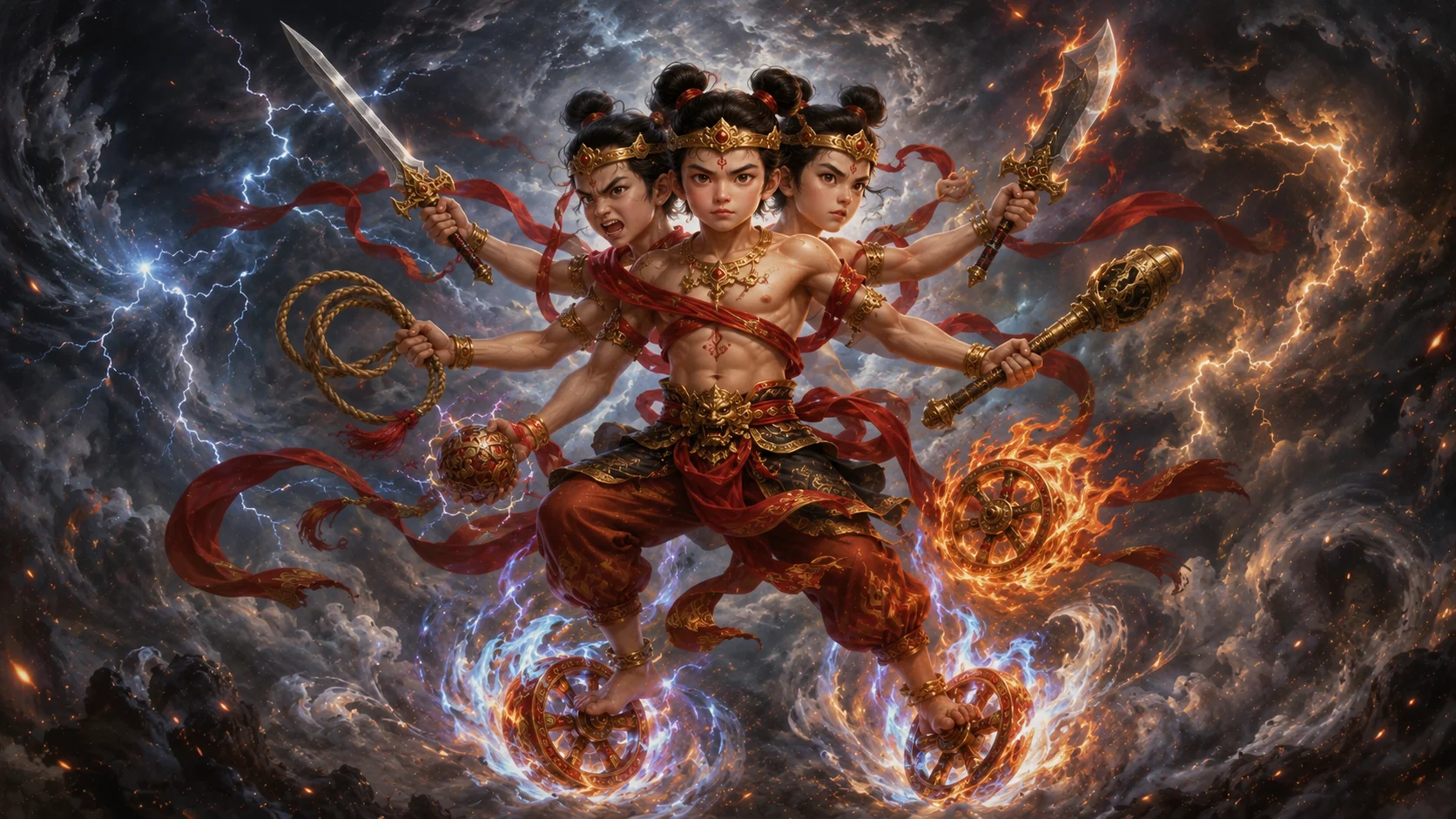
Nezha's iconography is as distinctive as his story, built around a recognizable set of magical implements that mark him instantly in temple statuary and popular art. He wields the Fire-tipped Spear, a weapon suited to a warrior whose power always runs hot and fast. He travels standing upon the Wind-Fire Wheels, which grant him flight and lend him the sense of a figure who is never quite earthbound, always in motion. He carries the Universe Ring, capable of both defense and devastating attack, and the Red Armillary Sash, the Hun Tian Ling — the very sash he wore bathing in the sea when his story first turned toward tragedy. Together these objects form a standardized, easily identified set that separates Nezha from other martial deities in the wider Chinese pantheon.
Three Heads, Many Arms, a Child's Face
In his fullest battle form, Nezha is depicted with three heads and as many as eight or six arms, a transformation that turns a youthful, sometimes child-like deity into something overwhelming and transgressive to look at. The contrast is deliberate: the same figure who can appear as an ordinary boy carries, latent within him, a capacity for power that exceeds normal human or even divine proportions. This tension between childlike appearance and immense capability runs through the entirety of his mythology — he is never simply young, and never simply powerful, but both at once, in a combination that unsettled dragon kings and heavenly officials alike.
A Disciple in the War of Investiture
Within Investiture of the Gods, Nezha's personal drama is folded into a much larger conflict: the war between King Wu of Zhou and the collapsing Shang dynasty. As a disciple of Taiyi Zhenren, who belongs to the Chan, or Immortal, sect, Nezha fights on the side of the Zhou cause, lending his rebirth-hardened power to a struggle that reshapes the whole mythic order of Heaven and earth. When the Zhou forces prevail, Nezha is canonized among the gods, his place in the celestial hierarchy formalized as a reward for service in a war that decided far more than any single battle beneath the sea ever had.
A General Sent Against the Monkey King
Nezha's second great literary appearance, in Journey to the West, shows him in a very different posture: not a rebellious child but a heavenly general, a marshal serving under the Jade Emperor and under his own father, Li Jing, now himself a Heavenly King. In this role Nezha is dispatched to subdue Sun Wukong, the Monkey King, during his rebellion against the order of Heaven — a mission that, notably, does not succeed. The failure is telling in its own way: even a deity of Nezha's proven ferocity is not enough to contain the chaos Sun Wukong unleashes, and the episode places Nezha within a much larger cast of heavenly officials whose authority Sun Wukong's rebellion calls into question.
The Third Prince of Living Devotion
Beyond the two great novels, Nezha occupies a vivid place in living religious practice, especially in Taiwan and southern China, where he is widely worshipped as a protective child-god. Popularly called San Taizi, the "Third Prince" — a title that reflects his position as Li Jing's third son — he is closely associated with youth, with boisterous martial temple processions that carry his image through the streets, and with spirit-medium, or jitong, practice, in which devotees understand him to descend and speak or act through a chosen vessel. Few deities in the tradition combine literary grandeur with this kind of immediate, embodied devotion so completely: Nezha is at once a character read on the page and a presence felt at the temple gate.
Brothers, Master, and the Family of the Story
Nezha's mythology is populated by a network of relationships that give texture to his arc. His brothers, Jinzha and Muzha, serve alongside him under their father Li Jing, situating Nezha's rebellion and reconciliation within a household of martial sons rather than as an isolated drama. His master, Taiyi Zhenren, is the constant guiding presence behind his transformations, first as teacher and then as the one who restores him from death. The Dragon Kings, led by Ao Guang, stand as the antagonists whose grievance sets his family's crisis in motion, while Randeng Daoren appears as the reconciling outside authority whose pagoda finally settles the rupture between father and son. Each figure anchors a different phase of Nezha's story, from childhood transgression through death to restored, if uneasy, order.
Rebellion, Sacrifice, and a Body Made New
What endures across every retelling of Nezha's mythology is a cluster of themes that later opera, folk performance, and modern storytelling have returned to again and again: the conflict between a father's authority and a son's untamed power, resolved only through outside intervention and symbolic submission; the transgressive strength of youth, disciplined but never fully erased by a Daoist master's guidance; and, above all, self-sacrifice followed by miraculous rebirth — a body given away to spare others, and a new body granted back out of lotus root and flower. In Nezha, Chinese tradition holds together a child's mischief, a son's devotion, a warrior's violence, and a god's capacity for renewal, refusing to resolve any of them into something simpler than the tension they carry.
Sources & traditions
- EncyclopediaWikipedia — Nezha
- TraditionChinese texts, oral tradition and village tellings (China)
Myths change from area to area and from time to time. This chronicle follows the most widely told versions; tellings in other villages, regions and eras may differ.