Erlang Shen is one of Chinese folk religion's most formidable warrior-gods: a three-eyed celestial general whose clear sight cuts through every disguise, and whose lance appears again and again at his side in the great vernacular novels that carry his name. Yet scholars are candid that "Erlang Shen" is less a single person with a continuous biography than a title — Second Son God, or God of the Second Peak — worn by at least two or three regionally distinct figures whom centuries of vernacular fiction eventually folded into one.
A God Assembled From Several Rivers
Unlike deities who appear whole in an early classical text, Erlang Shen has no single clean point of origin. His cult is a composite, drawing on regional worship traditions that scholars describe as unresolved and layered rather than a settled genealogy. The clearest thread runs back to Sichuan, to the folklore surrounding Li Bing, the Qin-dynasty engineer credited with the Dujiangyan irrigation system. Popular tradition credits Li Bing's son with subduing a flood-causing river dragon, and it is this son, tied to the Guankou region near Dujiangyan, who forms the earliest recognizable layer beneath the figure later worshippers would call Erlang Shen.
That flood-taming son was, in later Ming-dynasty vernacular fiction, syncretized with an entirely different figure: Yang Jian, nephew of the Jade Emperor. The two origins do not sit together as history so much as they were harmonized by storytellers who wanted one great warrior-god rather than two regional ones. Treating Erlang Shen's biography as continuous from the Qin dynasty onward is, by scholarly consensus, a literary convenience rather than a documented fact.
Nephew of Heaven, Son of a Punished Union
In the fiction that made him famous, Erlang Shen is most often named Yang Jian — son of a mortal man, Yang Tianyou, and a heavenly princess who was the Jade Emperor's own sister. That princess was punished by the celestial court for marrying a mortal, a detail that recurs across many tellings of Erlang Shen's story without being fixed identically in every version. It places him, from birth, at an uneasy junction: divine by blood through his mother, but carrying a mortal father's line, and owing his position among the gods partly to imperial relation rather than to origin myth alone. That tension between heavenly rank and family loyalty becomes, later, the very engine of his most famous folk story.
The Eye That Cannot Be Fooled
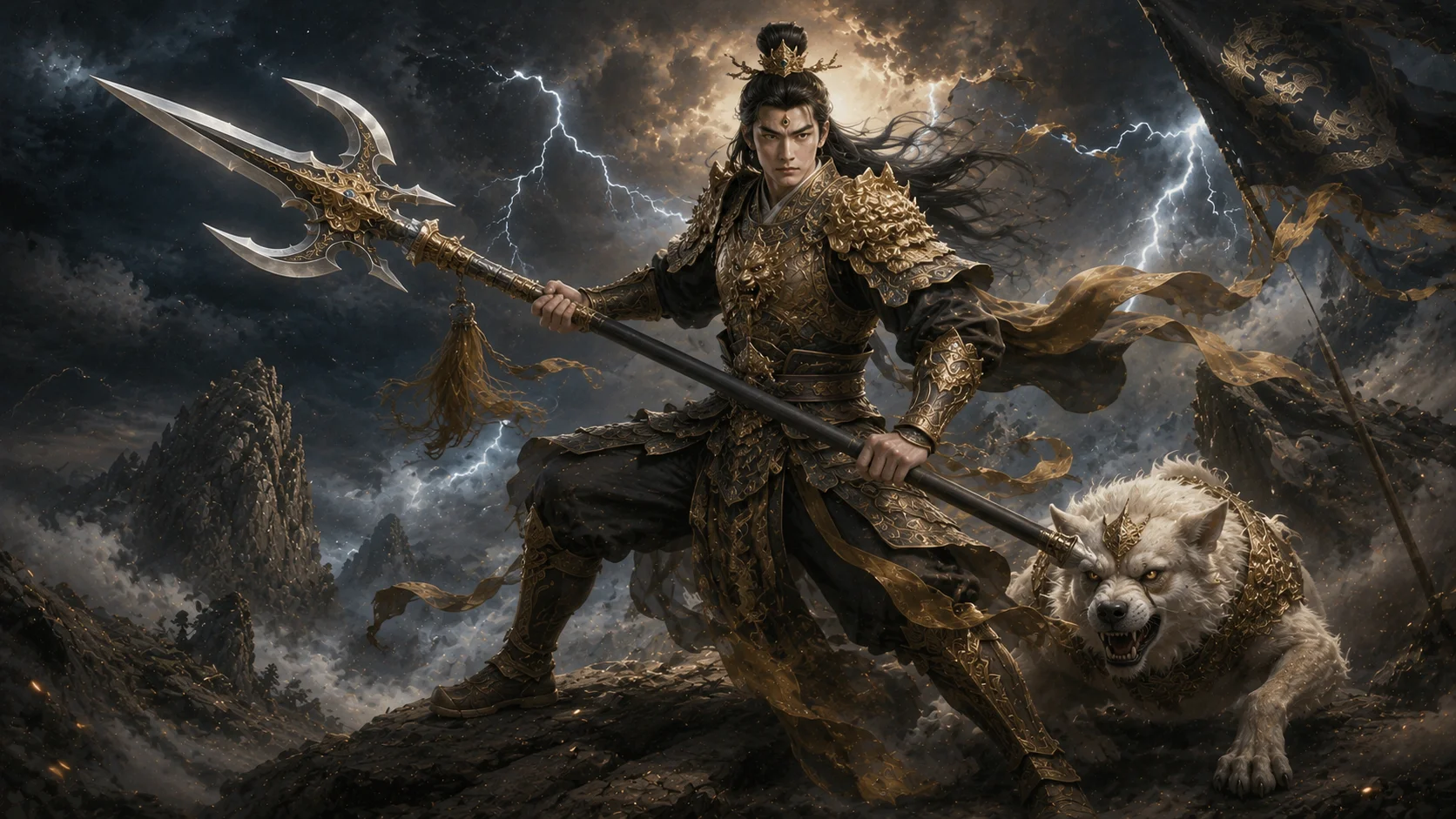
Erlang Shen's signature feature, unmistakable in every temple statue and stage depiction, is a third eye set vertically in the middle of his forehead. It is not decorative. This eye grants him true sight — the power to see through illusion, transformation, and disguise, cutting past whatever shapeshifting trick an enemy might attempt. In a tradition full of demons and spirits who escape capture by changing form, a warrior who simply cannot be deceived is a singular kind of threat. The third eye is what distinguishes Erlang Shen from the many other heavenly generals who crowd Chinese folk religion's martial pantheon: they have strength; he has strength plus a perception nothing can slip past.
The Lance With Two Edges and Three Points
His weapon is as distinctive as his eye: the Three-Pointed Two-Edged Lance (San Jian Liang Ren Dao), a polearm unlike the single-blade spears carried by most other generals in the same stories. It is consistently associated with his combat depictions across both major novels in which he features, a weapon built for a warrior expected to face threats no ordinary blade could finish. Depictions of Erlang Shen in temple art and opera nearly always show the lance in hand, as fixed to his identity as the third eye itself.
The Hound That Fights at His Side
No account of Erlang Shen is complete without his companion: a loyal celestial hound, sometimes called the Howling Sky Dog, or Xiao Tian Quan. The hound is not a passive pet but an active combatant, biting and distracting opponents in the middle of battle, buying the openings that let Erlang Shen's lance find its mark. This pairing of god and hound is a fixed element of his iconography — wherever Erlang Shen is carved, painted, or performed, the dog is rarely far from his heel, a reminder that even the most formidable of the heavenly generals fights as part of a bond, not alone.
A Draw Worth More Than a Hundred Victories
Erlang Shen's most celebrated feat comes in Journey to the West, during the rebellion in Heaven. When Sun Wukong, the Monkey King, overturns the celestial order and scatters every general sent against him, it is Erlang Shen who finally stands as his equal. Where other heavenly warriors fall quickly, Erlang Shen fights the Monkey King to a draw, or standstill — a battle of shapeshifting, cunning, and raw martial force between two of the very few beings in the story capable of matching each other blow for blow. That single engagement does more to establish his reputation than any title: among an entire court of armed and armored gods, he alone is the one who does not simply lose.
A Warrior Already Divine
Erlang Shen also appears, as Yang Jian, in the Investiture of the Gods (Fengshen Yanyi), fighting on the side of the Zhou cause. There he is noted for the same qualities that define him elsewhere — shapeshifting ability and battlefield cunning that let him out-maneuver enemies who rely on trickery of their own. Tellingly, at the novel's end, when so many fallen warriors on both sides are ceremonially deified as a reward for their sacrifice, Erlang Shen receives no such canonization, reflecting a status the story treats as already divine. He enters the story a god, and leaves it the same way — a detail that quietly underlines how differently his mythology treats him compared to warriors who earn their divinity through death.
Water, Stone, and the Debt to an Engineer
Beneath the fiction lies a folk religion still very much alive in Sichuan. Temples around Guankou, near the Dujiangyan works, honor Li Bing and his flood-taming son together, and it is through this channel that Erlang Shen retains a distinctly practical role: guardian against flood, protector of irrigation, a deity whose worship has real stakes for farmers and river communities rather than only mythic drama. His fame in fiction as a demon-slaying general sits alongside this older, quieter identity as a keeper of water and stone — the two strands of his worship rarely spoken of as separate, though their roots are.
The Mountain He Split for His Sister
The most emotionally complicated story attached to Erlang Shen belongs to his own family. In the folk tale of Chenxiang, also called the Lotus Lantern legend, Erlang Shen imprisons his own sister — a goddess who, like their mother before her, married a mortal scholar in violation of heavenly law — beneath Mount Hua. He acts here not as a brother showing mercy but as an enforcer of celestial order, willing to punish even his closest kin for the same transgression that shaped his own birth. Years later, her son Chenxiang grows to manhood, obtains a magic axe, and splits the mountain apart to free his mother. It is a story that parallels, without being identical to, the filial-conflict themes found in the Nezha and Li Jing story cycle — a distinct legend that is nonetheless sometimes confused with it, and worth naming separately rather than blending the two traditions together.
Justice That Answers to No Family
What makes the Lotus Lantern story resonate is not merely the drama of imprisonment and rescue, but what it says about Erlang Shen as a symbol. He represents an enforcement of heavenly law that does not bend for kinship — the same warrior who fought the Monkey King to a standstill here turns that same uncompromising strength against his own sister, because the law he serves recognizes no exception for family. It is a harder, colder kind of righteousness than the more familiar warrior-god archetype, and it is precisely what gives Erlang Shen his particular moral weight in the folk tradition: incorruptible, even when incorruptibility costs him something personal.
A Guardian More Regional Than Universal
Despite his prominence in two of the most widely read works of Chinese vernacular fiction, Erlang Shen's worship remains, in practice, less centrally organized than that of figures like Guan Yu or Mazu, whose devotion spans the country and beyond. He is venerated particularly in Sichuan, where the Dujiangyan connection gives his cult a concrete geography and a concrete purpose, and more broadly across Chinese folk religion as a martial guardian capable of subduing demons and monsters. That narrower, regionally anchored devotion is not a diminishment — it reflects a deity whose worship has always been tied to particular places, particular floods, and particular fears, even as his story traveled everywhere through the novels that carried his name.
Sight, Strength, and the Price of Both
Taken together, Erlang Shen's third eye, his lance, his hound, his standstill against Sun Wukong, and his unbending judgment against his own sister form a single portrait: a god whose power lies as much in perception as in force. He cannot be fooled, and he does not pretend that law is easier to enforce against strangers than against family. In a pantheon crowded with generals who are strong but easily deceived, or righteous but untested, Erlang Shen endures in memory as the rare figure proven both — and who paid, in his own mythology, a real price for insisting on it.
Sources & traditions
- EncyclopediaWikipedia — Erlang Shen
- TraditionChinese texts, oral tradition and village tellings (China)
Myths change from area to area and from time to time. This chronicle follows the most widely told versions; tellings in other villages, regions and eras may differ.