Guan Yu lived once as a man of flesh, iron, and unbending temper, and has lived ever since as something larger: a god summoned into shrines, shopfronts, and sworn oaths across the Chinese-speaking world. To tell his story honestly is to tell two stories at once — the soldier recorded in brittle third-century annals, and the deity built up around him, century by century, until the two became inseparable. Both deserve to be told, and neither should be mistaken for the other.
A Soldier of Hedong
Strip away nine hundred years of temple incense and what remains is a real man: Guan Yu, courtesy name Yunchang, born in Xie County in Hedong Commandery — the region known today as Yuncheng, in Shanxi province. He lived through the collapse of the Eastern Han dynasty and into the fractured, bloody decades of the Three Kingdoms, serving the warlord Liu Bei as one of his most trusted generals. Everything historians can say with confidence about him traces back to a single source: the Sanguozhi, the Records of the Three Kingdoms, compiled by the scholar-official Chen Shou in the third century CE. It is a spare, disciplined text, closer to a government dossier than a legend — and it is the bedrock beneath every embellishment that followed.
The Brotherhood That Never Was — and Endures Anyway
Ask almost anyone familiar with Guan Yu how his story begins, and they will describe a peach garden: three men — Guan Yu, Liu Bei, and Zhang Fei — kneeling among blossoming trees, swearing an oath of brotherhood unto death. It is one of the most famous scenes in Chinese literature. It is also, by the sober measure of the Sanguozhi, an invention. The Oath of the Peach Garden appears nowhere in Chen Shou's history. It belongs entirely to the fourteenth-century novel Romance of the Three Kingdoms, written by Luo Guanzhong roughly a thousand years after the events it describes. And yet the oath is not a falsehood so much as a distillation — the novel's way of naming something the history only implies: that Guan Yu, Liu Bei, and Zhang Fei moved through the world as an inseparable unit, bound by a loyalty fierce enough that later generations felt it needed a ceremony to explain it. The peach garden may never have bloomed, but the devotion it symbolizes was real enough to outlive the men who felt it.
Wine Still Warm: The Making of a Legend
The Romance gave Guan Yu his most theatrical moments, and none is more beloved than the beheading of Hua Xiong. In the novel, as allied lords hesitate before a fearsome enemy champion, Guan Yu asks only that his wine be poured and kept warm — he will return before it cools. He returns, Hua Xiong's head in hand, the wine still hot. It is a scene built for the stage, not the archive; nothing in the historical record confirms it happened as told. The same is true of his celebrated slaying of the general Yan Liang on the battlefield, a moment of single-combat glory that cemented his reputation as the mightiest warrior of his age. These episodes are not lies exactly — they are the novel's chosen vocabulary for a reputation that clearly existed, dramatized into scenes vivid enough to survive seven centuries of retelling.
Bound to an Enemy's Kindness
Guan Yu's most psychologically complex relationship was not with his sworn brothers but with his rival, the warlord Cao Cao. During a period when circumstance forced Guan Yu into temporary service under Cao Cao, the two men developed a strange, mutual respect. Cao Cao, by tradition, treated his captive general with genuine honor — offering him rank, wealth, and comfort in an evident attempt to win his loyalty permanently. Guan Yu accepted the courtesy without ever surrendering his heart, which remained fixed on Liu Bei. The Romance leans hard into this tension, using Cao Cao's generosity as the very instrument that proves Guan Yu's incorruptibility: here was a man who could be given everything and still choose loyalty over comfort. It is one of the novel's most enduring lessons — that yi, righteousness, is measured not by what a man refuses under threat, but by what he refuses when treated well.
Through Five Gates, Against Six Generals
When Guan Yu finally left Cao Cao's service to rejoin Liu Bei, he did not travel alone or unopposed. The Romance renders this journey as one of his defining trials: escorting Liu Bei's wives across hostile territory, he is forced through five heavily guarded checkpoints, cutting down six generals who bar his path one after another. Like the beheading of Hua Xiong, this episode is a novelistic elaboration rather than a strictly historical account — but it functions as something more than adventure fiction. It is a parable of loyalty under duress, each gate a fresh temptation to abandon the more difficult, dangerous road home. The number of gates and generals may be fiction's invention, but the underlying claim — that returning to Liu Bei cost Guan Yu dearly, and he paid the cost without hesitation — sits at the emotional center of his entire legend.
The Blade Beneath the Skin
Not every remarkable episode in Guan Yu's life belongs to the novelists. One of the most striking scenes attached to him is recorded in the Sanguozhi itself, and needs no embellishment to astonish: struck by a poisoned arrow, Guan Yu underwent a procedure in which a physician cut open his arm and scraped the poison directly from the bone, while Guan Yu continued calmly playing the board game Go, showing no sign of pain. It is a moment historians treat as genuine, even as they question one popular detail — tradition often names the physician as Hua Tuo, the legendary surgeon of the era, though the timeline of Hua Tuo's life makes that attribution difficult to sustain. Whoever held the blade, the composure attributed to Guan Yu needed no invention. It was, if anything, the historical record outdoing the myth.
The Flood at Fancheng
Guan Yu's greatest documented military triumph came in 219 CE at the Battle of Fancheng, where he faced the forces of Cao Cao's general Yu Jin. Rather than meeting Yu Jin's army in open battle, Guan Yu turned the region's flooding rivers into a weapon, using the rising waters to overwhelm and trap his opponent's forces. Yu Jin was captured; the rival general Pang De, who refused to surrender, was executed. It was a victory of calculation as much as courage, and it stands as the historical high-water mark of Guan Yu's career — a moment when the Han-era general and the legendary strategist were, for once, exactly the same man.
The Fall of Jing Province
Triumph at Fancheng did not last. While Guan Yu's forces were extended north, the rival warlord Sun Quan moved against him from behind, orchestrating the loss of Jing Province through the cunning of his general Lü Meng. It was a strategic betrayal as much as a military one — Sun Quan had, at times, been an uneasy ally against Cao Cao, and the campaign against Guan Yu shattered any pretense of alliance between Sun Quan's Wu and Liu Bei's forces. Cut off, outmaneuvered, and abandoned by the geography he had once used so effectively against others, Guan Yu found the tables of Fancheng turned against him.
A Death That Broke an Alliance
Guan Yu was captured following the loss of Jing Province and executed in 220 CE, at the hands of forces loyal to Sun Quan. His death was not merely the end of one general's life — it was a rupture that reshaped the entire political landscape of the Three Kingdoms. The fragile cooperation between Liu Bei's Shu Han and Sun Quan's Wu, always a marriage of necessity against the greater threat of Cao Cao's north, could not survive the killing of a man Liu Bei had loved as a brother. The consequences of that single execution rippled outward for years, reshaping alliances and campaigns long after Guan Yu himself was gone. Few deaths in Chinese history have cast so long a shadow — one that, in a sense, has never fully lifted, since it was that same death which opened the door to everything that came after.
From Marquis to Saintly Emperor
Death, for Guan Yu, was not an ending but a threshold. In the centuries following his execution, successive dynasties began elevating his posthumous status, a process that unfolded slowly but relentlessly across roughly a thousand years. He rose from Marquis to Duke, and eventually to titles carrying imperial weight, culminating under the Qing dynasty in the resplendent title Guan Sheng Di Jun — the Saintly Emperor Guan. This was not simply popular devotion bubbling upward; it was, in large part, deliberate state sponsorship, as emperor after emperor recognized the usefulness of a figure who embodied loyalty to a sovereign lord so completely that his cult could be turned toward reinforcing loyalty to the throne itself. Few historical figures anywhere have been so thoroughly and so officially transformed from subject to sovereign.
The Martial Sage, Beside the Civil Sage
The clearest measure of how far the imperial court carried Guan Yu's elevation is the company it set him in. Confucius had long stood as the Wen Sheng, the Civil Sage, the fixed reference point for scholarly and moral authority in the Confucian state — a rank no soldier could ordinarily approach. Guan Yu was nonetheless raised to stand opposite him as the Wu Sheng, the Martial Sage, a deliberate pairing that placed a third-century general on the same conceptual plane as the philosopher himself. State-sponsored temples to the Martial Sage were built and maintained alongside Confucian temples across the empire, following comparable rites, so that the civil and martial virtues each had their own sage, their own cult, and their own place in official reverence. It is difficult to overstate how singular this was: no other military figure in Chinese history was given a title built explicitly to mirror Confucius, and the pairing tells you exactly what the court believed loyalty and righteousness were worth — worth setting beside learning and virtue itself, not beneath them.
Guardian of the Monastery Gate
What makes Guan Yu's deification unusual is not just its scale but its breadth. He did not become the property of a single tradition; he became sacred to several at once. Buddhist tradition holds that Guan Yu appeared as a guardian spirit — a qielan, a protector of the monastic grounds — at Yuquan Monastery, an event credited with his adoption into Buddhist temples as a guardian figure standing watch alongside bodhisattvas. Daoism, meanwhile, folded him into its own pantheon as a martial protector and exorcist of evil influences, while popular folk religion embraced him more intimately still, as a deity approachable by ordinary people for ordinary needs. Confucian moral philosophy, for its part, held him up as a living embodiment of loyalty and righteousness, the virtues at the very center of its ethical universe — the same reasoning that had already earned him the Martial Sage's seat beside Confucius. That a single historical general could be simultaneously sacred to Buddhists, Daoists, and Confucian moralists — three traditions that rarely converge so completely on one figure — is perhaps the rarest honor of all those paid to him.
Sons in Bronze and Legend
Guan Yu is rarely depicted alone in temple statuary. Standing beside him, almost without exception, is Guan Ping, traditionally honored as his adoptive son and devoted attendant, worshipped in tandem with his father as part of the same sacred grouping. A second figure, Guan Suo, appears in later strands of the tradition as another son, though his historicity is considerably more uncertain, belonging more to the layered accretion of legend than to any documented record. Together, father and attendant-sons form a small sacred household, a family unit carried into the temple itself — loyalty, in Guan Yu's cult, was never imagined as a solitary virtue but as something lived within relationships, master to follower, father to son.
The Ledger and the Incense: God of Merchants and Oaths
Perhaps the most surprising turn in Guan Yu's long afterlife is his adoption as a patron of commerce. Popularly known as Guan Gong or Guan Di, he is invoked above all as the god of loyalty, zhong, and righteousness, yi — virtues forged on a battlefield, not a trading floor. Yet folk tradition, through an association with ledger-keeping that historians regard as widely cited but difficult to verify, transformed him into a guardian of merchants, businesspeople, and sworn brotherhoods, secret societies included, and eventually into something like a god of wealth in his own right. The logic, however loosely historical, is not hard to trace: a deity famous for absolute fidelity to an oath is exactly the figure a merchant wants watching over a contract, or a business partner wants presiding over a handshake. Loyalty, once sworn on a battlefield to a brother-king, was quietly rededicated to the far humbler oaths of the marketplace — and lost none of its solemnity in the transfer.
The Face at the Door
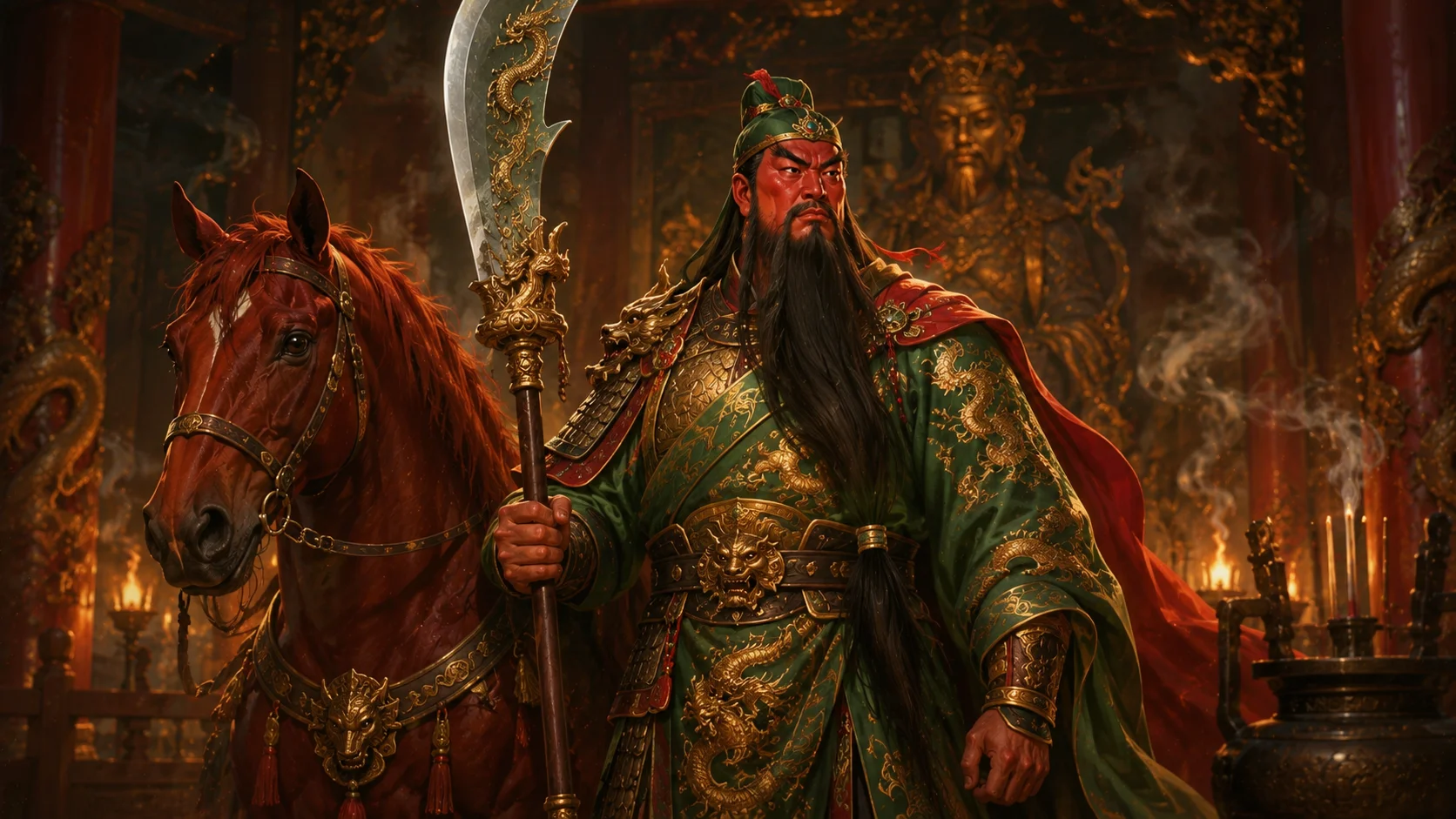
Walk into a Chinese restaurant, a martial arts hall, or certain security establishments in Chinese communities around the world, and there is a fair chance Guan Yu's image will be watching from somewhere near the entrance — red-faced, long-bearded, an unmistakable and immediately legible presence. Dedicated Guandi Temples carry his cult formally across China, Taiwan, and the wider Chinese diaspora, but his most intimate shrine may be this humbler one: a small statue or portrait placed by the door, standing guard the way he is remembered to have guarded Liu Bei's household, and Yuquan Monastery's gate before that. Soldier, brother, rival's respected captive, executed general, Martial Sage beside the Civil Sage, ascended emperor, guardian spirit, patron of the counting-house — Guan Yu has occupied nearly every role a culture can offer a revered man, and in each one, the virtue asked of him has stayed exactly the same. He is remembered, above everything else, for staying faithful. It is why, nearly two thousand years after his death, people still light incense and ask him to watch the door.
Sources & traditions
- EncyclopediaWikipedia — Guan Yu
- TraditionChinese texts, oral tradition and village tellings (China)
Myths change from area to area and from time to time. This chronicle follows the most widely told versions; tellings in other villages, regions and eras may differ.