Zhong Kui is the great demon-queller of Chinese folk religion and Daoist practice — the fierce-eyed 'Ghost King' invoked to hunt, capture, and devour malevolent spirits. Unlike gentler household guardians, Zhong Kui is remembered as an active exorcist: a hunter of ghosts rather than a passive gatekeeper, and one of the few major deities of the tradition whose sacred form is deliberately, unapologetically ugly rather than idealized.
A Scholar Undone on the Palace Steps
Tradition sets his story in the Tang dynasty. Zhong Kui, so the legend holds, sat the imperial examinations and answered with brilliance enough to place first among all candidates — the coveted rank of zhuangyuan. But the honor was denied him. The Tang Emperor, remembered in most tellings as Xuanzong (in other versions as Gaozu), looked upon Zhong Kui's face — described as hideous, dark, and fearsome — and refused to grant him the title on the grounds of his appearance alone. A lifetime of study, discipline, and proven merit was set aside for a matter of looks.
The humiliation was total. In the depth of his despair, Zhong Kui took his own life on the very steps of the palace, dying in view of the court that had just rejected him. It is a founding grief at the heart of his cult: a man whose intellect and integrity were never in question, undone entirely by the superficial judgment of earthly power.
Honor Restored Beyond the Grave
What follows is the hinge of the entire legend. Feeling remorse — in some versions moved by nothing more than conscience, in others prompted by Zhong Kui's own ghost returning to protect him — the emperor reverses course. He orders Zhong Kui buried with the full honors due a top scholar, the rank denied him in life restored to him in death. Alongside this posthumous burial, the emperor confers upon him the title that would define his entire spiritual career: Demon Queller. What the imperial bureaucracy withheld from a living man of talent, it grants in full to the same man made a spirit — a reversal that folk religion has never stopped finding satisfying.
The Dream That Made Him a God
The most widespread version of the legitimizing story goes further, and it is this episode — not the examination alone — that fixed Zhong Kui permanently into Chinese religious life. Emperor Xuanzong, gravely ill, dreamed one night of a small demon tormenting him, stealing about his sickbed and refusing to let him rest. Into the dream came a second figure: a huge, fierce-looking ghost, dark of face and bearded, who seized the small demon without hesitation and devoured it whole. Asked who he was, the great ghost identified himself as Zhong Kui, the scholar who had died on the palace steps and now served the throne from the realm of spirits.
Xuanzong woke cured. So vivid and exact was his memory of the dream-figure that he summoned the court painter Wu Daozi and described Zhong Kui to him in detail, commissioning a portrait built entirely from a sovereign's dream. That commissioned image is the seed of everything that followed — the reason Zhong Kui's face became fixed, standardized, and endlessly reproduced as a protective icon in Chinese households for well over a thousand years.
The Face Fixed in Ink and Silk
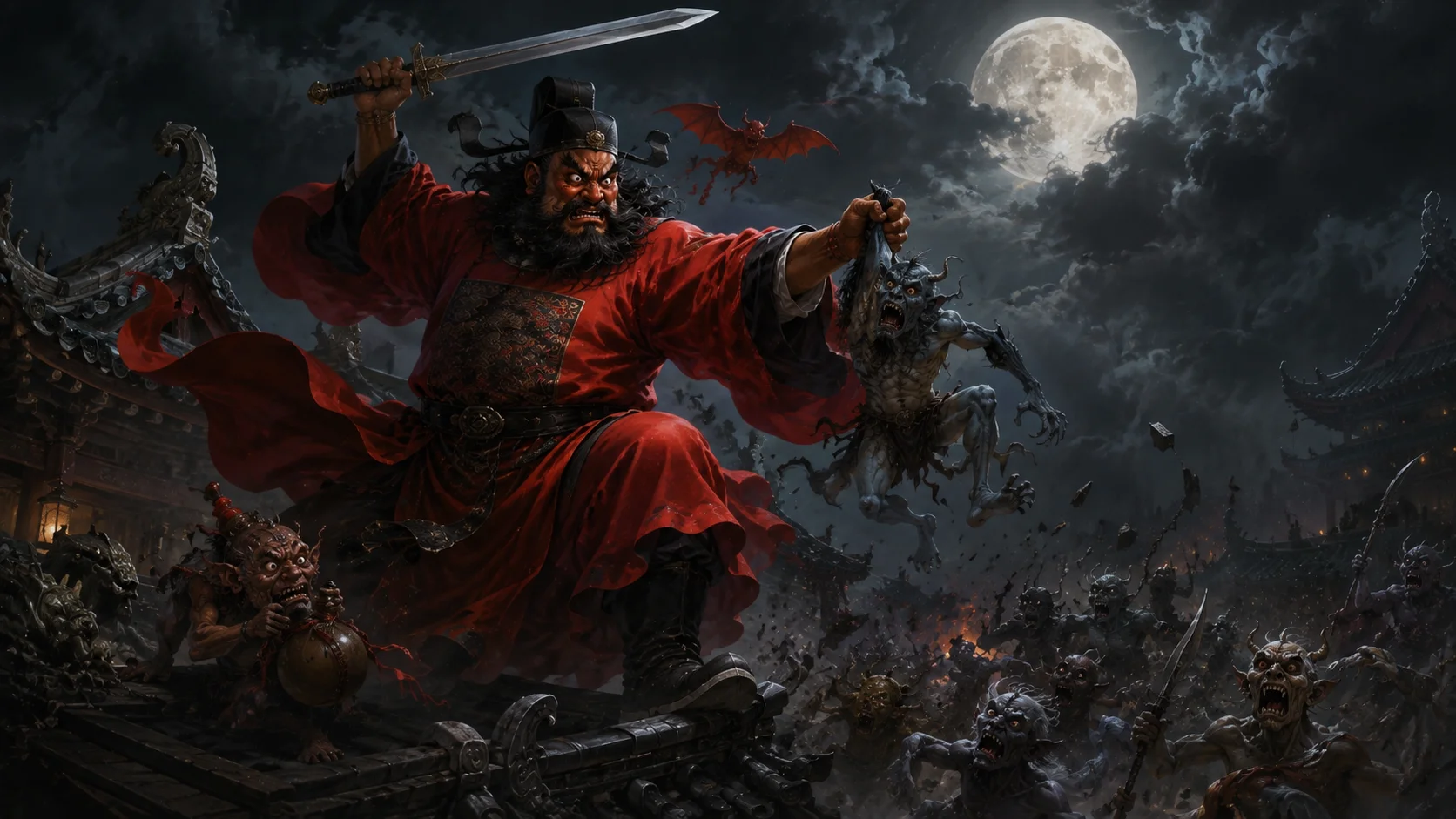
From that commissioned portrait forward, Zhong Kui's likeness has remained remarkably consistent. He is shown as a large man, densely bearded, with fierce and piercing eyes and a dark, uncompromising face — features that would have disqualified him from courtly favor in life but announce his authority over demons in death. He wears the robes and official's cap of a scholar-official, a costume that never lets viewers forget his origin: not a sky-born deity, but a man of the examination system, robbed of rank and given a greater one instead.
He is very often shown wielding a sword, the weapon of active pursuit rather than passive guardianship. A recurring companion in the imagery is a bat drawn flying above him — a detail that rests on a pun rather than a myth: the Chinese word for bat, fu, is a homophone for fortune, also fu, so the creature's presence over his head reads visually as good fortune attending the demon-slayer.
A Hunter, Not a Doorpost
It is worth being precise about what kind of protector Zhong Kui is, because Chinese households display more than one type at their thresholds. The paired door gods, or Menshen — figures such as Qin Shubao and Yuchi Gong — are defensive sentinels, posted to bar evil from ever crossing in. Zhong Kui is understood differently: an offensive exorcist, a demon-hunter and captor of ghosts who goes out after malevolence rather than simply blocking its path. Both belong to the same broad function of household protection, but the folk imagination has never confused the two — one stands guard, the other gives chase.
When His Image Goes Up
Zhong Kui's portrait is not displayed at random points in the year; Chinese folk practice fixes it to two deliberate occasions. The first is Chinese New Year, when his image is hung as a general protective and exorcistic guardian of the household, sometimes alongside the door gods and sometimes standing in for them entirely, driving out whatever misfortune or malevolent presence the old year leaves behind.
The second, and arguably the more central occasion, is the Duanwu or Dragon Boat Festival in the fifth lunar month. This is traditionally regarded as a perilous season, when the 'five poisons' — venomous and harmful creatures associated with the rising heat and dampness of early summer — and epidemic-associated evil spirits are believed most active. Zhong Kui's fierce image is hung specifically to ward off this seasonal danger, his sheer ferocity doing the work of a household inoculation against sickness and misfortune alike.
Called Upon in Rites of Purification
Beyond the calendar festivals, Zhong Kui's name and image have long been drawn into more direct ritual use. Daoist and folk ritual specialists have historically invoked him in house-purification rites and in ceremonies specifically aimed at warding off epidemic disease, treating his authority over ghosts as a force that can be summoned into a home rather than only displayed on its door. Pasting his image on doorways or hanging it inside a dwelling was understood as a practical act of protection — a way of making the demon-queller's vigilance felt in a specific, threatened space, particularly against disease-bearing or malevolent spirits believed to be circulating.
A Sister Given in Marriage
Later folklore and the operatic stage expanded Zhong Kui's household considerably beyond the solitary exorcist of the Tang legend. In these later elaborations he commands a retinue of subordinate 'little demons,' xiaogui, who serve and accompany him in his hunting. More distinctive still is the tale of his sister, Zhong Kui's meimei, told in the folk story known as 'Zhong Kui Marries Off His Sister.' In this narrative, Zhong Kui — already dead and dwelling among spirits — arranges for his sister to marry a former friend of his from among the living. It is important to hold this story at some distance from the founding Tang legend: it belongs to a distinct, later stratum of folk and operatic invention, not to the original account of the wronged scholar and the emperor's dream.
A Vindication the Living Bureaucracy Never Gave
At the symbolic core of the entire cult sits a single, deeply felt reversal. Zhong Kui is the wronged, physically unattractive but morally upright and supremely capable man, rejected by the earthly hierarchy for a reason that had nothing to do with his merit, who is nonetheless vindicated after death and elevated to a position of protective, even supreme, authority — not in the world of scholars and officials that spurned him, but in the world of spirits and demons, where competence and ferocity, not appearance, decide who rules. It is a story of bureaucratic injustice answered by cosmic justice, and it is precisely this shape — talent denied by petty men, then honored by higher powers — that has kept the tale resonant across centuries of retelling.
What the Record Actually Shows
No independent Tang-dynasty historical record confirms that an actual scholar named Zhong Kui lived and died as the legend describes. The earliest surviving textual and pictorial references to him date only from the mid-to-late Tang, and the body of material referring to him grows substantially in the following Song dynasty. Modern scholarship on the development of his cult treats him accordingly: not as a documented historical person whose biography can be verified, but as an early medieval legend that took shape gradually and then accumulated the elaborations — the little demons, the sister's marriage — that later ages added to it. This does not diminish his religious significance; it simply places him honestly as a figure of sustained belief and practice rather than of settled historical fact.
Why His Face Never Left the Popular Imagination
Zhong Kui remains one of the most immediately recognizable figures in Chinese New Year woodblock prints, nianhua, as well as in opera repertoire and popular art generally, and the reasons are not hard to see. His story fuses moral vindication with a comic-grotesque appearance and a sharply defined protective function, three elements that rarely combine so cleanly in a single figure. Where most major folk deities are rendered with an idealized, serene divinity, Zhong Kui is deliberately, purposefully ugly — a divine form built not despite his hideousness but because of it, since it was that very hideousness, and the injustice done to him for it, that made him the demon-queller in the first place.
Sources & traditions
- EncyclopediaWikipedia — Zhong Kui
- TraditionChinese texts, oral tradition and village tellings (China)
Myths change from area to area and from time to time. This chronicle follows the most widely told versions; tellings in other villages, regions and eras may differ.