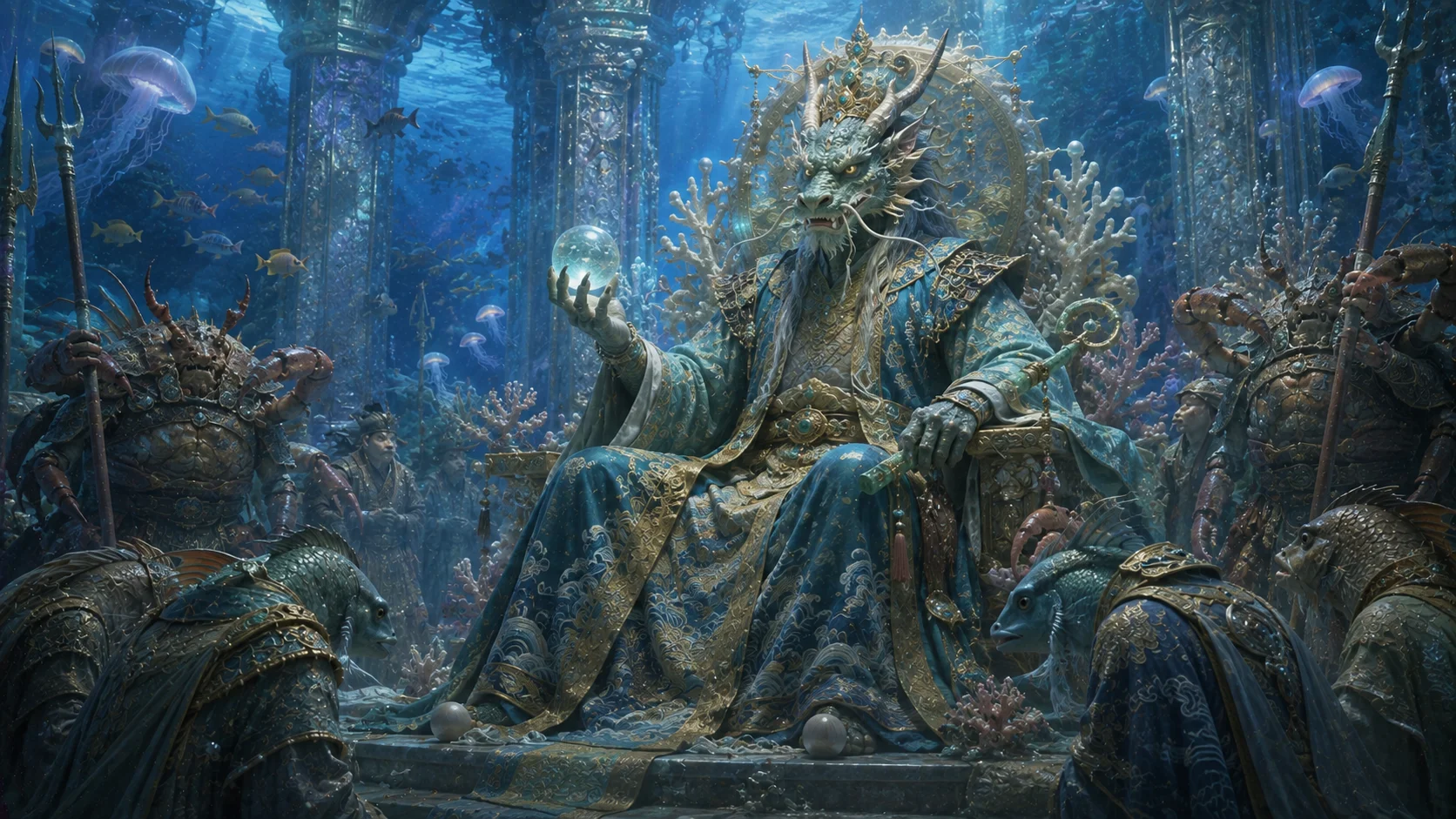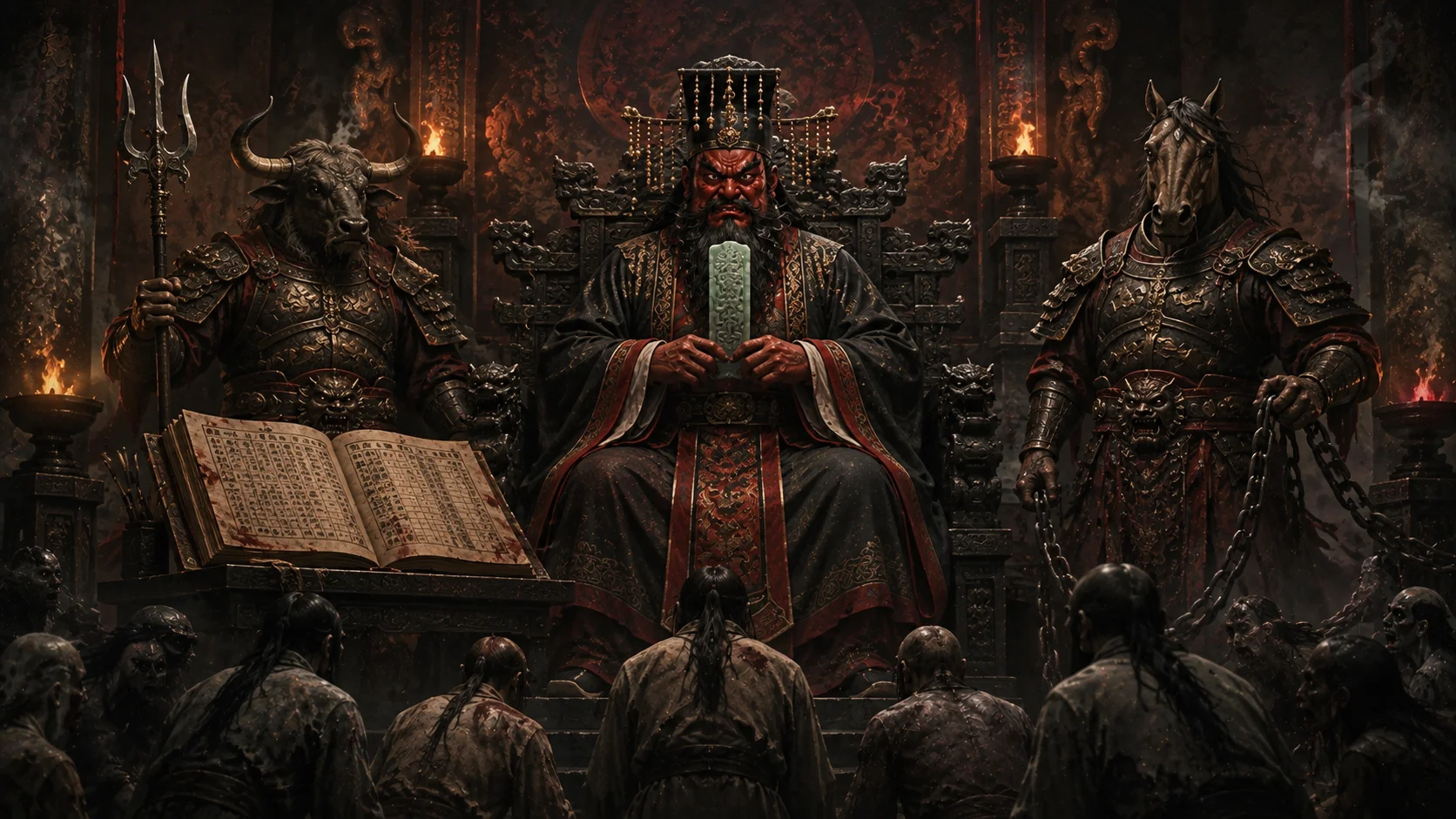
Yanluo — Yánluó Wáng (閻羅王), King Yama — is the supreme judge of the dead in Chinese religion, the stern magistrate who presides over Diyu, the underworld, and weighs the deeds of every soul that passes through his courts. He did not originate in China. His name and office descend from Yama Raja, the Hindu-Buddhist lord of death, carried into Chinese religion through centuries of Buddhist sutra translation and then thoroughly remade by native Daoist ritual and folk belief until he became something distinctly Chinese: a judge whose entire realm is modeled on the earthly imperial bureaucracy, right down to the robes, the registers, and the appeals.
A Foreign God Made Native
Yanluo's deepest roots lie outside China, in the figure of Yama, the Vedic and later Buddhist ruler of the dead. As Buddhism moved along the trade routes into China and its texts were translated into Chinese from the Han dynasty onward, Yama's name and function were absorbed and gradually merged with indigenous Chinese ideas about the afterlife, ancestral judgment, and cosmic bureaucracy. The result, over centuries, was not a straightforward import but a genuine synthesis — a Buddhist doctrine of karmic consequence fused with a very Chinese conviction that even death runs on paperwork, rank, and due process. By the time this synthesis matured, Yanluo was no longer simply a translated deity; he was a fixture of popular religion in his own right, worshipped, feared, and depicted across Daoist temples and mortuary art alike.
Sovereign of the Ten Courts
In the fully developed cosmology of Diyu, systematized especially from the Tang dynasty onward, the underworld is not a single pit but an administrative territory divided into ten courts, each overseen by one of the Ten Yama Kings — the Shi Dian Yanwang. Yanluo is chief among them, the name most people mean when they say simply "the King of Hell." Tradition is not perfectly settled on the exact shape of his authority: some texts within the Ten Kings scheme place him as ruler of the Fifth Court specifically, one judge among ten with a defined portfolio, while older and simpler folk tradition instead makes him the singular supreme ruler over the whole of the underworld, courts and all. Both versions persist side by side in the living tradition, a genuine point of variation rather than a contradiction to be resolved — different communities and different eras have told the story differently, and neither telling has erased the other.
The Mirror That Cannot Be Deceived
Whichever court he is understood to preside over, Yanluo's defining function never changes: he judges. Before him, souls face the Nie Jing Tai, the Mirror of Retribution, a device said to reflect back a lifetime of hidden deeds exactly as they were committed, stripped of excuse or self-serving memory. Nothing performed in secret survives contact with it. Denial is pointless in Yanluo's court not because he is cruel but because the evidence judges itself — the mirror shows what happened, and Yanluo's role is to weigh what the mirror reveals against the moral weight of a life, then assign punishment, reward, or the terms of the next rebirth accordingly.
The Ledger of Every Living Thing
Underpinning Yanluo's entire judicial apparatus is the Shengsi Bu, the Register of Life and Death — a ledger, kept by the underworld bureaucracy and its clerks, recording the allotted lifespan of every being that exists. Among those clerks are Ox-Head and Horse-Face and Black and White Impermanence, the functionaries tasked with the daily labor of keeping the register consistent with the world it governs. Nothing dies before its entry is due, and nothing lives past it; the register is consulted and enforced with the same procedural rigor as any earthly government's records. This is the single detail that makes Yanluo's underworld feel less like a torture chamber and more like a vast, inescapable civil service — one where a name written or struck from a page has the force of destiny itself.
When a Monkey Erased His Own Name
The register's power, and the disruption possible when someone defies it, is dramatized most famously in the Ming-dynasty novel Journey to the West. The Monkey King, Sun Wukong, descends into the underworld, seizes the Register of Life and Death, and strikes out his own name and the names of all monkeys from its pages — an act that, by the logic of the ledger, grants them freedom from death itself. Yanluo is, understandably, furious. Rather than accept the violation of his own court's authority, he takes the matter upward, lodging a formal complaint with the Jade Emperor. The episode captures something essential about how Chinese cosmology imagines its bureaucracy: even the King of Hell has no unilateral power to simply overrule a breach of cosmic order — he must petition a higher office, exactly as any wronged official would.
A Judge Who Must Also Answer to Heaven
That petition is not an isolated incident. Across Journey to the West, Yanluo appears repeatedly among the underworld and heavenly officials forced to negotiate with, or complain against, Sun Wukong's repeated disruptions of cosmic order. These episodes place Yanluo firmly within a larger hierarchy: in the folk-syncretic system that Chinese popular religion settled into, Yanluo commands the underworld absolutely, but he is himself subordinate to the Jade Emperor, Yudi, who sits above the entire structure of heaven, earth, and hell. Yanluo's authority is real and terrifying to the souls who face it, but it is delegated authority, exercised within limits — a King of Hell who still has a superior to report to.
An Emperor Returns From the Courts of the Dead
Yanluo's court was not imagined as a place only the dead could visit. A well-loved episode of underworld "hell tour" literature — also folded into Journey to the West, in its account of Tang Emperor Taizong's journey to the underworld — tells of the living emperor being brought before Yanluo and the Ten Kings to be judged, before ultimately being returned to the world of the living. Stories of this kind, in which a living person tours the courts of Diyu and comes back changed, were a popular didactic genre in their own right, using the vivid machinery of Yanluo's judgment hall to impress moral lessons on audiences who would one day face that judgment for real.
The Bureaucrat's Face of Death
Chinese religious art gives Yanluo a very particular look, and it is not the look of a monster. He is shown as a stern official in the formal robes and cap of an imperial magistrate, seated in judgment much as a living governor or minister would be. This iconography is deliberate: Diyu, in Chinese popular imagination, is not chaos but order — a mirror image of the imperial state, complete with its own courts, clerks, ranks, and paperwork. Yanluo's terror comes precisely from his resemblance to an incorruptible official rather than a demon; he frightens the way an unbending judge frightens, not the way a monster does.
The Underworld's Working Staff
Yanluo does not preside alone. His courts are staffed by functionaries who carry out the underworld's daily business — among them the ox-headed and horse-faced guards, Niutou and Mahmian, and the pair known as Black and White Impermanence, who appear throughout Chinese hell iconography as the enforcers and escorts who bring souls before the bench and see judgment carried out. Chinese tradition also folklorized certain historical figures into this same underworld administration; the incorruptible judge Bao Zheng, revered in life for uncompromising fairness, was in some traditions elevated into the role of an underworld judge or king in his own right, a testament to how thoroughly the living bureaucracy and the bureaucracy of the dead were imagined as mirrors of one another.
Karma Given a Bureaucratic Form
At its core, Yanluo's mythology is a way of making an abstract idea vivid and unavoidable: the Buddhist doctrine of karma, the conviction that every deed carries its own consequence, given the concrete, almost administrative shape of a court, a ledger, and a judge who cannot be bribed, flattered, or outrun. Chinese religion took a doctrine about moral cause and effect and gave it a face, a robe, a gavel, and a filing system. Yanluo is what happens when a culture insists that justice must be procedural to be trusted — that fairness needs paperwork, not just intention.
The Broth That Clears the Way
Judgment in Yanluo's court is not the end of a soul's passage but the hinge of it. Once a case is closed and a fate assigned, the soul is sent onward toward reincarnation by way of Meng Po's broth, the drink that clears away the memory of the life just judged so that rebirth can begin unburdened by what came before. It is a quiet, almost domestic image set right beside the machinery of courts and registers — the underworld's last administrative step, and the one that makes the whole system a cycle rather than a single verdict.
A Presence in Temple and Funeral Alike
This vision of Yanluo was never confined to literature. Daoist temples and City God (Chenghuang) shrines historically carried his imagery as part of the devotional and funerary landscape of everyday religious life, and elaborate hell-scroll paintings depicting the courts of Diyu — shibu diyu — were used in mortuary rites to instruct mourners and the newly dead alike on what judgment awaited. For ordinary worshippers, Yanluo was not a distant literary invention but a genuinely expected encounter, the figure every soul would eventually stand before, and the reason a life's conduct was understood to matter long after it ended.
Feared, and Trusted Precisely Because He Is Feared
What endures across every version of this tradition — the Ten Kings scheme and the older singular sovereign, the novel's irate petitioner and the temple's silent painted judge — is a single, consistent character. Yanluo is dreaded, but he is dreaded as an incorruptible magistrate is dreaded, not as a monster is. His courts are terrifying because they are fair: the mirror does not lie, the register cannot be bought, and the verdict, however severe, is never arbitrary. That is the quality that has kept Yanluo central to Chinese religious imagination for well over a thousand years — not cruelty, but an accounting that nothing escapes.
Sources & traditions
- EncyclopediaWikipedia — Yanluo Wang
- TraditionChinese texts, oral tradition and village tellings (China)
Myths change from area to area and from time to time. This chronicle follows the most widely told versions; tellings in other villages, regions and eras may differ.