Meng Po — Mèng Pó (孟婆), "Old Lady Meng" or "Lady Meng" — is the quiet administrator of forgetting in Chinese underworld belief: the spirit who waits at the last threshold before rebirth and ensures that no soul carries the weight of a former life into the next one. She is not a goddess of scripture, carved into the earliest Buddhist translations that reached China, but a figure of popular religion — a presence that grew up over centuries in folk story, vernacular hell-guidebooks, opera stages, and the "precious scrolls" (baojuan) that ordinary households once read aloud. That she has no single canonical origin does not make her marginal. It makes her exactly what Chinese folk religion does best: build a moral cosmology out of story, repetition, and communal memory, until a figure without an official birth becomes as real to believers as any deity enshrined by imperial decree.
The Woman Who Waits at the Bridge of Helplessness
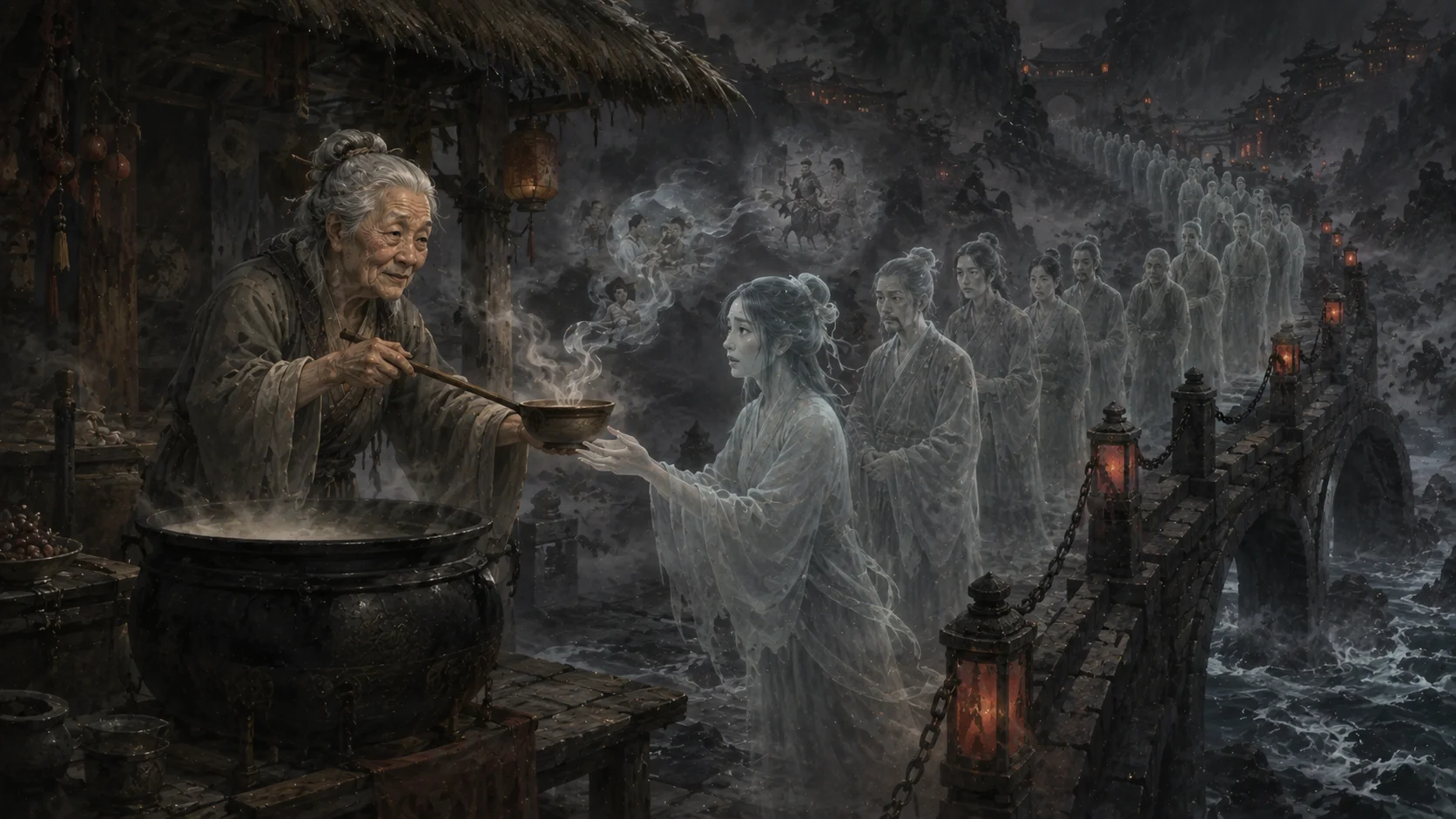
Every account of Meng Po places her in the same location: Naihe Bridge (奈何橋), the Bridge of Helplessness, the narrow crossing a soul must walk after its case has closed in the courts of the dead. The name itself carries the emotional truth of the place — naihe means something close to "what can be done," the sigh of a person facing an outcome beyond their control. Souls arrive at this bridge only after judgment has already been rendered elsewhere in Diyu, the layered Chinese underworld. There is nothing left to plead, nothing left to appeal. The bridge is not a place of deciding; it is a place of crossing over, and Meng Po is the one who stands at its foot.
She is usually pictured as an old woman tending a modest pavilion or teahouse beside the bridge — not a fearsome guardian, not an executioner, but something closer to an innkeeper stationed at the end of the world. Souls file past her one by one, and she offers each of them a bowl before they take the final steps across.
A Bowl Brewed From Five Flavors
What she offers is tea, though popular speech usually calls it soup: the Five-Flavored Tea of Forgetfulness, known widely as Mihun Tang, and just as often simply as Meng Po Tang — "Meng Po's Soup." The five flavors are said to correspond to the fullness of a human life — its sweetness, its bitterness, its sourness, its acridity, its saltiness — compressed into a single cup a soul drinks in a single swallow. Whatever grief, triumph, love, or regret a life contained, the tea takes it. What is left behind, on the far side of the bridge, is a soul clean of memory and ready to be born again with no trace of who it used to be.
This is not depicted as a punishment. It is depicted as a mechanism — as necessary and as impersonal, in most tellings, as the turning of a wheel. The tea does not judge whether a life was virtuous or wicked; that reckoning already happened in the courts before the soul ever reached the bridge. Meng Po's task begins only after judgment ends.
The Bureaucracy Beneath the Living World
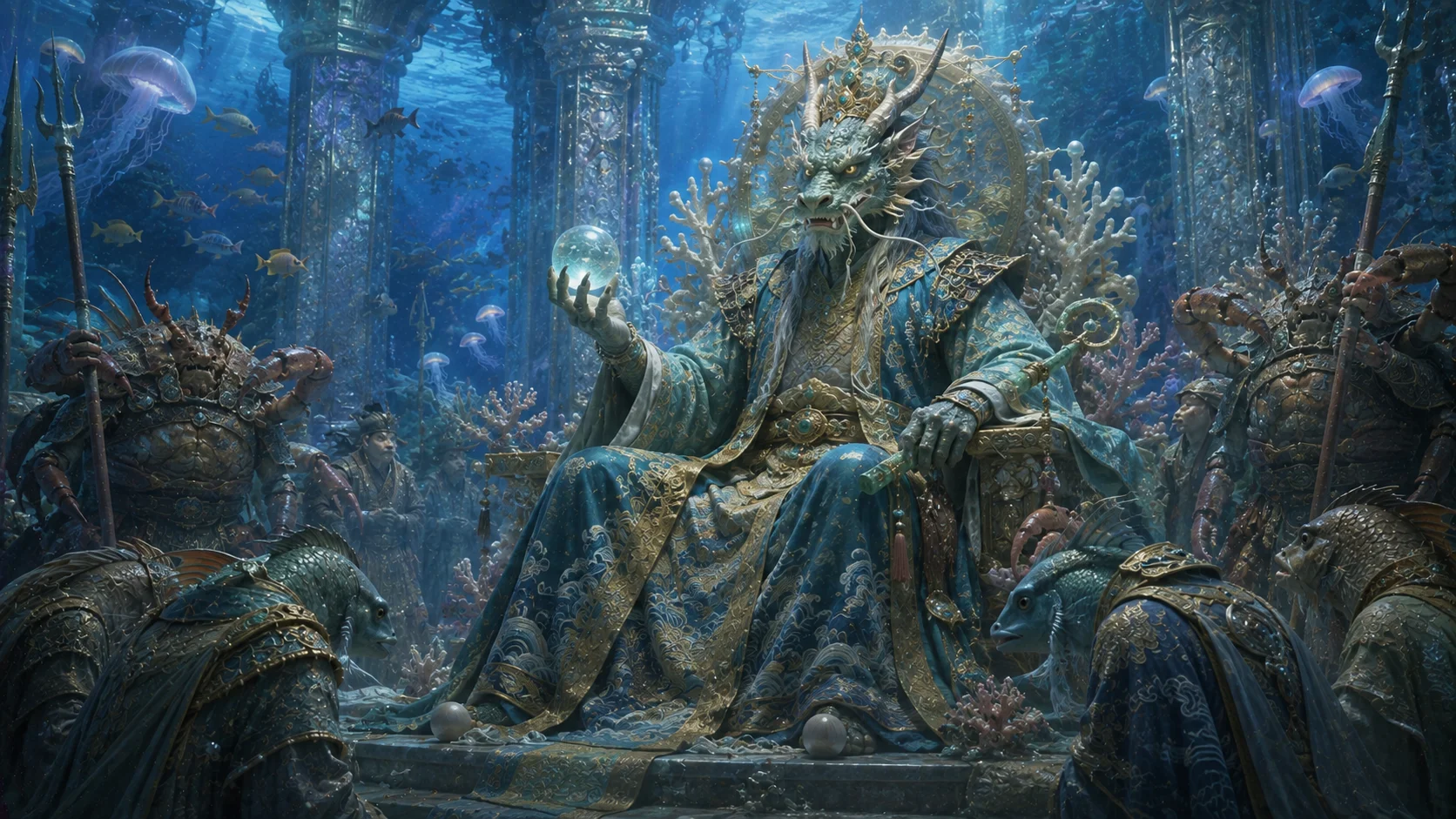
Meng Po does not act alone, and she does not act first. Chinese folk cosmology imagines Diyu as an administration in miniature — courts, ledgers, and officials, not unlike the bureaucracy of the living empire it mirrors. Before any soul reaches Naihe Bridge, it passes through the courts overseen by the Ten Yama Kings, among them Yanluo, the judge whose name became almost a synonym for the underworld itself in Chinese speech. It is in those courts that a soul's deeds are weighed and its next incarnation determined — what form it will take, what fortune or hardship awaits it, what lesson its next life is meant to teach.
Meng Po's station comes only afterward, and it belongs to a different kind of work entirely. Where the Yama Kings decide, she erases. Where they look backward across a completed life, she clears the way forward into one that has not yet begun. The soul that reaches her already has its fate settled; her task is only to make sure it walks into that fate without the burden of remembering what came before.
Why a Soul Must Forget to Live Again
The logic behind her role sits at the meeting point of Buddhist cosmology and distinctly Chinese sensibility. In the doctrine of samsara — lunhui in its Chinese form — souls are reborn again and again according to the weight of their past actions, cycling through existence until they are freed from it altogether. Indian Buddhist teaching does not require a literal potion to accomplish the forgetting that separates one incarnation from the next; the mechanism there is philosophical rather than narrative. Chinese folk religion, characteristically, wanted a scene, a gesture, a figure who could be pictured standing at a real bridge with a real bowl in her hands. Meng Po is that answer — a thoroughly Sinicized solution to a problem Buddhist cosmology posed in the abstract.
Without her tea, the tradition suggests, souls would carry their old attachments, grudges, and losses forward, and no life could ever begin cleanly. The child born into a new family would still ache for a mother it lost three lives ago. Forgetting, in this framework, is not a loss inflicted on the soul. It is the condition that makes a fresh life livable at all.
The Many Faces Behind One Name
Ask why Meng Po does this work and Chinese folklore does not give one answer — it gives several, none of them fixed as doctrine. In some versions she is remembered as a virtuous woman from an earlier life, someone whose compassion in the world of the living followed her even into death. Rather than pass on to her own next incarnation, she is said to have chosen to remain behind at the bridge, so that others would not have to carry the sorrows of their past lives into their futures. In this telling, her work is an act of deliberate mercy — a woman who understood grief well enough to spare strangers from it.
Other tellings offer different shapes to her story, different reasons for her post, different details of her life before she became the keeper of the bridge. None of these variants has ever been settled into a single authoritative biography, and none needs to be. Folk religion in China has never required its deities to hold one fixed origin the way scripture might demand; what stayed consistent across every version was never her backstory but her station — the bridge, the bowl, the erasure of memory. The biography is folklore. The function is fixed.
A Teahouse at the Edge of Everything
The image that survives in popular art and opera staging is deliberately domestic: an old woman running something like a modest teahouse, not a throne room or a torture chamber. She ladles her tea the way any elderly proprietor might serve a traveler passing through — with the plain competence of someone who has done this work more times than can be counted. There is no menace in the picture, and very little grandeur. It is precisely this ordinariness that has made her so durable in the popular imagination: she looks less like a cosmic force and more like someone's grandmother, waiting with a kettle at the edge of everything that has ever lived.
This everyday register also distinguishes her sharply from the other underworld figures a soul has already encountered by the time it reaches her. The courts of Yanluo carry the weight of judgment and consequence. Meng Po's pavilion, by contrast, carries the weight of an ending that is also, quietly, a beginning.
The Idiom That Outlived the Myth
Meng Po's afterlife in Chinese language may be even more persistent than her afterlife in religious narrative. To say someone has "drunk Meng Po's soup" is a common idiom for forgetting entirely, or for a fated fresh start scrubbed clean of what came before — a phrase reached for casually, in conversation that has nothing to do with the underworld at all. A person who cannot recall an old grievance, a couple starting over after a painful history, a life that seems to begin again from nothing: all of these get described, half-jokingly, in her terms.
Very few underworld figures anywhere achieve this kind of afterlife — a name that survives not because people still fear the bridge, but because the image of her bowl became the culture's shorthand for forgetting itself.
Opera, Scroll, and Story: Meng Po in Popular Voice
Long before any modern retelling, Meng Po populated the vernacular literature and performance traditions through which most people actually learned the geography of Diyu. Popular hell guidebooks, precious scrolls recited in village halls, and opera staged for holiday crowds all gave her a consistent role even as they varied her details: the old woman at the bridge, the tea that erases, the bureaucratic hush of an underworld doing its unglamorous, necessary work. These were not obscure texts confined to temples or scholars. They were the entertainment and moral instruction of ordinary households, which is exactly why Meng Po's image — teahouse, ladle, bridge — became so widely and consistently recognized despite never being fixed by a single scripture.
A Goddess China Made for Itself
Scholars of Chinese religion are careful to note what Meng Po is not: she is not part of the earliest Buddhist Yama literature translated into Chinese from Indian sources, and she has no required equivalent in Buddhist doctrine as it developed on the subcontinent. She belongs to a later layer, the elaboration of Diyu that Chinese popular religion built for itself once the basic architecture of underworld courts and judgment had already arrived from abroad. In that sense she is less an import than an addition — a distinctly Chinese answer to a distinctly Chinese question about what happens in the space between one life ending and the next one starting.
This also explains why she is sometimes loosely folded, in casual retelling, into the broader category of underworld hag or gatekeeper figures that populate regional Chinese folk religion. Careful folklore scholarship treats her as something more specific than that: a named figure with a defined motif — the soup, the bridge — that sets her apart from generic underworld crones even where popular imagination blurs the edges.
The Grief She Was Never Asked to Carry
There is something worth sitting with in the version of her story where Meng Po chooses to stay. A soul who might have moved on to her own peaceful rebirth instead remains fixed at the hardest junction in the whole cosmology, meeting every traveler at the single worst moment of transition, offering the same mercy again and again without pause and without acknowledgment. She is not thanked for it in most tellings, because the tea she gives ensures no one remembers there was anything to thank her for. It is a peculiar kind of devotion — service rendered permanently invisible by its own success.
Between the Court of Judgment and the Gate of Birth
It is worth being precise about what belongs to Meng Po and what belongs to the courts that precede her, because the two are easy to conflate. The Ten Yama Kings, Yanluo foremost among them, determine outcome: what a soul becomes, what fortune it is owed by the weight of its past conduct. Meng Po determines nothing about outcome at all. Her work is method, not judgment — she is the mechanism by which a decided fate is delivered clean, without the soul dragging old memory into a life it was never meant to recognize. The two stages together complete the underworld's task: judgment fixes where a soul is going, and Meng Po ensures it arrives there unburdened.
Forgetting as Compassion, Not Erasure
Taken as a whole, Meng Po's tradition frames forgetting not as a loss inflicted on the soul but as the last and gentlest act of the underworld's long process. A life that ends in grief, in longing, in unfinished love, does not have to reappear in the next one wearing all of that weight. The tea does not punish; it releases. Rebirth, in this vision, is not a repetition of suffering but an honest chance at something unmarked — made possible only because, at the edge of the Bridge of Helplessness, an old woman with a modest teahouse has spent longer than any story can measure making sure that no soul crosses over remembering what it cannot yet carry.
Sources & traditions
- EncyclopediaWikipedia — Meng Po
- TraditionChinese texts, oral tradition and village tellings (China)
Myths change from area to area and from time to time. This chronicle follows the most widely told versions; tellings in other villages, regions and eras may differ.