Heibai Wuchang, the Black and White Impermanence, are the paired psychopomp deities of Chinese folk religion — the spirit-officers sent out, always as a couple, always at the appointed hour, to fetch a soul from the world of the living and walk it into the world of the dead. Where grander gods sit in judgement, these two do the walking. They are attested in temple worship from at least the Qing dynasty in Fujian and Taiwan and across southern Chinese communities wherever the cult of the City God took root, and they remain, to this day, among the most recognisable faces in the underworld's bureaucracy — one laughing, one scowling, both utterly certain of their errand.
The Two Officers Under the City God
Heibai Wuchang do not rule anything. That is precisely the point of them. They are runners and enforcers, subordinate to the Chenghuang — the City God who holds jurisdiction over a town's living and dead alike — and beneath him, ultimately answerable to Yanluo Wang, King Yama, who presides over the full reckoning of souls in Diyu. Where the City God is a magistrate and Yanluo a supreme judge, Heibai Wuchang are the constables sent to the door: the ones who knock, who wait, who will not leave without you. Chinese folk religion has always populated its unseen bureaucracy with exactly this kind of rank-and-file spirit, and few pairs have lodged themselves in the popular imagination as firmly as these two.
Names Written in Impermanence
Wuchang, the word both figures share, is borrowed directly from Buddhist doctrine — anicca, impermanence, the teaching that nothing conditioned endures. Folk religion took that abstract truth and gave it two bodies, two faces, and a beat to walk on. This is Chinese religious life doing what it has always done best: fusing an imported philosophical concept with an indigenous vision of the afterlife as a functioning government, complete with clerks, ledgers, and enforcement officers. Heibai Wuchang belong to no canonical sutra and no fixed scripture. They are a product of temple worship and oral tradition, which is exactly why their story survives in several tellings rather than one, and why no single version of it should be mistaken for orthodoxy.
White Impermanence, the Tall Emissary
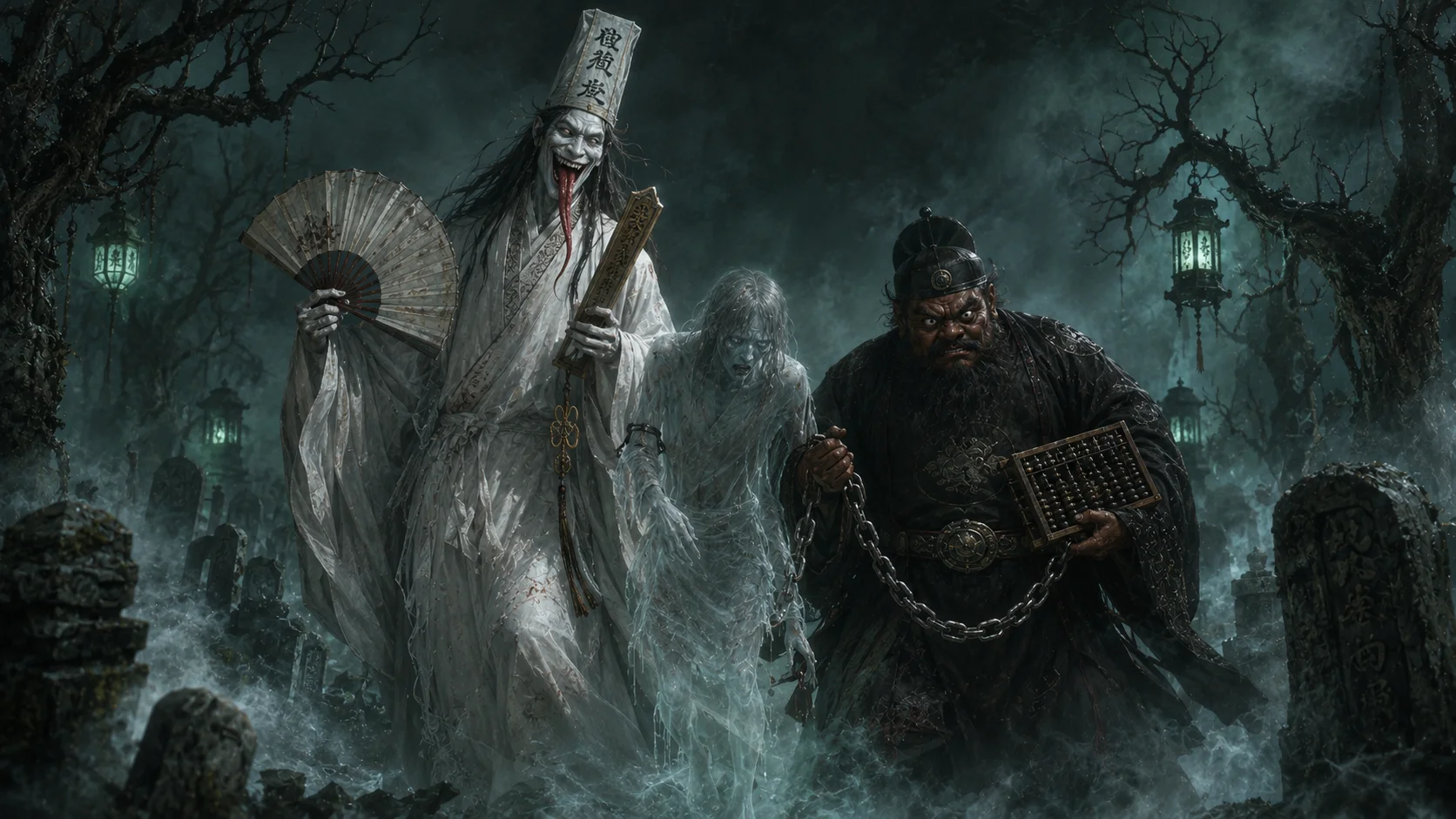
Bai Wuchang — White Impermanence, personal name Xie Bi'an — is the taller, paler, and by far the more sociable of the two. He is depicted in a long white robe, his face powdered white, a tall conical hat set on his head, and, most tellingly, a smile that never quite leaves him. That hat often carries an inscription: yi jian da ji, "one look brings good fortune," or else the wry, almost conversational ni ye lai le — "you too have come." It is a strange kind of welcome, spoken to the newly dead as though greeting an old acquaintance at a familiar gate. Bai Wuchang carries a fan in one hand and, in the other, the chained ledger known as the siming bu, the register of life and death, in which every soul's appointed hour is already written. He does not decide who dies. He consults the book and calls the name.
Black Impermanence, the Scowling Enforcer
Hei Wuchang — Black Impermanence, personal name Fan Wujiu — is his necessary opposite: black-robed, black-faced, capped with a round hat, his expression fixed in a scowl that has frightened children in temple courtyards for centuries. Where Bai Wuchang beckons, Hei Wuchang compels. He is typically shown with an abacus, tallying a soul's accumulated debts and merits, or with chains, reserved for those spirits reluctant to follow quietly. The two figures are, visually, a single argument made in two bodies — fortune and misfortune, invitation and compulsion, the smile and the frown standing shoulder to shoulder at the same threshold. Worshippers reading their statues side by side are meant to feel both halves of what death is: an appointment that has been kept for you, and one you cannot refuse.
The Bridge, the Flood, and the Broken Meeting
The legend that explains how two mortal men became death's own officers is folk story rather than fixed doctrine, and it survives in more than one shape — sometimes the pair are sworn brothers, sometimes lowly government clerks or yamen constables, sometimes simply old friends. The core of it holds steady across the retellings. The two had sworn to meet beneath a bridge. One arrived early; before the other could come, the skies opened and the river began to rise. The brother in black went to fetch an umbrella so his friend would not have to stand in the rain, but the floodwaters rose faster than he could return, and he drowned trying to keep the promise. The brother in white waited at the bridge as the water climbed around him, refusing to leave the spot they had agreed on — and rather than break the pact that bound them, he hanged himself on the very structure where they were meant to meet.
A Debt Repaid in the Court of Yanluo
What could have been simply a tragedy became, in folk telling, an origin. The devotion the two men showed each other — xin, the virtue of trustworthiness kept even at the cost of life — was noticed by the powers above, in some versions the Jade Emperor, in others Yanluo Wang himself. Rather than let such loyalty dissolve into the ordinary churn of reincarnation, the two were raised to the underworld's service and given the very task their deaths had already rehearsed: to walk beside the dying, to keep an appointment no one escapes, and never again to fail to meet at the appointed place. It is a story built entirely from a single virtue, stretched until it explains an entire cosmology — which is precisely why it has endured in temple courtyards long after its details have been allowed to drift.
The Ledger and the Chains
In their working iconography, Heibai Wuchang are less mythic figures than functionaries with tools. Bai Wuchang's fan and shackled register mark him as the one who reads the appointment and announces it — his instruments are for summoning, not seizing. Hei Wuchang's abacus and chains mark him as the one who accounts for what is owed and restrains what resists. Between the two of them they cover the entire transaction of a death: the calling of the name, the tallying of the debt, and, where necessary, the physical binding of a soul unwilling to leave the world it knew. Nothing about their equipment is decorative. Every object a temple sculptor gives them is a piece of underworld paperwork made visible.
Kin to Ox-Head and Horse-Face, Yet Not the Same
Visitors to Chinese temples sometimes confuse Heibai Wuchang with Niutou and Mamian, Ox-Head and Horse-Face, the other well-known escorts of the dead — and the confusion is understandable, since both pairs perform the same essential labour of bringing souls into the underworld. The distinction folk tradition draws is one of jurisdiction. Niutou and Mamian serve directly under Yanluo Wang, operating within Diyu itself, the underworld proper. Heibai Wuchang belong instead to the City God's earthly domain — they are the officers who go out into the streets and homes of the living, under the Chenghuang's authority, to bring a soul as far as the threshold before others take over. One pair works the underworld's own halls; the other works the world above it, at the exact boundary where the two meet.
Flanking the City God's Throne
Walk into almost any Chenghuang temple across Fujian, Taiwan, or the diaspora communities descended from them, and Heibai Wuchang are rarely far from view — typically flanking the City God's central statue, tall enough to loom over worshippers even from the side aisles. The Xia Hai City God Temple in Taipei is one of the tradition's best-known homes for this arrangement, its incense-blackened statues of Bai and Hei Wuchang standing sentinel exactly where the legend puts them: at the god's side, ready to be sent out. Their placement is not incidental. A City God temple without its Wuchang pair would be, in the eyes of many devotees, missing the very officers that make its administration of the dead complete.
The Night the Streets Belong to Bai Wuchang
Nowhere is Bai Wuchang more visible, or more beloved, than during Taiwan's Zhongyuan pudu observances — the Ghost Festival season when the gates of the underworld are said to open and wandering spirits are fed and appeased. Keelung's pudu parade is famous for it: a towering effigy of Bai Wuchang, sometimes many times human height, carried through the streets as the guest of honour, welcoming the very ghosts he might otherwise be sent to collect. On his own birthday, celebrated with City God processions in the same tradition, he is treated less as an agent of dread than as an honoured guardian — proof that a figure whose entire office is death can still be given a festival day, garlands, and a crowd's genuine warmth.
Offerings for the Approachable Dead
That warmth shows up in smaller, quieter ways too. Devotees who leave offerings before statues of Heibai Wuchang do not always bring the formal fare of incense and fruit alone — cigarettes, betel nut, and wine appear regularly at their feet, the kind of gifts one might bring an uncle rather than a judge. It is a telling contrast to their grim function: a folk tradition that has decided its death-officers, for all the fear they are entitled to command, are also approachable, even a little comic, figures who might appreciate a smoke and a drink like anyone doing an unpleasant job well. Fear and familiarity sit together here without contradiction, which is very much how Chinese folk religion tends to hold its underworld — close, transactional, and never entirely without humour.
Wuchang on the Stage and in the Storyteller's Mouth
Traditional opera and ghost-story literature have long found Heibai Wuchang irresistible as characters precisely because they are civil servants, and civil servants, in every culture's folklore, can sometimes be reasoned with. Stock tales cast them as figures who might be bribed with wine, outwitted by a clever mortal, or moved to mercy by a display of genuine virtue — postponing a death, looking the other way, or bending the rigid schedule of the siming bu just once. These stories are not theology; they are folk commentary on fate itself, voicing a very human hope that even the most fixed appointment might, under the right circumstances, be negotiated. That hope is part of why the pair remain such durable dramatic figures centuries after the plays that first popularised them were written.
Between Buddhist Mercy and Daoist Bureaucracy
Some regional traditions place Heibai Wuchang within an even wider frame, treating them as attendants or subordinate aspects connected to Dizang Wang, the bodhisattva known elsewhere as Ksitigarbha, whose vow to empty the hells of suffering souls sits at the compassionate end of underworld cosmology. That such an association exists at all is a small monument to how thoroughly Buddhist and Daoist frameworks have interlaced in Chinese folk practice: a bureaucratic Daoist underworld staffed with ledgers and chained registers, watched over at its furthest horizon by a Buddhist vow of universal mercy. Heibai Wuchang stand at the meeting point of both systems — enforcers of an appointment that is, in the end, also understood as an act of compassionate release.
Faces That Change Their Colour
It should be said plainly that none of this is fixed scripture. Regional traditions vary on which brother wears white and which wears black, some give the pair entirely different names, and the founding legend itself shifts shape depending on the town, the temple, and the storyteller — sworn brothers in one telling, yamen colleagues or simple friends in another, the flood sometimes a river, sometimes a rising tide beneath a different bridge entirely. This is not a flaw in the tradition but a feature of how folk religion actually lives: carried temple to temple, generation to generation, changing its details while keeping its shape, so that Heibai Wuchang can be venerated in a dozen slightly different forms and still, unmistakably, be recognised as themselves — the two who kept their promise, and were given eternity to keep it.
Sources & traditions
- EncyclopediaWikipedia — Heibai Wuchang
- TraditionChinese texts, oral tradition and village tellings (China)
Myths change from area to area and from time to time. This chronicle follows the most widely told versions; tellings in other villages, regions and eras may differ.