Caishen, the God of Wealth, occupies a place in Chinese folk religion shared by almost no other deity: he is worshipped in nearly every home and shop in the tradition, and yet there is no single agreed answer to who he actually is. Scholars describe Caishen not as one canonical personage fixed in scripture, but as a title — a divine office of sorts — that different regions, sects, and even individual families have filled with different historical and legendary figures. This is not treated as a problem to be solved. It is simply how the god of wealth exists.
A Title Worn by Several Faces
Ask a household in northern China who Caishen is and the answer may differ from a merchant family in Jiangnan, and both would be considered correct within their own tradition. The plurality of Caishen is openly acknowledged rather than resolved: no single scripture, council, or lineage has ever declared one figure the sole and final God of Wealth. Instead, at least three distinct men — a fallen Daoist marshal, a martyred Shang minister, and a retired statesman-merchant — have each been elevated to the role in different corners of Chinese folk religion, alongside a fourth deity who fills the function without formally holding the title.
Zhao Gongming and the Iron Whip that Subdues Dragons
The most widely cited literary origin of Caishen comes from the Ming-dynasty novel Investiture of the Gods (Fengshen Yanyi). In its telling, Zhao Gongming was a warrior who died fighting on the losing Shang side of a great dynastic conflict. Death did not end his story — the Jade Emperor posthumously canonized him, naming him Marshal of the Zhengyi, or "Right-One," Chief of Wealth, and placing under his command four subordinate Wealth-Bringing Immortals: Zhaobao Tianzun, Nazhen Tianzun, Zhaocai Shizhe, and Lishi Xianguan. Through this act, a defeated general became the head of a small celestial bureaucracy devoted entirely to prosperity.
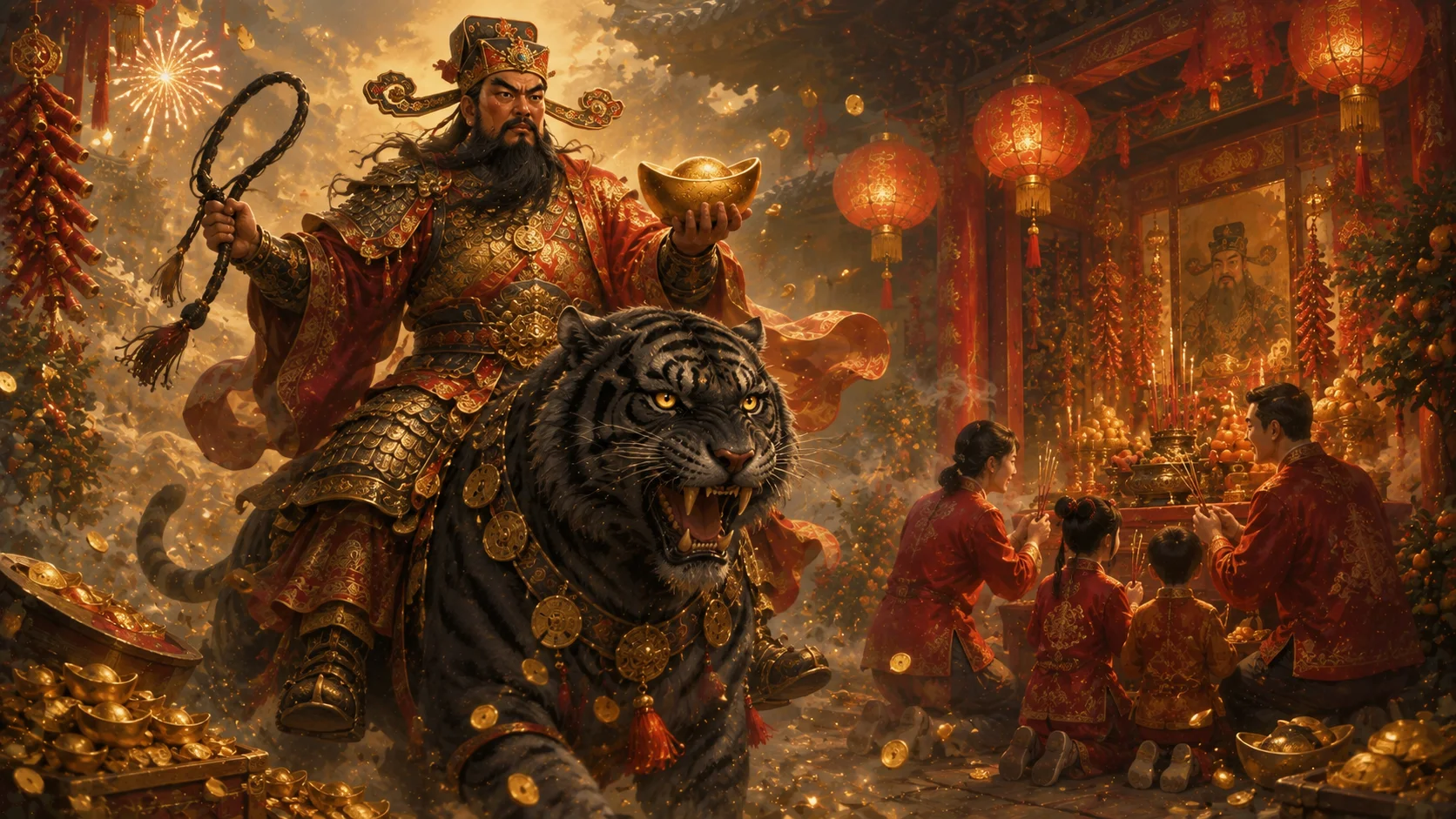
Zhao Gongming's iconography still carries the memory of his martial origins. He is depicted with a dark, almost fearsome face, clad in armor, mounted on a black tiger, and gripping an iron whip or rod — sometimes named the Iron Whip that Subdues Dragons. This is not the gentle, smiling gift-giver one might expect of a wealth deity. He reads instead as an exorcistic, protective force: a god who does not simply hand out riches but stands guard over them, and over the households and shops that keep his image.
The Loyal Minister Whose Heart Was Cut Out
A very different tradition identifies Caishen with Bi Gan, a righteous minister of the Shang dynasty and uncle to the tyrant King Zhou. Bi Gan's story is one of principled defiance: he remonstrated against his nephew's misrule, refusing to stay silent while the kingdom was ill-governed, and paid for that honesty with his life. In the most dramatic version of the account, King Zhou had his heart cut from his chest as punishment for daring to criticize the throne.
Out of this brutal end came a form of veneration built not on martial power but on moral character. Bi Gan's posthumous reputation for incorruptible honesty led worshippers to see in him a different model of wealth altogether — one earned and guarded through integrity rather than force. Where Zhao Gongming protects prosperity with a whip and a tiger, Bi Gan is honored as a civil god whose gift is fair dealing: wealth that comes to those who deal justly, and is denied to those who do not.
Fan Li, the Statesman Who Made and Gave Away Fortunes
In the merchant culture of the Jiangnan region, a third identification takes hold: Fan Li, a historical statesman of the Spring and Autumn period who served as advisor to King Goujian of Yue. After a career in politics, Fan Li retired from court life and turned to commerce, where he became celebrated for a very particular skill — amassing great fortunes through business acumen and then redistributing them, again and again, rather than hoarding what he built.
Fan Li's veneration reflects a third and distinctly practical model of prosperity: wealth gained not through martial protection or moral righteousness alone, but through genuine commercial skill. He stands as a patron for those who see fortune as something built through cleverness, timing, and the willingness to let money circulate rather than simply accumulate. In regions shaped by trade and merchant life, this version of Caishen resonates in a way the martial or purely moral forms do not.
Civil Fortune and Martial Fortune, Side by Side
Chinese folk religion organizes these overlapping identities into a broad, workable distinction: Wen Caishen, the Civil God of Wealth, generally understood as Bi Gan or sometimes linked to the star deity Fu Xing, and Wu Caishen, the Martial God of Wealth, usually Zhao Gongming, though occasionally extended to Guan Yu in his role as a commercial patron. The pairing is not decorative. It expresses two distinct ethical paths to prosperity — one rooted in scholarship and integrity, the other in protection, enterprise, and martial strength.
This civil-versus-martial framework gives households and businesses a way to choose which face of Caishen suits their own understanding of how wealth ought to be gained and defended, without needing to declare any other version false. A family that prizes honest dealing may lean toward the civil god; a shop that feels exposed to misfortune or theft may prefer the guardian marshal on his black tiger.
Guan Yu, the Warrior Who Became a Merchant's Patron
No account of wealth veneration in Chinese folk religion is complete without Guan Yu, whose primary religious identity is that of a martial and loyalty deity rather than a dedicated god of wealth. Yet Guan Yu's legendary reputation for scrupulously honoring his oaths and financial obligations made him, in practice, an enormously popular patron of merchants and shopkeepers. In countless businesses across Chinese communities, his image functions as a de facto Wu Caishen — a protector of commercial integrity and prosperity — even though he was never formally installed in the wealth-god office the way Zhao Gongming or Bi Gan were. His presence in this tradition is a reminder that the boundaries around Caishen's identity are porous, shaped as much by what merchants needed a god to represent as by any fixed doctrine.
Gold Ingots, the Character of Fortune, and the Fish of Abundance
Whichever figure a household has in mind, the visual language surrounding Caishen stays remarkably consistent. Images and statues commonly show him with gold ingots, known as yuanbao, cradled or stacked nearby, along with a wand or rod associated with attracting wealth. The character Fu, meaning fortune, frequently appears alongside him, and fish — yu, a word that sounds like the term for surplus or abundance — round out the symbolic vocabulary. These shared symbols allow the many regional and sectarian versions of Caishen to remain visually unified even while their underlying identities diverge.
An Altar in Nearly Every Shop
Few deities in Chinese folk religion enjoy worship as widespread as Caishen's. Statues and images of him, in whichever regional form a household favors, are placed in homes and — perhaps even more prominently — in businesses and shops, where his presence is treated as a practical necessity rather than an optional devotion. Incense is offered to him regularly, with particular intensity building around the Lunar New Year, when the coming year's fortunes feel most immediately at stake.
Welcoming Wealth on the Fifth Day
The fifth day of the first lunar month holds special significance across northern Chinese and Cantonese traditions alike. Known as Ying Caishen, or Po Wu, this day is set aside specifically for welcoming the god of wealth into the household or business for the year ahead. Firecrackers are set off, special foods prepared, and ritual greetings exchanged, all aimed at the same goal: inviting prosperity across the threshold at the very start of the new cycle, before the routines of ordinary life resume.
Prosperity as a Sanctioned Domain of the Divine
Underlying all of these practices is a belief that runs through much of Chinese folk religion: that material prosperity is not a lesser or unworthy concern compared to spiritual salvation, but a legitimate domain in which the divine is expected to intervene. Caishen, in his many guises, gives that belief a face and a set of rituals. The coexistence of a martial form who protects wealth by force and a civil form who ensures wealth is gained righteously reflects two distinct ethical models — protection and virtue — sitting comfortably within one folk tradition, each honored where it fits.
Holding Contradiction Without Needing to Resolve It
Perhaps the most distinctive feature of Caishen's worship is how little tension believers feel over the fact that Zhao Gongming, Bi Gan, and Fan Li cannot all literally be the same person. In a doctrinal system built around a single fixed truth, this would be a contradiction demanding resolution. In Chinese folk religion's more pragmatic and non-exclusive approach to divine identity, it simply is not treated that way. A family's choice of which Caishen to honor is shaped by region, inherited custom, and personal preference, and none of these choices is considered to invalidate the others. The god of wealth, it turns out, is large enough to be several people at once — and that plurality, rather than undermining his worship, may be part of what has kept it so universal.
Sources & traditions
- EncyclopediaWikipedia — Caishen
- TraditionChinese texts, oral tradition and village tellings (China)
Myths change from area to area and from time to time. This chronicle follows the most widely told versions; tellings in other villages, regions and eras may differ.