Zao Jun, the Kitchen God, keeps his post above the stove in nearly every traditional Chinese household, watching the family's conduct through the turning of the year. Once a year he leaves that post entirely, rising to the court of Heaven to lay a full account of the household before the Jade Emperor — and it is that single, dreaded, anticipated journey that shapes almost everything believers do around him.
A Post Above the Flame
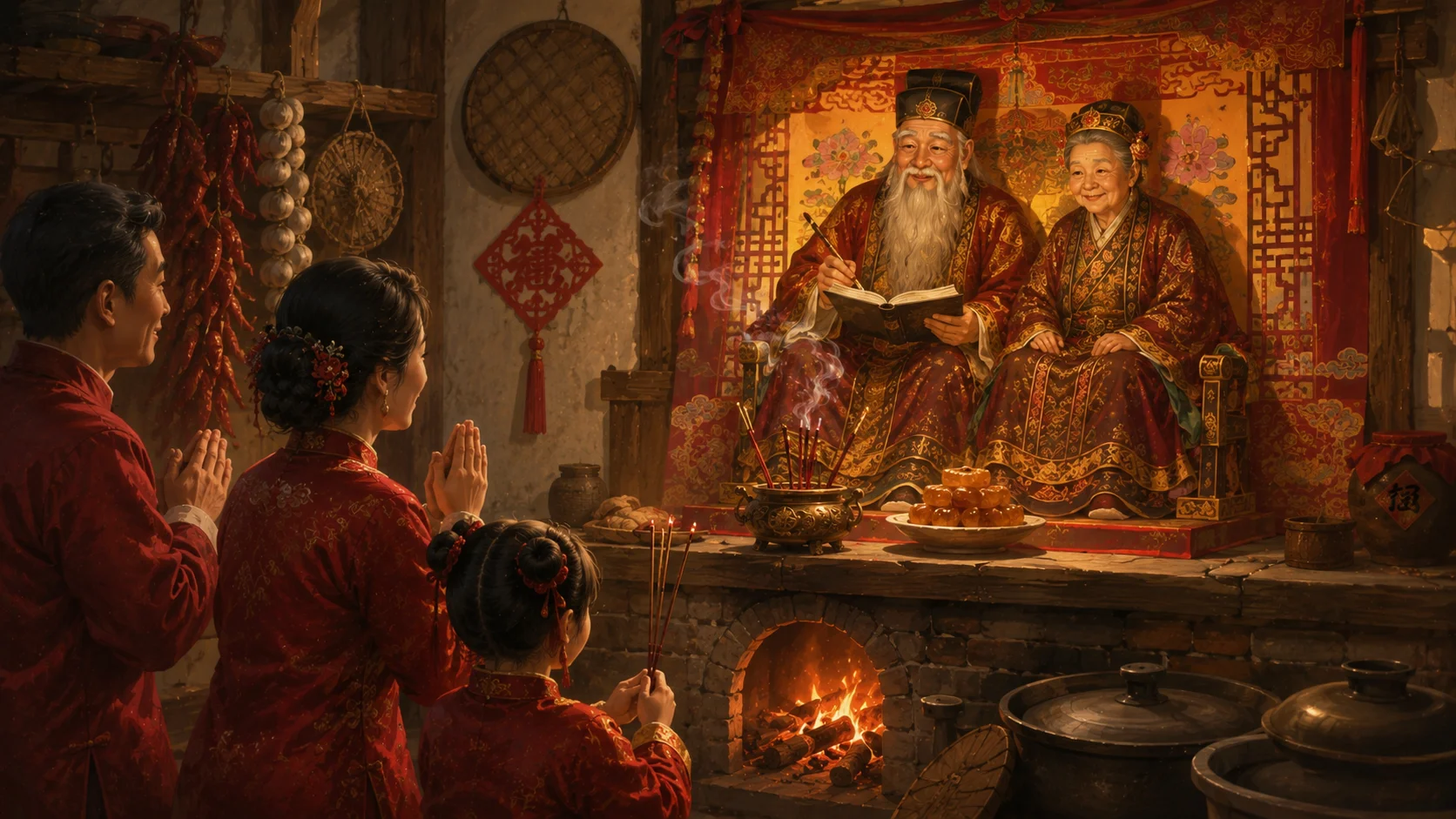
Zao Jun's place in the home is not incidental to who he is — in the most literal readings of the tradition, he is inseparable from the stove itself, the household's daily source of cooked food, warmth, and gathering. To install his image near or above the hearth is to place the family's most consequential deity exactly where its most essential domestic activity happens. He is typically pictured as an older man with the bearing of a bureaucratic official, often in the robes of a court functionary, a detail that is not decorative but doctrinal: Zao Jun's entire cosmological role is that of an official, and his image is meant to look like one.
An Antiquity Older Than the Legends Told About Him
The cult of a kitchen or stove spirit — referred to in early sources as Zao Shen — predates the fully elaborated folk narrative that later became attached to him. Ritual and philosophical writing from as early as the Han dynasty already discusses offerings made to household and stove spirits, showing that reverence for a deity of the hearth is not a late folk invention layered onto an older figure, but a genuinely ancient thread of domestic religion that the more colorful legends of later centuries were woven around, not out of nothing.
The Tale of Zhang Lang
The most widely circulated origin story identifies Zao Jun with a mortal man, sometimes called Zhang Lang or Zhang Sheng, whose life took a bitter shape: he mistreated a virtuous wife, abandoned her for another woman, and in time fell into poverty and blindness. In his ruin, unknowing, he was cared for by the very wife he had wronged. When he finally recognized her, shame overtook him so completely that he threw himself into the kitchen stove and died there. The story does not end in punishment alone — the Jade Emperor, moved by what had happened, took pity on him and appointed him the household's resident overseer, a position that is at once a penance for his failures as a husband and a kind of redemption, since it makes him forever after the guardian of the domestic order he once broke.
Regional Voices, One Deity
Like much of Chinese folk religion, the particulars of Zao Jun's story and worship are not uniform across the country, and this variation is not a flaw in the tradition but a feature of how a genuinely living, regionally rooted practice works. In northern China, his report to Heaven is more commonly held to fall on the twenty-third day of the twelfth lunar month; in the south, the twenty-fourth is more usual. The foods offered to him, the exact wording of household prayers, and small details of the send-off ritual likewise shift from province to province and household to household. No single date or custom should be read as the fixed, universal form of the observance — the diversity is the practice.
The Ledger Kept All Year
Central to Zao Jun's religious function is the idea that he is always watching and always recording. From his post in the kitchen — the room where a family's daily life concentrates — he observes conduct, quarrels, kindnesses, and failings as they happen, compiling an account that only becomes consequential once a year but that is being written continuously. This is what gives him his distinctive moral weight within the home: he is not a distant judge invoked only in crisis, but a quiet, constant presence whose accumulated report will eventually matter enormously.
The Night of the Ascent
Traditionally on the twenty-third or twenty-fourth day of the twelfth lunar month, Zao Jun rises from the stove and travels to Heaven to deliver his account of the household directly to the Jade Emperor. The Jade Emperor, on hearing this report, determines the fortune the family will receive in the coming year. This is the hinge on which the entire cult turns: everything else in Zao Jun's worship — the sweets, the burning of his image, the timing of household cleaning — exists in relation to this one annual act of testimony.
Sweetening the Messenger
In the days before his departure, households traditionally present Zao Jun's paper image with sticky, sweet offerings — maltose candy, tangyuan, honey, and similar foods. Folk explanations for this practice diverge, and both are told without either being treated as more official than the other: some say the sweetness is meant to put good words in his mouth, so that whatever he reports will be softened and favorable; others say the point is more direct, that the candy is sticky enough to seal his lips shut so that unfavorable conduct simply cannot be spoken aloud before the Jade Emperor. Whichever explanation a household holds, the underlying gesture is the same — an attempt, however gently comic in tone, to influence a report already fixed by a year of real behavior.
Burning the Paper Face
To send Zao Jun on his journey, the household burns his paper image, often mounted alongside a paired image of his wife, Zao Jun Furen, also called Zaowang Nainai. The burning is not a disposal but a departure — the flame is understood as the vehicle that carries him upward to Heaven to deliver his account. This send-off, performed around Xiaonian, the Little New Year, marks the moment the kitchen is left without its resident overseer, a small but meaningful absence in the household's spiritual order until his return.
A New Face for the New Year
Zao Jun does not remain absent for long. As Chinese New Year approaches, a new paper image is pasted up near the stove to welcome him back and mark his resumption of his post. This welcoming is the necessary counterpart to the earlier burning — together the two rituals frame the household's year with a departure and a return, and the freshly pasted image signals that the kitchen's watchful presence, and the moral accounting that comes with it, has begun again from a clean page.
Nianhua and the Painted Couple
Zao Jun and his wife are frequently rendered together in nianhua, the New Year prints that are among the most familiar visual traditions of Chinese folk religion. Pasted near or above the stove, these paired images give the couple a settled, domestic presence rather than the remote grandeur of temple statuary — they are pictured as belonging to the house itself, official-looking but intimately positioned within its most lived-in room.
Little New Year and the Turning of the Household
The day of Zao Jun's ascent, Xiaonian, carries significance far beyond his own cult. It functions as the traditional starting point for the entire season of Chinese New Year preparation, including the thorough house-cleaning that precedes the holiday. In this way, a ritual centered on one household deity's departure becomes a structural anchor for the broader calendar, setting in motion the sequence of domestic renewal that culminates in the New Year itself.
A Bureaucracy That Mirrors the Empire
Zao Jun's role only fully makes sense against the backdrop of how the Chinese folk-religious cosmos is imagined: as an administration that mirrors the structure of imperial government. The Jade Emperor sits as its central authority, and beneath him a hierarchy of officials — celestial and local — file reports much as magistrates once reported to the imperial court. Zao Jun functions as exactly this kind of local reporting official, assigned to a single household the way a magistrate might be assigned to a single district, his stove-side post a small administrative office within a vast celestial bureaucracy.
Neighbors in the Household Pantheon
Zao Jun is not the home's only spiritual guardian, and his worship exists alongside, rather than in place of, other protective figures. Door gods, or Menshen, guard the threshold against harmful influences, and the Earth God, Tudigong, watches over the immediate locality of the home. Each of these deities is understood to hold a distinct domain of responsibility, and Zao Jun's is unmistakably the domestic conduct of the family itself, exercised through his singular power of annual testimony.
A Report That Shapes Behavior
Because Zao Jun's account is believed to directly determine the family's fortune for the coming year, his presence functions as a living mechanism of household ethics — not an abstract moral teaching but a felt, personal accountability, since the very deity who will one day report on a wrongdoing is also the one who cooked beside it in the kitchen all year. Families have long treated the coming of his ascent as an annual reminder to examine their own conduct, making him as much a quiet keeper of domestic order as a figure of devotion.
Sources & traditions
- EncyclopediaWikipedia — Kitchen God
- TraditionChinese texts, oral tradition and village tellings (China)
Myths change from area to area and from time to time. This chronicle follows the most widely told versions; tellings in other villages, regions and eras may differ.