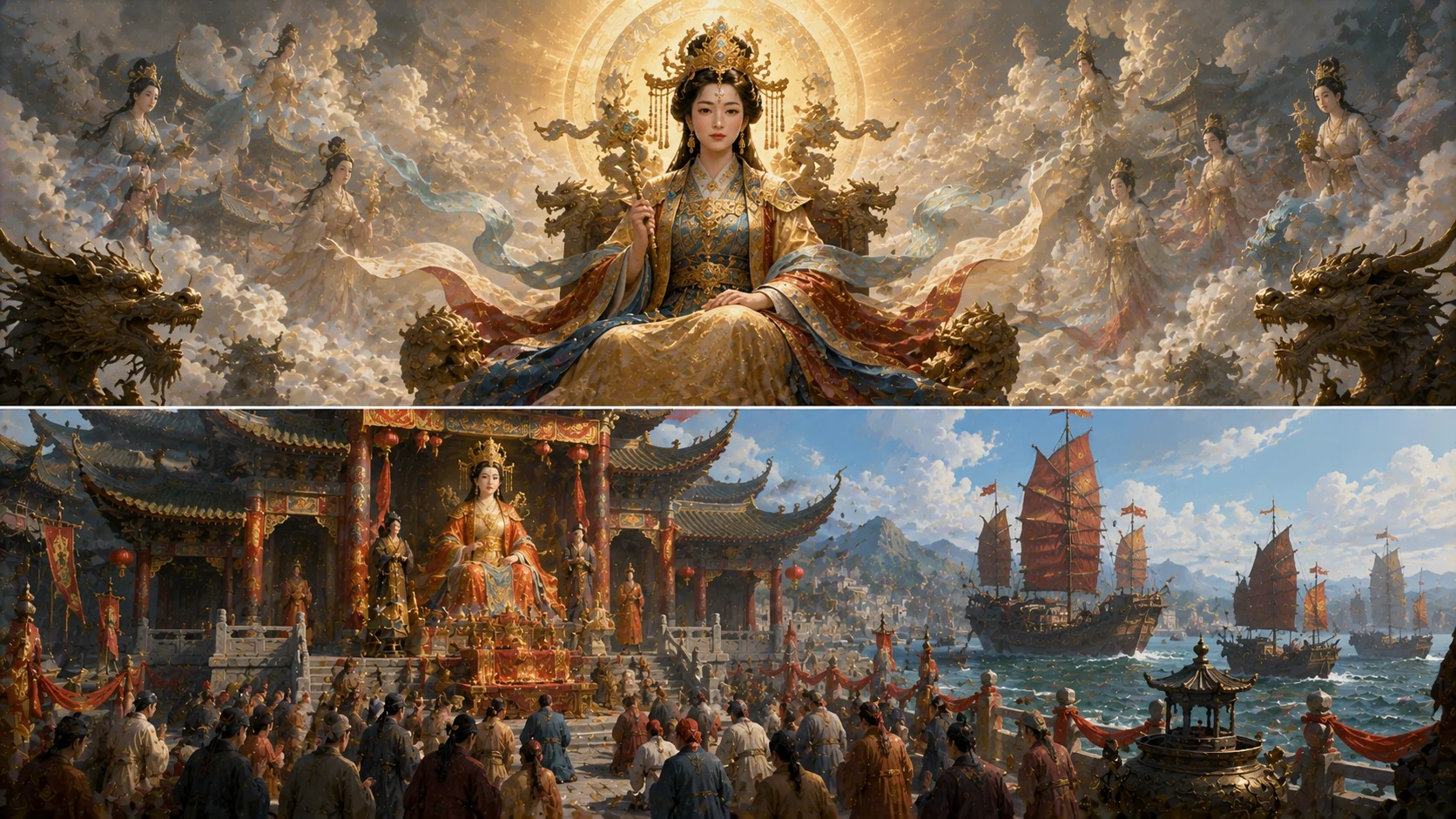
Tianhou — Tiānhòu (天后), the Empress of Heaven — is the supreme exalted title and aspect of the sea-goddess Mazu in Chinese religion: the highest honour by which the beloved protectress of sailors is venerated, raised by imperial decree to be the “Empress of Heaven,” a great celestial goddess. Where Mazu is the intimate, maternal sea-goddess, Tianhou is her exalted, imperial, heavenly form.
The Exaltation of Mazu
Tianhou (“Empress/Queen of Heaven”) is the highest of the many titles given over the centuries to Mazu, the deified sea-goddess (the spirit of Lin Moniang). As Mazu’s cult grew ever greater — carried across the seas by the seafaring peoples of southern China, Taiwan, and the overseas Chinese diaspora, and credited with countless rescues of sailors and even of imperial fleets and envoys — successive emperors honoured her with ever-grander posthumous titles, raising her step by step up the celestial hierarchy: from “Lady” to “Consort” to “Heavenly Consort (Tianfei)” and at last, in the Qing dynasty, to the supreme rank of “Tianhou,” the “Empress of Heaven” — and even “Holy Mother in Heaven.” In this exalted form she is a great celestial empress-goddess, second in dignity among the goddesses perhaps only to the highest.
Last updated .
The Empress of Heaven and the Sea
As Tianhou, the Empress of Heaven, Mazu is venerated in her most majestic aspect — robed and crowned as a celestial empress, enthroned in glory, the supreme protectress of the seas and of all who depend on them. Her great temples are called Tianhou temples (Tin Hau temples in Cantonese) — found in every coastal Chinese city, in Taiwan, Hong Kong, Macau, and throughout the overseas Chinese world from Southeast Asia to the ports of the wider world — among the most important and beautiful temples of the Chinese religious landscape. Whether invoked intimately as “Mazu” (Maternal Ancestor, the kindly mother of sailors) or majestically as “Tianhou” (the Empress of Heaven), she is the same beloved goddess of the sea — the fisherman’s daughter raised, by her boundless mercy and the gratitude of the seafaring peoples, to the highest heaven.
The Imperial Goddess of the Seafarers
The title Tianhou reflects the supreme importance of Mazu to the maritime Chinese world and the official recognition of her cult by the empire itself. The Empress of Heaven, the exalted celestial form of the sea-goddess Mazu, crowned and enthroned in glory, protectress of the seas, honoured in the great Tianhou temples of every port — Tianhou is the imperial, heavenly aspect of the beloved sea-goddess of China. (See also Mazu for her life and legend.)
The Politics of a Title
Titles like Tianhou were not simply bestowed — they were negotiated, in a very particular sense, between a local shrine and an empire that needed to know which gods it could trust. Imperial China kept an official register of sanctioned cults, sorting spirits into the zhengsi, the canonical sacrifices the state recognised and protected, and the yinsi — the “illicit” or “excessive” sacrifices whose shrines a conscientious magistrate was expected to pull down. A fisherman’s daughter from a small island off the Fujian coast had no natural claim on the first category. She earned it one crisis at a time.
The first imperial notice came in 1123, and it was not a title at all. A Song envoy named Lu Yundi, returning from a mission to the Korean court, lost most of his convoy to a storm in the Eastern Sea and credited his own survival to the island spirit of Meizhou. Emperor Huizong’s response was a plaque for her temple reading Shunji, “Favourable Crossing” — recognition of the shrine rather than promotion of the goddess. Her first personal rank came a generation later, in 1156, when the Southern Song court named her Linghui Furen, “Lady of Numinous Grace.” From that rung the climb never really stopped. By the reckoning of the standard lists she was re-titled at least thirty-six times over the following seven centuries, the last grant arriving in 1872, by which point her full official style had swollen past sixty characters and had to be abbreviated on all but the most formal stelae.
Each major promotion has a specific emergency behind it. In 1281 the Yuan court raised her to Tianfei, “Heavenly Consort” — in full, the Heavenly Consort who protects the state and illuminates the people. The Mongol capital in the north was fed by an enormous sea-borne grain transport out of the rice country of the Yangtze delta, and the officials who pressed her case argued her protection of that fleet explicitly. It was a decisive shift. Her cult was no longer tied to one grateful envoy; it was tied to whether the capital ate.
The Ming admiral Zheng He — a Muslim by upbringing, which makes his patronage of a Chinese sea goddess one of the more telling details of his career — credited Tianfei with carrying his treasure fleets through storms, and the court extended her title again in 1409 on the strength of it. His devotion left buildings and stone behind. The Yongle Emperor ordered a Tianfei palace raised at Nanjing in 1407, after the first voyage came home; a reconstruction stands there today, built for the six-hundredth anniversary of the expeditions. Before the last voyage sailed, Zheng He and his officers restored her temple at Changle in Fujian and set up a stele recording what they believed she had done for them — an inscription that survives as one of the few first-hand accounts of the voyages left by the men who made them.
The final leap came with the conquest of Taiwan. In 1682 the Qing admiral Shi Lang massed his invasion fleet at Pinghai on the Fujian coast and found the well in front of the local Tianhou temple brackish and undrinkable. He prayed to the goddess, ordered the well dug deeper, and reported that it yielded fresh water in inexhaustible quantity; he had a stele cut on the spot naming it Shiquan, the Army’s Spring, and it still stands. Taiwan fell the following year, and Shi Lang petitioned the throne to reward the goddess who he insisted had made it possible. The Kangxi Emperor granted the rank this article is named for — Tianhou, Empress of Heaven — formal parity with the highest tier of the state pantheon. A village spirit too small to register had become, on paper, an empress.
The Two Generals Who Serve as Her Eyes and Ears
Step into almost any Tianhou temple and two oversized, fierce-faced figures flank the approach to the main altar, glaring outward at the doors rather than up at the goddess they serve. One strains forward with bulging eyes; the other cups a hand to an enormous ear. They are Qianliyan, “Thousand-Mile Eye,” and Shunfeng’er, “Ears That Hear on the Wind” — demons in the older stories, and in the version most often told, a pair who confronted Lin Moniang at Peach Blossom Mountain and were beaten outright by a girl they had badly underestimated. Defeated, they swore never to leave her side, and after her deification they became her permanent attendants.
Their names describe her power more precisely than any imperial title does. Tianhou is not imagined as protecting shipping in some general, distant way. She is a goddess who can see a boat foundering a thousand miles out and hear one sailor’s prayer through the noise of a gale. The two generals are the mechanism by which an empress enthroned in heaven still notices a single drowning fisherman.
Mazu by the Sea, Tin Hau in the Harbour
Ride the MTR to Tin Hau station on Hong Kong Island and you step out, by name, inside this goddess’s imperial title. The station was named for a small temple at the foot of Red Incense Burner Hill; the surrounding district was then named for the station. A Song-to-Qing honorific, filtered through Cantonese pronunciation and a subway map, ended up as a postal address.
The split in usage is not trivial. In Taiwan and Fujian, ordinary devotion runs almost entirely under the older, warmer name: people join a Mazu association, walk a Mazu pilgrimage, argue about Mazu — even when the gate above their heads is carved Tianhou Gong in formal characters, and the grander title survives mainly on plaques, stelae and official documents. In Hong Kong, Macau and Cantonese-speaking Guangdong the imperial title won instead: more than a hundred Tin Hau temples, a Tin Hau Festival, a Tin Hau district. Two coastal populations, one goddess, and opposite halves of her name worn smooth by daily use.
The Empress’s Birthday and the Long Walk to Meet Her
Once a year, on the twenty-third day of the third lunar month, her birthday turns whole coastlines into festival ground. At the ancestral temple on Meizhou Island — treated across the Mazu world as the root from which every other temple branches — delegations arrive throughout the third month from Taiwan, Hong Kong and the overseas Chinese communities to offer incense at what is regarded as her original home.
Taiwan answers with something more physically demanding. The Dajia pilgrimage carries a statue of the goddess by palanquin from Jenn Lann Temple in Taichung to Fengtian Temple in Xingang, Chiayi County, and back again — more than 340 kilometres on foot over nine days and eight nights, with participants joining and falling away along the route in their hundreds of thousands. Devotees kneel and crawl beneath the passing palanquin for a share of her protection; towns along the way compete for the honour of housing her overnight. It is routinely counted among the largest annual religious processions held anywhere on earth. Almost nobody walking it would tell you they were marching for Tianhou. They are walking for Mazu.
An Empress Without Borders
The cult did not stop at the Chinese coastline. Wherever Chinese sailors, merchants and labourers settled for good, a temple to her tended to be among the first communal buildings they raised. San Francisco’s Tin How Temple was founded in 1852 by a Cantonese association whose members had just crossed the Pacific under precisely the conditions she was believed to answer. The 1906 earthquake and fire destroyed the building, but her image, the temple bell and part of the altar came through it; the temple reopened in 1910 on the top floor of a new building on Waverly Place, where it still operates as one of the oldest Chinese temples in the United States. Comparable shrines anchor the historic Chinese quarters of Malaysia, Singapore and Vietnam, where she is Thien Hau.
In 2009 UNESCO inscribed “Mazu belief and customs” on its Representative List of the Intangible Cultural Heritage of Humanity — China’s first entry on that list for a living folk belief rather than a craft, an opera or a performance tradition. There is a neat inversion in that. A title devised by emperors to bring an unruly local cult inside the state’s register has outlived every dynasty that added to it, carried out of China by exactly the sort of people who made her a goddess in the first place: sailors, migrants, the frightened and the grateful.