Beneath the muddy currents of the great rivers and the still black water of mountain lakes, something older than the celestial dragon waits to rise. The Jiaolong (蛟龍) is not yet a long — not yet the horned, whiskered, cloud-riding sovereign that graces the imperial banners — and it is precisely that unfinished state that makes it dangerous. It is a dragon in becoming, scaled and serpentine, coiled in deep water, and every flood that swallows a rice paddy or capsizes a ferry has, in the old counties along the Yangtze, borne its name.
A Beast Older Than the Records
The character 蛟 (jiāo) surfaces in some of the earliest strata of Chinese cosmological writing. The Shanhaijing — the Classic of Mountains and Seas, a text compiled across centuries from the Warring States period into the Han dynasty, roughly the 4th century BCE through the 1st century CE — already treats the jiao as a known category of scaled aquatic beast, cataloged alongside the strange fish, spirits, and mountain guardians that populate its geography of the unseen. It is not introduced as a novelty. It appears the way a naturalist's field guide notes a species already familiar to its readers, which suggests the belief in river-dwelling proto-dragons predates the text itself by an unknown span of oral tradition.
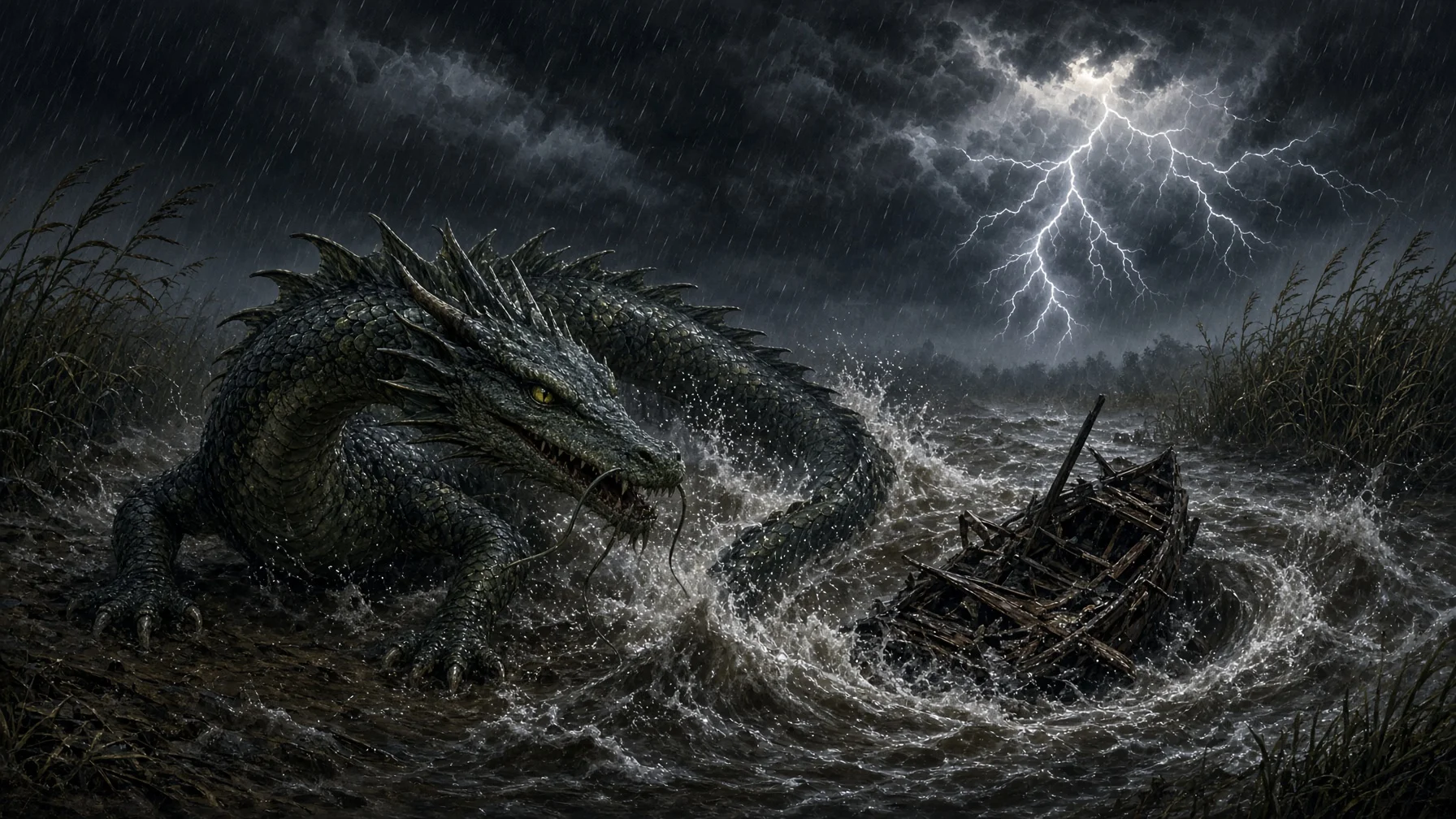
By the time later scholars tried to pin the creature down in more systematic terms, the description had sharpened without losing its strangeness. Li Shizhen's monumental Bencao Gangmu of 1596 CE — a work of materia medica far more than mythography — pauses to describe the jiaolong as snake-bodied but four-legged, with a broad head and a hide patterned in scales, at home in rivers, lakes, and marshland. This is a creature imagined with the eye of someone who has spent time near real water and real reptiles: not a wholly abstract sky-spirit, but something with weight, with feet, with a habitat you could point to on a map.
Serpent, Dragon, and the Centuries Between
Chinese dragon lore does not treat divinity as an instantaneous gift. It treats it as a slow, almost geological accumulation of time — and the jiaolong occupies the middle rungs of that ladder. Folk belief held that an ordinary snake or fish, left undisturbed long enough, could begin the transformation: after some five hundred years, it becomes a jiaolong. The jiaolong itself is not the end of the road. Another thousand years, and it is said to complete its metamorphosis into a full long, the true dragon. And even the long has further to climb: sources such as the Shuyi Ji, a record of strange things attributed to Ren Fang and dated to the Liang dynasty of the fifth to sixth centuries CE, describe a horned intermediate stage called the qiulong, followed at last by the yinglong, the winged dragon that represents the summit of draconic maturity.
What this staged cosmology quietly implies is unsettling if you sit with it: somewhere in every river system, in theory, patience alone is manufacturing dragons. The jiaolong is not a separate species walled off from the long by an uncrossable gulf of nature. It is a long that has not yet finished waiting. Every flood dragon glimpsed thrashing in a swollen river is, in this framework, a god still under construction — which may be exactly why it is treated as both a threat to be fought and a power that must eventually be respected.
The Water That Answers to No One
Long before hydrology gave floods a scientific vocabulary, Chinese river communities gave them a face. The jiaolong's stirring in its underwater lair was blamed, in local folklore and in the more sober records kept in county gazetteers, for swollen rivers, drowned fields, and boats swamped without warning. This was not idle superstition so much as an attempt to explain the unpredictable violence of water in moral and narrative terms — a river does not simply flood; something down there moved, or was angered, or was hungry.
The Huainanzi, the sprawling Han-dynasty philosophical compendium from the second century BCE, situates jiao among the creatures governed by yin and by water in its cosmological classification of animal life — placing the jiaolong not as folklore's outlier but as a properly cataloged part of the yin-and-water order that structured how educated readers of the Han understood the natural world. Even the historian Sima Qian, in the Shiji — the Records of the Grand Historian, completed around 94 BCE — references jiao-type creatures when describing the rivers of the south, and touches on them again within the omen literature that dynasties used to argue their own legitimacy. A jiao sighting was never only zoology. It was a message the state had to interpret.
That habit of reading the jiao as omen persisted for centuries. The Book of Later Han, the Hou Hanshu compiled in the fifth century CE, along with other dynastic histories, occasionally logs jiao sightings among the unusual natural phenomena formally reported to the throne — filed alongside comets, eclipses, and other disruptions to the expected order of heaven and earth. A dragon glimpsed in the wrong river at the wrong time was, in effect, a piece of political intelligence.
Zhou Chu and the Scourge of the River
No story fixes the jiaolong's menace in memory more firmly than the tale of Zhou Chu, preserved in the Jin-dynasty text Shishuo Xinyu — A New Account of Tales of the World, compiled in the fifth century CE. Zhou Chu, in his youth, was reckoned one of the Three Scourges plaguing his home region, ranked alongside a man-eating tiger and the jiaolong itself that terrorized the local river, dragging down boats and travelers. When Zhou Chu was finally told, bluntly, that he himself was counted among the district's calamities, the shame of it drove him to prove otherwise: he went out and killed both the tiger and the jiaolong. The surviving text does not describe how the fight against the river dragon actually unfolded — no duration, no detail of the terrain of the struggle — only that it was done and that it marked his turn.
The victory is not really the point of the story, or not the whole point. It marks Zhou Chu's moral turn — his passage from being a scourge to being a man capable of removing one. The jiaolong here functions as more than a monster to be slain for glory. It is a measure of a young man's capacity to change, a test that only means something because the creature was genuinely feared, genuinely capable of taking a life. A hero who kills a harmless thing gains nothing. Zhou Chu's reformation depends entirely on the jiaolong being real, and being terrible — the specifics of the fight itself are left to the reader's imagination, not to the record.
Cast in Bronze, Carved in Jade
The jiaolong's presence in Chinese material culture reaches back even further than its clearest textual descriptions. Ritual bronze vessels from the Shang and Zhou dynasties are frequently decorated with interlaced serpentine motifs that scholars and artisans alike have long called jiaolong patterns, 蛟龍紋 — sinuous, coiling bands that wind across the surface of a vessel meant for sacrifice or ceremony. The same motif recurs in jade carving from the same eras, where the interlocking, almost illegible tangle of dragon-serpent bodies becomes an ornamental language in its own right.
These are not illustrations of a story. They predate, in some cases, the written narratives that would later give the jiaolong its personality and its victims. What the bronzes and jades preserve instead is something more like a visual instinct — the sense that coiling, water-adjacent, serpentine power belonged on the vessels used to communicate with ancestors and spirits. Long before Zhou Chu waded into a river with a blade, the jiaolong's shape was already sacred enough to be cast into metal meant to outlast a dynasty.
Guardian of the Deep, Hoarder of Pearls
Not every account of the jiaolong casts it purely as a destroyer. A persistent motif in later folk tales and classical poetry paints it as a hoarder, a creature that keeps pearls and treasure in the recesses of its underwater lair — a dragon less interested in drowning travelers than in guarding what it has already claimed from the riverbed. Tang-dynasty poetry carries traces of this image; Li Bai, among others, alludes to the jiaolong stirring in the depths, its movement enough to trouble the surface of the water above it without the creature ever needing to be seen directly.
This treasure-guarding aspect gives the jiaolong a texture closer to other deep-dwelling mythic hoarders found across many traditions — a being whose danger is inseparable from its wealth, whose lair is worth fearing precisely because it might also be worth finding. It is a small but telling addition to the creature's character: the jiaolong does not merely destroy out of a stormy temperament. It possesses, and it protects what it possesses.
A Word for the Hidden and the Unrisen
Beyond bestiary and folktale, jiaolong settled into classical Chinese as a piece of living metaphor. Poets and essayists used the term generically for any dangerous aquatic dragon-like threat, but it also took on a gentler, more hopeful shade of meaning: a hidden potential not yet recognized, a "dragon submerged, waiting to ascend." A talented person overlooked by their era, a capacity for greatness that circumstance has not yet allowed to surface — both could be described through the image of the jiaolong coiled beneath the water, fully itself already, simply not yet risen into the sky where a long belongs.
This metaphorical afterlife matters because it shows how thoroughly the creature's cosmology — snake to jiaolong to long to yinglong, patient stage after patient stage — seeped into how people described human ambition and unrecognized worth. To call someone a submerged jiaolong was not an insult. It was almost a prophecy.
Rank and Rite in the Water Hierarchy
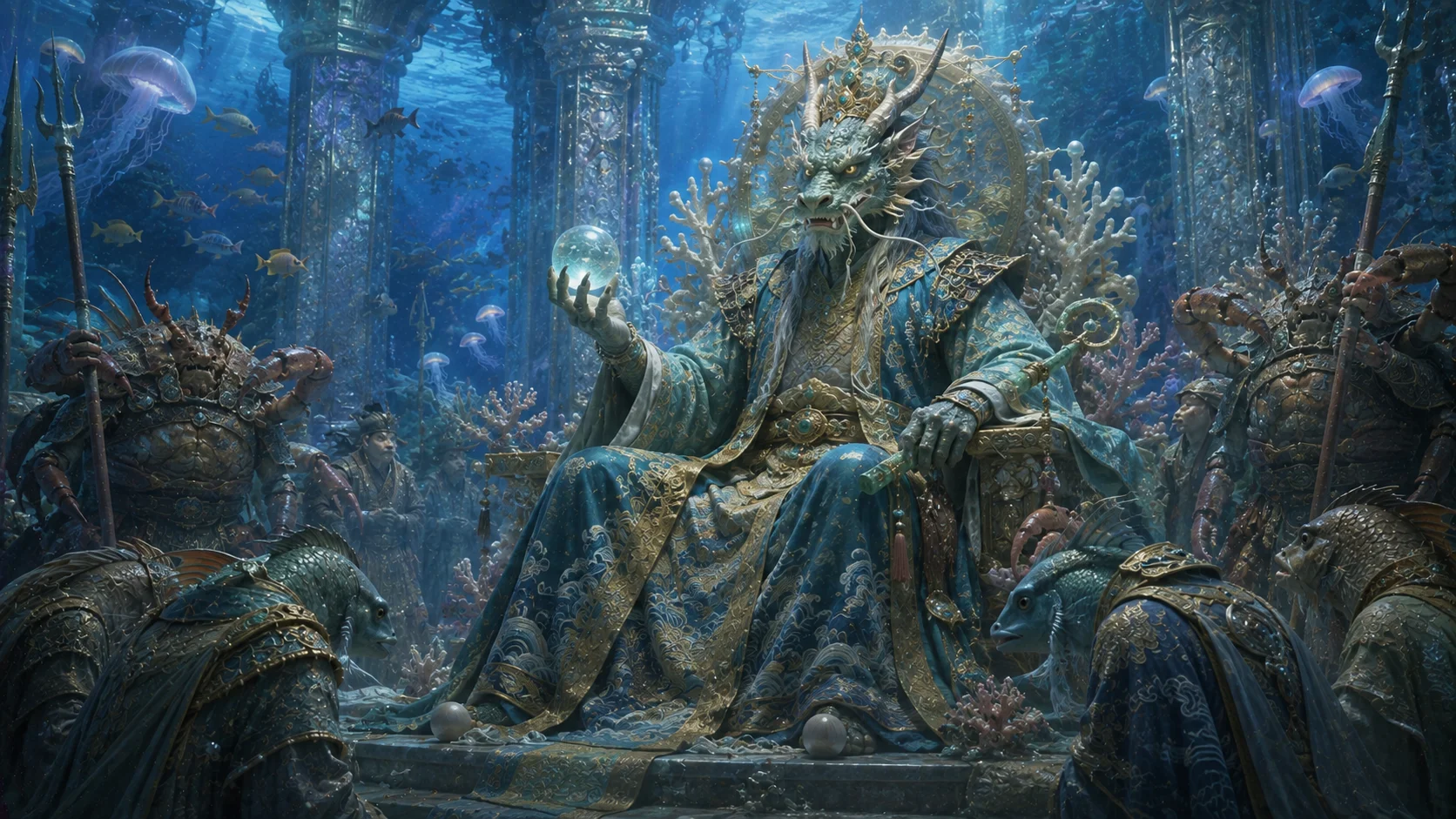
Daoist and folk-religious cosmology did not leave the jiaolong to wander unclassified. Within the layered hierarchy of water spirits, it typically sat below the dragon kings, the longwang, who governed the four seas as sovereigns govern provinces. The jiaolong, by contrast, occupied a more local, more intermediate rank — often serving as a subordinate guardian of a particular river or lake rather than commanding an ocean.
In parts of southern China, especially within the Chu cultural sphere of what is now Hunan and Hubei, this local guardianship took on a more ambivalent, more devotional character. There the jiaolong was regarded less as a monster to be exterminated and more as a river deity or water spirit in its own right — a power capable of both causing floods and, when properly appeased, mediating them. Sacrificial rites directed at placating water spirits in this region reflect exactly that ambivalence: you did not necessarily kill the thing that could drown your village. Sometimes you made offerings to it instead, and hoped the river stayed within its banks another season.
A Shadow Cast by a Real River
Modern attempts to trace the jiaolong back to a zoological source point, cautiously, toward the Chinese alligator, Alligator sinensis, once native to the Yangtze River basin in numbers now long diminished. The resemblance is not hard to see: a scaled, elongated, four-legged body moving through river shallows and marshland, capable of startling violence, capable of vanishing beneath the surface without a trace. A description like Li Shizhen's — snake-bodied yet four-legged, broad-headed, patterned in scales, a dweller of rivers and marshes — reads almost like an eyewitness account of a large crocodilian filtered through centuries of retelling and mythic elaboration.
This is offered by scholars as informed speculation, not settled fact, and it does not need to displace the religious and literary weight the jiaolong carries to be worth noting. A living animal glimpsed rarely, feared reasonably, and explained imperfectly is exactly the kind of seed from which a cosmology of transforming dragons could plausibly grow — the ordinary riverbank made strange enough to need a myth.
Lesser Dragon, Unfinished God
What ultimately distinguishes the jiaolong from the long is not a difference of kind but a difference of completion. The long is horned, celestial, associated with rain brought by imperial favor and cosmic order — the dragon as finished symbol, worthy of the throne. The jiaolong is typically hornless, or only partially formed, water-bound rather than sky-bound, its authority local and unstable rather than universal. It is a lesser dragon only in the sense that a chrysalis is a lesser butterfly: not permanently inferior, simply earlier in a process that has not yet run its full course.
That unfinished quality is, in the end, what keeps the jiaolong vivid across so many different kinds of text — cosmological bestiary, dynastic omen record, hero's origin story, temple offering, love poem for a genius the world has not yet noticed. It is a creature defined by threshold: between snake and dragon, between destroyer and guardian, between the water it cannot leave and the sky it has not yet earned. Every river with a bend deep enough to hide something is still, in that old imagination, a place where the next five hundred years might already be quietly underway.
Sources & traditions
- EncyclopediaWikipedia — Jiaolong
- TraditionChinese texts, oral tradition and village tellings (China)
Myths change from area to area and from time to time. This chronicle follows the most widely told versions; tellings in other villages, regions and eras may differ.