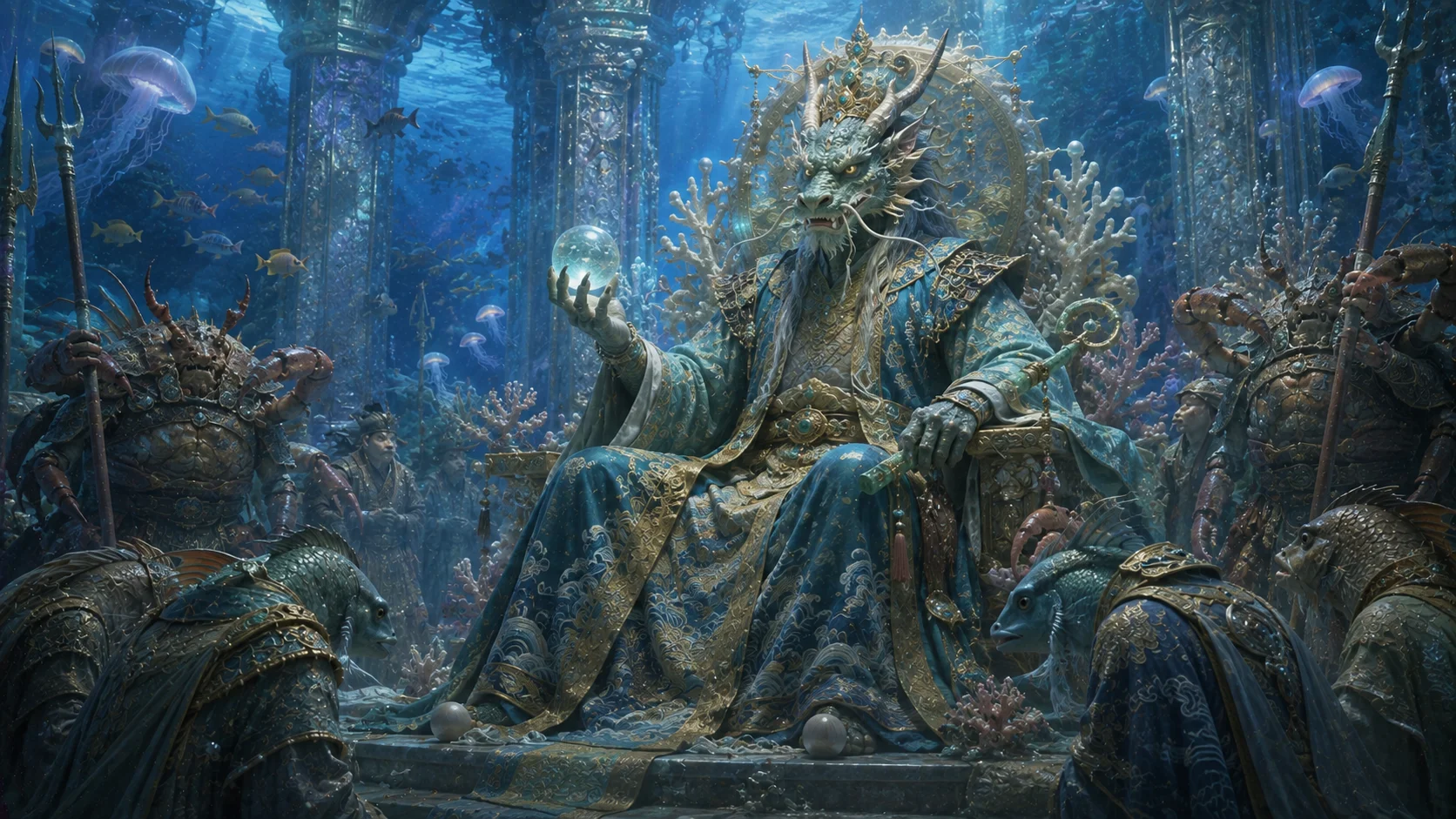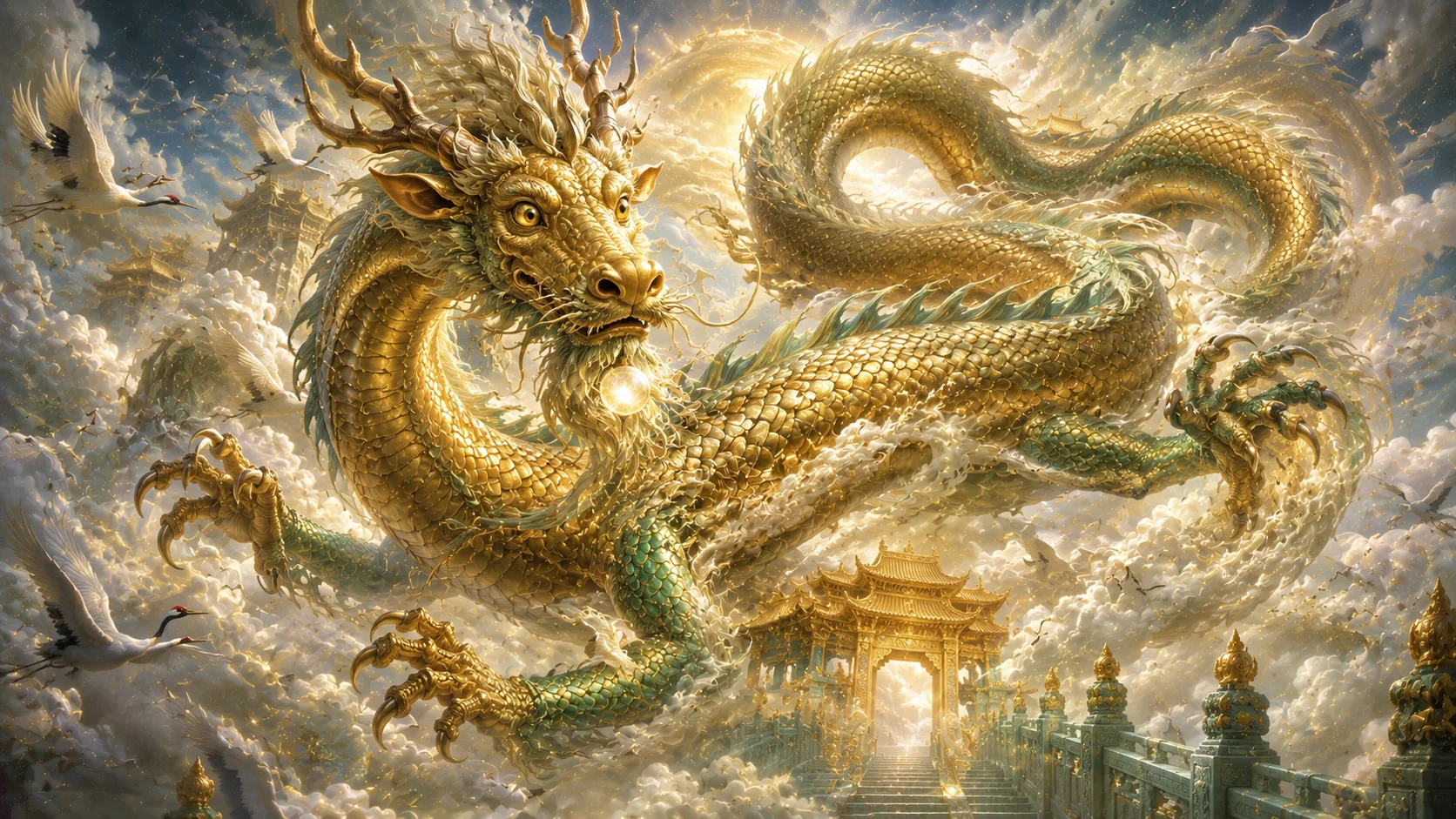
Among the dragon-kinds catalogued by China's Ming and Qing scholars, none stood higher in rank or farther from the touch of mortal life than the Tianlong — the Heavenly Dragon, the Celestial Dragon. Where its kin moved through rivers and rain clouds and the daily weather of the human world, the Tianlong's charge was the sky itself: the architecture of heaven, the roof-beams of the gods' own dwellings, the unseen scaffolding that keeps the firmament from falling.
A Taxonomy Written in Heaven's Order
The compilers of the Sancai Tuhui, working in 1609, inherited centuries of dragon-lore and set about giving it shape — not as a single undifferentiated creature but as a family with offices, the way the imperial bureaucracy itself was divided into ministries. Tianlong stood at the summit of this ordering, guardian of celestial palaces. Beneath it moved Shenlong, the spirit-dragon of rain and thunderheads, whose moods decided whether a season's rice would flood or wither. Below that again ran Dilong, dragon of the earth's waterways, coiled through rivers and lakes and the underground channels that fed a village well. And in the deep dark beneath mountains slept Fucanglong, hoarder of hidden treasure, a dragon of the earth's locked vaults rather than its open water. Four dragons, four domains, and Tianlong alone assigned to a domain no farmer or fisherman could ever visit.
The Sky That Does Not Fall
What set Tianlong apart from every other classified dragon was the abstraction of its task. Shenlong could be blamed for a drought; Dilong could be thanked for a good harvest of fish; Fucanglong might be petitioned before breaking new ground for a mine. Tianlong governed nothing a person could measure with a bucket or a scale. Its charge was cosmological: to hold up the mansions of the gods so that the residences of heaven did not collapse down onto the world of men. It was less a creature that acted upon the world than a structural condition of the world's stability — sentinel and support beam at once, standing watch over palaces no living eye would see, so that the ordinary sky overhead might go on looking ordinary.
Where the Idea Predates the Name
Long before any text used the word Tianlong, the dragon was already bound to the sky in the Chinese imagination. Hongshan culture jade carvers, working perhaps as early as 4700 BCE, shaped the coiled zhulong — the "pig-dragon" — out of stone meant to outlast its makers by millennia. Yangshao potters painted dragon motifs onto vessels that circulated through Neolithic villages long before writing existed to record what those coils were meant to mean. By the time the Yijing took shape, the link between dragon and heaven had already hardened into scripture: the hexagram Qian, "The Creative," builds its entire sequence of line statements around a dragon's ascent, culminating in the phrase now inseparable from Chinese cosmology — a flying dragon in the heavens. Tianlong, when it finally received its name, was not a new idea. It was an old and deeply rooted one, given a bureaucratic seat.
Nine Resemblances, One Body
Chinese dragon lore holds, in a description credited to the Song-dynasty scholar Luo Yuan in his Erya Yi, that every long — dragon of any category, Tianlong included — carries the features of nine different creatures fused into a single composite form: the horns of a deer, the head of a camel, the eyes of a demon or a hare, the body's scales borrowed from a fish, the claws that grip like a hawk's. No single animal could account for such a creature, and that was precisely the point. A dragon assembled from nine resemblances was, by its very construction, a synthesis standing above the ordinary animal kingdom — fitting vessel for a being tasked with holding up heaven's own architecture.
The Weight of Nine
That the dragon should be built from nine parts is no coincidence in a cosmology that treated nine as the most yang of numbers, the purest expression of active, masculine cosmic force. Dragons as a class were already yang creatures, paired conceptually against yin forces the way the sky itself was paired against the earth. Tianlong, dwelling nearest to heaven and farthest from the moist yin realms of river and lake governed by Dilong, sat at the most concentrated point of that yang energy — the numerological logic and the cosmological rank reinforcing one another until the placement felt less like classification and more like inevitability.
Claws Reserved for the Highest Rank
Chinese imperial art encoded this same hierarchy into the dragon's very anatomy. By decree, especially under the Ming and Qing courts, a five-clawed dragon could represent only the emperor himself or the highest-ranking celestial dragons — Tianlong among them. Four claws marked lower nobility; three marked regional or lesser deities. A viewer standing before a temple beam or an imperial robe did not need a caption to know which order of dragon they faced. The claws told them. This was not decoration but a visual grammar of rank, as precise in its way as any court title, and it placed Tianlong's iconography permanently at the top of that ladder.
Beams That Do Not Buckle
The belief that celestial dragons held up the sky found direct expression in how temples and palaces were built and adorned. Dragons carved into roof beams and painted across ceiling coffers were not merely ornamental flourishes; they enacted, in miniature, the very cosmological function attributed to Tianlong — visibly bearing weight, visibly guarding the structure above the heads of those who worshipped or ruled beneath. The Forbidden City's Nine-Dragon Wall stands as the most famous surviving expression of this idea, nine dragons rendered in glazed tile, a number chosen with the same deliberateness as the nine resemblances that built each dragon's body. To walk beneath such a wall was to walk beneath a visual argument that the heavens above the palace were, in fact, held up.
An Eightfold Assembly Borrowed from Elsewhere
Buddhism, arriving in China from India, brought with it its own assembly of dharma-protecting beings — devas, the heavenly ones, and nagas, the serpent-dragon beings, among eight classes total. Chinese translators, faced with rendering this foreign cosmology into their own language, merged devas and nagas under a single term already carrying immense weight in the native tradition: Tianlong. The word came to serve double duty — the celestial guardian-dragon of the older four-part taxonomy, and shorthand for the entire eightfold legion of nonhuman dharma protectors in the Tianlong Babu, the "Eight Legions." Two systems of thought, indigenous and imported, folded into a single term without either one erasing the other.
A Name Carried into Fiction
Centuries later, that same Buddhist term would travel again, this time into popular fiction. Jin Yong took Tianlong Babu as the title of one of his most celebrated wuxia novels, rendered in English as Demi-Gods and Semi-Devils. The novel does not retell the mythological assembly directly — its plot belongs to the world of martial arts clans and human drama rather than dharma-protecting spirits — but the borrowed title carried the old cosmological weight into a wholly new readership, introducing the phrase Tianlong Babu, and by extension Tianlong itself, to millions who might never have encountered the Sancai Tuhui or the Buddhist sutras it drew from.
A Bureaucracy Above the Sea Kings
Chinese folk religion, ever fond of modeling its unseen world on the visible machinery of the imperial state, placed Tianlong in a distinct administrative lane from the more famous Dragon Kings. The Four Dragon Kings, the Sihai Longwang, governed the Four Seas and were the deities most commonly petitioned by fishermen, sailors, and coastal villages — figures with jurisdictions as concrete as any magistrate's district. Tianlong answered to no sea and claimed no coastline. Its niche was celestial rather than territorial, its office closer to the architecture of heaven than to the governance of water, and folk cosmology kept the two systems layered rather than merged, each dragon-type occupying a rank and a domain that did not overlap with the other's.
Paired Against the Phoenix
In the visual language of imperial China, the dragon rarely stood entirely alone. Paired with the phoenix in the symbolism known as longfeng, the dragon represented yang and masculine authority — the emperor's own emblem — set in cosmic balance against the phoenix's yin, feminine, empress-associated grace. This pairing recurred across imperial regalia, wedding iconography, and temple carving alike, a visual shorthand for the union of complementary cosmic forces. Tianlong's own yang-heavy, heaven-facing nature made it a natural bearer of that half of the pairing, its guardianship of the gods' palaces echoing the emperor's guardianship of the human realm below.
A Dragon That Could Wear a Human Face
Regional folk traditions and later syncretic Daoist-Buddhist texts add one more dimension to the highest-ranking dragons: the capacity to change shape, including into human form. This trope runs throughout Chinese dragon mythology more broadly — the Dragon King's daughter, the various Dragon Princes of folk tale, figures who move between serpent-coil and human likeness as easily as a courtier changes robes. Tianlong, standing at the apex of the dragon order, was described in some of these traditions as sharing that same transformative gift, a mark of the especially high standing accorded to dragons whose domain lay closest to the divine — one more thread separating the celestial guardian from the lower animal-form spirits it was said to outrank.
Sources & traditions
- EncyclopediaWikipedia — Tianlong
- TraditionChinese texts, oral tradition and village tellings (China)
Myths change from area to area and from time to time. This chronicle follows the most widely told versions; tellings in other villages, regions and eras may differ.