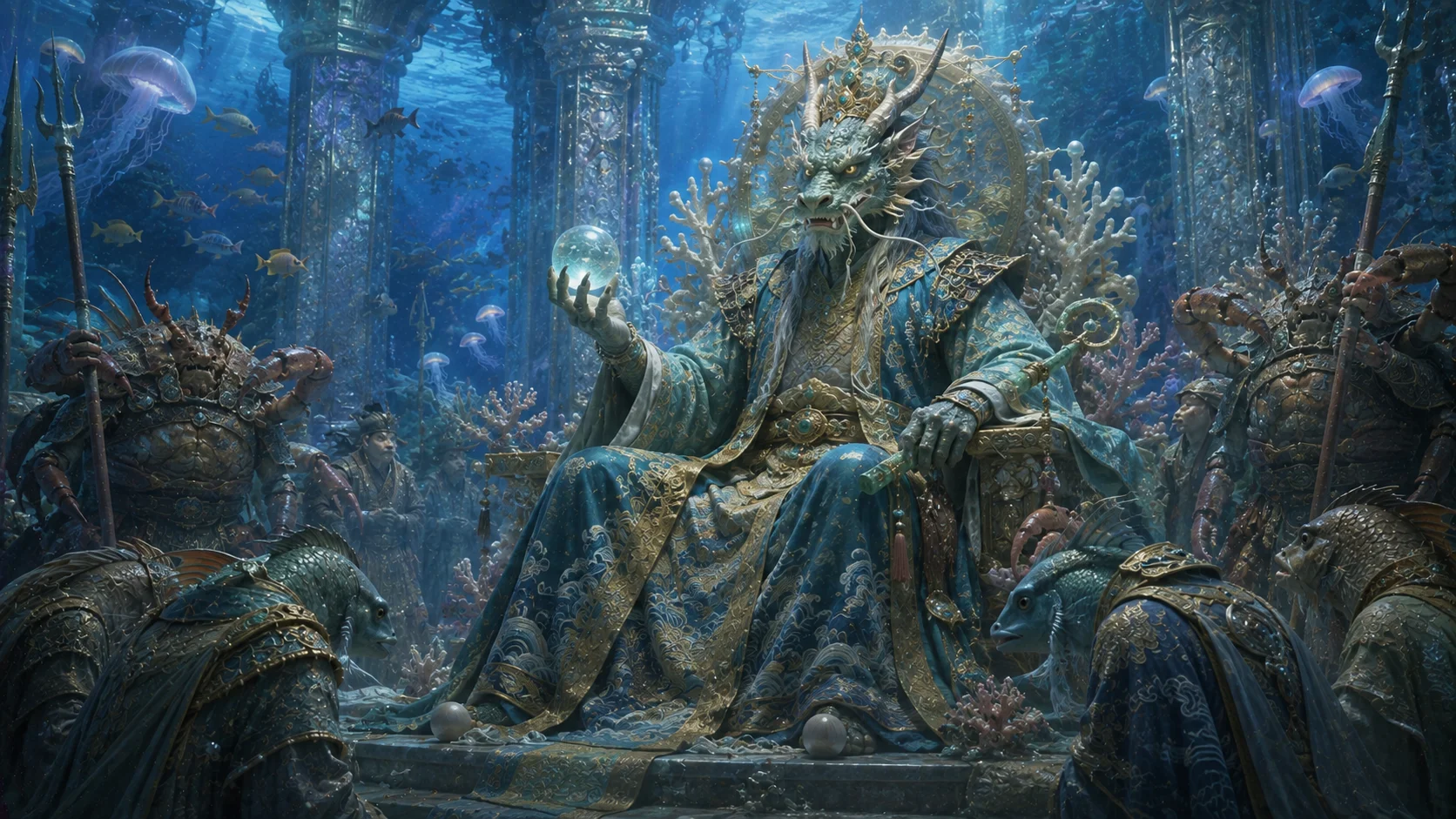
Beyond the Northwest Sea, past the last habitable shore, the world does not end so much as it goes dark. There, north of the Red River, a mountain called Zhangwei rises where sunlight has never once fallen — and it is here, according to the Classic of Mountains and Seas, that the world's oldest light was born: not from a sun, but from a dragon's eye.
Where the Sun Does Not Reach
The Shan Hai Jing places him with unusual geographic precision for a text so often content with riddles and wonders. In both the "Classic of Regions Beyond the Seas: North" and the "Classic of the Great Wilderness: North," the same coordinates recur: beyond the Northwest Sea, north of Chishui, at Mount Zhangwei — also written Mount Zhongshan. This is not simply a remote peak. It is described as a threshold, a place marking the edge of the habitable world, where the ordinary mechanics of day and night that govern the rest of creation simply stop working. The sun's arc does not extend there. Something else has to fill the gap.
A Face Human, a Body Serpent
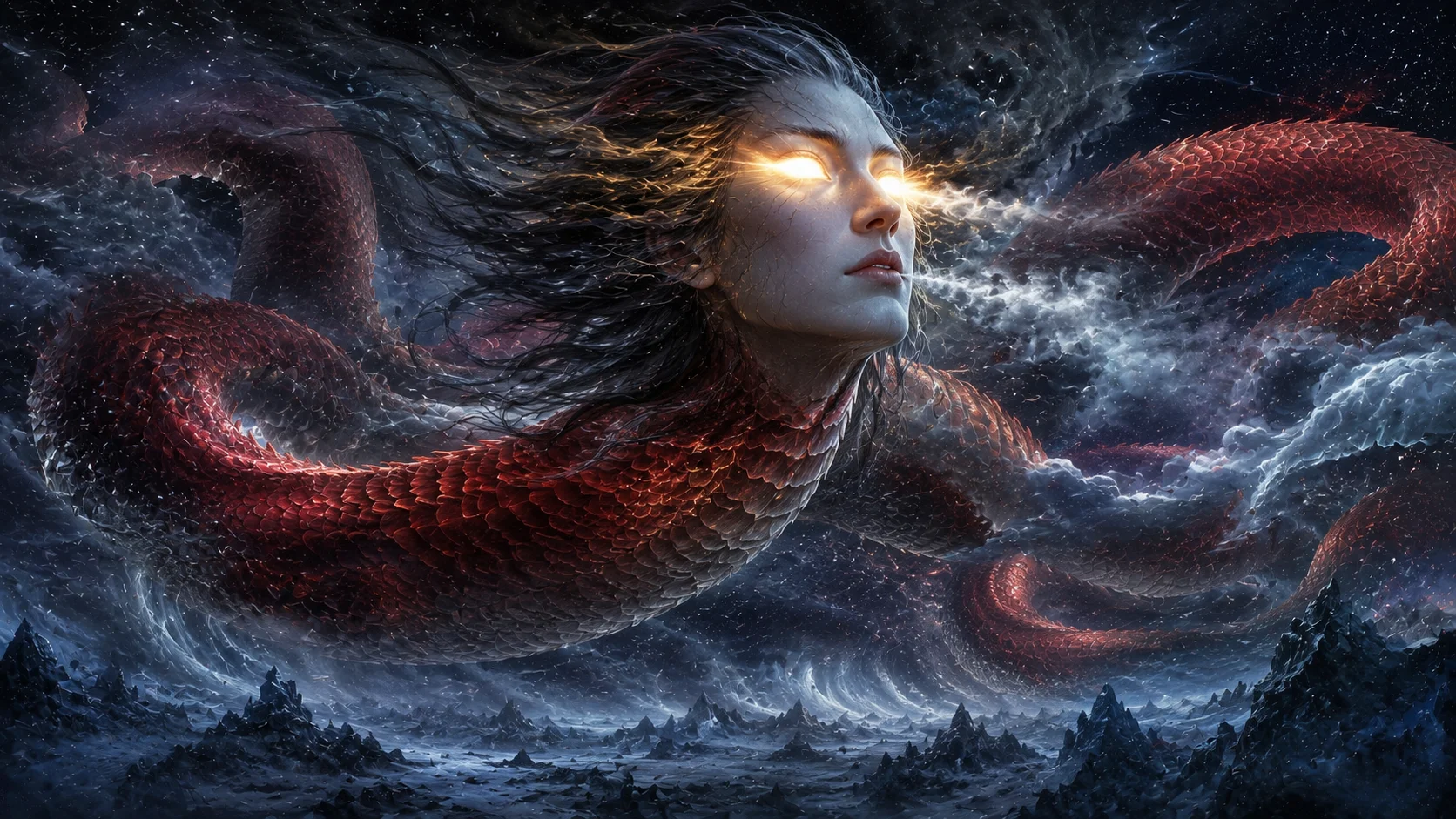
What fills it is Zhulong — 燭龍, the Torch Dragon, also recorded as Zhuyin, the Torch Shadow. The texts give him a scale that resists ordinary imagination: a body a thousand li in length, coiled at the world's northern seam, skin the deep red of embers or blood. And yet where the rest of him is wholly serpent, his face is human. This is one of the stranger details the old cosmographers left unexplained — no myth of birth, no account of why a being holding up the border of day and night should look back at the world with a human countenance. The texts simply state it, the way they state the mountain's location, as fact rather than symbol.
The Opening and Closing of an Eye
The mechanism attributed to him is startling in its simplicity. When Zhulong opens his eyes, day begins. When he closes them, night falls. There is no sun-chariot here, no separate solar deity driving light across the sky — that role belongs elsewhere, to Xihe and her ten suns, a wholly different strand of the old cosmology. Zhulong's light is not borrowed and not solar in origin. It is bound to his body, switched on and off by the same act that, in a human face, would be an unremarkable blink. At the edge of the world, that blink is the difference between illumination and total dark.
Breath as Season
Season, too, answers to him. The texts describe his breath as the mechanism of winter and summer: when he exhales, cold winds pour out and the world turns toward winter; when he inhales, the air warms and summer follows. It is worth sitting with how total this authorship is. Most deities of weather command a single storm, a single wind, a single river's flood. Zhulong's body is described as regulating the entire annual rhythm of cold and heat through nothing more than the ordinary act of breathing — a scale of responsibility so vast it borders on the impersonal, closer to a natural law wearing a dragon's shape than to a god with intentions.
A Being That Needs Nothing
Several tellings add a further, quieter strangeness: Zhulong does not eat, does not sleep, and does not breathe air in the ordinary sense a mortal creature would. His breathing generates the wind rather than merely displacing it; his body needs no sustenance because it is not, in the end, a body built along mortal lines at all. This absence of appetite and rest sets him apart even from other primordial figures in the old cosmology, most of whom still hunt, tire, or hunger in some fashion. Zhulong simply persists, a mechanism of the world rather than an inhabitant of it.
The Torch in His Mouth
The name itself carries the clearest clue to his purpose. 燭, zhú, means candle or torch, and it is chosen deliberately to separate him from any solar deity. Some accounts describe him holding a candle or torch in his mouth specifically to illuminate the corners of the world the sun cannot reach — the underworld-dark reaches of the far north, sealed off by Mount Zhangwei from the ordinary cycle of sunrise. Where Xihe's suns cross a sky, Zhulong's light does not travel at all. It simply exists at the world's edge, holding back a darkness that would otherwise be total and permanent.
A Riddle Old Enough to Be Quoted
By the third century BCE, Zhulong was already established enough to be posed as a philosophical puzzle rather than freshly described as a wonder. In the "Tianwen," the Heavenly Questions chapter of the Chuci, Qu Yuan asks how it is that Zhulong can illuminate a place where the sun itself does not shine — a question that treats the dragon's light not as an oddity needing introduction, but as a known cosmological fact worth interrogating. That a poet could invoke him in a single rhetorical line, trusting his audience to already know the reference, says something about how deeply Zhulong had settled into the era's sense of how the world was built.
Guo Pu's Commentary and a Question of Names
Centuries later, Guo Pu (郭璞, 276–324 CE), the Jin dynasty commentator on the Shan Hai Jing, took up the text as a subject worth careful annotation, and his commentary addresses the relationship between the names Zhulong and Zhuyin directly — whether they name one being described twice or two closely related figures. The text does not resolve the question with the tidiness a modern reader might want, and Guo Pu's notes are best read as the earliest surviving attempt to make sense of an ambiguity that was already old by his time, rather than as a final answer. The ambiguity itself is worth preserving; it is part of how the figure survived, copied and re-copied across a text that treated precision and mystery as compatible.
Not to Be Mistaken for the Lord of Fire
A separate confusion has followed Zhulong into later, more popular retellings: his occasional conflation with Zhurong, the god of fire, on the strength of a phonetic near-match between the two names. Most careful readers of the source texts treat this as a false kinship. Zhurong's domain is fire and summer heat in a more directly elemental sense; Zhulong's is light and the turning of the seasons through breath, tied specifically to the mountain at the world's northern edge. The two figures come from different currents of the old mythology, and the resemblance is a matter of sound, not of shared descent or shared story.
A God Without a Household
Unlike the more relationally embedded figures of the wider mythology — the Yellow Emperor with his descendants and court, Xihe with her brood of ten suns — Zhulong is given no spouse, no offspring, no lineage. His relationships, such as they are, run entirely to place and phenomenon: to Mount Zhangwei, to the Red River, to the concept of the world's outer boundary. This is not an omission so much as a different kind of figure. He belongs to the oldest layer of the mythology, the cosmogonic layer, where gods personify forces and thresholds rather than families and reigns, and where no temple ever rose to receive an offering in his name.
Aurora, or Something Older Than Explanation
Modern scholarship has occasionally proposed that Zhulong encodes a folk memory of the aurora borealis, or of the extreme light cycles of high latitudes, filtered down through ancient contact between Chinese observers and northern nomadic peoples who may have described such phenomena firsthand. It is a compelling reading, and a plausible one — but it remains a modern interpretive theory, not a claim the ancient texts themselves make. The Shan Hai Jing offers no such explanation and asks for none. Whether the dragon began as an attempt to account for a real polar sky or as pure cosmological invention, the text hands down only the dragon itself, whole and unexplained, exactly as it was recorded.
A Sparse Original Behind a Crowded Modern Dragon
Contemporary fiction, film, and games have made Zhulong into a fully realized character — a major dragon-god, sometimes hero, sometimes antagonist, given personality, dialogue, and elaborate backstory. It is worth holding that modern abundance apart from the source. The Shan Hai Jing gives him only a handful of lines: a location, a shape, a mechanism for day and night, a mechanism for the seasons, and a note that he neither eats nor sleeps. There is no plot attached to him, no dialogue, no arc. What survives from antiquity is closer to a diagram of the cosmos than a story about a character — and that spareness is itself part of what makes him remarkable: a being defined entirely by function, holding open a boundary between order and chaos, light and dark, one season and the next, simply by existing at the edge of the map.
Sources & traditions
- EncyclopediaWikipedia — Zhulong (mythology)
- TraditionChinese texts, oral tradition and village tellings (China)
Myths change from area to area and from time to time. This chronicle follows the most widely told versions; tellings in other villages, regions and eras may differ.