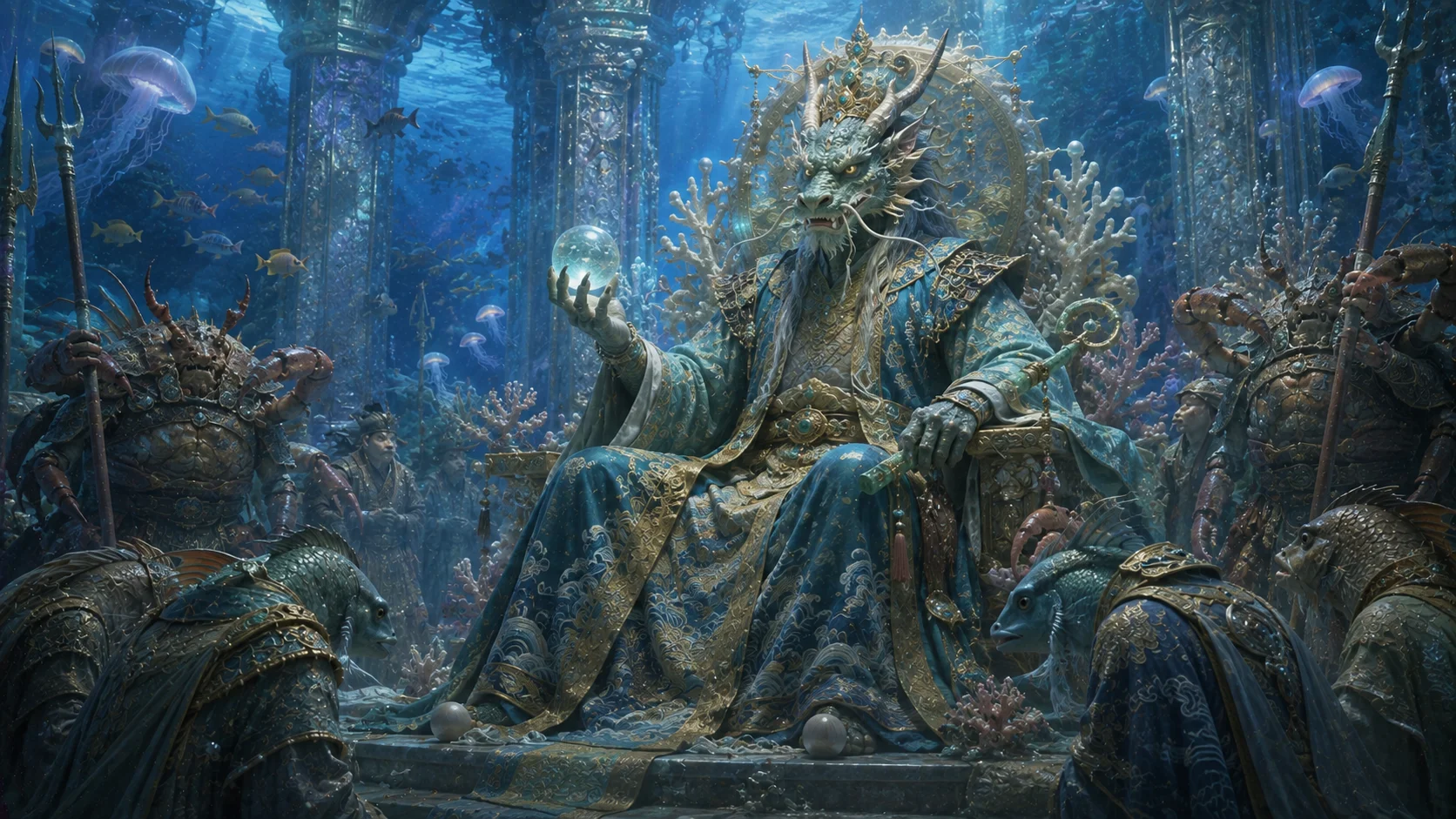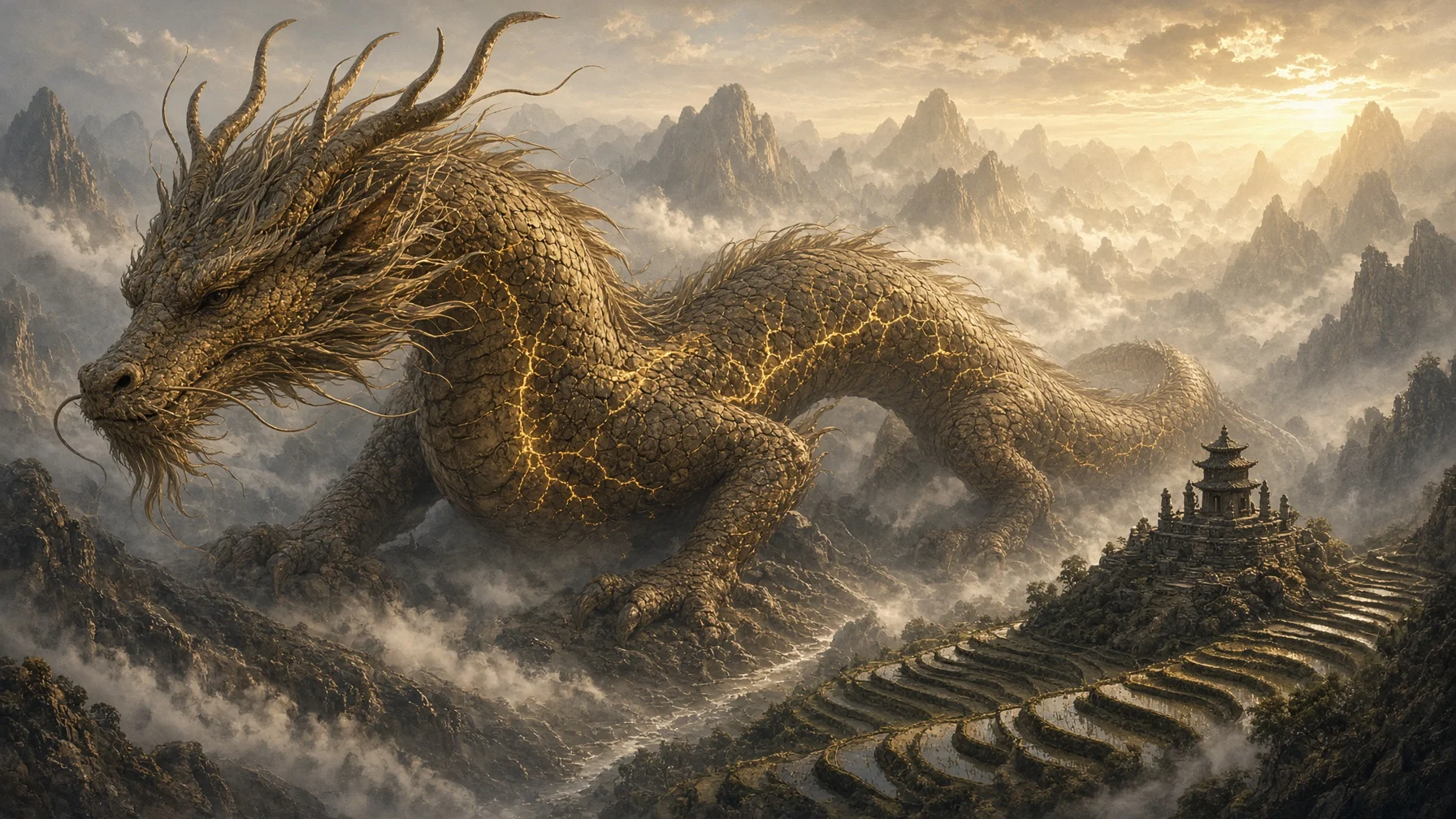
The Dilong, the Earth Dragon, does not announce itself the way its kin do. No temple bell calls its name, no painted eye stares down from a rafter carved in its exact likeness. It moves instead through the language people use to describe the ground they stand on — the pulse felt in a mountain ridge, the cold water struck by a well-digger's spade, the shudder that runs through a house at midnight for no reason anyone can name. To speak of dilong is to speak of the earth itself as something alive, something with veins and breath and, on occasion, a temper.
Dragon of the Hidden Waters
In the layered taxonomies that later folk compendia built around the dragon, several broad kinds are often set against one another: tianlong, the heavenly dragon, occupying a celestial-guardian role in the scheme; shenlong, the spirit-dragon who commands rain and storm; and dilong, the earth dragon, given charge of what lies beneath the surface — springs, wells, and the hidden watercourses that thread through rock and soil. Where shenlong answers for the water that falls, dilong answers for the water that seeps, pools, and rises unseen. It is a division of labor as much as a division of realms, and it reflects a very old instinct: that the visible world of weather and the invisible world underfoot are governed by different kinds of dragon-force, each with its own place in the scheme and its own duties.
This scheme, it must be said, was never handed down whole from a single ancient source. It is the product of centuries of folk systematization, refined and rearranged by different compilers in different eras, so that no two almanacs or popular treatises describe the four-or-five-fold dragon hierarchy in quite the same terms. Dilong's place within it is consistent in spirit — earth, water-below, the underground realm — even where the fine details of rank and company shift from text to text. It is best understood not as a fixed dogma but as a living vocabulary, one that different storytellers and geomancers reached for when they needed to explain why a well ran dry, or why a spring appeared where none had been before.
A Category, Not a Cult
It is worth pausing on what dilong is not. Unlike Longwang, the Dragon King, who commands devoted temples at the edges of lakes and along riverbanks, and whose worship forms one of the most prominent institutions in Chinese folk religion — complete with the Dragon Kings of the Four Seas and countless local shrines where villagers pray for rain — dilong has no comparable cult. There is no standard image of dilong enshrined and burned incense before, no annual procession carried in its honor, no priesthood devoted to its particular favor. It functions instead as a taxonomic term, a way of classifying a kind of dragon-force rather than naming a single individual deity with a personal history and a court of worshippers.
This absence of a personal cult is not a diminishment so much as a difference in kind. Some dragons in the Chinese imagination are figures: they have names, deeds, and shrines. Dilong is closer to a category of nature itself, the way one might speak of "mountain spirits" in general without needing every mountain to have its own temple. It is less textually prominent in the earliest classical sources — the Shan Hai Jing gives considerably more attention to other dragon-figures named within it — than to any single episode naming dilong outright. Its definition accrued instead through later Daoist cosmological schematization and syncretic folk religion, gathering meaning the way sediment gathers in a riverbed, layer upon layer, rather than springing whole from one founding myth.
The Vein That Runs Beneath the Land
Where dilong finds its clearest expression is in feng shui, the ancient art of siting and orientation, where the term can refer to the underground dragon veins — a localized expression of the broader concept of longmai, the dragon pulse that geomancers trace through hills, ridgelines, and watercourses. Here "dragon" becomes less a discrete zoomorphic creature stalking beneath the soil and more a way of naming the qi, the vital energy, believed to flow through the land as blood flows through a body. A mountain range rising and falling in long undulations is read as a dragon's spine; a river curving around a hillside is read as a dragon's embrace; and the underground channels through which this vitality moves are, in this specialized sense, dilong.
To a geomancer trained in this tradition, the landscape is never inert. Every rise and fall of ground carries implication, every confluence of streams marks a gathering of force, and the practitioner's task is to read these signs the way a physician reads a pulse — searching for the point where the dragon vein is strongest, most concentrated, most auspicious for a grave or a dwelling to be placed upon it. This is dilong not as monster but as method: a conceptual tool for understanding the earth's hidden vitality, and for locating the places where that vitality pools closest to the surface.
Reading the Earth: Dilong in Feng Shui
The practical stakes of this reading were considerable. Site selection for graves and buildings alike depended on identifying where a dragon vein ran strong and where it ran weak, where it pooled and where it dispersed. A grave placed atop a vigorous dragon vein was believed to channel that vitality forward to descendants for generations; a building raised in ignorance of the vein beneath it risked cutting the flow, or worse, provoking disturbance in ground better left undisturbed. Mountains, ridgelines, and rivers together formed the visible anatomy of this unseen system, and a geomancer's skill lay in tracing the dragon's body across a landscape that offered no obvious seams.
This is a usage that treats "dragon" more as a geomantic principle than a being with appetites and moods, and it sits somewhat apart from the earthquake lore and the classificatory schemes discussed elsewhere in dilong's tradition. Yet the two threads are not unrelated: both treat the earth as something with an internal structure, a hidden architecture that rewards careful attention and punishes carelessness. Whether one imagines an actual scaled creature turning in its sleep beneath a village, or an invisible current of qi running along a ridge, the underlying conviction is the same — the ground beneath our feet is not simply ground. It has a shape, a flow, and a will of its own.
When the Earth Dragon Turns Over
In certain regional folk traditions, dilong takes on a more vivid and more feared character: dragons said to dwell underground or in caves, whose stirring and turning are blamed for earthquakes. The logic mirrors, almost exactly, the way coastal communities have long blamed sea dragons and dragon kings for sudden storms — an unpredictable natural violence given a face and a motive, so that the shaking earth becomes not a mere accident of geology but the restlessness of something vast and slumbering below. When the ground heaved without warning, it was easier, and perhaps truer to the felt experience of the event, to imagine a dragon shifting position in its underground lair than to imagine nothing at all beneath the disturbance.
It bears repeating that this earthquake association is a regional folk motif rather than a single canonical doctrine binding all of Chinese tradition. Different regions, shaped by their own geological histories and their own local storytelling, developed their own versions of the idea, and no single authoritative text lays out dilong's relationship to seismic activity as settled fact. What persists across these variations is the underlying symbolic logic: dilong stands for underground stability, and for what happens when that stability is disrupted. The dragon does not cause the earthquake out of malice so much as embody it — the earth's hidden telluric forces given a shape large enough, and old enough, to explain why the world beneath a village might suddenly refuse to hold still.
The Worm That Shares Its Name
Any honest account of dilong must pause over a linguistic curiosity that runs alongside its mythological sense: in traditional Chinese medicine and in everyday speech, "dilong" (地龍) is also the common term for the earthworm. This is not a secondary or corrupted meaning layered accidentally onto the mythic one — it is a parallel usage, old and functional in its own right, used by physicians and herbalists and ordinary speakers with no particular reference to underground dragons at all.
The overlap is worth flagging precisely because it invites confusion. In certain regional folk contexts the two senses brush against each other — a pun, a double meaning, a moment where the humble worm turning the soil and the vast dragon turning beneath the mountains share a single name and, perhaps, a single poetic logic: both are creatures of the hidden underground, unseen while at work, revealed only by their effects on the surface above. But this overlap should be treated as exactly that — a linguistic resonance worth noting — rather than proof that worm and dragon were ever understood as a single unified mythic concept. They are two things wearing one name, not one thing wearing two faces.
Center and Yellow: A Place in the Five-Fold Order
Some folk almanacs extend the classification of dragons into a five-direction, five-color cosmology, assigning an earth-associated dragon — dilong or a figure very like it — to the center and to the color yellow. This placement echoes the broader correlations of Wu Xing, the Five Phases, in which earth occupies the center of the cosmic diagram, flanked by wood, fire, metal, and water at the cardinal points. A dragon of yellow, seated at the middle of the compass rather than at any single edge, would naturally be an earth dragon, since earth itself sits at the pivot around which the four directional elements turn.
As with the broader dragon taxonomy, these correlational schemes vary meaningfully from source to source, and no single almanac can be taken as the definitive word on which dragon belongs to which direction and color. What the association does capture, consistently enough to be worth stating, is a symbolic fittingness: an earth dragon at the center of a five-fold cosmic map is not an arbitrary placement but a natural extension of everything else dilong is said to represent — centrality, groundedness, the stable core around which more volatile forces circulate.
A Face Without a Fixed Form
Because dilong functions more as a category and a geomantic principle than as an individual named deity with a personal following, it lacks the kind of fixed, widely recognized iconography that distinguishes many of its fellow creatures in the wider bestiary. Bixie is known by its winged-lion form, instantly identifiable wherever it is carved or painted. Luduan is known by its single horn, a mark as distinctive as a signature. Dilong has no such settled silhouette. It might be imagined as a dragon indistinguishable from any other dragon, save for its underground habitation; it might be imagined, in the geomantic sense, as no creature at all but a current, a line, a pulse traced across a map rather than a body drawn on a scroll.
This lack of a fixed form is itself instructive. It tells us that dilong was never primarily an object of artistic devotion, commissioned in bronze or jade for a shrine's altar, the way a deity with a settled cult might be. It was, and largely remains, an idea pressed into service wherever the culture needed language for the earth's hidden dragon-force — in a geomancer's assessment of a hillside, in a village elder's explanation of a tremor, in a physician's prescription calling for dried earthworm. A being without one fixed face because it was never asked to wear only one.
Not the Dragon King's Temple
The contrast with Longwang worship deserves to be drawn out fully, because it clarifies what kind of tradition dilong belongs to. Dragon king temples are a major and enduring institution across Chinese folk religion: distinct dragon kings preside over each of the Four Seas, and countless local dragon-king shrines dot the landscape, each one a site where villagers gather to pray for rain in times of drought, to give thanks after a good harvest, or to mark the turning of the agricultural year. This is organized, visible, communal religious practice, with priests, festivals, and offerings attached to it.
Dilong occupies no comparable institutional space. It is not the object of dedicated temple worship in the way Longwang is; there is no dilong festival calendar, no network of shrines built specifically in its honor. This does not make dilong a lesser tradition, only a differently shaped one — a concept woven into geomancy, medicine, and regional earthquake lore rather than concentrated into a single devotional institution. Where Longwang asks to be prayed to, dilong asks, in a sense, to be read: understood through the land's contours, through a diagnosis, through the aftermath of a tremor.
Naga and Dilong: A Later Confluence
A separate and well-documented strand of dilong's story runs through the arrival of Buddhism in China. Certain Buddhist-influenced texts, translating concepts from Indian naga lore — the serpent-like beings said to dwell in rivers, lakes, and the underground realms of Indian cosmology — reached for existing Chinese dragon categories to render those ideas comprehensible to a Chinese audience. Nagas dwelling beneath the earth found a ready conceptual home in the native idea of an earth dragon, and the translation traffic between the two traditions left its mark on how dilong was understood in certain textual contexts.
This cross-pollination is real and worth naming, but it should be kept distinct from the purely indigenous folklore of dilong as earthquake-bearer, geomantic vein, and folk-taxonomic category. The Buddhist-naga strand represents a later, textually traceable confluence between two independent traditions — Indian and Chinese — rather than the origin point of dilong itself, which had its own native life in Chinese cosmological thought well before Buddhism's spread. The two strands sit alongside each other in the historical record, each illuminating a different facet of how the idea of an underground dragon-being took root and grew.
Springs, Wells, and the Water Below
Return, finally, to the most concrete of dilong's attributed duties: the governance of springs, wells, and underground watercourses. In a society whose survival depended on locating and managing water — for drinking, for irrigation, for the turning of the agricultural seasons — the idea that some dragon-force presided specifically over the unseen movement of water beneath the soil answered a real and pressing need for explanation. A well that ran clear and abundant, a spring that emerged unexpectedly from a hillside, a watercourse that shifted its underground path and left a once-reliable well dry: all of these were phenomena that a community would want to understand, and dilong offered a framework for that understanding.
This role complements, rather than competes with, shenlong's dominion over rain. Together the two suggest a complete picture of water's journey through the world as the tradition imagined it: falling from the sky under one dragon's governance, and moving invisibly through the earth under another's. Dilong's water is patient water, slow water, water that must be sought rather than water that simply arrives — the underground counterpart to a sky that announces itself in thunder.
Living With an Unfinished Myth
What emerges from all of this is not a single tidy story but a constellation of related ideas gathered loosely under one name. Dilong is a category within a folk-systematized dragon taxonomy, a geomantic principle for reading the land's hidden vitality, a folk explanation for the terror of earthquakes, a linguistic neighbor to the humble earthworm, a point of contact between native Chinese cosmology and imported Buddhist naga lore, and a quiet counterpart to the far more visible institution of dragon-king worship. No single thread accounts for all of it, and that is, in its own way, faithful to how the tradition actually developed — accumulated rather than authored, regional rather than uniform, practical rather than doctrinal.
To treat dilong with the reverence such a tradition deserves is to resist the temptation to flatten it into a single clean definition. It is better understood as a way that generations of people made sense of the ground beneath their feet: the water they could not see, the tremor they could not predict, the pulse of vitality that a trained eye might trace along a ridgeline before laying a foundation or a grave. The earth dragon does not need a temple to remain present in how the land itself is still, in certain places and certain practices, read as something alive.
Sources & traditions
- EncyclopediaWikipedia — Dilong
- TraditionChinese texts, oral tradition and village tellings (China)
Myths change from area to area and from time to time. This chronicle follows the most widely told versions; tellings in other villages, regions and eras may differ.