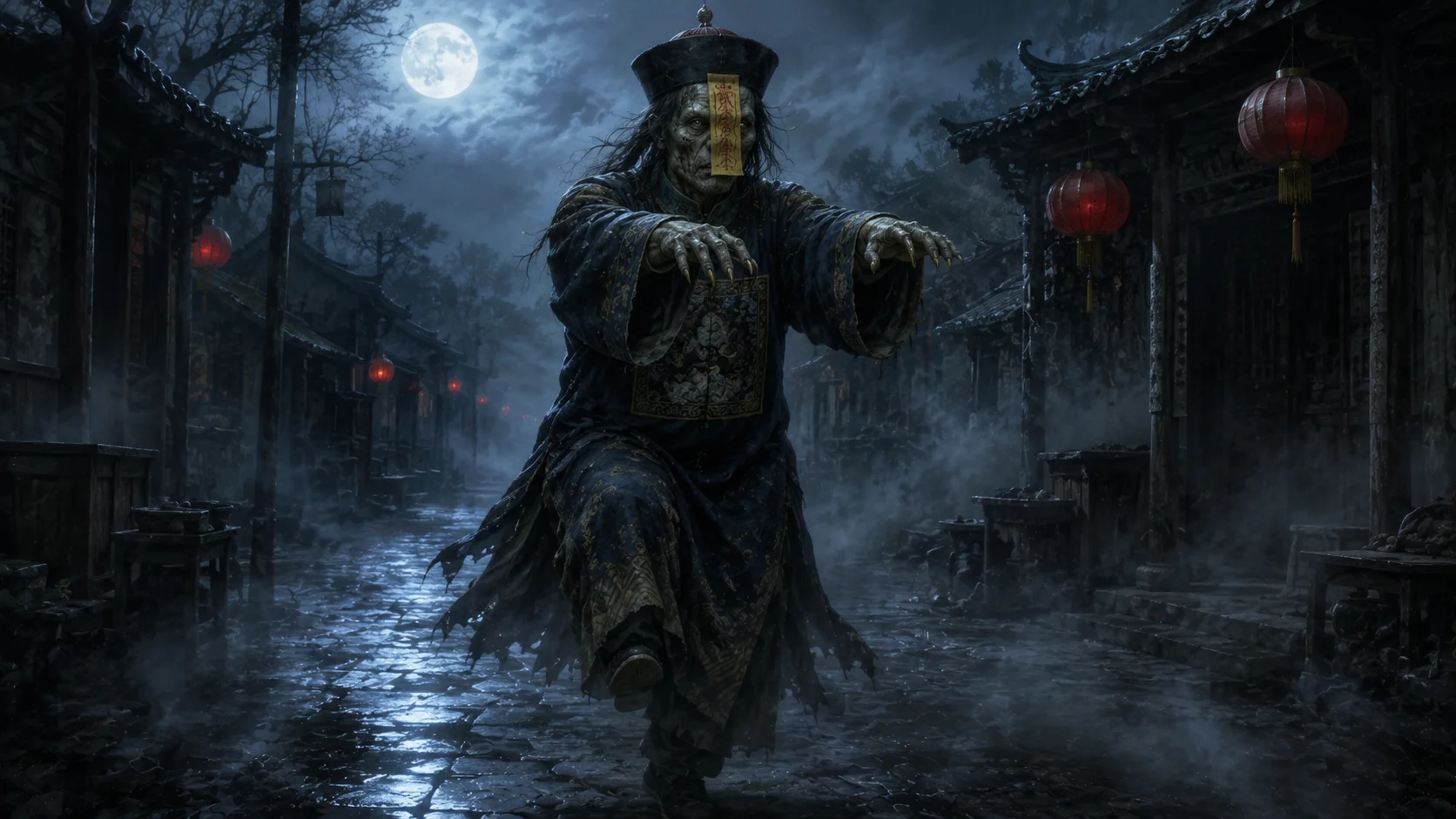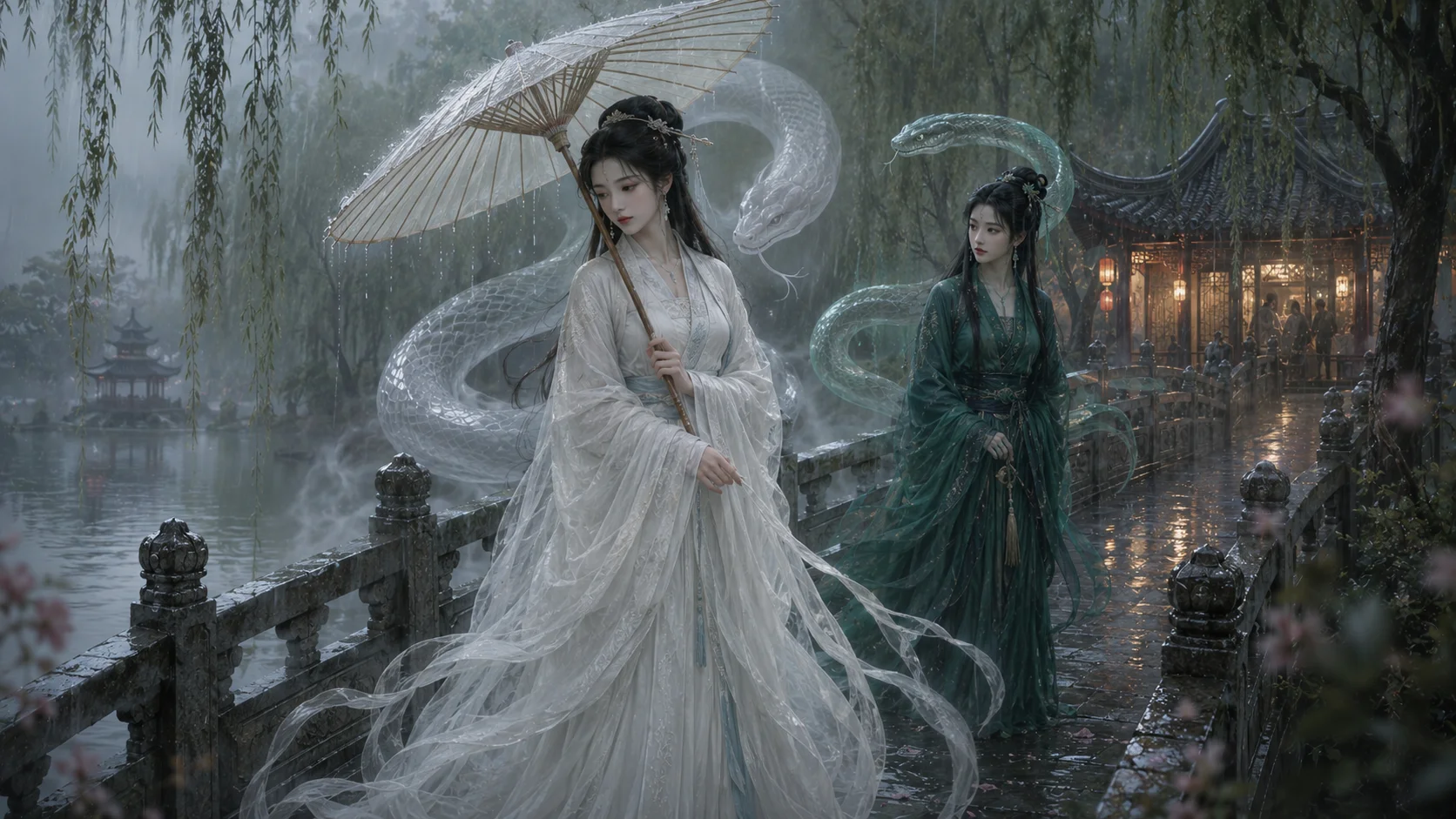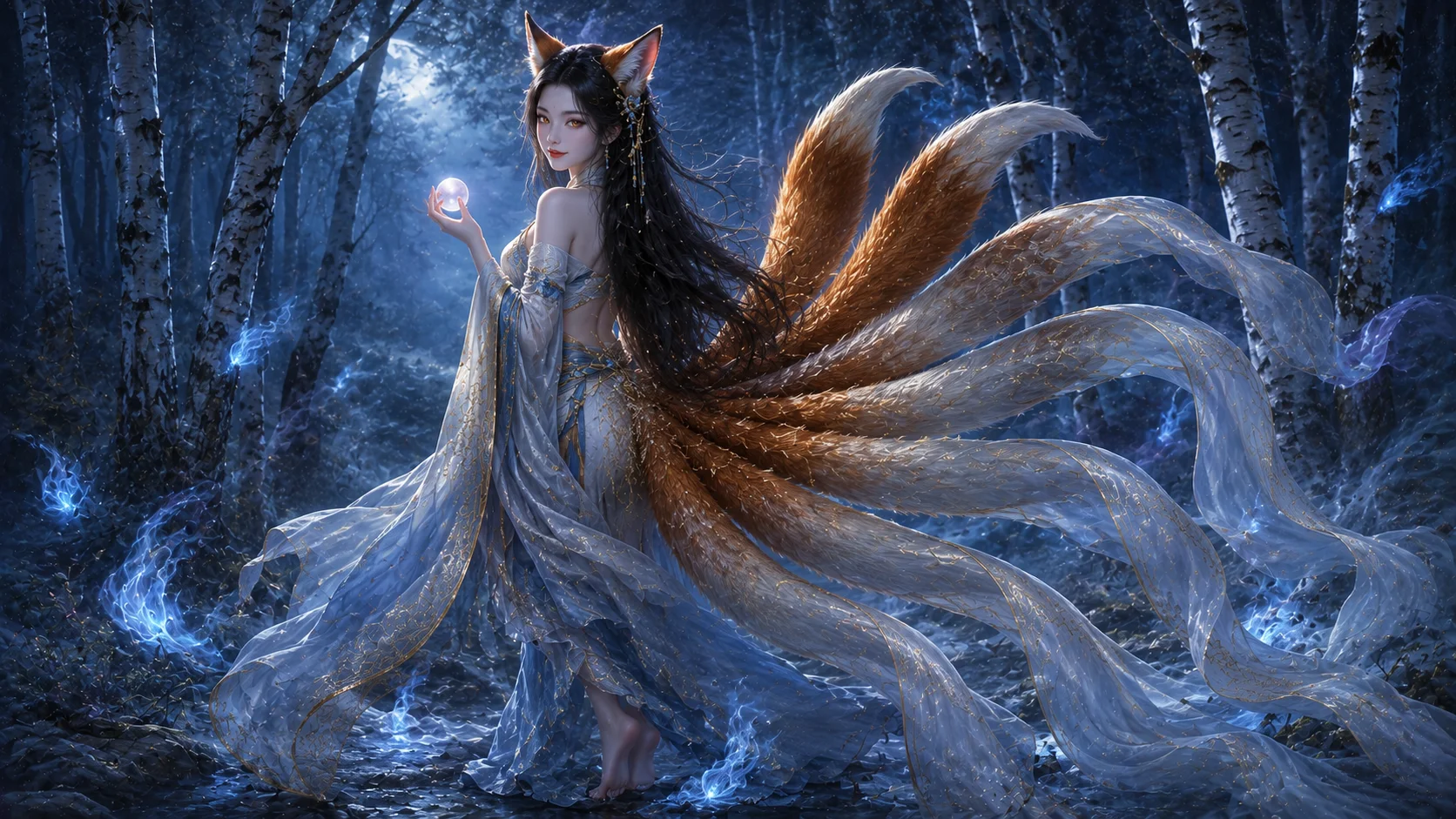
The Huli Jing is the fox spirit of Chinese folklore — a creature so old, so widely told, and so morally unsettled that no single story can claim to define it. Across more than two thousand years of texts, the huli jing has been an omen of virtuous kingship, a devouring monster, a grieving widow, a corrupting seductress, and, in the mouths of ordinary Chinese speakers today, an insult. To understand the fox spirit is to watch one culture argue with itself across centuries about desire, power, and what it means for something wild to become almost human.
The Cry on Qingqiu Mountain
The earliest fox spirits do not seduce anyone. They appear in the Shan Hai Jing, the ancient "Classic of Mountains and Seas," as inhabitants of Qingqiu Mountain — nine-tailed foxes said to cry with a voice like a human infant. The text is blunt about their danger: they are reputed to devour people. And yet, in the same broad textual tradition, the nine-tailed fox carries the opposite meaning as well — it is an auspicious sign, a creature whose appearance marks the reign of a sage-king. From its very first attestation, the huli jing refuses to be only one thing. Benevolent omen and man-eating terror sit side by side in the oldest sources, unresolved, and that unresolved quality never really leaves the tradition.
The Fox That Confirmed a Dynasty
Nowhere is the fox's early prestige clearer than in its attachment to Yu the Great, the legendary founder of the Xia dynasty. According to the old legend, a white nine-tailed fox appeared to Da Yu at Tushan. He read the sighting as auspicious — confirmation that he should marry a woman of Tushan, a union that the tradition ties directly to the founding of a dynastic line. This is a remarkable role for what later centuries would recast as a demon: here the fox spirit is a herald standing at the birth of Chinese civilization's mythic political order, its nine tails a mark of favor rather than menace.
Nine Tails, Earned Slowly
The number nine is not decorative. In the mature folklore that develops over the following centuries, a fox's power and its tails grow together through age and cultivation — a framework borrowed directly from Daoist self-cultivation, or neidan, in which the practitioner refines the body and spirit toward immortality over vast spans of time. A fox that pursues this path long and successfully enough is said to eventually grow all nine tails and approach a near-divine or immortal condition. Folk practice sometimes calls such a being a hu xian — a "fox immortal" — language that borrows the vocabulary of sainthood for an animal. Regional traditions disagree on the mechanics: how many tails per century, what rites or transgressions accelerate or interrupt the process, whether the ninth tail is even the ceiling. No single canonical account survives intact across all of China's regional practice, Daoist ritual texts, and literary sources — the cultivation framework is a shared grammar, not a fixed rulebook.
The Turn Toward the Beautiful Stranger
Something shifts by the Tang and Song dynasties. The dominant image of the huli jing stops being the infant-voiced predator of Qingqiu Mountain and becomes something quieter and more intimate: a fox that takes the shape of a beautiful young woman — occasionally a man — in order to draw a human being into her orbit. Tang chuanqi tales catalogue these encounters extensively, laying the groundwork for what would become the single most influential portrait of the fox spirit in all of Chinese literature. The fox is no longer approaching from the mountains as an omen. She is approaching from the next room, at night, as someone you might fall in love with.
Liaozhai's Long Shadow
That portrait reaches its fullest and most famous expression in Pu Songling's Qing-dynasty collection Liaozhai Zhiyi — "Strange Tales from a Chinese Studio" — which contains dozens of fox-spirit stories on their own. It is difficult to overstate how thoroughly this one collection has shaped what "huli jing" now means to a Chinese reader. Scholars, students, merchants, and monks all cross paths with foxes in its pages, and the encounters run the entire emotional range the tradition allows: comic, erotic, tragic, cautionary, tender. No later account of the fox spirit writes as if Liaozhai did not happen first.
The Draining of Vitality
The tales that cemented the huli jing's dangerous reputation follow a recognizable shape: a fox spirit assumes the form of an alluring woman, seduces a man, and slowly drains his life-essence — his qi, his vitality, sometimes explicitly through sexual energy — leaving him wasted, ill, or dead. This motif did more than entertain; it became a kind of cultural shorthand for the dangers literati imagined in desire itself, dressed as folklore rather than sermon. The fox in these stories is rarely stupid or crude. She is patient, charming, and difficult to suspect until the damage is already done — which is precisely what made her such an effective vehicle for warning.
Loyal Wives and Rescuing Spirits
It would be a serious misreading of the tradition to stop there, and the tradition itself does not stop there. Alongside predatory tales like "Painted Skin" sit stories of fox-wives who are loyal, learned, and generous — spirits who marry impoverished scholars, share their scholarship, manage a household with more competence than any human bride, and sometimes rescue their husbands from ruin or death. These are not exceptions grudgingly included; they are a substantial, recurring current within Liaozhai and its imitators. The huli jing's moral character in Qing literature is genuinely ambiguous rather than uniformly villainous — the same creature that ruins one man saves another, often in stories sitting only pages apart.
Shrines in the Northern Villages
The fox spirit was not confined to literature. In North China — particularly Hebei, Manchuria and the broader Northeast, and among some communities around Beijing — folk religious practice included the actual worship of fox spirits as deities, known as Hu Xian or Hu San Taiye. This cult sat within a wider popular religious complex of animal-spirit deities, sometimes grouped with weasel, hedgehog, and snake spirits under names such as the "Wu Da Jiaomen," the Five Great Sects. Small shrines and household altars dedicated to these spirits are documented into the Qing dynasty and on into the Republican period — evidence that for many ordinary households, the fox spirit was not a literary device at all, but a being to be respected, propitiated, and asked for favor or protection.
A Mask for the Corrupt and the Hypocritical
Across the centuries of chuanqi and zhiguai — "records of the strange" — writing, the fox spirit repeatedly serves a purpose beyond ghost-story thrills: it is a vehicle for social commentary. A fox can expose a corrupt magistrate, humiliate a hypocritical scholar, or stage a forbidden desire that no respectable narrator could otherwise put into words. Scholars studying this literary tradition consistently note this didactic function as a central reason the fox-spirit tale proliferated so richly among literati writers in particular — the fox let them say things about power and hypocrisy that a straightforward human story could not safely say.
Tells of the Hidden Shape
Because the fox spirit's danger depends on disguise, the tales built up a shared set of tropes by which the truth eventually surfaces. A fox-shaped shadow lingers where a human one should fall. A tail refuses to stay fully hidden beneath a robe. Mirrors reflect what the eye cannot see. Dogs growl at what looks, to their master, like a perfectly ordinary guest. And Daoist priests skilled in exorcism can see straight through the illusion that has fooled everyone else. These devices recur across countless Liaozhai-style stories as the narrative mechanism by which a husband, a friend, or a neighbor finally learns what — or who — has been sharing their life.
Cousins Across the Sea
The huli jing does not stand alone in East Asian folklore. It is historically and textually related to the Japanese kitsune and the Korean kumiho, both of which draw partly on transmitted Chinese fox-spirit lore. Yet each tradition developed its own regional character and its own moral center of gravity over time, and the huli jing remains the earliest attested and most textually extensive of the three — the deep root from which the others grew their own, distinct branches. The kitsune and the kumiho deserve to be read as their own traditions, not as mere variations, even where a shared ancestor is visible in the pattern of shapeshifting and cultivation.
A Word That Outlived the Legend
The fox spirit's most persistent legacy may be linguistic rather than literary. In modern colloquial Mandarin, "huli jing" is used — and has been since at least the Republican era — as a pejorative for a seductive woman accused of breaking up someone's marriage or manipulating others through feminine charm. It is a striking survival: a two-thousand-year-old creature, born as an omen of sage-kingship on a mythic mountain, now living on chiefly as an insult muttered in an ordinary argument. The full range of the tradition — the auspicious white fox at Tushan, the devoted fox-wife rescuing a starving scholar, the immortal fox sage nearing the end of her cultivation — rarely survives into that one narrowed, everyday word, even as the word itself proves how deeply the fox spirit settled into the culture that told her stories.
A Tradition Still Unsettled
What makes the huli jing worth taking seriously, rather than filing away as a single stock monster, is precisely its refusal to resolve. Is she demon, minor deity, or something genuinely in between? Is she a warning about desire or a portrait of loyalty pushed to its limit? Different regions, different centuries, and different tellers have answered differently, and the disagreement itself is part of what the tradition is. To read the huli jing honestly is to hold the infant's cry on Qingqiu Mountain, the white fox at Tushan, Pu Songling's ledger of the strange, and the household altars of Hebei all at once — and to accept that Chinese fox-spirit lore was never trying to settle on one answer.
Sources & traditions
- EncyclopediaWikipedia — Huli jing
- TraditionChinese texts, oral tradition and village tellings (China)
Myths change from area to area and from time to time. This chronicle follows the most widely told versions; tellings in other villages, regions and eras may differ.