The Pixiu is a winged, hybrid mythical beast in Chinese folk tradition, distinguished above all by its appetite for gold and treasure and its inability to expel anything it consumes, a trait that anchors its enduring role as a symbol of wealth. Its image, carved in stone, jade, bronze or gold, has guarded tombs, desks, doorways and wrists across the Chinese-speaking world for close to two thousand years.
The Winged Lion-Dragon
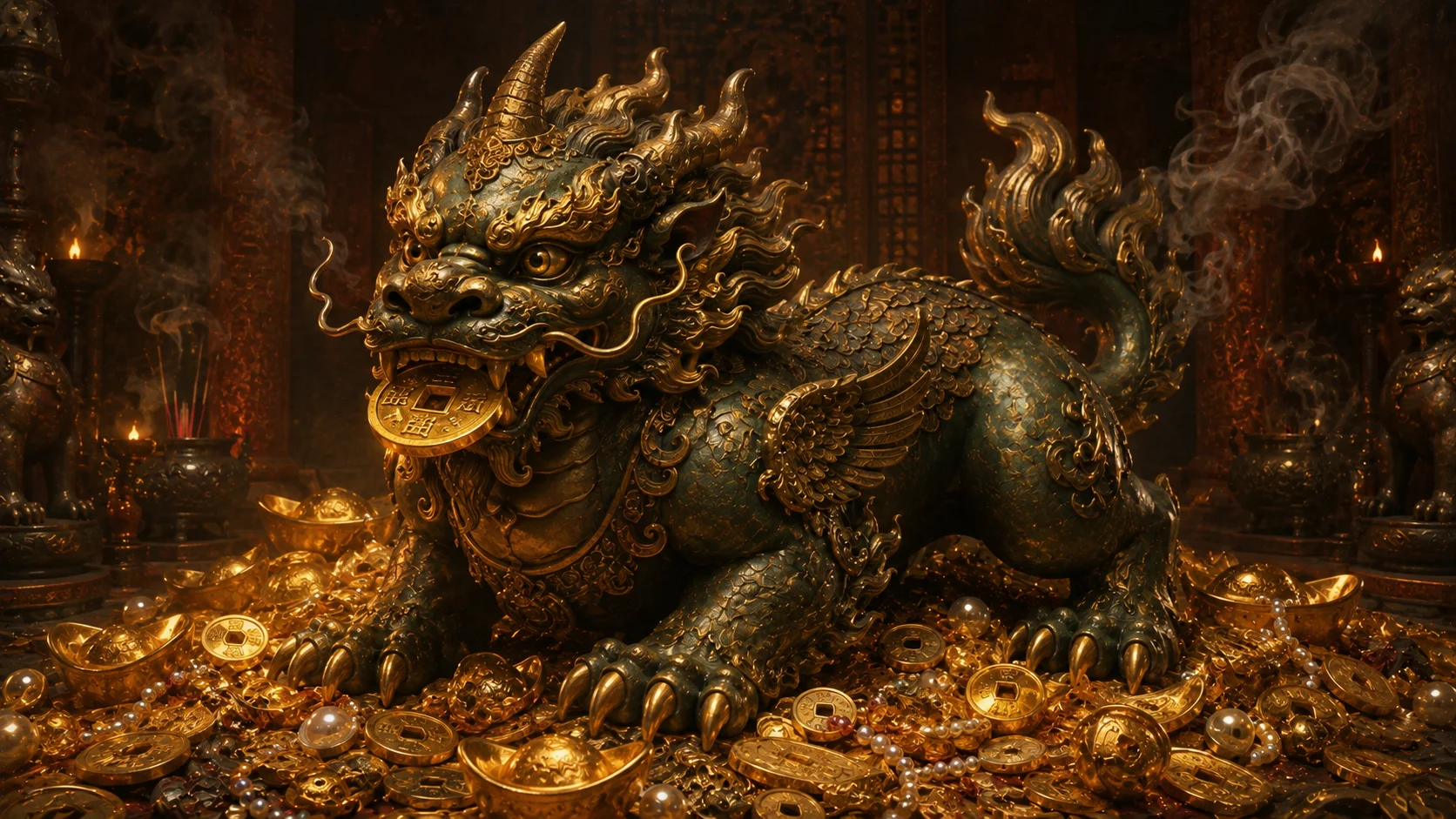
Set beside a qilin or a Fu dog, the Pixiu is distinguished by a consistent set of features. It carries a dragon's head, a body drawn from the lion or the horse, and a pair of wings folded along its flanks, a body built, in legend, for flight through the heavens and passage across the four seas. Chinese folklore compilations describe the type as having originally comprised two distinct variants, distinguished by a single horn (tianlu) or two horns (bixie), which over time merged into the one popular composite image now called simply Pixiu. Depictions vary in fine detail from region to region and workshop to workshop, some emphasizing the mane and haunches of the lion, others the sinuous body of the horse, but the dragon's head, the folded wings and the alert, forward-facing posture recur across nearly every rendering, whether the piece is a monumental tomb guardian or a pendant small enough to close in a fist.
Tianlu and Bixie, the Two Faces of One Beast
What is spoken of today as a single creature was once two related celestial beasts: Tianlu, the heavenly emolument beast, typically depicted with a single horn, and Bixie, the evil-averting beast, typically depicted with two. Tianlu leaned toward blessing and prosperity, Bixie toward protection and the warding-off of malevolent spirits, complementary rather than identical roles. Over generations of retelling and re-carving, the two horned variants folded into the popular composite figure now called simply Pixiu, and most modern statues no longer trouble to distinguish which of the two ancestors they descend from, though the two names persist as a collective term for the type. Some lineages of craftsmen and some regional temples kept the distinction alive longer than others, continuing to carve single-horned and double-horned pairs side by side, but as the composite image spread through popular use the finer point of horn count became a matter of connoisseurship rather than common knowledge, something a collector or a temple keeper might still note but a buyer of a desk ornament or a bracelet charm generally would not.
Stone Sentinels of the Han Spirit Roads
The beast's presence in the written and carved record reaches back to the Han dynasty, between 206 BCE and 220 CE, when stone figures of horned, winged lions were raised along the shendao, the spirit roads leading to the tomb avenues of officials and nobility. Flanking the avenue in pairs, these monumental guardians stood watch over the approach to the dead, their wings and horns marking them as creatures apart from the natural world, positioned to guard the resting place beyond them. The scale of these Han figures set them apart from the personal charms of later centuries: carved from a single block of stone and set on plinths along a processional way, they were meant to be seen from a distance by anyone approaching the tomb, a public statement of the rank and protection owed to the person buried beyond them, rather than a private object meant for one owner's hand or desk.
The Six Dynasties Tomb Avenues
The practice did not end with the Han. In the centuries that followed, through the Six Dynasties period from 220 to 589 CE, winged guardian statues in the same lineage were still being erected along the tomb avenues of the aristocracy, with notable surviving examples near Nanjing. Regional usage sometimes called these figures qilin or bixie rather than settling on one name, but their stated purpose held constant: statues set at the threshold of the tomb, intended to ward off evil spirits and protect the deceased. The surviving examples near Nanjing are counted among the most studied stone sculptures of the period, their weathered surfaces still legible enough to show the same folded wings and forward stride found on the earlier Han figures, evidence read by historians as continuity of belief and craft across the political fragmentation that otherwise separated the two eras.
A War Beast's Older Ancestry
Before the composite Pixiu of horn and wing took its familiar shape, the two characters that spell its name already had lives of their own in ancient texts. They appear individually in works such as the Book of Documents and in bestiary traditions adjacent to the Classic of Mountains and Seas, describing fierce animals likened to tigers or bears. Some scholars trace this thread of ferocious war-beast imagery as one origin for the later composite Pixiu image, used in ancient China as a symbol of military valor before the creature settled into its later role as a household emblem of fortune. In this earlier guise the name was invoked less as a guardian figure standing watch than as a description of ferocity itself, a term applied to brave soldiers or to armies compared to tigers and bears in their fearlessness, a martial sense of the word that predates and stands apart from the wealth-hoarding mythology attached to the later composite beast.
The Sin Against the Jade Emperor
Folk legend offers an origin story for the Pixiu's strangest trait. According to this account, the beast once offended the Jade Emperor by defecating on him, and as punishment the Jade Emperor sealed its anus, trapping wealth inside its body once eaten, forever. What began as a punishment became, in the popular imagination, the mythological basis for the creature's association with hoarded fortune: everything the beast swallows from that day forward is said to remain trapped inside it. Versions of the tale differ on the particulars of the offense and on whether the Jade Emperor's sealing was an act of anger or, in gentler retellings, a corrective meant to turn a disgraced creature into a useful one, but the outcome is told the same way in every account: a body once ordinary became a body that could only take in and never release, and that permanent condition is what the folk imagination then repurposed as a blessing for anyone who kept the creature's image close.
A Body Built Only to Hoard
From that legend follows the core of the Pixiu's economic mythology. Traditionally described as having no anus, or a sealed anus, the creature is said to take wealth in but never let it go, it can only consume, never expel. Its diet was said to consist exclusively of gold, silver and jewels, offered in folk explanation as the reason it excretes nothing at all. A figurine built on this belief is treated, in the logic of the folk tradition, as a container that only fills. This is also why owners are told never to let a Pixiu figure sit empty or unfed in a purely symbolic sense, and why some households make a small show of tapping the statue near where coins or jewelry are kept, or of running a finger from its head toward its tail in an appropriately upward, coin-gathering direction rather than the reverse, a gesture meant to align the handling of the object with the direction wealth is supposed to travel once the creature has taken it in.
Kinship with the Dragon King
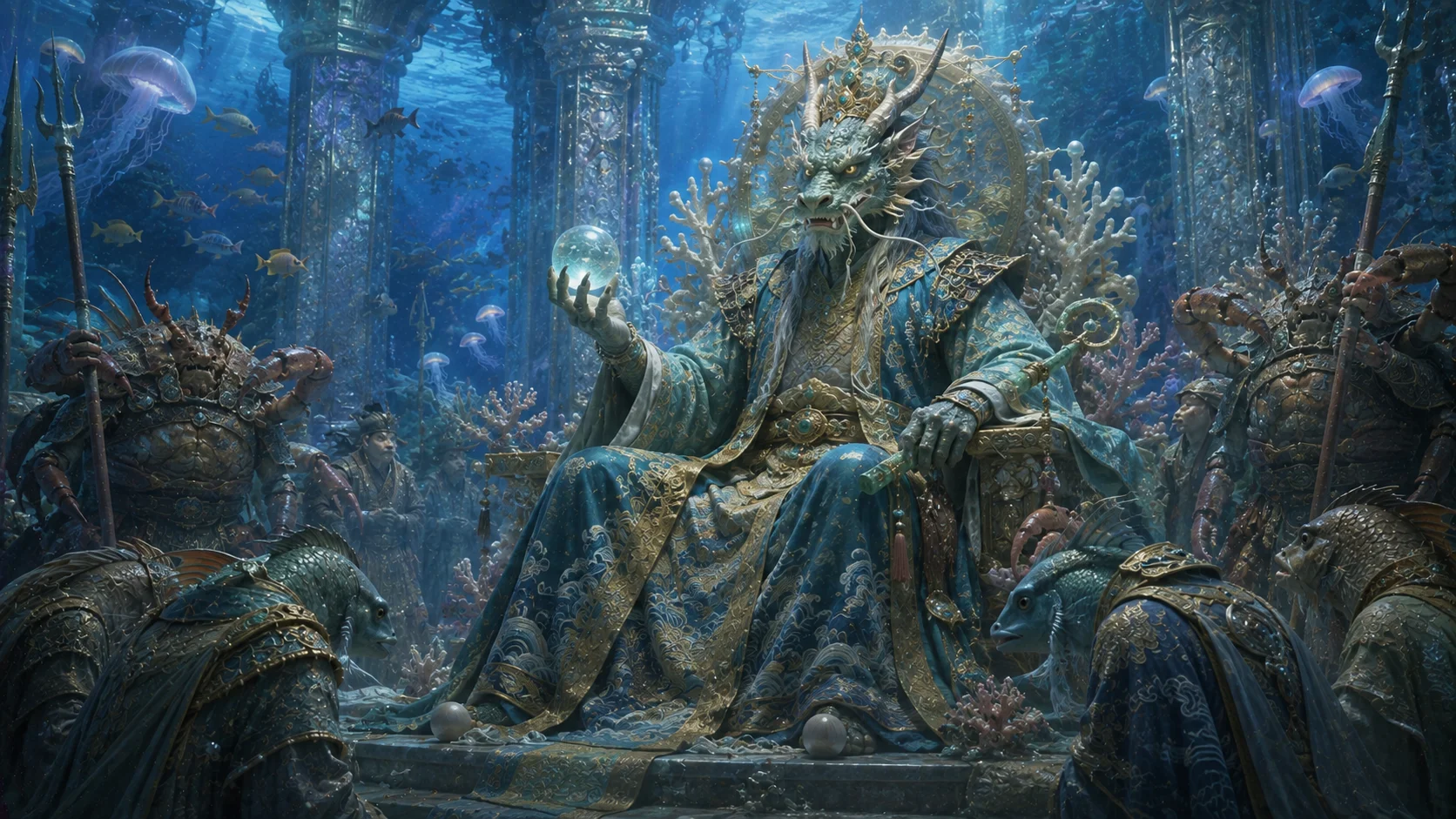
In popular legend, the Pixiu is sometimes said to be one of the nine sons of the Dragon King, part of the loose family of dragon offspring known collectively as the longsheng jiuzi. Its exact inclusion in that list varies by source, and it is sometimes treated instead as a separate divine beast rather than a dragon son, the tradition holds both possibilities without settling on a single genealogy. Lists of the nine dragon sons themselves are not fixed even where the Pixiu is included, since different regional and textual traditions swap in different names and characters for one or more of the nine positions, so the Pixiu's presence or absence on any given list says as much about which version of the list is being consulted as it does about the creature's own standing in the wider mythology of dragon-descended beasts.
Jade, Bronze and Gold Upon the Body
Pixiu iconography became especially popular during the Ming and Qing dynasties as a decorative and symbolic motif well beyond the tomb avenue. Carved in jade, cast in bronze, worked in gold, small Pixiu figures appeared on scholars' desks, in personal jewelry, and at business entrances, particularly among merchants in southern China and Hong Kong. The beast that once guarded the dead had, by degrees, become a fixture of the living economy. The choice of material was itself read as meaningful in this later, domesticated use: jade was favored for its association with purity and long life and for the coolness of its touch against skin, bronze for its durability and its echo of the ritual vessels of antiquity, and gold for its direct, unambiguous kinship with the very substance the creature was said to hoard, so that a gold Pixiu doubled as both symbol and specimen of the wealth it was meant to attract.
Rules for Placing the Beast
Feng shui practice surrounding the Pixiu is precise about orientation. A statue should face a door or window, drawing wealth inward from beyond the threshold. It should never face directly at a mirror, another Pixiu, or the owner's bed, and should ideally be placed slightly lower than eye level. Placement guidance also extends to pairing and company: practitioners generally advise against positioning a Pixiu so that it faces an image of the Lord Buddha or another devotional image in the home directly, out of respect for the difference in status between a wealth-summoning creature and an object of worship, and advise that if more than one Pixiu is kept in the same room they should face the same general direction rather than confront one another, since a pair set staring at each other is treated as cancelling out the beneficial flow each is meant to bring in on its own.
Waking the Eyes with Smoke and Wine
Tradition holds that a Pixiu amulet, once acquired, should not be touched by other people except the original owner or the person who activates it. It is often ritually awakened by having its eyes touched with incense smoke or dabbed with tea or wine before being worn, a ceremony understood in folk practice to bind the object to its owner and to explain the custom that others should not handle it afterward. The underlying idea in most explanations of this custom is that an unactivated Pixiu is inert, a carving with no more power than any other ornament, and that the smoke or the drop of tea or wine is what opens its eyes in a figurative sense and sets its loyalty to a single person, which is also why a secondhand or borrowed Pixiu is sometimes treated with more caution than a newly bought one, on the reasoning that its earlier bond may need to be considered before it is re-awakened for a new owner.
Left Wrist, Wealth In
It is customary in Chinese folk belief to wear a Pixiu bracelet or pendant on the left wrist, following the principle left in right out, the idea that wealth energy enters the body through the left side. A Pixiu meant to draw fortune inward is worn on the left wrist rather than the right accordingly. The same left-in, right-out logic is sometimes extended by practitioners to other wealth-related objects worn on the body, and it is offered as the reason a Pixiu bracelet is not simply worn on whichever wrist is more convenient, since wearing it on the right would, by the same principle, be read as directing its pull outward rather than in, working against the very purpose the piece is meant to serve.
From Tomb Guardian to Gambler's Charm
The Pixiu's migration from funerary stone to personal talisman has carried it into some of the most commercially minded corners of the modern Chinese-speaking world. Macau's gaming and business districts, as well as Hong Kong's financial district have popularized modern Pixiu statues as good-luck charms for gamblers and investors, reflecting the creature's continued role in contemporary Chinese folk economic culture. In these settings the creature is invoked at exactly the moment of financial risk rather than after the fact, carried into a casino or set beside a trading desk in the hope of drawing a favorable outcome toward the person who holds or displays it, a use that keeps faith with the oldest description of the beast as a devourer of gold even as the setting has moved from a tomb avenue to a gaming floor.
Distinguishing the Pixiu from Its Cousins
The Pixiu is often confused with or compared to the qilin and the lion-dog in Chinese art. It is distinguished from both by its wings, by its wealth-hoarding mythology, and by its dragon-headed appearance, explicit in most modern depictions. The qilin, though also a composite creature drawn from more than one animal, is generally read in folklore as an omen of wise rulership and the arrival of a sage rather than as a container for wealth, and the lion-dog pairs that flank so many doorways are guardians of the threshold in a general protective sense without the specific hoarding trait or the winged, dragon-headed form that marks the Pixiu apart, distinctions that matter to collectors and temple keepers even when a casual viewer might group all three under the same broad heading of auspicious guardian beasts.
A Guardian Still at Work
Across two thousand years the Pixiu has changed size, material and setting many times over, from stone sentinel on an imperial spirit road to a jade pendant resting against a wrist, while retaining the two roles associated with its ancestors Tianlu and Bixie: drawing prosperity toward the one it protects, and warding off misfortune and evil. It remains, in home and business alike, a recurring figure asked to do both at once, much as it was positioned to do beside the tombs where its recorded history began.
Sources & traditions
- EncyclopediaWikipedia — Pixiu
- TraditionChinese texts, oral tradition and village tellings (China)
Myths change from area to area and from time to time. This chronicle follows the most widely told versions; tellings in other villages, regions and eras may differ.