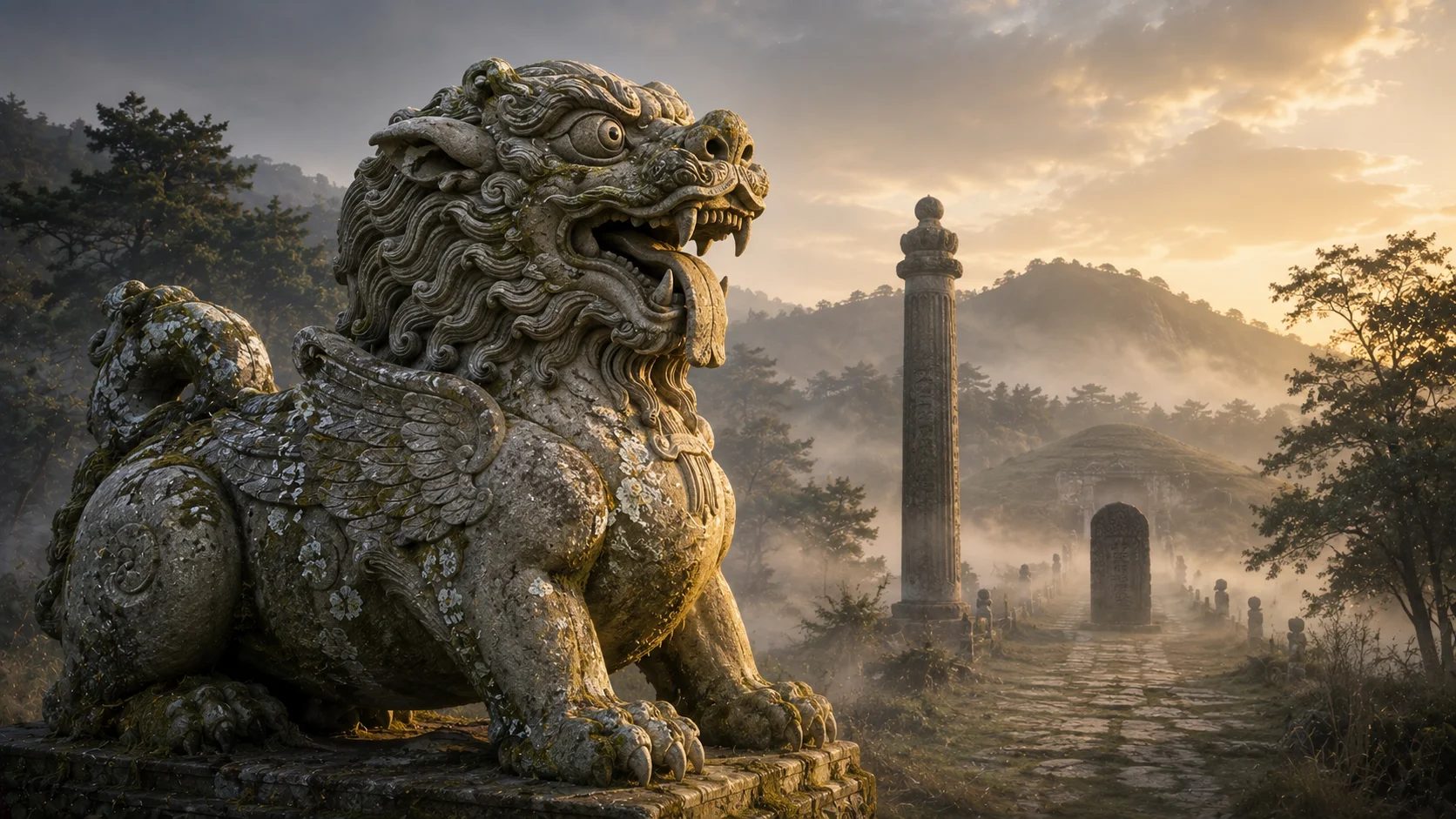
Along the old imperial roads of China, where stone avenues once led toward hidden tombs, a beast still crouches with its chest thrust forward and its mouth open in a silent, arrested roar. This is the Bixie, 辟邪 — a name that means, quite literally, "to ward off evil." It is not a creature of subtle implication. Its very syllables are an incantation, a command carved into the world: turn back, corruption; turn back, misfortune; turn back, whatever walks here uninvited.
A Name That Is Also a Spell
Few mythical beings anywhere carry their function so nakedly in their name. The character 辟 (bi) means to avoid, to repel, to ward; 邪 (xie) means evil, the heterodox, the crooked and unclean forces believed to drift through the world as xie qi — malignant breath, inauspicious energy, the residue of death and wrongdoing. Put together, Bixie is not so much a name as a job description. Where the Qilin embodies benevolence and the Pixiu came to embody wealth, the Bixie's entire mythic purpose collapses into a single, austere verb: repel. It does not bless. It does not attract. It stands, and by standing, it forbids.
Born in the Han Dynasty's Age of Stone
The creature's iconography crystallizes during the Han Dynasty (206 BCE–220 CE), a period when Chinese funerary art turned decisively toward monumental stone guardianship. Before the Han, tomb protection had been the province of ritual, talisman, and text. The Han elite wanted something more permanent and more visible — an array of carved beasts that could stand sentry through centuries, long after the mourners themselves had turned to dust. It was in this era that the winged, lion-bodied Bixie first strides into the historical record, erected at imperial and elite tombs. Han funerary practice typically placed pairs of Bixie and Tianlu together, flanking the tomb avenue on either side, so that visitors and spirits alike passed between two matched sentinels rather than one.
The Spirit Way and Its Silent Sentinels
Nowhere is the Bixie's grandeur more visible than along the Shendao — the Spirit Way — the ceremonial avenues leading to the tombs of the Southern Dynasties (420–589 CE) near present-day Nanjing. Here, at sites attributed to figures such as Xiao Jing and other royal and aristocratic dead, pairs of colossal stone beasts still stand along the avenues where they were originally placed some fourteen to sixteen centuries ago. To walk the Spirit Way is to walk between two ranks of guards frozen mid-stride, each seeming to dare the air itself to carry misfortune past them.
A Body Assembled From More Than One Kingdom of Nature
The Bixie's physical form is a deliberate hybrid. It is typically depicted as a lion- or dog-like beast with wings — accounts and regional traditions vary on which four-legged model dominates, lion or dog, but both share the same low-slung, muscular build suited to a predator's controlled violence. Across its flanks runs a coat rendered as dragon-like scales, linking it to the most exalted of Chinese cosmological beings. From its shoulders sprout feathered wings, curled elegantly along the body rather than spread for flight, suggesting a power held in reserve rather than constantly exercised. Cloven or clawed feet grip the earth. A long tongue lolls or curls from an open jaw. The eyes bulge, wide and fixed, seeing everything, blinking at nothing. It is a creature designed by accumulation — lion or dog for physical menace, dragon for divinity, bird for the reach of the sky — and the result reads not as a jumble but as a single coherent statement of total vigilance.
Single Horn, Twin Horn: Reading the Difference
Chinese funerary tradition frequently paired the Bixie with a closely related beast, the Tianlu, and distinguished the two chiefly by their horns. Where the Tianlu bears two horns, the Bixie is typically shown with a single horn — or, in some regional and period variations, none at all. The naming conventions were never perfectly fixed; scholars note that different eras and different workshops applied the terms with some flexibility. But the underlying logic held: in Han funerary arrangement, the two were set together as a flanking pair along the same tomb avenue, their small anatomical difference a kind of visual shorthand understood by everyone who passed between them.
Cousins Often Mistaken for One Another
The Bixie shares its mythic neighborhood with two other celebrated hybrid beasts, the Qilin and the Pixiu, and confusion among the three has persisted for centuries. The distinction that matters most is one of purpose. The Pixiu, in later folk religion, became closely tied to the accumulation of wealth — famously said to have no anus, so that whatever fortune it swallowed could never leave it, a beast of pure retention. The Bixie's identity runs in the opposite direction entirely. It does not hoard; it repels. Its task is not to draw riches inward but to keep evil outward, and this apotropaic, exorcistic character has remained its defining trait even as its more commercially minded cousin evolved into a fixture of modern Feng Shui prosperity culture.
Guardian of the Threshold, Wherever a Threshold Exists
Though it began at tomb entrances, the Bixie's protective vocabulary quickly generalized to any boundary worth defending. It guarded the approaches to palaces as readily as it guarded the dead, understood as a bulwark against both spiritual malevolence and the very physical threat of grave robbery. A threshold, in this worldview, is never merely architectural — it is a seam between the ordered world and whatever presses against it from outside, and the Bixie's entire being is oriented toward holding that seam closed.
Echoes From Further West
Some scholars trace a thread connecting the Bixie's winged-lion form to iconography carried along the Silk Road from the Near East and Central Asia — the great winged lamassu of Assyria among the most cited antecedents. If this transmission occurred, it was not a simple copy but a genuine synthesis: foreign wings and a foreign leonine silhouette grafted onto native Chinese dragon and tiger symbolism until the result became something distinctly its own. The Bixie, in this reading, is a monument to cultural contact as much as to religious belief — a creature standing at the crossroads of civilizations even as it stands at the crossroads of the living and the dead.
Jade Against the Skin, Bronze Against the Dark
Not every Bixie was built to tower over a tomb avenue. Many were small enough to hold in a closed hand. Han and later dynasties produced jade and bronze Bixie amulets and carvings meant to be worn or carried by individuals — personal talismans invoked against illness, bad luck, and the same malevolent spirits its monumental cousins held at bay along the Spirit Way. The scale changed; the function did not. Whether rendered in tons of stone or a few ounces of carved jade, the Bixie's purpose remained the same act of quiet, constant vigilance.
Masterworks in Stone
Among the most celebrated survivors of this tradition are the stone Bixie of Luoyang and the guardian beasts of the Southern Dynasties tombs near Nanjing, including the striking example associated with the tomb of Xiao Xiu. These sculptures are prized not merely as historical artifacts but as achievements of early Chinese art in their own right — dynamic, striding forms with chests thrust boldly forward and jaws open in a roar. Roughly fourteen to sixteen centuries old depending on the specific tomb, they capture a moment of arrested motion, a beast caught forever at the instant of lunging forward to meet a threat that never stops arriving.
A Star-Born Force in Later Belief
Beyond its sculptural presence, certain textual traditions elevated the Bixie further still, framing it as a manifestation of celestial or star-deity origin — a protective cosmic force dispatched to earth rather than simply an invented emblem. This framing places the Bixie alongside other great hybrid guardians of Chinese cosmology, part of a broader imaginative structure in which the boundary between heaven and earth is patrolled by beings assembled, quite deliberately, from more than one kind of creature at once.
A Guardian Family, Not a Sacred Four
It is worth noting what the Bixie is not. Chinese cosmology holds a canonical set of four supreme symbolic beasts — the Azure Dragon, the White Tiger, the Vermilion Bird, and the Black Tortoise — and the Bixie stands outside that revered quartet. It belongs instead to the broader and more populous tradition of zhenmushou, tomb-guardian beasts, a category rich with regional variation and local invention. Its omission from the Four Symbols does nothing to diminish its cultural weight; it simply marks it as belonging to a different, more grounded order of protective imagination — one built for practical vigilance at a specific gate rather than for governing a cardinal direction of the cosmos.
Crossing the Sea to New Guardians
The Bixie's influence did not remain within China's borders. Carried through Buddhist and secular artistic exchange, the motif traveled to Korea and Japan, where it left its mark on regional guardian-lion traditions — the shishi and komainu figures that still flank shrine and temple entrances today. These descendants evolved distinct local characteristics over time, shaped by different craftsmen, different religious contexts, and different centuries, yet the underlying idea persisted intact: a hybrid, lion-derived beast set at a threshold, charged with keeping what is unwelcome on the far side of it.
Rooftops, Doorways, and the Ritual Present
The Bixie's life did not end with antiquity. In later folklore and Daoist ritual practice, its image found new perches — carved into architectural elements, set upon rooftops, positioned at doorways — always with the same charge, preventing inauspicious energy from entering a home. This domestic-scale guardianship extended the tomb-avenue logic into everyday life: a house, too, has a threshold, and a threshold, in this worldview, is never something to leave undefended.
Standing Watch in the Present Day
That vigilance has not faded with modernity. Bixie imagery persists today in Chinese decorative arts and jewelry, and in contemporary Feng Shui practice its figurines are still placed in homes and offices for the same ancient purpose — deflecting sha qi, negative energy, and the misfortune it is believed to carry. Unlike the Pixiu, whose meaning has drifted strongly toward wealth in modern commercial culture, the Bixie has largely kept its older, more austere identity. It remains what it was carved to be along the Han dynasty roads and the Spirit Way at Nanjing: not a beast that gathers fortune to itself, but one that stands, roaring silently, so that nothing ill-favored may pass.
Sources & traditions
- EncyclopediaWikipedia — Pixiu
- TraditionChinese texts, oral tradition and village tellings (China)
Myths change from area to area and from time to time. This chronicle follows the most widely told versions; tellings in other villages, regions and eras may differ.