Among the Four Auspicious Beasts of Chinese tradition, none is gentler or rarer than the Qilin (麒麟) — a creature so benevolent that legend says it will not crush a single blade of grass beneath its hooves. Alongside the Dragon, the Phoenix, and the Tortoise, the Qilin completes this classical set of four, representing the pinnacle of terrestrial, land-based auspicious creatures. Where the Dragon rules the scaled creatures and the Phoenix reigns over the feathered, and the Tortoise stands for endurance and the cosmos itself, the Qilin is remembered as the king of all fur-bearing, hairy land animals — 走獸之長 — a sovereign whose power is expressed not through dominance but through restraint.
A Name Woven From Two
The word Qilin is itself a pairing. 'Qi' (麒) traditionally named the male of the pair, and 'lin' (麟) the female — a yin-yang structure that echoes the way 'feng' and 'huang' were once separate genders of the single phoenix, feng-huang, before popular usage folded them into one being. Over centuries, Qi and Lin fused in the same way, until 'Qilin' came to denote a single hybrid creature rather than a mated pair. The oldest written traces of it reach back to the Chunqiu, the Spring and Autumn Annals, and its form was elaborated further in the Erya, the ancient dictionary compiled roughly in the 3rd century BCE — meaning the Qilin has been named, described, and revered in Chinese letters for well over two thousand years.
A Body Built From Many Beasts
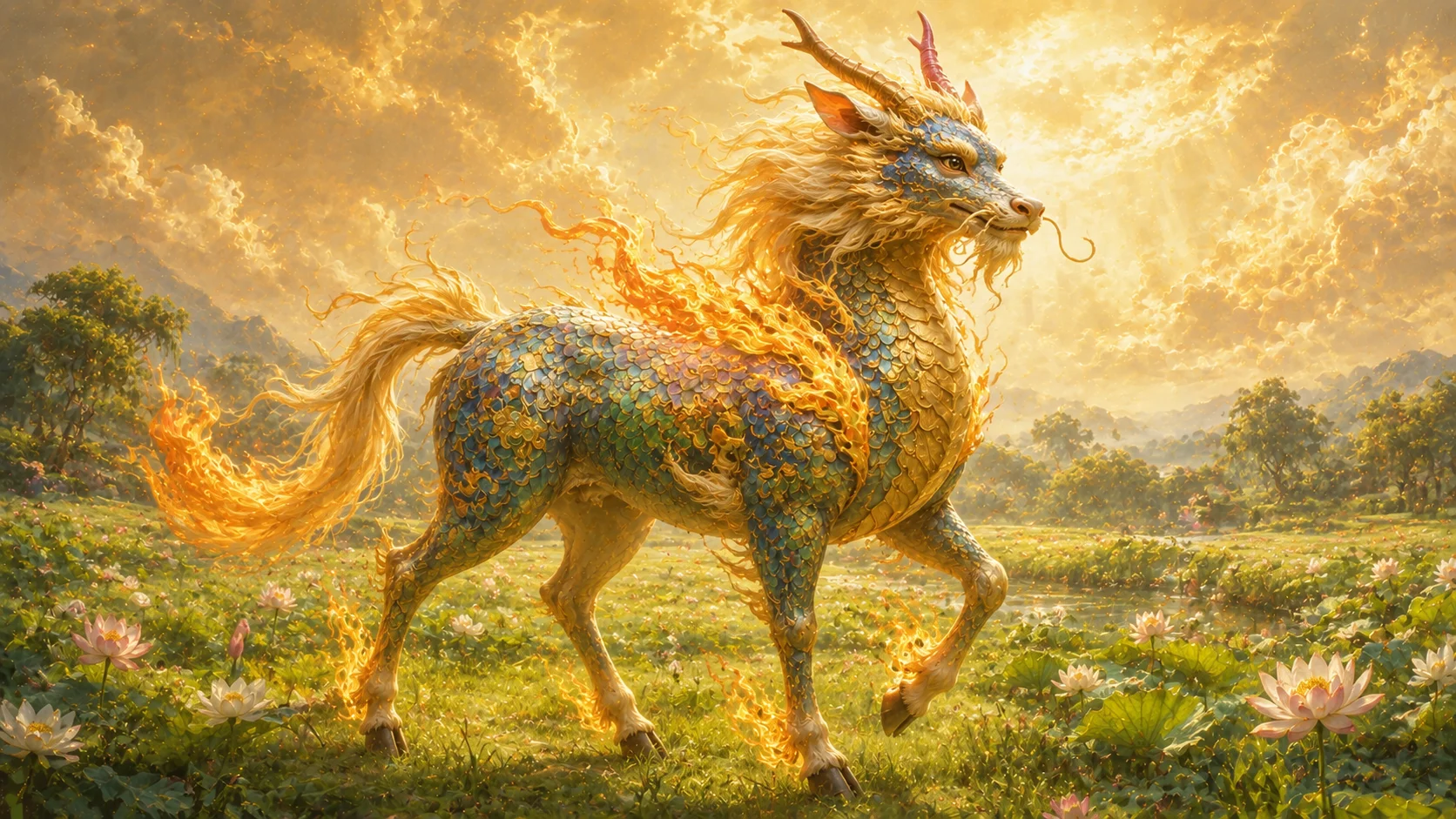
Unlike the Western unicorn, to which it is so often loosely compared, the Qilin is not a horse crowned with a horn. Its form is a true composite, drawn from the most auspicious traits of several creatures at once: a body scaled like a dragon, hooves borrowed from the deer or the ox, a tail modeled on the lion or the ox, and a hide so richly multicolored that old texts likened it to the iridescent scales of a fish or a dragon. Its horn — solitary, and often described as fleshy or sheathed in soft tissue so that it cannot be used to gore — is a secondary mark of its nature, not the defining one. Some depictions add flames or a fiery aura licking along its flanks, a visual signal that this is no earthly animal but something with a celestial, supernatural origin. Every element of the Qilin's body tells the same story: power without violence, strength wrapped in restraint.
The Beast That Will Not Harm
Central to the Qilin's character is its diet and its temperament. It is strictly vegetarian, and tradition holds that it moves through the world so carefully that it will not crush a single blade of grass beneath its step, nor bring harm to any living creature it encounters. This is not incidental gentleness — it is the Qilin's entire meaning. In a culture shaped by Confucian thought, the Qilin became a living embodiment of ren (仁), benevolence, the highest of the Confucian virtues. A beast with the physical power of a dragon and the ferocity of a lion, choosing instead to walk softly and harm nothing, is a portrait of the ideal sage-ruler: strength held always in service of compassion.
The Jade Tablet of a King Without a Throne
The Qilin's story is bound tightly to the life of Confucius himself, beginning even before his birth. Later hagiographic traditions, recorded in texts such as the Kongzi Jiayu and various commentaries, tell that a Qilin appeared before Confucius's pregnant mother and presented her with a jade tablet. Its inscription foretold that the child she carried would become a king without a throne — an uncrowned sage whose authority would come not from a throne or a crown, but from wisdom and moral teaching that would outlast any dynasty. It is one of the most striking omens in Chinese legend: a creature that heralds greatness announcing it not with pomp, but with a single quiet gift, delivered before the sage had even drawn breath.
The Wounded Omen at the End of an Age
If the Qilin's appearance at Confucius's birth was a promise, its appearance near his death was a warning. The Zuo Zhuan commentary to the Chunqiu records that in 481 BCE, toward the end of Confucius's life, a Qilin was found wounded or captured. Confucius is said to have wept at the news, recognizing in the beast's injury an omen of his own approaching death and, more gravely, of the decline of virtue in the world around him. This episode became known as huò lín, the Capture of the Qilin, and tradition holds that it was this very event that caused Confucius to lay down his brush and cease writing the Chunqiu altogether. A creature that only shows itself in eras of peace had been harmed — and its harming was read as proof that peace itself was ending.
A Portent That Cannot Be Summoned
What makes the Qilin's every appearance so significant is precisely that it cannot be compelled, bribed, or predicted. Tradition holds that the Qilin reveals itself only in times of great peace and prosperity, or at the birth or death of a truly sage ruler. In eras of war, corruption, or moral decay, it withdraws entirely, refusing to be seen. This is what separates the Qilin from a mere decorative symbol — it functions as a kind of moral barometer for the age itself. Its sighting is never routine; it is always news, always read by those who witness it as a sign about the character of the times they are living through, for better or for worse.
A Wish Carried on the Qilin's Back
Beyond the court and the classical texts, the Qilin settled deeply into folk custom, most enduringly through the image of qilin song zi — 麒麟送子, "the Qilin delivers a son." In this beloved motif, a Qilin is shown bearing a baby boy upon its back, carried as a gift into a household. The image became a fixture of wedding and birth-blessing traditions, a wish for the birth of a talented and worthy son given visual form. It is a softer, more domestic register of the same core belief that runs through every Qilin legend: that this creature is a bringer of good fortune, connected to fertility, to the arrival of gifted children, and to the flourishing of a family line.
Guardian at the Gate
The Qilin's benevolence did not keep it confined to nurseries and wedding chambers — it also took up a protective post in stone. Qilin statuary appears as a guardian figure throughout Chinese temple and imperial architecture, often carved flanking gates and thrones in the same tradition that placed guardian lions at entrances. Positioned at these thresholds, the Qilin was believed to ward off evil spirits and stand against misfortune, its gentle nature transformed into a quiet, watchful strength — protection offered not through aggression, but through the sheer moral weight of what the creature represents.
When a Giraffe Was Mistaken for a Miracle
One of the most remarkable turns in the Qilin's long history arrived by sea. After Admiral Zheng He's naval expeditions reached East Africa, his fleet returned in 1414 bearing tribute animals from Bengal and Malindi — among them, giraffes. At the Ming court, these tall, gentle, strikingly unfamiliar creatures were identified with the mythical Qilin itself, their peaceable temperament and extraordinary form seeming to confirm that the legendary beast had finally walked into the world. The association proved so lasting that it survives today in language: the modern Japanese and Korean words for giraffe, kirin and girin, both descend directly from qilin — a linguistic fossil of the moment myth and a real, living animal briefly seemed to be the same creature.
Longevity, Integrity, and the Wisdom of Restraint
Across all its forms — nativity omen, death omen, guardian statue, folk blessing, misidentified giraffe — the Qilin consistently stands for the same cluster of virtues: longevity, integrity, and wisdom. It is a creature whose supernatural power is never in doubt, yet whose defining trait is the choice not to use it destructively. That combination, of immense capability paired with deliberate gentleness, is why the Qilin could serve simultaneously as a symbol of imperial legitimacy, a protector of sacred thresholds, and a tender wish whispered over a newborn child. Few mythological beings carry so wide a range of meaning while remaining so recognizably, consistently themselves.
A Legend Still Carried Today
The Qilin has not faded into the past the way so many old omens have. Its image persists in Chinese decorative arts, embroidery, and jade carving, still commissioned and treasured as it was centuries ago, and the qilin song zi motif remains a living wish given at weddings and births. Its name traveled outward as well, most famously into commerce: the Kirin brewing company of Japan took both its name and its logo directly from this mythological beast, carrying the Qilin's likeness — however far from temple gates and jade tablets — into daily life around the world. It remains, after more than two thousand years, a beast defined not by what it destroys but by what it refuses to harm, appearing only when the age itself deserves it.
Sources & traditions
- EncyclopediaWikipedia — Qilin
- TraditionChinese texts, oral tradition and village tellings (China)
Myths change from area to area and from time to time. This chronicle follows the most widely told versions; tellings in other villages, regions and eras may differ.