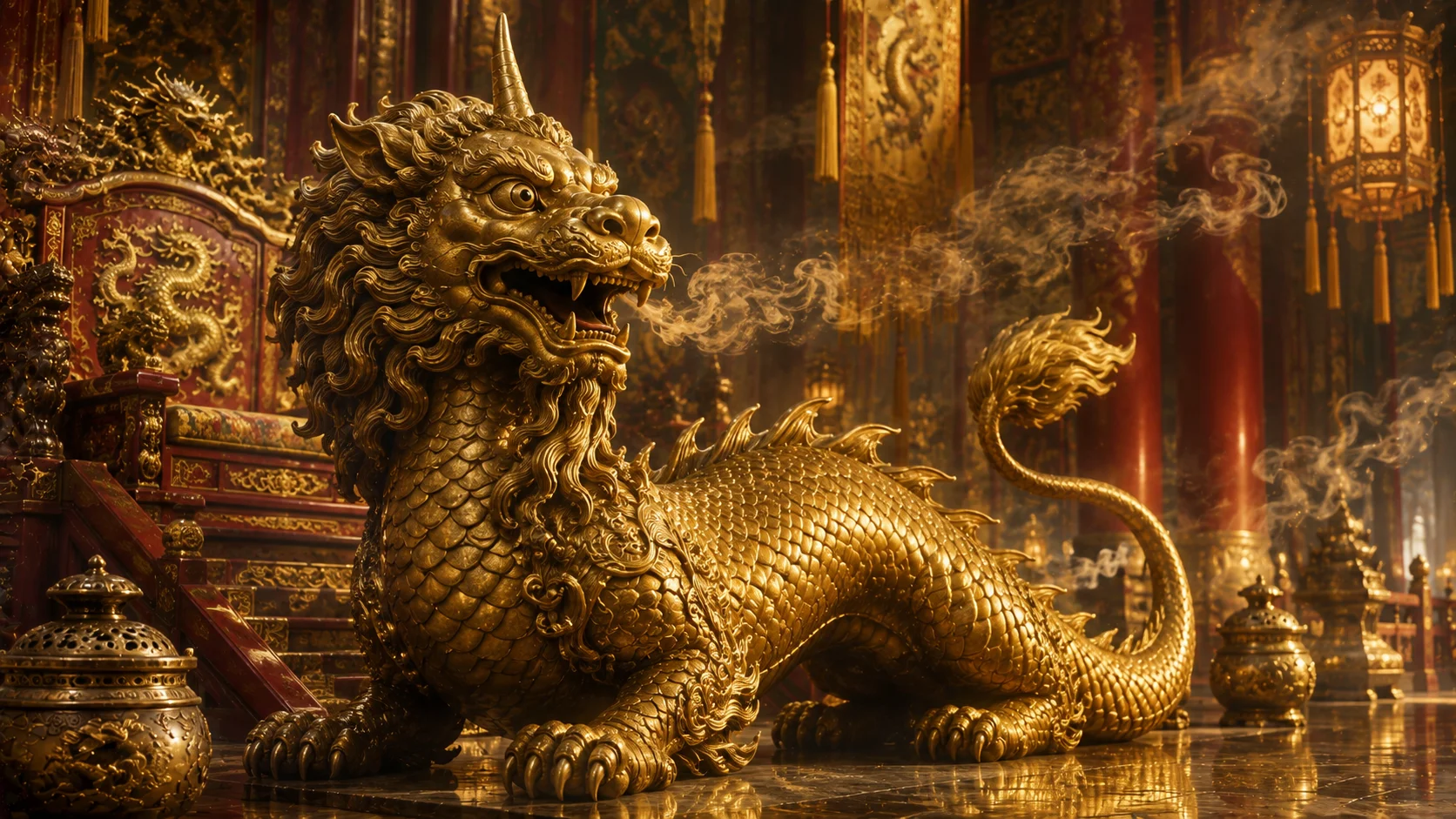
The Luduan is a single-horned, scale-bodied beast of Chinese tradition, sometimes maned like a lion, sometimes rendered close kin to the qilin, said to cover eighteen thousand li between one sunrise and the next and to understand every tongue spoken beneath heaven. It does not hunt, does not war, does not demand tribute. It watches. And it is said to appear — only, ever, exclusively — in the presence of a ruler whose virtue has actually earned the watching.
Beast That Knows All Tongues
Most omen-creatures in the Chinese bestiary announce themselves through a single dramatic sign: a phoenix descending, a qilin's cry, a dragon's shadow crossing the sun. The Luduan's gift is quieter and, in its way, stranger — it is language itself. Tradition holds that the creature comprehends every dialect and foreign speech spoken across the breadth of the realm and beyond it, so that nothing said anywhere, in any tongue, in any province or distant kingdom, escapes its understanding. Paired with its unmatched speed — eighteen thousand li, a distance that dwarfs the empire's own borders, crossed between dawn and dusk — the Luduan becomes something closer to a living instrument of perfect information than a beast of omen alone. It hears and it travels, and between those two faculties nothing under heaven remains unknown to it.
This is a very particular kind of magic to assign a mythical animal. It is not strength, not fire, not the power to bless a harvest or curse an enemy. It is comprehension without limit. In a civilization that prized the written edict, the correctly transmitted memorial, the accurately reported grievance from a distant county, a creature whose entire supernatural endowment was flawless communication carried unmistakable political weight.
The Sage-King's Mirror
Like the qilin and the fenghuang phoenix, the Luduan belongs to the class of auspicious creatures that Chinese folk tradition holds will not simply appear at any time or before any figure of power. It shows itself, the stories insist, only when a truly enlightened and benevolent monarch sits upon the throne — a sage-king whose rule is just, whose conduct is upright, whose governance actually deserves the mandate it claims. In this sense the Luduan functions less as a decoration of majesty than as a kind of moral verdict rendered in animal form: its presence certifies virtue that has already been proven, rather than granting virtue to whoever happens to claim the throne.
This distinction mattered enormously in a political culture built on the idea of the Mandate of Heaven — the belief that a ruler's authority was conditional, revocable, and dependent on continued righteous conduct rather than birthright alone. An omen-beast that could not be flattered, purchased, or coerced into appearing was, in effect, a check written into the mythology itself: no amount of ceremony could conjure a Luduan for an unworthy sovereign. Its rarity was the point. A ruler under whom no Luduan had ever been sighted had, by the logic of the legend, simply not yet earned one.
The Legend of the Halted Campaign
The single episode most often attached to the Luduan as something resembling a narrative — rather than a static emblem — comes down through Ming-era popular retellings, and it is worth approaching with the caution the tradition itself invites. The story holds that a Luduan appeared before a conquering ruler in the field, sometimes named as Genghis Khan, sometimes attributed elsewhere depending on which version is being told, and that the creature spoke: a warning against further bloodshed, a plea — or perhaps a command, depending on the telling — to turn the army back before more lives were spent. In the versions where the tale is allowed to resolve, the ruler heeds the beast and halts the campaign.
It is important to be honest about what this story is and is not. Folklorists who have traced its transmission note that the specific attribution to Genghis Khan is inconsistent across sources, that the tale was popularized rather than originating in an early, stable textual tradition, and that its historicity is disputed rather than settled. It should be read as a popular legend that crystallized around the Luduan's established symbolic identity — omniscient, far-traveling, morally attuned — rather than as an inherited fact about any specific historical campaign. What the legend does preserve faithfully, whatever its origin, is the Luduan's core character: a creature whose wisdom exists to restrain power, not to serve it unconditionally.
Restraint as the Highest Virtue
Read against the wider field of Chinese guardian and omen beasts, the halted-campaign legend places the Luduan in unusually direct opposition to violence for its own sake. Many mythic animals of the tradition are protective in a martial sense — warding off evil, devouring calamity, standing sentinel with tooth and claw. The Luduan's intervention, by contrast, is entirely verbal and entirely aimed at stopping bloodshed rather than causing it. Its heroism, such as the legend grants it, is the heroism of a single sentence spoken at the right moment to the right ruler.
This is consistent with the broader values the beast has always carried: understanding is worth more than force, and a wise sovereign's greatest strength lies in knowing when not to act. The Luduan does not conquer anything in its own legend. It simply insists, and is believed.
Eyes and Ears Beneath Heaven
Because the Luduan hears every language and reaches every corner of the realm in a single day, it became, over time, something more than an isolated omen — it became a working metaphor for the emperor's own claimed reach. To govern "all under heaven" properly required knowing what was happening in every province, hearing every petition, understanding every grievance regardless of the dialect or dialect-adjacent tongue in which it was voiced. No mortal sovereign could literally do this. The Luduan, mythically, could — and so the beast came to stand in for the ideal the emperor was meant to approximate: a ruler whose awareness, whose administrative and moral attentiveness, extended to the furthest reaches of the realm as though he, too, could travel eighteen thousand li and understand every voice raised within it.
This metaphorical weight is part of what elevated the Luduan from a minor creature of folk anecdote into an image fit for the throne room itself. An emperor who kept the beast's likeness near him was, by implication, claiming to govern with something like the Luduan's own omniscient care.
Bronze and Cloisonné Before the Dragon Throne
That claim was made in metal as much as in metaphor. Ming and Qing dynasty imperial artisans rendered the Luduan repeatedly in bronze and cloisonné, most famously as incense burners whose lids took the creature's scaled, single-horned, faintly leonine form. In the Hall of Supreme Harmony — the ceremonial heart of the Forbidden City, where enthronements were held and the emperor received his most formal audiences — Luduan-shaped censers flank the dragon throne itself. Their placement was never incidental. Positioned beside the seat of ultimate authority, they stood as a permanent visual argument that the ruler enthroned between them saw and heard everything beneath heaven, exactly as the beast in bronze was said to do.
Incense rising from those censer-lids carried a further layer of meaning: the smoke of the offering ascending through and around a creature whose entire mythic purpose was awareness. Function and symbol were fused in the same object — a working censer and a standing claim of omniscient, virtuous governance, cast in the same casting.
Kin to the Qilin, Yet Its Own Beast
Visitors to the Forbidden City, and readers of the wider bestiary, often mistake the Luduan for a variant of the qilin, and the confusion is understandable — both are hybrid, hoofed-or-scaled, single-horned or horn-bearing auspicious creatures tied to the appearance of virtuous rule. But the two are distinguished with real consistency in the tradition. The qilin carries a broader symbolic portfolio: benevolence, fertility, the miraculous births of sages — it is, famously, said to have appeared at the birth of Confucius. The Luduan's iconography is narrower and more specific, built around its single horn and scaled body, and its symbolic focus is correspondingly narrower too: not fertility or sagely birth, but omniscience, communication across every tongue, and the moral rectitude of a ruler restrained from needless violence.
Where the qilin announces a blessing upon the realm's fortune and its lineage, the Luduan announces something closer to an audit of the ruler's own conduct — a certification, not a fertility rite.
An Emblem Without an Epic
Unlike many of the great figures of Chinese myth, the Luduan was never given an extended narrative cycle of its own. It has no long saga of trials, no genealogy of encounters stretching across dynasties, no cycle of tales in the manner of a trickster-spirit or a dragon-king. Aside from the disputed halted-campaign legend, the Luduan functions overwhelmingly as an omen-creature and an iconographic motif — a figure invoked, depicted, and referenced, rather than a protagonist whose adventures are told and retold for their own sake. This is not a diminishment. Some figures in a mythic taxonomy exist to act; others exist to certify, to watch, to stand as a fixed point of meaning against which the actions of others — emperors, generals, dynasties — are measured. The Luduan belongs unmistakably to the second category, and its cultural weight has never depended on having more story attached to it.
The Character Behind the Name
The name itself, 甪端, is built from two characters whose combination is unique to this creature. The first, 甪, appears to have no significant independent life outside naming the Luduan — a character reserved, essentially, for this single mythic purpose. The second, 端, carries the sense of "end" or "tip," but also of correctness and uprightness — the same character that underlies compounds meaning proper, upright, and dignified conduct. Some commentators have read a deliberate resonance in this pairing: a beast named partly for rectitude, fittingly, is the very beast whose appearance is said to certify a ruler's moral uprightness. It is worth being precise about how solid this reading is — it is interpretive, offered by commentators working from the character's broader semantic range, rather than a meaning textually fixed in an early source. But interpretive or not, it sits comfortably alongside everything else the tradition says the Luduan represents.
Company Among the Auspicious Beasts
The Luduan does not stand alone in Chinese mythic taxonomy; it belongs to a recognizable company of hybrid creatures whose collective purpose is to validate, rather than merely decorate, dynastic rule. Alongside the qilin's benevolence and the fenghuang phoenix's harmony, and alongside pixiu with its own distinct associations of fortune and protection, the Luduan takes its place as one of heaven's several instruments for confirming that a given reign, and a given ruler, deserves the authority claimed. Each of these creatures reads a different quality in the sovereign it appears before — the qilin reads benevolence and the birth of sages, the phoenix reads harmony and cosmic balance, the Luduan reads omniscience and restraint. Together they form less a menagerie than a kind of distributed moral instrument, each beast a different lens trained on the same question: does this rule deserve to stand?
What the Beast Still Asks
Strip away the censer lids and the disputed legend, and what remains of the Luduan is a remarkably direct piece of political philosophy expressed as a beast fable in miniature: true authority is inseparable from true understanding, and true understanding is inseparable from the willingness to stop, to listen, and to hold back the sword when holding back is the wiser act. A creature that hears every language and travels every distance exists, in the end, to ask a single unglamorous question of whoever sits upon the throne — do you actually know what is happening to the people you claim to rule, and are you willing to be told no. The Forbidden City kept its bronze answer to that question standing in gilded silence beside the dragon throne for centuries. Whether any sovereign who sat there ever fully earned it is, appropriately, a question the Luduan itself was always better positioned to judge than any court chronicler.
Sources & traditions
- EncyclopediaWikipedia — Luduan
- TraditionChinese texts, oral tradition and village tellings (China)
Myths change from area to area and from time to time. This chronicle follows the most widely told versions; tellings in other villages, regions and eras may differ.