The Fenghuang is the sovereign bird of Chinese mythology — not a single species but a composite vision, assembled across millennia from the finest traits of the creatures its makers most admired. Long before it became the elegant court emblem familiar from embroidered robes and wedding crowns, it was something closer to a divine messenger: a voice on the wind, a sign that Heaven itself had taken notice of the world below. To call it "the Chinese phoenix," as translators have done for centuries, is convenient but misleading. It is its own being, with its own history, its own appetites, and its own quiet, exacting standard for the age it deigns to visit.
The Bird Before the Word
The fenghuang's story does not begin in a painting or a poem but in bone and bronze. Inscriptions carved into oracle bones during the Shang dynasty already speak of the "feng" — read by later scholars as a wind spirit and a messenger of Di, the high god of the Shang cosmos. To send a feng was to send word from the sky itself; its flight was a form of speech no human voice could match. This makes the fenghuang, in one of its earliest incarnations, among the oldest attested mythical creatures in the entire Chinese tradition, older than most of the pantheon that would later surround it.
Originally, "feng" and "huang" were distinct: the feng understood as male, the huang as female, two aspects of a single sacred principle rather than one bird wearing two names. Zhou-dynasty bronzes carried its likeness into ritual vessels, and by the Han dynasty the two had folded into a single composite figure, the pairing preserved only in the compound name itself. What survived that merger was not diminished — if anything, the fenghuang grew larger in the culture's imagination for having absorbed both halves of its own myth.
A Body Made of Many Kingdoms
Ask an artisan of the Shan Hai Jing what the fenghuang looks like and you get one answer; ask a scholar working from the Erya and you get another; ask a Ming court painter and you get a third. No single canonical description has ever existed, and that absence is not a gap to be filled but a feature of the tradition itself — the fenghuang was never meant to be pinned down to one silhouette. What recurs, version after version, is the principle of assembly: a creature built from borrowed excellence rather than invented from nothing.
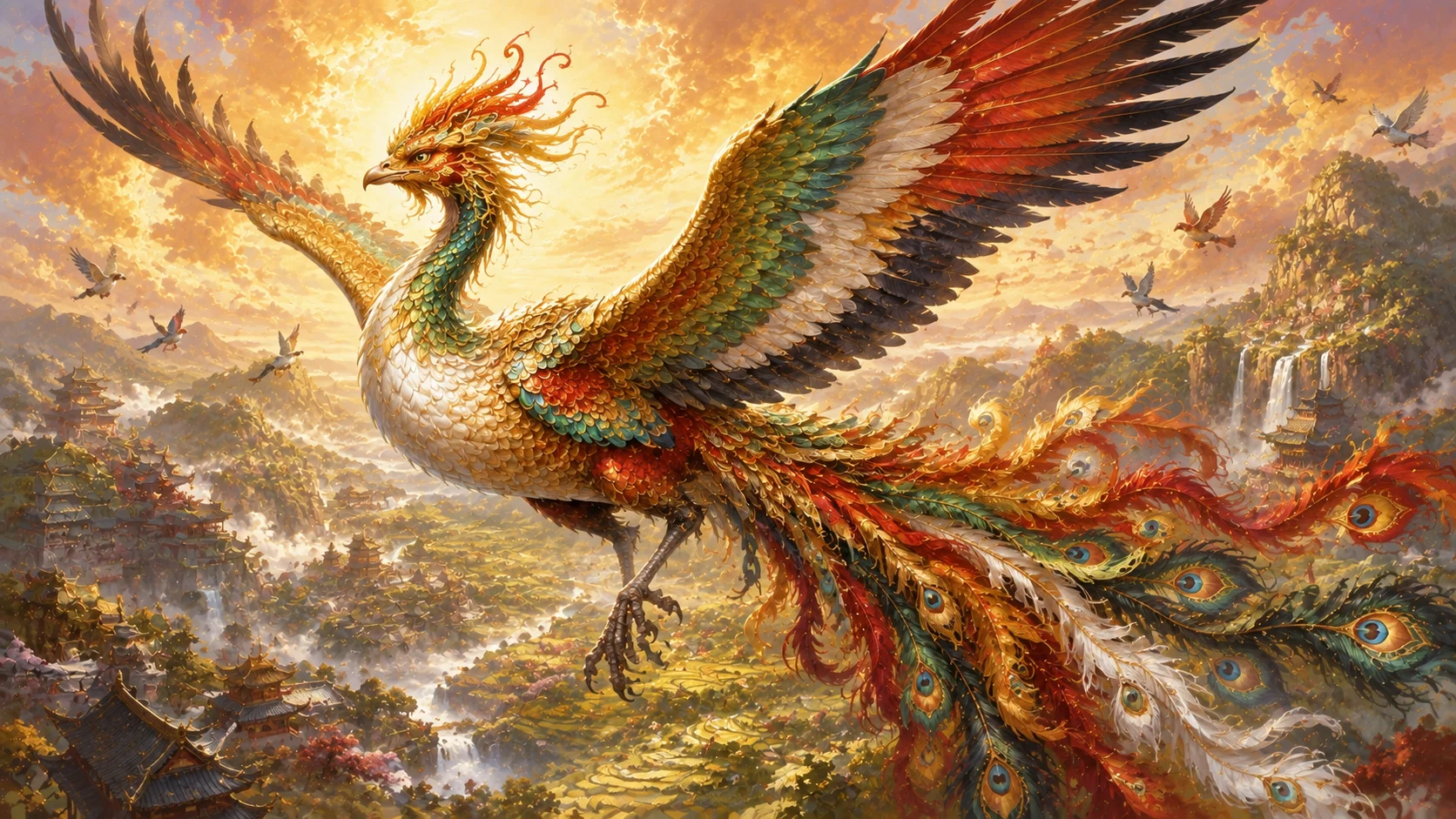
Among the most widely repeated versions, the fenghuang carries the head of a golden pheasant or fowl, the body of a mandarin duck, the sweeping tail of a peacock, the long legs of a crane, and the curved mouth of a parrot. Each element was chosen, in the logic of the tradition, because that creature already embodied something admirable — beauty, fidelity, grace, dignity, cleverness — and the fenghuang, as king of all birds, was entitled to wear the best of what its subjects offered. Other tellings assemble it differently still, swapping in a swallow's throat or a snake's neck, and none of these lists overrules the others. The fenghuang's body is plural by design.
Five Colors, Five Virtues
Where the composite body varies, the plumage holds remarkably steady across the tradition: five colors, radiant and distinct, covering the bird like a robe of office. These were not read as mere decoration. Chinese cosmological and ethical thought mapped the five colors directly onto the five Confucian virtues — benevolence, righteousness, propriety, wisdom, and sincerity — so that to see the fenghuang in full plumage was, symbolically, to see moral order made visible in feather and light.
This is worth sitting with, because it separates the fenghuang from creatures whose beauty is simply beauty. Its color was an argument. A ruler who could summon such a bird, even in legend, was a ruler whose court had achieved something more than military strength or fertile harvests — it had achieved the alignment of human governance with the virtues Heaven itself was thought to prize. The fenghuang's five colors are, in effect, a checklist the tradition uses to grade the moral temperature of an era.
The King Who Answers to No Cage
Among the Four Benevolent Animals — the dragon, the qilin, the tortoise, and the fenghuang — the fenghuang holds a particular office: sovereign of the entire avian world, the bird to whom all other birds owe deference. Where the dragon presides over seas and storms, and by extension over the emperor's own authority, the fenghuang's dominion is the sky's other half — the feathered half, the half made of song and flight rather than flood and thunder.
This kingship is not enforced through violence or fear, which is precisely what distinguishes it from the political kingships humans invent. The fenghuang rules because its excellence is self-evident and its virtue uncontested — an idealized picture of authority earned rather than seized, one that Chinese political philosophy returned to again and again when imagining what a truly worthy ruler might look like.
The Cry on Mount Qi
Legend ties the fenghuang directly into one of the founding moments of Chinese dynastic history. On Mount Qi, the ancestral heartland of the people who would become the Zhou, the cry of a fenghuang was heard and taken as an omen — a sign that Heaven's Mandate was turning toward King Wen of Zhou, the ruler whose line would soon topple the Shang and inaugurate thirty generations of Zhou rule. In a political culture where legitimacy needed to be visible, audible, and undeniable, the fenghuang's voice on that mountain became one of the founding proofs that the new dynasty was not merely powerful but sanctioned.
This is the pattern the fenghuang repeats throughout Chinese legend: it does not seize thrones or fight wars. It announces them. Its appearance is retrospective evidence, offered by the cosmos, that events already in motion were meant to happen.
Bamboo Seeds and Sacred Springs
A creature this exalted could not be permitted an ordinary appetite, and the tradition is careful on this point. The fenghuang is said to eat only bamboo seeds — a food so modest, so free of luxury or excess, that its selectiveness reads less like fussiness and more like discipline. In other tellings it drinks only from sacred springs, water untouched by the corruptions of ordinary rivers and wells.
Both details serve the same purpose: they mark the fenghuang as a creature of purity in the fullest sense the tradition could imagine, uncontaminated by greed, excess, or compromise. A bird that could eat anything but chooses austerity is a bird whose restraint becomes, itself, a form of moral instruction. It is easy to read past this detail as mere folklore color, but it sits at the center of why the fenghuang was trusted as a barometer of virtuous rule in the first place — an animal that polices its own appetite is a fitting judge of whether a human ruler has learned to do the same.
The Wutong Tree and the Waiting
Tradition holds that the fenghuang, when it does deign to land, perches specifically in the wutong tree — never any branch, never any perch of convenience. The choice matters because it is exclusive: a fenghuang will not settle for a lesser tree any more than it will settle for a lesser age to grace with its presence. This selectivity is the mechanism by which the fenghuang functions as an omen at all. An omen that appeared indiscriminately would mean nothing; it is precisely because the fenghuang is understood to withhold itself from mediocre or corrupt times that its rare appearances carry such weight.
In this sense the fenghuang's mythology is built around absence as much as presence. Most of Chinese history, by the terms of its own legend, was a history the fenghuang did not visit — and the years or reigns when it reportedly did were remembered precisely because they were the exception.
Dragon and Phoenix, Emperor and Empress
No pairing in Chinese symbolism is more enduring than the fenghuang alongside the long, the dragon. Together they form a complete cosmological statement: yin and yang, feminine and masculine, empress and emperor, held in balance rather than competition. The phrase longfeng chengxiang — dragon and phoenix bringing auspiciousness — became a fixture of Ming and Qing imperial iconography, stitched into robes, carved into palace lintels, and painted across the ceremonial objects that marked an imperial wedding.
The dragon-and-phoenix motif was never a contest for supremacy between the two creatures; it was a portrait of harmony, each animal completing rather than rivaling the other. That the fenghuang came to represent the empress specifically, rather than femininity in the abstract, tied it to a real and singular office at the summit of Chinese court life — making it, in the palace context, not folklore but protocol.
From Cosmic Bird to Empress's Emblem
It is worth pausing on how much this gendering was a historical development rather than an original feature. In its earliest attested forms — the oracle-bone feng, the Zhou-bronze imagery — the bird carried no fixed feminine association at all; if anything, the original feng was read as more masculine or gender-neutral, a messenger spirit rather than a consort figure. It was only from roughly the Han dynasty onward, as the feng and huang folded into one creature and court symbolism matured, that the fenghuang settled into its familiar role as the empress's emblem, standing opposite the emperor's dragon.
This shift matters because it reframes what is often presented as timeless symbolism as, in fact, a layered history — a bird that began as a genderless cosmic messenger and only later, through centuries of court usage, became inseparable from femininity and the imperial consort. Both chapters are real; neither should be mistaken for the whole story.
A Hundred Birds Paying Homage
Few images capture the fenghuang's standing as vividly as the folk motif and classic painting tradition known as "Hundred Birds Paying Homage to the Phoenix." In these compositions, birds of every ordinary kind — sparrows, magpies, cranes, pheasants — gather in ranks around a single resplendent fenghuang, each one deferring to it as sovereign. The scene functions as a kind of court in miniature, the avian world's own version of a royal audience, and it reinforced in popular art exactly what the classical texts had already established: that among birds, hierarchy exists, and at its summit sits the fenghuang, unchallenged.
The endurance of this image across centuries of painting and folk art speaks to how thoroughly the fenghuang's kingship had settled into the culture's common vocabulary — not an obscure classical reference but a scene ordinary audiences would recognize on sight.
Attendant of the Queen Mother of the West
The fenghuang's associations extend into the Daoist immortal world as well, where it appears bound closely to Xiwangmu, the Queen Mother of the West — one of the most powerful figures in the Daoist pantheon, keeper of the peaches of immortality and ruler of the paradisiacal Kunlun. In this context the fenghuang appears as an attendant or vehicle-adjacent presence, part of the retinue and iconography that surrounds her.
This placement is consistent with everything else the fenghuang represents: it does not belong among ordinary creatures, and its presence marks whatever it accompanies — a virtuous king, an empress, a queen of the immortals — as operating at the very top tier of cosmic or worldly order.
The Phoenix Crown and the Wedding Bed
The fenghuang's most visible legacy today is not textual but material: it survives in silk, gold, and gemstone. The fengguan, or phoenix crown, worn historically by empresses and still echoed in elaborate form by brides across Chinese communities, keeps the bird's image perched literally atop the wearer's head on the most consequential day of a traditional wedding. Bridal jewelry, wedding dress embroidery, and ceremonial textiles continue to carry the dragon-and-phoenix pairing forward, centuries after the imperial court that first codified it disappeared.
This afterlife is not nostalgia so much as continuity. The fenghuang's original meanings — harmony, virtue, an auspicious joining of complementary forces — map with almost no translation needed onto the hopes any wedding is meant to carry, which is likely why the motif has outlasted the empire that made it fashionable.
Not the Bird of Ash and Flame
English convention calls the fenghuang a "phoenix," and the comparison is close enough to be useful and misleading enough to require a correction. The Western phoenix's defining act — dying in flame and rising reborn from its own ashes — has no place in the core Chinese mythos. The fenghuang does not burn, does not die on a schedule, and does not resurrect. Its power lies elsewhere: in its selectivity, its purity of diet, its role as a moral barometer for the age it visits.
Modern popular retellings, especially those shaped by cross-cultural media, have sometimes grafted the fire-death-rebirth motif onto the fenghuang anyway, blending the two birds into a single syncretic image. That blending is a contemporary development, not a classical one, and it is worth naming plainly so that the fenghuang's own, older story — the wind-messenger of the oracle bones, the omen on Mount Qi, the bird that eats only bamboo seeds — is not quietly overwritten by a myth that was never originally its own.
What the Fenghuang Still Means
Across more than three thousand years, the fenghuang has changed shape more than once — from wind-spirit messenger of a Shang high god, to omen of dynastic legitimacy, to the empress's personal emblem, to a bridal motif stitched into modern silk. What has not changed is the underlying claim the bird makes every time it reappears: that virtue is visible, that a well-governed age announces itself, and that beauty assembled from many excellent parts can still add up to something whole and singular. The fenghuang remains, in every era that has told its story, a judgment as much as an image — a bird that only ever shows itself to a world that has, for once, earned the sight.
Sources & traditions
- EncyclopediaWikipedia — Fenghuang
- TraditionChinese texts, oral tradition and village tellings (China)
Myths change from area to area and from time to time. This chronicle follows the most widely told versions; tellings in other villages, regions and eras may differ.