The Bai Ze is the wise, all-knowing beast of Chinese mythology who knows the names and natures of every spirit and demon under heaven. Its name means "White Marsh," and though it is remembered today chiefly as an image on talismans and screens, the tradition behind it describes something closer to a single, extraordinary conversation — a beast that spoke as a man speaks, and told a ruler everything.
The Beast of the White Marsh
Unlike the dragon or the fenghuang, whose forms recur across dynasties in fairly stable outline, Bai Ze occupies a narrower and stranger niche in the Chinese bestiary: it is not primarily a symbol of an office, a season, or a virtue, but of a single quality — total knowledge of the supernatural world. Its name, read literally as "White Marsh," has led some scholars to suspect the figure began as a regional nature-spirit tied to an actual wetland or mountain locale, only later elevated into the omniscient beast of the surviving legend. That etymological thread is intriguing but unresolved; what is certain is that by the time Bai Ze enters the textual record in a developed form, it is no longer a spirit of place but a walking archive, a being whose entire mythic function is to know and to tell.
An Audience on the Slopes of Dongwang
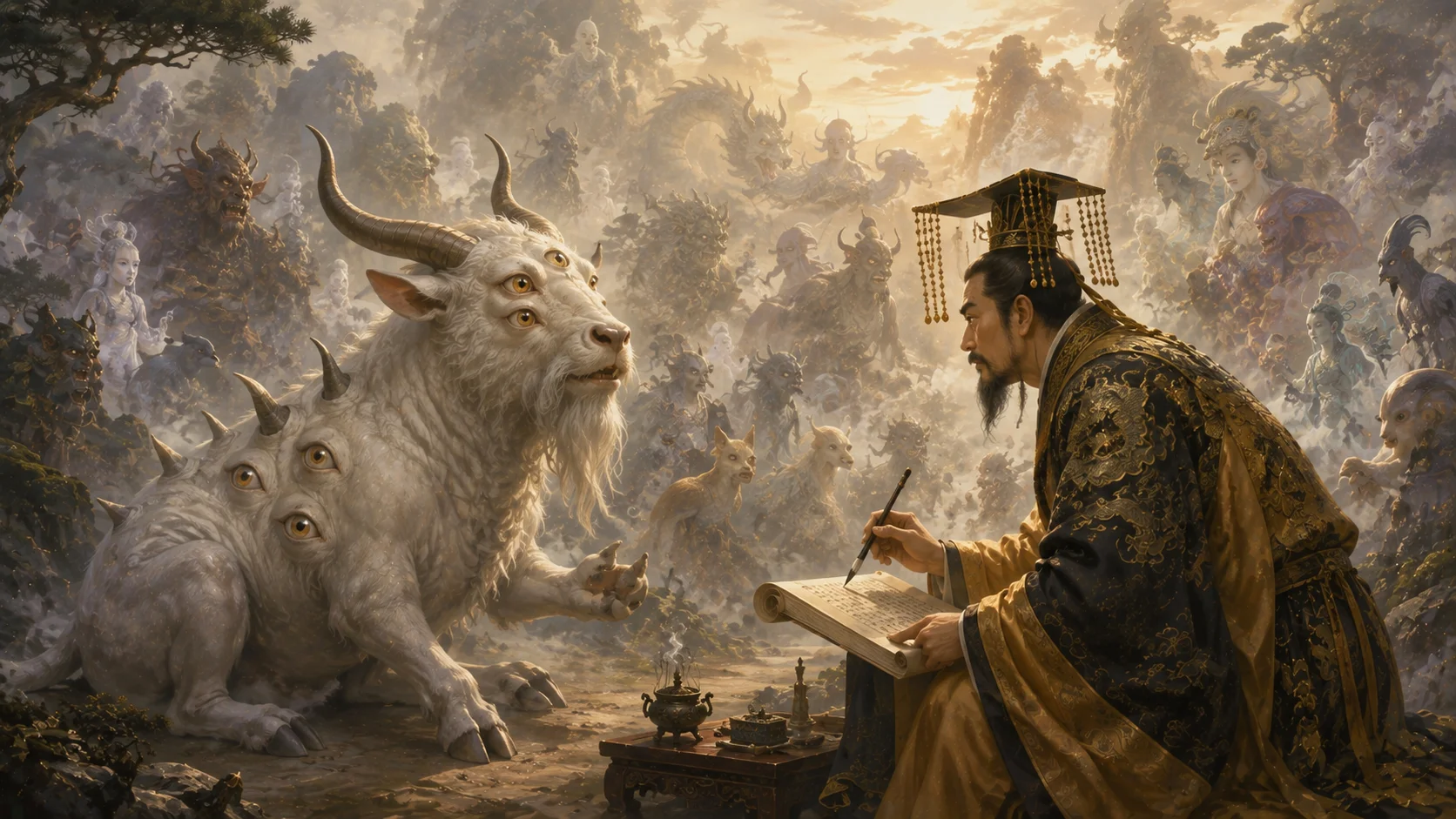
The core story is set during the reign of the Yellow Emperor, Huangdi, the culture-hero sovereign credited elsewhere with inventions, ritual reforms, and the great war against Chiyou. Traveling among the peaks associated with Mount Huan and Dongwang, Huangdi is said to have encountered Bai Ze directly. This episode belongs to the wider mythic cycle of Huangdi's deeds, but it is a separate and later-attested strand rather than part of the oldest core material about him — the beast's appearance was folded into an already-old sovereign's story, deepening it rather than originating it. The encounter itself is described with a kind of hushed formality befitting a meeting between the ruler of men and the one being alive who could speak with authority about everything that was not human.
Nine Eyes and a Human Voice
Bai Ze's iconography sets it apart from every other creature in the Chinese menagerie. It is most often shown as lion-like or ox- and deer-like in its body, but crowned with a face that is human or nearly so, and studded with extra eyes — as many as six or nine in total across some depictions, set not only on its face but on its horns and body as well. These are not decorative excess. Every additional eye is a statement about the creature's nature: a being that sees everywhere at once, that misses nothing moving in the dark corners of the world, rendered visually as a body that is mostly eyes. And crucially, Bai Ze could speak — not cry out or growl as beasts do in other tales, but converse in human language, fluently and at length, which is precisely what made its meeting with the Yellow Emperor a dialogue rather than an omen to be interpreted.
The Bai Ze Tu: A Chart of Every Spirit
What Bai Ze gave Huangdi was not a blessing or a prophecy but information — an exhaustive account of the spirit world. According to the legend, the beast recounted the forms and habits of some 11,520 kinds of spirits, demons, and monsters (some versions of the story give the number as 1,522), and the Yellow Emperor had this recitation recorded and illustrated. The resulting work became known as the Bai Ze Tu, the "Bai Ze Chart" or "Diagram of Omens" — a document that functioned, in effect, as a mythical proto-encyclopedia of the supernatural, the ancestor in spirit of every later Chinese bestiary and demonological compendium.
What the Chart Was Said to Hold
The Bai Ze Tu was not merely a catalogue of names. For each spirit it described, the chart is said to have recorded its appearance, its typical behavior, and — most valuably — the correct ritual or method by which a person could ward it off, subdue it, or in some cases turn its power to their own use. This is the detail that separates Bai Ze's legend from a simple bestiary: knowing a demon's name and shape was only half the value; knowing precisely how to survive an encounter with it was the whole point. A traveler, a household, or a ritual specialist armed with the chart's contents was, in principle, prepared for anything the spirit world might put in their path. It is this practical, protective dimension of the chart that gave Bai Ze its lasting cultural weight, far beyond the single mythic conversation on the mountain.
A Text That Outlived Its Own Pages
Here the tradition grows honestly uncertain. The original Bai Ze Tu itself is lost; no complete primary copy survives into the present. What we know of its contents comes almost entirely through references, quotations, and summaries preserved in later compilations, including Daoist and medieval encyclopedic sources that cited or drew upon it. This means that much of what is said about the chart's specific contents is reconstructed secondhand, filtered through centuries of copying, excerpting, and retelling, rather than read directly from a complete original. Scholars treat this as a genuinely open and disputed point in the tradition — not a minor gap to be smoothed over, but a real limit on how much can be said with certainty about what Huangdi's scribes actually set down on the mountain.
Auspicious Beast, Sagely Reign
Bai Ze belongs to the class of creatures the Chinese tradition calls rui shou, auspicious beasts, that appear only in the presence of a virtuous ruler. This is the same logic that governs the qilin's reluctance to walk on living grass or the fenghuang's descent only in eras of peace: the beast's very appearance is a verdict on the age, proof that Heaven approves of the sovereign before it. Bai Ze fits this pattern but occupies its own particular office within it. Where the qilin signals general benevolence and the fenghuang signals harmony and the arrival of a sage, Bai Ze's domain is narrower and stranger — arcane and spiritual knowledge specifically. Its appearance to Huangdi is not simply an omen of a good reign; it is a reward of understanding, as if the cosmos itself judged the Yellow Emperor worthy not just of good fortune but of the truth about what moves unseen in the world.
Talisman Against the Dark
Long after the mountain encounter itself became a fixed and half-legendary story, Bai Ze's practical legacy lived on in a much more everyday form. Its image was reproduced on amulets, folding screens, and household items, believed to carry into the home a portion of the same protective authority the beast had once handed down as a complete chart. The logic is straightforward and consistent with the core myth: if Bai Ze is the ultimate authority on how to repel every kind of demon, then to keep its likeness near you is to borrow, however faintly, some of that authority for your own household. This use of Bai Ze as guardian imagery is arguably the form in which most people across Chinese history actually encountered the creature — not through a scholarly citation of the lost chart, but through a painted or carved face watching from a screen or a doorway.
Carried Across the Water: Hakutaku
Bai Ze's story did not stay within China. Transmitted through Chinese texts, the creature crossed into Japan as Hakutaku, where it found particular popularity during the Edo period among artists and compilers of yokai. Hakutaku preserves the essential shape of the original — the multi-eyed, human-faced beast of total supernatural knowledge, invoked for protection — but it is worth marking clearly as a later, derivative development of the tradition rather than a parallel origin. The Japanese adaptation is a genuine and important point of cross-cultural transmission, evidence of how far the mountain encounter's fame traveled, but the core Chinese legend of Bai Ze and the Yellow Emperor remains the original strand from which Hakutaku descends, not a separate tradition that happens to resemble it.
Beast, Marsh, or Mountain
The unresolved question of the creature's name deserves to be sat with rather than explained away. Some sources treat "Bai Ze" as also naming an actual marsh or mountain locale, which would suggest the legendary beast took its identity from a real or half-real place before it became detached from geography and reattached to the figure of an omniscient talking animal. Whether the place gave its name to the beast, or a beast already named White Marsh was later associated with a landscape to match, is not something the surviving textual record settles. It is one of the tradition's honest loose threads: a creature defined almost entirely by what it knows, whose own origin is among the few things nobody claims to know for certain.
Kin Among the Auspicious Beasts
Set beside figures such as the qilin, Bai Ze reveals both the shared grammar of Chinese auspicious-beast mythology and its capacity for real specialization. Both are composite creatures that appear to virtuous rulers as living proof of Heaven's approval; both are gentle by nature rather than fearsome despite their strange, multiform bodies. But where the qilin's gift to the world is essentially moral — a walking guarantee that harm will not be done needlessly — Bai Ze's gift is epistemic: it does not bless a reign so much as inform it, arming the sovereign and, through the chart's later diffusion, ordinary households with knowledge rather than mere fortune. The distinction matters, because it is what makes Bai Ze the ancestral figure behind China's long tradition of demonological cataloguing rather than simply another omen-beast in the same family as the qilin or the fenghuang.
A Legend Without a Temple
It is worth stating plainly what Bai Ze is not, since the honesty of the tradition depends on it. Unlike the City God Chenghuang or the widely worshipped Guandi, Bai Ze has no associated festival calendar and no organized temple cult built around it. Nobody burns incense to Bai Ze on a fixed date, and no clergy maintain shrines in its name. Its place in Chinese tradition is literary and iconographic rather than devotional: it survives as the origin figure of the bestiary genre and as a recurring protective emblem, not as a deity with an ongoing ritual practice of its own. This does not diminish its cultural importance — if anything, it sharpens what kind of importance Bai Ze actually has. It is remembered less as a god to be petitioned than as an idea to be invoked: the notion that somewhere, once, every spirit in the world was named and catalogued, and that the record of that naming, however fragmentary now, still offers protection to anyone who carries its image.
The Long Afterlife of an Encounter
What endures from the story of Bai Ze is less the beast's exact appearance than the shape of the exchange it describes: a single meeting on a mountainside that was believed to have produced a complete accounting of the unseen world, later scattered into fragments and citations across centuries of Chinese and Japanese texts. In that sense Bai Ze's legend mirrors the fate of the Bai Ze Tu itself — a whole once glimpsed, now known only through pieces, and valued precisely because those pieces still seem to promise that the whole once existed. Invoked on a screen in a doorway, cited in a Daoist compendium, or redrawn as Hakutaku in an Edo woodblock print, Bai Ze persists as the enduring idea that somewhere a complete reckoning of the spirit world was made — and that even its fragments are worth keeping close when the road ahead runs through unfamiliar and haunted country.
Sources & traditions
- EncyclopediaWikipedia — Bai Ze
- TraditionChinese texts, oral tradition and village tellings (China)
Myths change from area to area and from time to time. This chronicle follows the most widely told versions; tellings in other villages, regions and eras may differ.