The Yellow Emperor, Huángdì (黃帝), stands at the head of the traditional Five Emperors recorded in Sima Qian's Records of the Grand Historian (Shiji) — the legendary sage-ruler venerated as a, or the, common ancestor of the Han Chinese people. Chinese tradition places his reign around 2697-2597 BCE, though modern scholarship treats him not as a verified historical individual but as a culture hero: a figure through whom a civilization narrates its own beginning. To approach Huangdi is to approach the founding memory of a people rather than a biography, and the reverence owed to that memory belongs equally to the story and to those who still carry it forward.
The Sovereign Who Wears the Earth's Colour
Within the correlative cosmology of the Five Phases (Wuxing), Huangdi is bound to the element earth and to the colour yellow, the hue that gives him his name and his epithet. In this schema each of the mythic sovereigns of high antiquity carries a phase, a direction, and a colour, and Huangdi's placement at the centre — earth beneath the other four elements, yellow as the colour of the loess soil that cradled early settlement along the Yellow River — casts him as the pivot around which the rest of the cosmological and political order turns. He is not merely a ruler among rulers; he is the still point, the ground upon which the others stand.
The Battle of Banquan and the First Unification
Before he could be remembered as founder, Huangdi had to be remembered as unifier. Tradition holds that he fought and defeated Yan Di, the Flame Emperor — a figure sometimes identified with, and sometimes held distinct from, the agricultural deity Shennong — at the Battle of Banquan. The victory did not erase Yan Di from memory; instead it fused two lineages of tribal identity into a single confederation, and it is this fusion that Chinese self-description still echoes today in the phrase "descendants of Yan and Huang" (Yan Huang zisun), a compound ancestral claim naming both sovereigns as joint progenitors of the Chinese people. Banquan is therefore remembered less as conquest than as the moment two founding streams became one.
The Fog of Chiyou and the War for Zhuolu
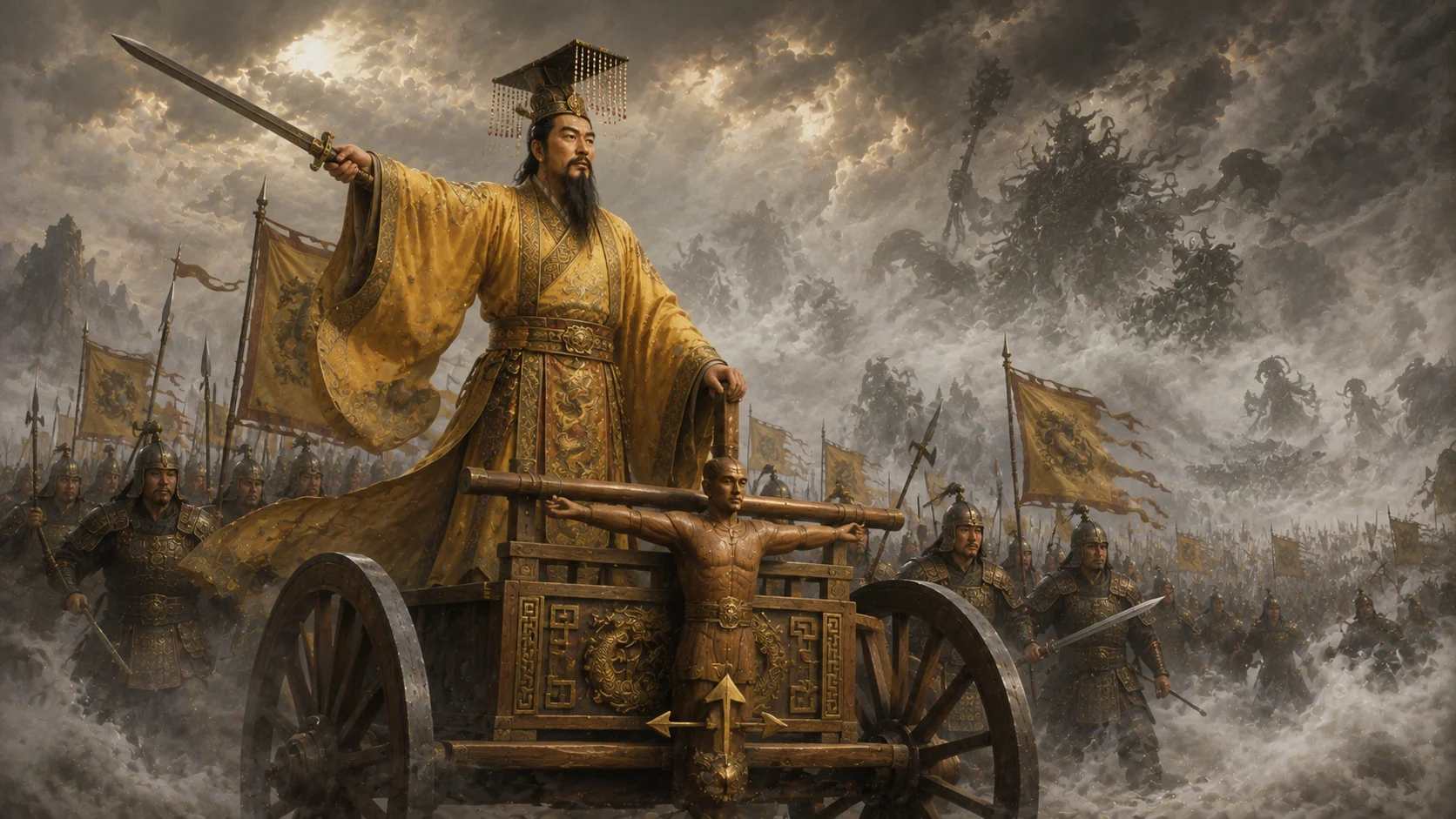
The more decisive and more dramatically remembered contest was against Chiyou, the horned warlord-deity whose armies met Huangdi's at the Battle of Zhuolu. Legend describes Chiyou summoning a thick, disorienting fog to blind and scatter his opponents — a weapon of confusion rather than force. Huangdi's answer was ingenuity: the invention of the south-pointing chariot, the zhinan che, a compass vehicle whose figure always indicated true south regardless of how the chariot turned, allowing his forces to hold their bearings and their formation inside the fog itself. Chiyou was defeated and slain, and the victory at Zhuolu became the founding narrative through which Huaxia — the political and cultural identity ancestral to the Han Chinese — claimed its dominance. It is a myth about clarity overcoming confusion, and about the invention born of necessity in the moment before defeat.
The Chariot That Always Knows South
The south-pointing chariot deserves to be held apart from the war it is remembered for, because its afterlife in Chinese tradition ran far beyond one battlefield. As a legendary invention it stands among the earliest expressions of a recurring theme in Huangdi's story: that civilization's tools arrive at moments of crisis, gifted through or by the sage-ruler rather than accumulated by ordinary trial. Whether or not any single chariot existed, the idea of a device that cannot lose its orientation became, in later centuries, a natural metaphor for steady rule itself — a sovereign, like the chariot's figure, who does not waver no matter which way the age turns.
The Scribe Cangjie and the Birth of Writing
Among the cultural inventions attributed to Huangdi's court, none carries more weight than writing itself, credited to his historian Cangjie. As with the chariot, this is legendary attribution rather than literal single authorship — no tradition claims one man invented the whole of Chinese script in an afternoon — but the attribution matters precisely because of what it assigns writing to: not commerce, not record-keeping alone, but the court of the ancestral sovereign, placing the origin of the written word inside the same founding moment as the origin of the people who would use it.
The Calendar, Governance, and the Shape of Order
Huangdi's court is also credited, again through legendary attribution rather than documented history, with establishing the calendar and the early forms of government and ritual that later Chinese statecraft would look back upon as precedent. A calendar orders the agricultural year; governance orders the human one; ritual binds both to the ancestral and cosmic order the Yellow Emperor himself was said to embody as the sovereign of the centre. These attributions, taken together, describe less a set of individual inventions than a single claim: that the whole architecture of civilized life — timekeeping, rule, ceremony — descends from one founding reign.
Leizu and the Discovery of Silk
Beside Huangdi in tradition stands his consort Leizu, credited with discovering sericulture — the cultivation of silkworms for silk — after observing or discovering the cocoon and recognizing what could be drawn from it. Silk would go on to define Chinese trade and dress for millennia, carried along the roads that would one day bear its name, and Leizu's place in the founding myth ensures that the origin of this defining craft, like writing and the calendar, is anchored to the same ancestral household rather than left to anonymous accumulation.
The Dialogues With Physician Qibo
Huangdi's name is attached to the Huangdi Neijing, the Yellow Emperor's Inner Canon, the foundational text of Chinese medicine, cast as a series of dialogues between the sovereign and his physician Qibo. The attribution here, as elsewhere, is honorific rather than literal: the text as it survives was compiled much later, in the Han dynasty or after, drawing together centuries of accumulated medical understanding under the authority of the ancestral name. That the foundational medical canon of an entire civilization should be framed as conversation — a ruler asking, a physician answering — rather than as decree, says something of how this tradition preferred to imagine the transmission of essential knowledge: through dialogue between sovereign and servant, not command alone.
The Dragon's Beard Left Behind
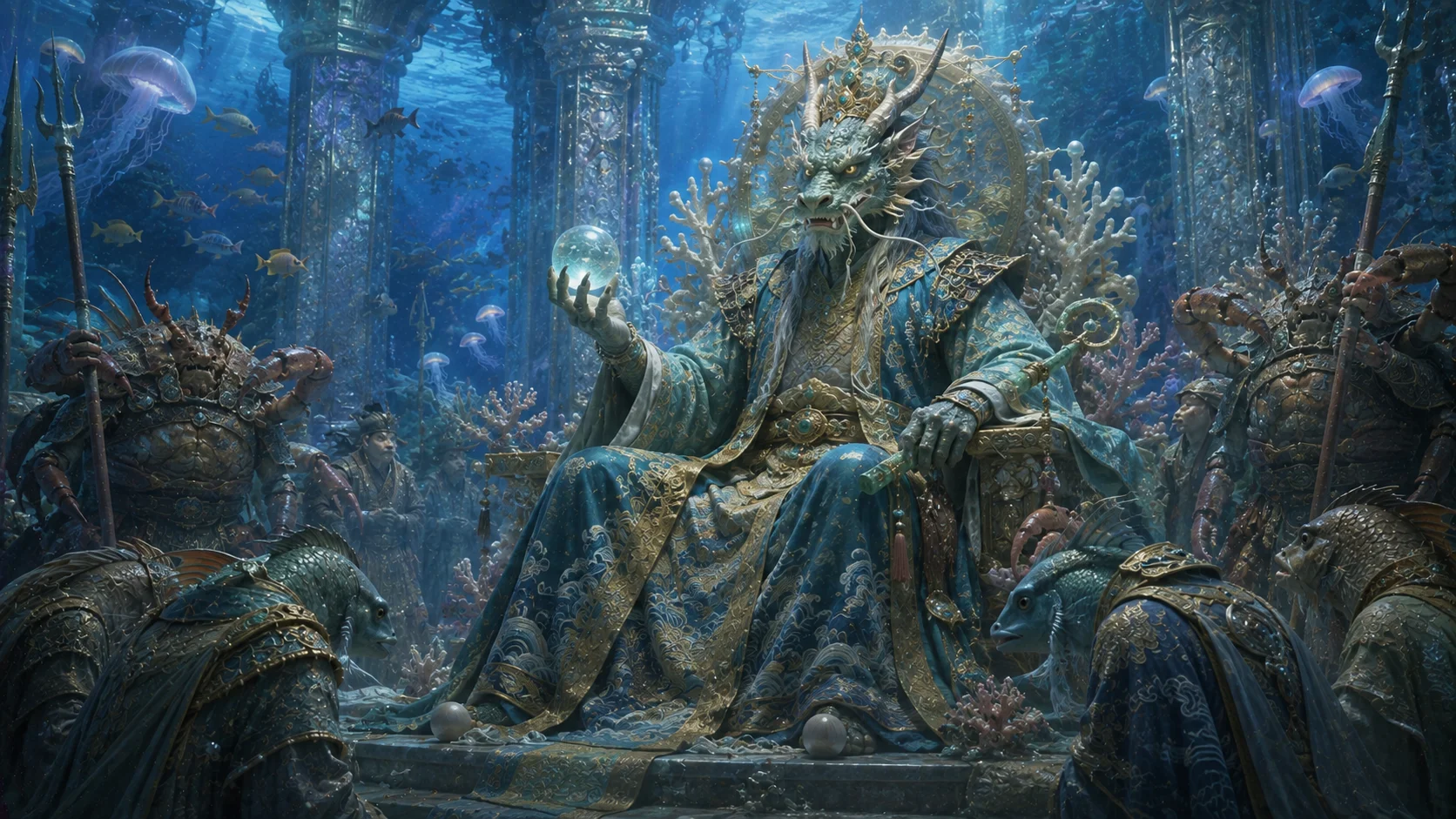
At the end of his earthly reign, tradition holds that Huangdi ascended to Heaven riding a dragon, passing from ruler into immortal. The Records of the Grand Historian preserves the scene with a detail sharp enough to have become its own idiom: as the dragon rose, the ministers and attendants who could not join him clutched at its beard, and the beard came away in their hands as the dragon and its rider departed. The Chinese phrase drawn from this moment — describing something grasped at but ungraspable — carries forward not the triumph of ascension but the grief of those left standing on the ground, a rare note of very human loss inside a myth otherwise devoted to founding and unifying.
The Mausoleum at Huangling and Rites That Continue
Huangdi's veneration is not confined to ancient text. The Huangdi Mausoleum at Huangling, in Shaanxi Province, remains the site of major memorial ceremonies, most prominently the Qingming Festival rites honoring him as ancestral progenitor. These are not merely historical reenactments; in modern times they are attended by government officials and by delegations of overseas Chinese, making the mausoleum a living point of contact between a legendary founding figure and a present-day people who continue to claim descent from him. Few figures in any tradition bridge myth and contemporary civic ceremony so directly.
The Weight an Ancestor Is Asked to Carry
Across all of these threads — the victories at Banquan and Zhuolu, the chariot and the script, the calendar and the medical canon, the silk and the dragon's ascent — Huangdi functions as a single symbolic anchor for political unification, cultural origination, and ancestral legitimacy. He is invoked wherever Chinese civilization narrates its own beginning, and the compound phrase "descendants of Yan and Huang" shows that this anchoring was never meant to rest on one figure alone but on the union of two, remembered together as the dual root of a single people. To tell his story with care is to recognize how much cultural memory a legendary ancestor is asked to hold, and how carefully that weight has been kept, retold, and ritually renewed for millennia.
Sources & traditions
- EncyclopediaWikipedia — Yellow Emperor
- TraditionChinese texts, oral tradition and village tellings (China)
Myths change from area to area and from time to time. This chronicle follows the most widely told versions; tellings in other villages, regions and eras may differ.