Shennong, the Divine Farmer, is remembered as the great teacher of agriculture and medicine: the ox-headed sovereign, his body wrapped in leaves, who is said to have given early humanity the plow, the five grains, and the very idea that the plants of the earth could heal as easily as they could kill. Counted among the Three Sovereigns in most versions of that ancient triad, Shennong occupies a place in Chinese cultural memory shared by almost no other figure except the Yellow Emperor himself — together the two are invoked in the phrase "descendants of Yan and Huang," a description of the Han Chinese people that has outlived every dynasty since.
The Ox-Headed Sovereign
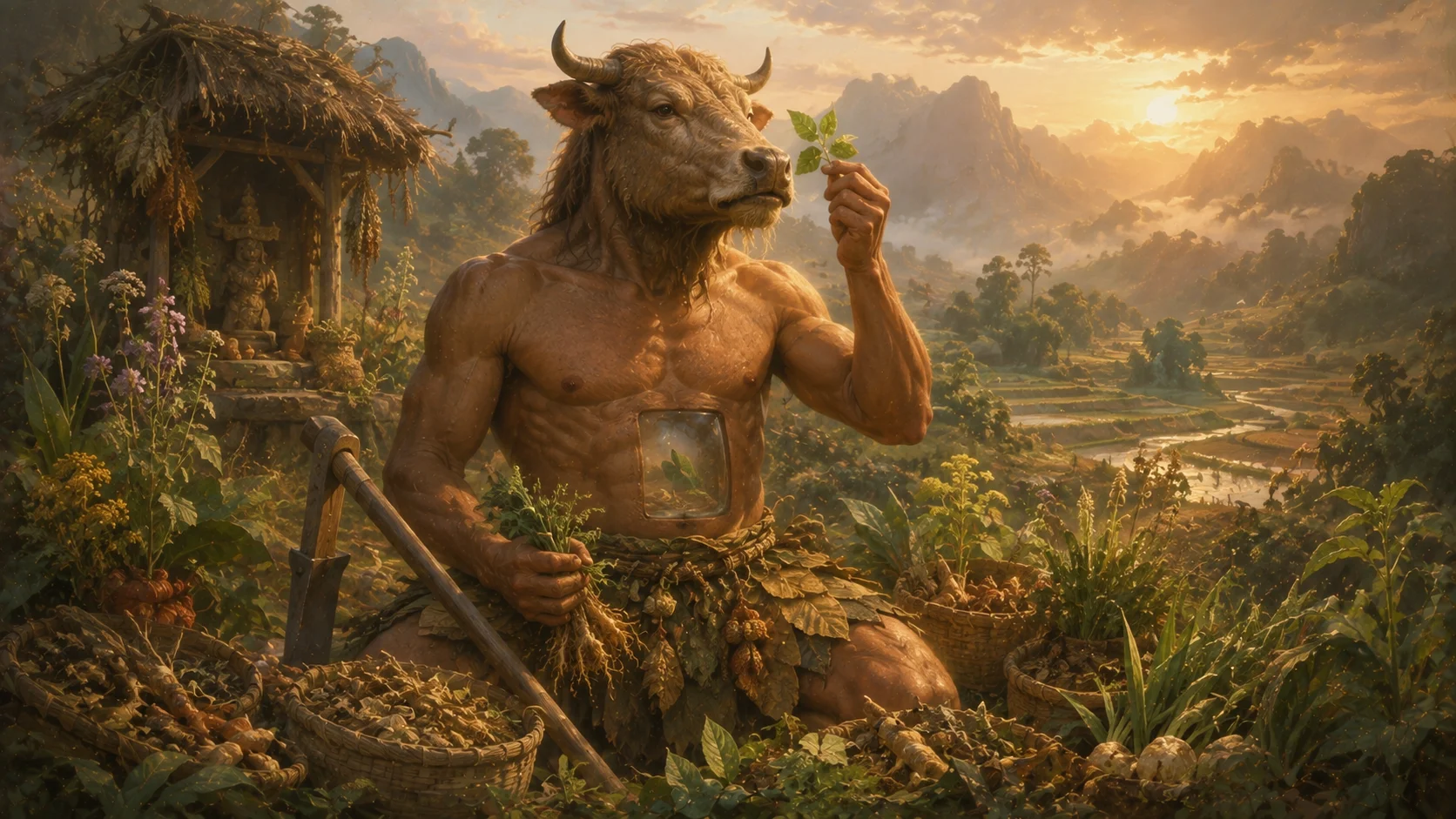
Tradition remembers Shennong not as a man of ordinary appearance but as a being marked by his domain: an ox-like head or a pair of horns set above a human body, itself wrapped in leaves rather than woven cloth. The imagery is not decorative. An ox recalls the labor of the field before the plow made that labor lighter; leaves recall a humanity that had not yet learned to spin or weave, surviving instead on what could be gathered and, eventually, cultivated. In this sense Shennong's very appearance is a kind of memory made visible — a portrait of the world he was said to have inherited and the world he left behind.
The Gift of the Plow
Before Shennong, the stories say, people lived by hunting and gathering, dependent on the uncertain generosity of forest and field. Shennong is credited with changing that dependency into mastery: inventing the wooden plow known as the lei, teaching people to till the soil, and showing them how to cultivate the five grains, the staple crops that would come to define settled Chinese civilization. This was not simply a technical improvement but, in the tradition's own telling, a turning point — the moment humanity stopped following food and started producing it. For that reason Shennong is remembered less as an inventor of a single tool than as the architect of an entire way of life.
The Founding of the Marketplace
Agriculture created surplus, and surplus, in Shennong's story, created the need for exchange. He is credited with establishing the first markets, spaces where early people could trade the fruits of their new settled life — grain for tools, tools for pottery, pottery for whatever else a growing society required. It is a small detail beside the grander claims made for him, but it matters: the tradition credits Shennong not only with feeding people but with giving them the means to build a society around that abundance, one transaction at a time.
Tasting the Hundred Herbs
The image most associated with Shennong, and the one most often retold, is that of the god personally tasting hundreds of herbs, one after another, to learn which nourished, which healed, and which killed. Some versions of the story give him a transparent stomach, so that he could watch with his own eyes what each plant did once swallowed — a detail that turns an act of reckless courage into something closer to careful, deliberate science, performed on his own body because there was no one else's to spare. Through this labor, repeated herb after herb, poisoning after poisoning, Shennong is said to have built the foundation of Chinese medicine from nothing but his own endurance.
The Price of Discovery
The tradition does not soften what this labor cost him. Shennong is said to have been poisoned again and again in the course of his tasting, and in most versions of the story it was this same practice that ultimately killed him — a lethally toxic plant, ingested in the course of an experiment he had performed safely so many times before, finally proving too much even for him. There is something quietly devastating in this ending: a god who dies not in battle or by betrayal but in the ordinary course of his own generosity, undone by the very method that had given humanity its medicine.
The Classic of Materia Medica
Out of this labor came the Shennong Bencao Jing, the Divine Farmer's Classic of Materia Medica, traditionally regarded as the foundational text of Chinese pharmacology. Later scholarship holds that the text as it survives was compiled and attributed retrospectively, most likely during the Han dynasty, long after any historical figure who might lie behind the legend could have written it himself. The tradition, however, has never required that authorship be literal to be meaningful: the text carries Shennong's name because it carries his labor, cataloguing precisely the kind of hard-won, herb-by-herb knowledge his story says he paid for with his own body.
A Brew Discovered by Accident
Amid the deliberate, almost grim discipline of tasting poisons one by one, one of Shennong's most beloved discoveries is remembered as pure accident. As he sat boiling water, the story goes, leaves from a nearby plant blew into the pot; rather than discard the result, he drank it, and found it refreshing and beneficial. That plant, tradition says, was tea — cha — and this small, almost domestic scene is treated by later generations less as sober history than as a charming and cherished legend, the kind of story a civilization tells about the origin of something it has come to love. Whether or not it happened as told, the attribution has bound Shennong to tea drinking in Chinese memory ever since.
Shennong and the Flame Emperor
Much of the complexity surrounding Shennong comes from his uncertain relationship to Yan Di, the Flame Emperor. Some classical sources treat the two as one and the same figure under different names; others describe them as distinct rulers whose stories later became entangled. The identification is genuinely disputed rather than simply forgotten, and the tradition has never fully resolved it — Shennong sometimes appears as Yan Di's own title, sometimes as a separate sovereign associated with him, and the ambiguity itself has become part of how the figure is discussed.
The Battle of Banquan
In the versions where Shennong and Yan Di are treated as one ruler distinct from the Yellow Emperor, that ruler is remembered as an antagonist turned ally: defeated by Huangdi at the Battle of Banquan and, following that defeat, absorbed into the Yellow Emperor's confederation rather than destroyed by it. This is why the two names are so often spoken together rather than in opposition — "descendants of Yan and Huang" remembers a unification, not a conquest, and Shennong's lineage is honored as an equal root of Chinese identity alongside Huangdi's own.
Among the Three Sovereigns
Shennong is counted among the Three Sovereigns, the Sanhuang, in most enumerations of that ancient triad of culture-bringing rulers, though as with the closely related figure of Fuxi, the precise membership of the Three Sovereigns shifts from one classical source to another. What remains constant across these variations is Shennong's association with agriculture and medicine specifically — whichever other figures are named beside him, the domain of the plow and the herb is his alone, and no version of the tradition assigns it elsewhere.
Temples of the Divine Farmer
Shennong has long been honored at regional temples and shrines, including sites in Hubei and Shaanxi tied to the places where his legendary activities are said to have unfolded. These were not merely commemorative spaces; agricultural and medicinal folk ritual practice historically drew on Shennong's name and example, treating him as a figure whose patronage extended into the ordinary rhythms of planting, harvest, and healing rather than remaining confined to distant myth.
The Measure of a Civilizing God
Across all his stories, Shennong stands for a single, coherent transformation: the passage from a people who searched for food to a people who grew it, and from a people who feared the unknown plant to a people who understood it. He embodies self-sacrifice made ordinary and repeated, a god who is said to have paid for humanity's knowledge one poisoning at a time rather than in a single dramatic act. It is this patience, more than any single invention, that the tradition asks to be remembered — the Divine Farmer as the quiet, wounded architect of settled life itself.
Sources & traditions
- EncyclopediaWikipedia — Shennong
- TraditionChinese texts, oral tradition and village tellings (China)
Myths change from area to area and from time to time. This chronicle follows the most widely told versions; tellings in other villages, regions and eras may differ.