Chiyou — Chīyóu (蚩尤) — is the bronze-headed war god and rebel chieftain of early Chinese legendary history: leader of the Jiuli tribal confederation, credited as an inventor of metal weapons, and the great adversary of the culture hero Yellow Emperor at the founding battle that later tradition placed at the origin of Chinese civilization's political order. Attested across classical texts including the Shanhaijing (Classic of Mountains and Seas) and Sima Qian's Shiji (Records of the Grand Historian), Chiyou occupies a singular place in Chinese myth: he is simultaneously the monstrous chaos-figure who had to be defeated for the civilized order to begin, and — in traditions preserved among the Miao, Hmong, and other non-Han peoples of southern and southwestern China — a heroic ancestor honored rather than condemned.
A Bronze Head Under Southern Mist
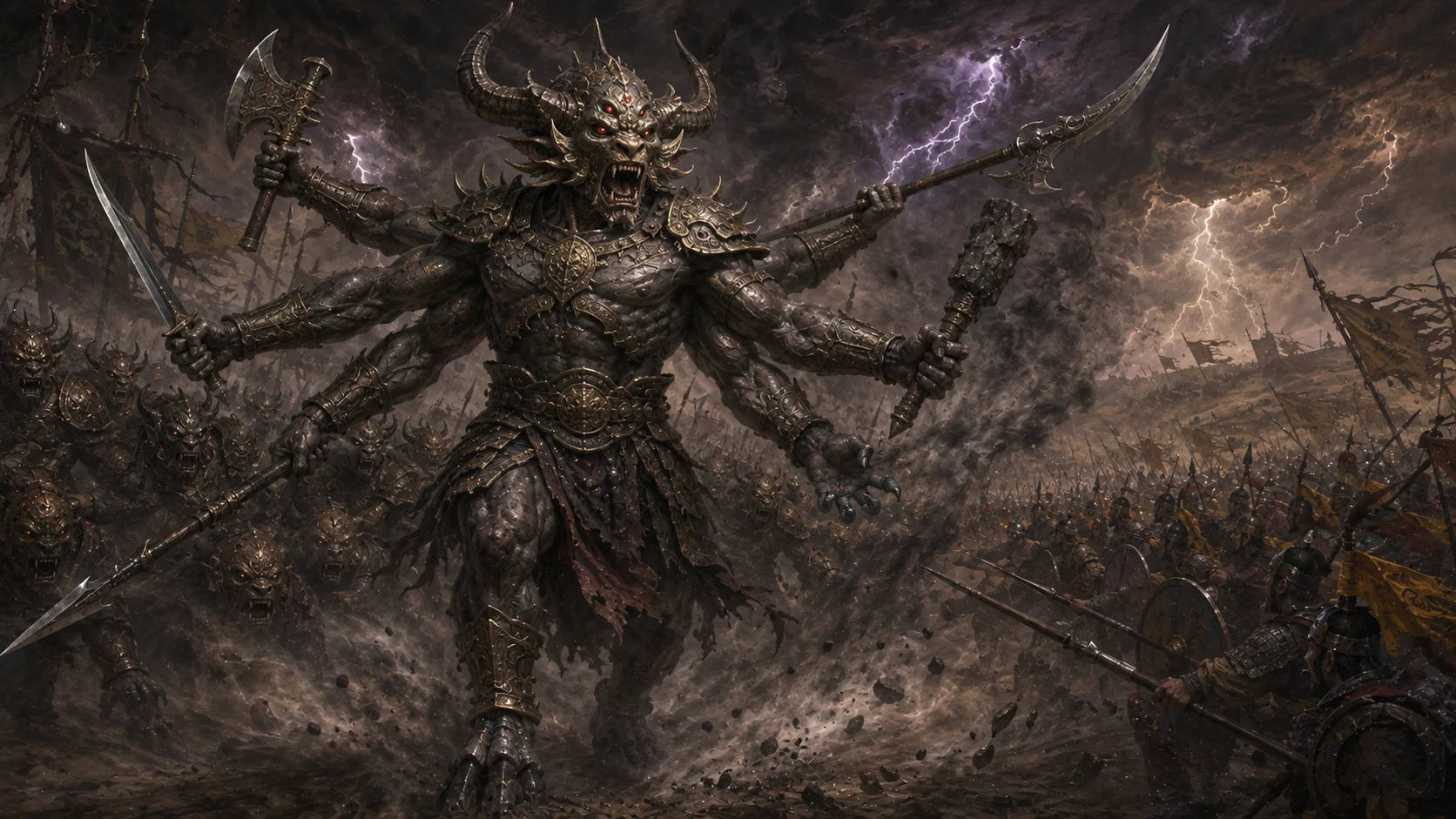
The Shanhaijing does not describe Chiyou as a man in any ordinary sense. He appears with a bronze head and an iron forehead, sometimes bull-headed, sometimes rendered with four eyes and six hands, and in the fuller retellings commanding eighty-one brothers — or eighty-one beast-bodied warriors — who fought at his side. This is not incidental grotesquerie. In the visual language of early Chinese myth, monstrous hybridity marks a figure as belonging to the world before order was imposed: a being of raw martial force rather than settled, civilized kingship. Where the Yellow Emperor is remembered as a sage-ruler who taught agriculture, medicine, and governance, Chiyou is remembered as something that had to be fought, precisely because he did not fit the mold of civilized authority the victors were writing.
The Forge Before the Throne
Chinese legendary history credits Chiyou as an inventor or early popularizer of metal weapons — bronze and iron implements of war, at a stage of the tradition when weapon-making itself was a marker of power and technological advance. This detail matters beyond battlefield color: it ties Chiyou permanently to the domain of war and weapons as such, not merely to a single conflict. In the layered chronicles that later scholars and mythographers assembled, he is less a king who happened to fight than a personification of martial capability itself — the force that makes war possible before there is a state to direct it.
Jiuli: The Nine Li and Their Chieftain
Chiyou is remembered as the leader of the Jiuli, the "Nine Li," a tribal confederation whose exact composition and territory are themselves part of the legend's ambiguity rather than settled fact. Some genealogical strands of the tradition link Chiyou, through this confederation, to the lineage of Emperor Yan (Shennong) — sometimes as ally, sometimes as kinsman — though the sources are inconsistent on this point and the relationship shifts depending on which version is being followed. What stays constant is the structural role: Chiyou stands at the head of a coalition that the Yellow Emperor's alliance had to overcome, and that coalition's defeat is remembered as the moment a fragmented tribal landscape gave way to a more unified order.
Fog Over Zhuolu
The Battle of Zhuolu is the center of the entire Chiyou tradition — a legendary war, not a documented historical event, but one that early Chinese historiography treated as foundational all the same. In the telling, Chiyou led the Jiuli against the combined forces of the Yellow Emperor and Emperor Yan. At the height of the fighting, Chiyou is said to have summoned a dense fog to disorient his enemies, erasing direction and turning the Yellow Emperor's numerical or tactical advantages into confusion. The countermeasure differs by source: some retellings credit the Yellow Emperor's court with inventing the south-pointing chariot (zhinan che), a device holding a fixed directional pointer regardless of how the vehicle turned, to cut through the fog's disorientation; others assign the role of dispelling Chiyou's weather to different figures or forces. These variations are not contradictions to be resolved so much as evidence of how many hands shaped the story as it passed through centuries of retelling — a single battle remembered differently by different tellers, each emphasizing a different marvel.
What the Sources Do Not Agree On
Unlike figures whose myths converge on a single canonical account, Chiyou has no fixed version of his own end. Some sources describe an execution following his defeat at Zhuolu. Others speak of exile. Still others hold that his shackles, or his spilled blood, transformed into a grove of maple trees — the red of the autumn leaves read afterward as a lingering trace of his death. None of these is presented as more official than the others; the tradition itself is a composite, assembled across the Shanhaijing, the Shiji, and the Han-dynasty texts that followed, each layer adding or altering detail. To read Chiyou is to read a figure built by accumulation rather than by a single author's design — his story was never fixed because it was never told once.
A God Summoned Before Battle
Whatever punishment or transformation ended his mortal defeat, Chiyou did not disappear from Chinese religious life. He was absorbed into folk religion as a war god — sometimes titled Bingzhu, "Lord of Weapons" or "Lord of War" — with cultic worship attested from the Qin and Han periods onward, including at sites such as Mount Tai that were already significant to state sacrifice. Most strikingly, the very dynasty founded by defeating rival claimants inherited this cult rather than erasing it: Liu Bang, the founding emperor of the Han dynasty, is recorded as having sacrificed to Chiyou as a god of war before going into battle. The figure remembered as the Yellow Emperor's defeated rebel became, within a few centuries, a power invoked by emperors seeking victory of their own — a reversal that says as much about how Chinese religious practice absorbed defeated figures as gods of the very forces they once wielded against the state.
The Adversary Who Defines the Throne
Chiyou's mythological function is inseparable from his opponent. The Yellow Emperor's legitimacy as the great civilizing ancestor of Chinese tradition is built, in large part, against Chiyou's defeat — the sage-king's wisdom and right to rule are demonstrated precisely by his victory over the chaotic, monstrous rebel. In this sense Chiyou is a foil in the deepest structural meaning of the term: the story needs him to lose in order to say what it wants to say about the winner. This is worth sitting with rather than passing over, because it means the Han-centric portrait of Chiyou as monster and rebel is not a neutral description — it is the shape a victor's history gives to the side it defeated.
An Ancestor Remembered Differently
Outside the Han historiographic tradition, an entirely different memory of Chiyou survives. The Miao, Hmong, and other non-Han peoples of southern and southwestern China preserve oral traditions in which Chiyou is not a monster to be overcome but a heroic ancestor — a leader whose defeat at Zhuolu is remembered as a tragedy and a founding sorrow for these peoples rather than a just victory for civilization. This divergence is not a minor footnote; it is a genuinely contested point within the tradition itself, and both readings deserve to be held together rather than resolved in favor of one. The same battle, the same figure, carries opposite moral weight depending on whose ancestors are telling the story — a reminder that "Chinese mythology" was never told by a single voice, and that the losing side of a founding war often kept its own memory alive long after the victors wrote theirs into the histories.
Chaos as a Necessary Shape
Read across all these strands, Chiyou represents something Chinese myth needed a name and a body for: primordial martial chaos, the raw capacity for war and weapon-craft that exists prior to, and in tension with, settled political order. He is not evil in the way a purely didactic villain might be — he is untamed, a war god whose fog and army and forge-born weapons belong to a world not yet organized under a single throne. That the same figure could be executed as a rebel by one tradition, worshipped as a protector by emperors in another, and honored as an ancestor by a third is not an inconsistency to be smoothed away. It is the clearest sign that Chiyou's story survived precisely because it was useful and meaningful to more than one people, in more than one direction, across more centuries than any single chronicle could claim to close.
Sources & traditions
- EncyclopediaWikipedia — Chiyou
- TraditionChinese texts, oral tradition and village tellings (China)
Myths change from area to area and from time to time. This chronicle follows the most widely told versions; tellings in other villages, regions and eras may differ.