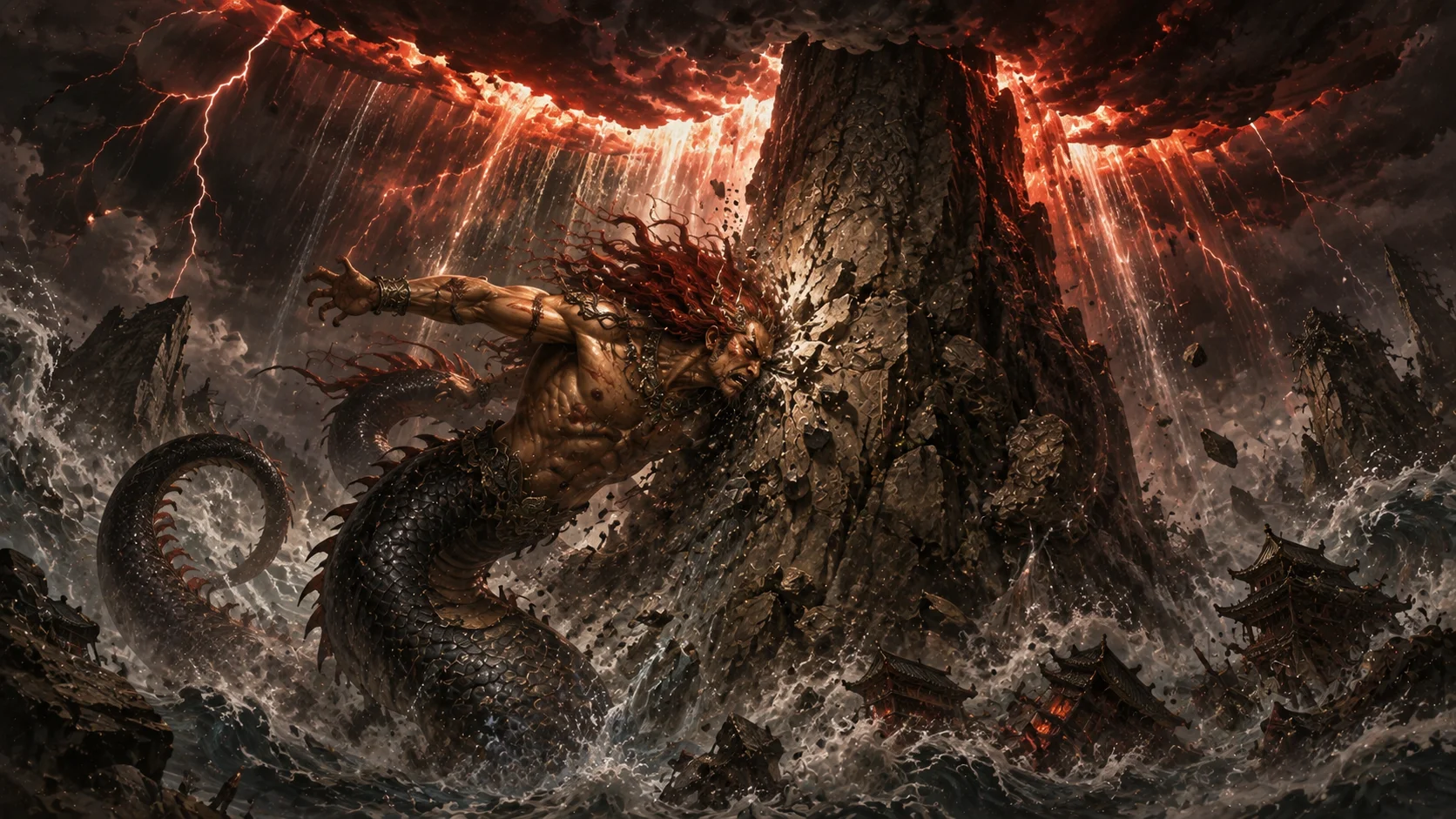
Gonggong — Gònggōng (共工) — is one of the oldest and most unruly figures in Chinese cosmogonic memory: a water-spirit of catastrophic floods, given the body of a serpent or dragon, a human face, and hair the color of blood. He appears across the earliest strata of Chinese mythological writing — the Shanhaijing, the Western Han-era Huainanzi, and the cosmogonic retellings that followed them — not as a god who is worshipped so much as a force that must be reckoned with. Where other early deities preside over order, harvest, or the turning of the seasons, Gonggong presides over what happens when water refuses to be contained. His single most consequential act, in the classical telling, is not a flood at all but a blow of his own skull against a mountain — an act of fury that tears open the sky itself and sets in motion one of the most famous repair-myths in the entire tradition, the mending work of the goddess Nüwa.
A Serpent-Bodied Sovereign of the Floodwaters
Gonggong's domain is described consistently across the old sources as floodwater and the disruption that floodwater brings — not a tended river or a benevolent tide, but the sudden, uncontainable rise of water that drowns fields, breaks banks, and erases the boundary lines by which the ordered world is known. This is a different register of water-power than the stately, court-like authority sometimes attributed to dragon-kings of later folk religion: Gonggong's water is not administered, it is loosed. He is, in the oldest layers of the material, less a ruler of a domain than the domain's own violence given a face and a name.
Red Hair, Dragon Coils: The Shape of a Chaos-Spirit
The physical descriptions that survive him are hybrid and unsettling by design. He is given the coiling body of a serpent or dragon beneath a human face, and hair described as red — a detail that, across the wider bestiary of early Chinese myth, tends to mark a being as wild, ungovernable, or touched by disaster rather than by blessing. Some tellings pile on further monstrous features. None of this is incidental description; in a tradition where a deity's appearance is often a direct statement of their moral and cosmic function, Gonggong's hybrid, serpentine form is the visual argument for who he is before he does anything at all — untamed water wearing a body.
The Rivalry With the Fire God Zhurong
The central episode of Gonggong's mythology is a war for supremacy, and in its most widely repeated form — the version preserved in the Huainanzi — his opponent is Zhurong, the fire god, his elemental and temperamental opposite. Fire against flood, the searing against the drowning: it is the kind of paired opposition early Chinese cosmological thought returns to again and again, two forces whose natures make their collision almost inevitable. Gonggong loses this contest. The sources do not dwell on the mechanics of the battle itself so much as on what his defeat provokes in him — not resignation, but a rage large enough to reshape the physical architecture of the cosmos.
A Rage That Cracked the World
Beaten by Zhurong, Gonggong turns his fury outward in a single, world-altering gesture: he drives his head into Mount Buzhou (不周山), one of the great pillars understood in early Chinese cosmology to hold the sky aloft above the earth. It is worth sitting with how the myth frames this — not a calculated act of destruction, not a siege or a weapon, but the desperate, almost animal violence of a defeated god smashing his own skull against the one thing large enough to answer his humiliation. The mountain cracks. And because the mountain was never merely a mountain but a structural pillar of the sky, its breaking is not a local catastrophe. It is cosmic.
Mount Buzhou, the Broken Pillar of Heaven
With one of the sky's pillars shattered, the heavens themselves tilt and the fabric between sky and earth tears. This is the hinge on which the entire myth turns: Gonggong's collision with Mount Buzhou is not simply a dramatic flourish appended to his war with Zhurong, it is the direct causal event that necessitates everything that follows. Without the broken pillar, there is no torn sky; without the torn sky, there is no need for Nüwa's intervention. In the architecture of the myth, Gonggong functions as the disaster that calls the mender into being — his violence is the precondition for one of Chinese cosmogony's most celebrated acts of repair.
Why the Sky Tilts and the Rivers Run Southeast
Few episodes in Chinese creation mythology carry as much explanatory weight in traditional cosmology as this one. The tilted sky and the sunken earth described in the aftermath of Gonggong's collision are offered, across generations of retelling, as the reason the heavens are understood to lean toward the northwest and the reason China's great rivers are seen as running toward the southeast, where the earth is said to have sunk. A single mythic collision becomes, in effect, a geography lesson and a cosmological axiom at once — the shape of the visible world explained as the scar tissue of a god's fury.
Nüwa's Answer to the Catastrophe
The damage Gonggong causes falls to Nüwa to repair, and her response is deliberate where his violence was not. She smelts stones of five colors and uses them to mend the torn sky, and in some versions of the story she further steadies the wounded heavens by propping them up on the legs of a giant turtle. The pairing could hardly be more pointed: Gonggong's blind destructive force answered by Nüwa's patient, almost artisanal act of restoration. The Gonggong myth is, in this sense, inseparable from the Nüwa myth — one is the wound, the other the suturing, and neither is fully legible without the other.
A Second, Contested Rival: The Sage-King Zhuanxu
Not every classical source agrees on whom Gonggong was fighting when he struck the pillar. Alongside the Zhurong version, earlier and variant tellings — found across the Huainanzi, the Liezi, and other classical compilations — instead name his rival as Zhuanxu, a legendary sage-king descended from the line of the Yellow Emperor. This is a genuine inconsistency in the textual record rather than a minor variant to be smoothed over: two different kinds of opponent — a rival elemental deity in one telling, a rival claimant to legitimate rule in the other — are both attached to the same catastrophic act. The disagreement is itself a window into how these myths accumulated across centuries and compilers rather than descending from one fixed original.
The Minister Who Failed the Great Flood
A separate strand of tradition folds Gonggong — or a minister bearing the same name or title — into the legendary-historical narrative of China's Great Flood. In these accounts he appears not as a cosmic rebel but as an official charged with managing floodwaters, whose methods fail: he is remembered for building dikes that could not hold, worsening the very disaster he was tasked with controlling. This bureaucratic Gonggong stands at some distance from the mountain-shattering deity of the Zhurong myth, yet both share the same underlying signature — proximity to floodwater, and a fundamental incapacity, whether through rage or through poor method, to bring it under control.
Gun, Yu, and the Contrast in Method
This flood-management strand of the tradition is built on contrast. Where Gonggong's dike-building is remembered as a failure, the era's flood-control narrative goes on to celebrate the success of Yu the Great and, before him, his father Gun, whose eventual methods succeeded where Gonggong's had not. The pairing is instructive rather than incidental: Chinese legendary history uses the Great Flood as a proving ground for competing approaches to controlling water, and Gonggong's name is attached to the approach that the tradition holds up as the failed one, a foil against which the achievement of Yu the Great is measured.
Banishment Under the Reign of Yao
Some retellings place Gonggong more concretely within the court of the sage-king Yao, describing him as a minister or official who is banished or executed for his failures, or for outright rebellion against the throne. This version of the figure sits at the seam between myth and legendary history — no longer purely the cosmic serpent who broke a mountain, but a courtier undone by the same currents of chaos and misrule that the cosmic Gonggong embodies on a larger scale. The punishment meted out to him, whatever its exact form in a given telling, reinforces the same verdict the tradition returns to again and again: that Gonggong's relationship to power always ends in defeat.
One Name, Layered Traditions
Scholars examining these accounts side by side have noted that they do not resolve cleanly into a single, consistent biography. The cosmic rebel who cracks Mount Buzhou, the failed dike-builder of the flood narrative, and the banished minister at Yao's court may represent conflated or layered traditions gathered under one name rather than one continuous figure moving through one continuous story. This is not a flaw to be corrected but a feature of how such mythic material was transmitted — a name substantial enough, and a set of associations coherent enough, that later compilers kept reaching for "Gonggong" whenever they needed a figure who stood for disastrous, uncontrolled water and the ruin that follows it.
Chaos Against the Civilizing Hand
Across every version, Gonggong's mythic function stays remarkably stable even when his exact story does not: he embodies destructive, uncontrolled natural force, set in direct opposition to the ordering, civilizing labor of culture-heroes. Against Nüwa's careful stone-work and Yu the Great's disciplined engineering, Gonggong stands for the flood that refuses management, the fury that answers defeat with wider ruin rather than restraint. This chaos-against-order dynamic is one of the recurring structural patterns of Chinese cosmogony, and Gonggong is among its clearest embodiments — the disruptive half of a pairing that only makes full sense alongside the figures who clean up after him.
A Figure Without a Temple
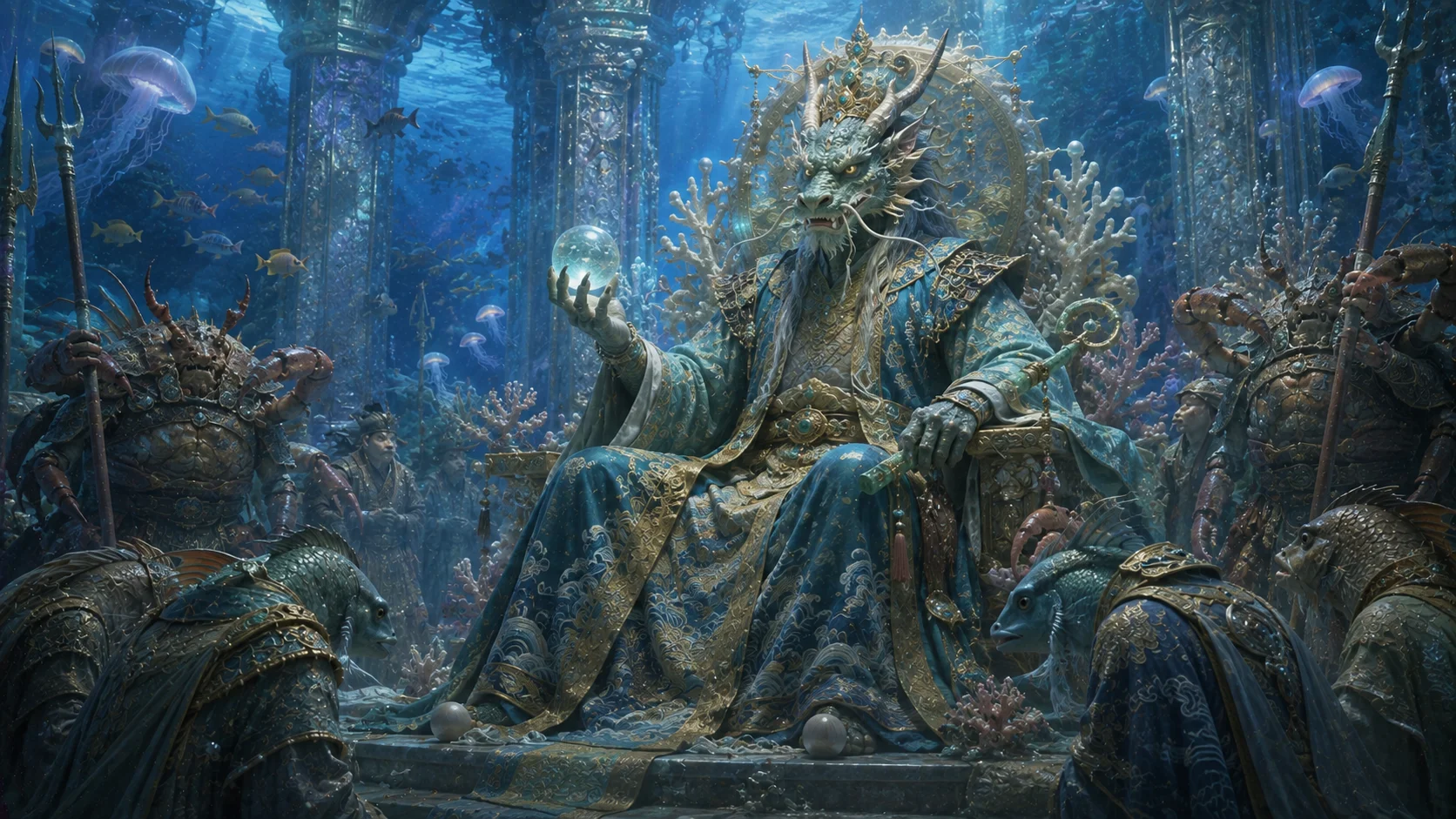
Unlike deities such as Long Wang, whose authority over waters carried into an extensive and continuing popular temple cult, Gonggong is not attested as the object of any comparably developed worship tradition. He survives overwhelmingly as a mythic and cosmogonic figure within classical literature — a name invoked to explain the tilt of the heavens and the direction of the rivers — rather than as a god whose altars and festivals persisted into the living practice of ordinary devotion. Later syncretic folk tradition sometimes loosely associates him with general river or flood spirits, but this remains an informal drift of association rather than any fixed doctrinal identification. Gonggong's afterlife, in other words, is textual and cosmological rather than ritual: he endures in the telling of why the world is tilted the way it is, not in incense offered at a shrine.
Sources & traditions
- EncyclopediaWikipedia — Gonggong
- TraditionChinese texts, oral tradition and village tellings (China)
Myths change from area to area and from time to time. This chronicle follows the most widely told versions; tellings in other villages, regions and eras may differ.