Xiangliu (相柳), rendered in some strands of the textual tradition as Xiangyao (相繇), is the nine-headed serpent of ancient Chinese mythology — a monster first set down in the Shan Hai Jing, the Classic of Mountains and Seas, in both its "Classic of the Great Wilderness" (Dahuang Beijing) and "Classic of Regions Beyond the Seas" (Haiwai Beijing) chapters. He is remembered as the minister and follower of Gonggong, the water-god of flood and rebellion, and as a being whose very presence turned fertile ground into poisoned marsh. Yu the Great, labouring to tame the world's floodwaters, killed him — and found that even in death the serpent's blood went on ruining the earth it touched. Few monsters in the old Chinese sources are given so complete an arc: appetite, blight, death, and an afterlife of contaminated soil that resisted every attempt to heal it.
The Nine Faces Upon One Coiling Body
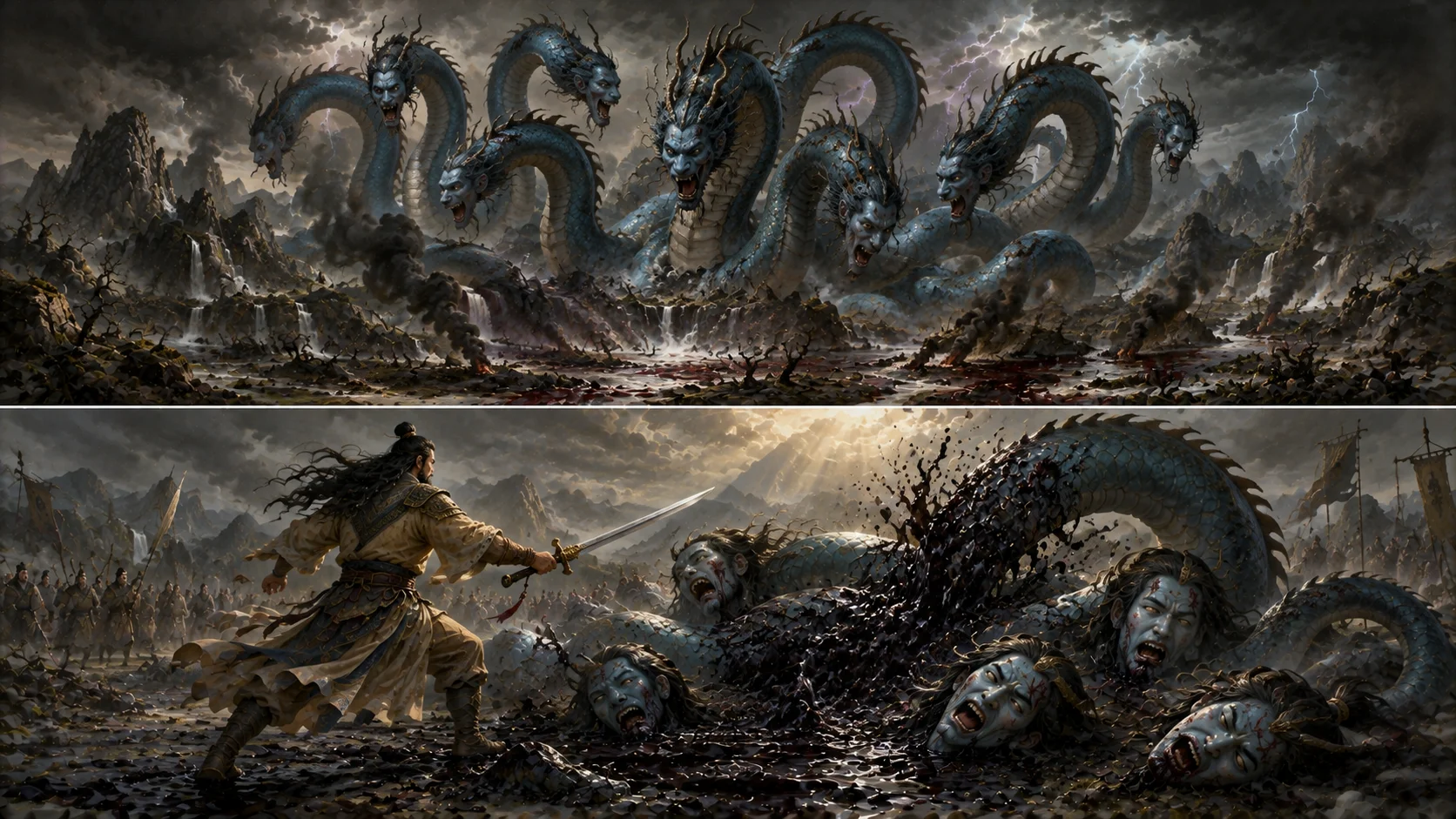
The Shan Hai Jing gives Xiangliu a shape that is, even by the standards of that catalogue of wonders, difficult to hold steady in the mind: nine heads, each bearing a human face, rising from a single serpentine body of enormous size. The body itself is consistently described as blue-green, qing in the old color vocabulary that spans the range from deep jade to the blue of a stormy sky — a color long associated in Chinese cosmological thought with wood, with the east, and with the damp vitality of growing things, here inverted into something venomous. Later commentators, including Guo Pu in his notes on the Shan Hai Jing, elaborated on the picture without ever displacing its core: nine human faces set atop one great snake, coiled or stretched across a landscape it did not so much inhabit as consume.
Last updated .
The nine heads are not merely a mark of monstrousness for its own sake. In the compressed, elliptical style of the Shan Hai Jing, physical excess in a creature's body routinely signals excess in its function — many eyes to see everything, many mouths to eat everything, many heads to command more territory than a single throat could reach. Xiangliu's nine faces are the physical expression of an appetite and a reach that no ordinary serpent, however large, could possess.
Servant to the Lord of Ruinous Waters
Xiangliu does not stand alone in the mythic record; he is named a minister — a chen, a subordinate and follower — of Gonggong, the god of water most closely tied in the tradition to catastrophic flooding and to open rebellion against the ordering powers of heaven. Placing Xiangliu within Gonggong's retinue does real work in the old cosmology: it tells the reader what kind of monster this is before a single deed is recounted. He belongs to the party of chaos-waters, the forces that flood fields, drown settlements, and refuse the boundaries that sage-kings and culture-heroes spend their labors trying to fix in place.
This is also why Xiangliu's story cannot be told in isolation from the great flood narrative that dominates so much of early Chinese myth-history. He is not an independent menace wandering the wilds for its own sake; he is one head — here, quite literally nine heads — of a larger struggle between the flood-chaos associated with Gonggong and the flood-taming order that the sage-kings and their agents, above all Yu, were laboring to establish. Xiangliu's individual horrors are inseparable from that larger war.
A Hunger That Emptied Nine Lands at Once
Among Xiangliu's signature traits is an appetite scaled to his anatomy: with nine heads he was said to feed from nine different lands simultaneously, devouring their produce at once, an image of consumption so total that no single region could satisfy him and no single region could escape him either. Some passages of the fragmentary source material give the number as eight rather than nine — a discrepancy that later scholars and textual critics have noted rather than resolved, since the Shan Hai Jing survives as a patchwork compiled from disparate and not always consistent strands of transmission. Whether eight lands or nine, the shape of the image is the same: a creature whose hunger operates on a geographic scale, laying waste to the produce of entire territories rather than a single field or flock.
This detail does more than establish scale. It ties Xiangliu's menace directly to subsistence — to the grain and produce that sustained the settled agricultural world the old sage-kings were trying to secure. A monster that eats nine lands bare is not simply frightening; it is an existential threat to the very possibility of feeding a people, and that threat sits at the center of everything else told about him.
Wherever He Rested, the Earth Turned to Rot
Xiangliu's most distinctive horror, and the trait for which he is most remembered, is what happened to the ground beneath him. Wherever the serpent rested, wherever his great body moved or lingered, the earth turned to swamp and marsh — fetid, poisoned ground unfit for the five grains, the staple cultivated crops whose successful growing defined a habitable, civilized landscape in the old agrarian imagination. His breath and his touch alike were enough to blight soil that might otherwise have fed a village or a province.
It is worth sitting with how total this affliction was meant to be. This was not damage that time or ordinary labor could undo — not a flattened field that could be replanted the following season, but ground made structurally hostile to cultivation, turned into a landscape category of its own: marsh where farmland had been, poison where nourishment should have been. In a mythology built around the anxieties of flood and soil, Xiangliu is essentially the personification of the worst thing that can happen to arable land — not merely inundation, which recedes, but contamination, which does not.
The Great Flood and the War Against Gonggong's Order
Xiangliu's story reaches its climax inside the broader narrative of the Great Flood and Yu's labors to master it. Yu — Da Yu, Yu the Great — is the culture-hero credited in the old tradition with taming the catastrophic floodwaters that threatened to drown the settled world, channeling rivers, opening passages through mountains, and making the land safe for grain and habitation again. That labor was inseparable from a struggle against the forces aligned with Gonggong, the flood-chaos that Yu's work was meant to overcome and discipline into manageable rivers.
Xiangliu, as Gonggong's minister, stood among the notable monstrous figures defeated in the course of this campaign — one of the obstacles, alongside other beings tied to Gonggong, that had to be cleared before cosmic and political order could be established under the sage-kings. His death is not an isolated monster-slaying episode; it is a chapter within the founding narrative that explains, in the old mythic logic, how China's rivers came to be governable and its land came to be arable at all.
Yu's Blade and the Fall of the Serpent
According to the Shan Hai Jing, it was Yu the Great who killed Xiangliu, in the course of his labors against the flood and against the chaos-forces associated with Gonggong. The text does not linger over the mechanics of the kill in the way a later, more narratively expansive tradition might; the Shan Hai Jing's register is closer to catalogue and gazetteer than to epic, recording the fact of the slaying and its aftermath rather than dramatizing the confrontation blow by blow. What the source does dwell on, at some length, is what came after — because killing Xiangliu did not simply end the threat he posed. It transformed that threat into something stranger and, in its own way, more enduring.
Blood That the Soil Could Not Forgive
When Xiangliu died, his blood spilled across the ground — and that blood carried the same corrupting property that had marked the living serpent. Wherever it fell, the earth was ruined: rank, foul, and so thoroughly poisoned that the five grains could not be grown there. The monster's death did not cleanse the land of his influence; it simply relocated that influence from a moving, breathing threat into a fixed, saturated wound in the earth itself. In effect, Xiangliu's corpse and his blood became a second monster — passive now, incapable of devouring another field or resting on another hillside, but no less hostile to cultivation than he had been alive.
This detail carries a bleak symbolic logic that the old myth does not spell out but does not need to: some forms of ruin outlast the ruinous agent that caused them. Defeating the monster is a necessary act, but it is not, by itself, a sufficient one. The poison persists after the poisoner is gone, and someone still has to deal with the ground.
Three Failed Fillings North of Kunlun
That task fell to Yu himself. The tradition records that he attempted, three separate times, to fill in and reclaim the poisoned ground left where Xiangliu had fallen — and three times the earth simply collapsed or sank back in on itself, refusing to hold. This is a striking detail to preserve in so compressed a source: not a single triumphant reclamation but a repeated, effortful failure, the hero trying the direct approach again and again before the ground would allow anything else.
Only after those three attempts failed did Yu change his method, giving up on filling the site as ordinary land and instead turning it into a pool or pond — accepting the contamination rather than continuing to fight it, and finding a use for the site that did not require it to bear grain. Some versions of the tradition go further, describing the reclaimed site as later used for terraces, or as the foundation for a shrine or altar associated with the assembled lords. Whether read as pool, terrace, or altar-ground, the throughline is the same: the poisoned earth could not be returned to what it had been before Xiangliu rested there, only repurposed into something else entirely.
The Pool Where a Monster Once Lay
The site itself is placed north of Kunlun, the great cosmic mountain that anchors so much of early Chinese sacred geography as an axis between the human world and the realms of gods and immortals. Locating Xiangliu's death, and the ruined ground it left behind, in relation to Kunlun situates the episode within that larger cosmological map rather than leaving it as a rootless folk-tale event — this was a real place, in the geography the Shan Hai Jing constructs, that a reader could in principle locate relative to the world's sacred center.
The pool or pond that Yu eventually made of the site stands, in that sense, as a kind of scar on the cosmological map: a permanent, named feature of the landscape whose existence is explained entirely by reference to the monster that once lay there and the hero who was finally forced to work around rather than through the damage he had caused.
A Name Divided: Xiangliu and Xiangyao
The textual record itself is not perfectly unified on what to call this being. Some editions and chapters of the Shan Hai Jing render the name as Xiangliu (相柳); others use Xiangyao (相繇). Traditional commentators have generally treated these as the same figure under variant transmission — different textual streams preserving the same monster under a slightly different written name — rather than as two distinct beings. Modern scholars note the variant rather than fully resolving it, which is characteristic of working with a source as fragmentary and multiply-sourced as the Shan Hai Jing: certainty about a name's single "correct" form is often simply not available, and the honest position is to record the variant rather than force an artificial resolution.
The Country of Communal Injustice
Some versions of the geography surrounding Xiangliu's death connect the site to the Country of Communal Injustice, or Country of Sharing Wrong (Gongdi guo) — one of the many named lands that populate the Shan Hai Jing's accounting of the world beyond the settled center. The connection is characteristic of the text's method: mythic incident and cosmological geography are woven together so tightly that a monster's death and a distant country's name can sit beside each other on the same map, each lending the other a kind of local specificity that a purely abstract account of "a monster, somewhere" would lack.
Reading the Serpent: Flood, Blight, and the Shaping of Order
Read as a whole, Xiangliu's myth encodes some of the oldest and most practical anxieties of an agricultural civilization built along flood-prone rivers: the fear not merely of water rising, but of land being rendered permanently unfit to farm. A flood that recedes is a disaster that ends. A blight that poisons the soil itself is a disaster that does not end on its own — and Xiangliu, serpent of both flood-service and soil-ruin, embodies exactly that compounded fear. His place within the Gonggong cycle ties him to the flood half of that anxiety; his poisonous body and blood tie him to the blight half.
His defeat, correspondingly, belongs to the foundational narrative explaining how China's rivers came to be manageable and its land came to be arable — the culture-hero's labor is not complete merely by winning a fight, but by dealing, however imperfectly, with what the fight leaves behind. The three failed attempts to fill the poisoned ground, and the eventual acceptance of a pool where farmland could not be restored, model something the flood-taming myths return to again and again: order is established not by erasing chaos entirely, but by finding a stable, bounded place to put what chaos leaves in its wake.
What the Commentators Added, and What They Left Alone
Later readers of the Shan Hai Jing, Guo Pu among them, added description and explanatory gloss to Xiangliu's entry over the centuries, but none of that accumulated commentary altered the essential image handed down from the earliest layer of the text: nine human-faced heads on one great blue-green serpent body, minister to the flood-god Gonggong, blighter of the land wherever he rested, slain at last by Yu the Great — and even in death, still capable of poisoning the ground his blood touched, until a hero who had already tamed the world's rivers was reduced to filling a hole in the earth three times over before he could finally let it become a pool instead of a field. Few monsters in the old catalogue are given so complete a reckoning: appetite, blight, death, and an unhealed wound in the land that outlived him.