Gun is the tragic flood-fighter of Chinese mythology: the father of Yu the Great, who first attempted to control the catastrophic Great Flood by stealing magic self-expanding soil from Heaven to dam the waters, and who, failing, was executed, only for his son Yu to be born from his body and succeed where he had failed. The doomed predecessor, Gun is the flood-fighter whose failure prepared his son's triumph.
A World Drowned Beneath the Great Flood
The oldest layers of Chinese mythic memory describe a catastrophe so total that it barely admits of ordinary description: the Great Flood, hongshui, a deluge that did not merely swell rivers but swallowed the land itself, drowning fields and threatening to erase the people entirely. This is the flood recorded in the Shanhaijing, the Classic of Mountains and Seas, and in the Shujing, the Book of Documents, in its Canon of Yao and Canon of Shun, texts among the earliest strata of Chinese historical and mythological writing. It was against this backdrop that the sage-emperor Yao looked for someone capable of mastering the waters, and it is here that Gun enters the story, not as a god demanding worship, but as a minister asked to accomplish what no one else could.
Last updated .
The Council's Reluctant Recommendation
According to the Shujing's account, Yao did not choose Gun eagerly. It was the council of the Four Mountains, the Siyue, who put forward Gun's name, and they did so despite Yao's own visible doubts about the man's character. The texts preserve this hesitation deliberately: Yao is said to have distrusted Gun, yet the Four Mountains pressed the recommendation, and lacking any better candidate, Yao relented and placed the fate of the flooded world in Gun's hands. This detail matters because it frames Gun's later failure not as random misfortune but as something the narrative had already half-anticipated, a shadow cast over the appointment before the work had even begun.
Genealogy of a Doomed Minister
Gun's place in the wider mythic lineage is layered and, in places, contested. Some genealogies name him a son of Zhuanxu, one of the legendary Five Emperors and a figure closely tied to the descent lines radiating from the Yellow Emperor, Huangdi; other tellings place him at a further remove, a descendant of that same lineage rather than a direct son. Whichever branch is followed, Gun stands within the ancestral network Chinese myth uses to bind its sage-kings, culture heroes, and flood-tamers into a single continuous house. He served as a subordinate and minister under Emperor Yao, and it was this same lineage that would, through his son, ultimately found the Xia dynasty, giving Gun's story a weight beyond his own fate: whatever happened to him, his blood would sit at the root of a ruling house.
Nine Years Against the Water
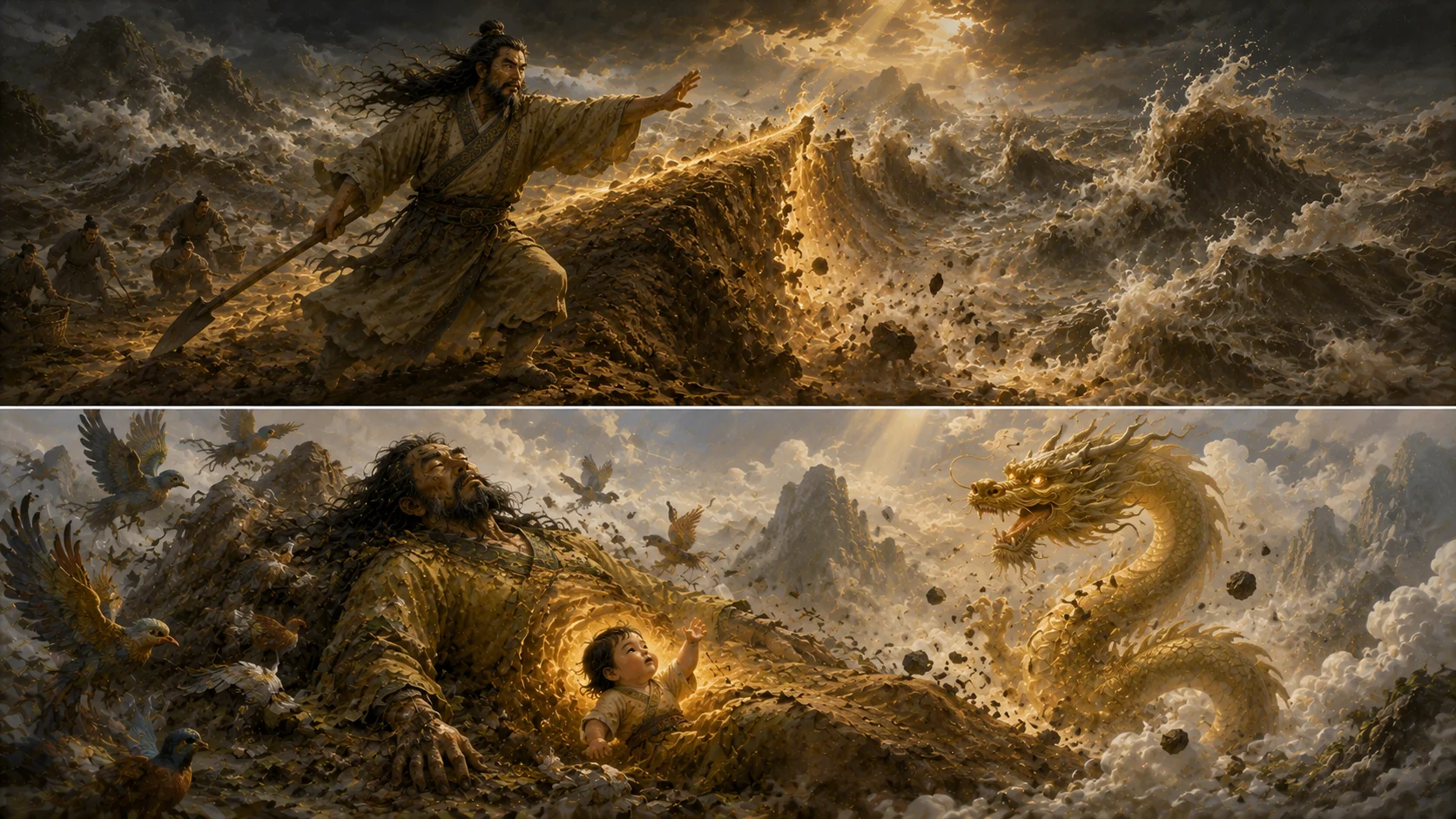
Gun's chosen method was blockage. He built dikes, banks, and containing walls, embankments raised in the ancient technique the sources call yan, to hem the floodwaters in and hold them back by sheer structural force. For nine years he labored at this task, grinding effort against a flood that did not relent. This is the detail on which the entire myth turns: Gun met the water as an enemy to be walled out, not a force to be guided, and the contrast between his approach and the one his son would later adopt is the story's whole moral architecture. Where Gun blocked and resisted, shu, the guiding and dredging technique of Yu, would later open channels and let the water find its own way to the sea. The two methods sit across from each other like a proverb waiting to be spoken.
The Soil That Grew Without End
To build dikes capable of holding back a world-drowning flood, ordinary earth was not enough, and here the myth introduces one of its most haunting images: xirang, the self-growing soil. This was no common clay but a living, swelling substance that expanded and regenerated of its own accord, so that even a small quantity could be coaxed into vast dikes and endless embankments. Xirang belonged to Heaven, the possession of Di, the Supreme God, often identified with the high heavenly sovereign Shangdi, and it was not Gun's to take. Desperate, Gun stole the self-growing soil from Di without leave or sanction and used it to raise his dams against the flood. The Shanhaijing states this plainly, without softening it into misunderstanding or accident: it was a theft, an unauthorized seizure of a divine and jealously guarded substance, and it is remembered as such.
When the Dikes Gave Way
The tragedy of Gun's method is that it could only ever buy time. Dikes built to contain rather than release a flood must eventually meet more water than they can hold, and when they burst, they release not a manageable current but a catastrophe magnified by the very walls meant to prevent it. After nine years, the floodwaters still ravaged the land, undiminished despite every barrier Gun had raised. His stolen soil, wondrous as it was, could not out-build the flood, because the strategy itself, blockage rather than release, worked against the nature of water rather than with it. This failure is the hinge on which the myth turns: not a failure of effort, but of method, one the tradition would spend the rest of the story correcting through his son.
Judgment at Feather Mountain
For the theft of the heavenly soil, and by extension for the flood's continued ravages, Gun was condemned. Di ordered his execution and dispatched the fire god Zhurong to carry it out at Yushan, Feather Mountain, where Gun met his end at the hand of a deity whose very nature, fire, stood in elemental opposition to the floodwaters he had spent his life fighting. Other versions describe Shun, acting as Yao's successor and regent, as the one who ordered Gun's execution or banishment, arriving at the same fatal outcome by a more human, political route. Both versions carry the same verdict: Gun's theft and failure were judged severe enough to cost him his life, whether the judgment descended from Heaven or from the sage-court he had served.
Three Years Undecayed
What follows is among the strangest and most enduring images in early Chinese myth. Gun's body, though slain, did not decompose. For three years it lay whole and unbroken, as though something within it were still unfinished, still waiting. When at last the body was opened, in some tellings by a blade called Wudao, the sword of Wu, it was not decay that spilled out but life: Gun's son, Yu, was born from his father's body. Certain versions render this birth in vivid, heraldic terms, describing Yu emerging in the form of a horned dragon, a qiulong, bursting forth from the corpse of the father who had failed where the son would succeed. The image collapses death and birth into a single moment, refusing to let Gun's story end in simple defeat.
The Yellow Bear in the Abyss
A second, equally old transformation motif runs alongside the birth of Yu, and it concerns Gun himself. The Zuozhuan, in its account of the seventh year of Duke Zhao, records that Gun, after his death, transformed into a huangneng, a yellow bear, and entered the abyss known as Yuyuan. This passage is one of the most closely argued textual cruxes in the study of Chinese mythology, because the character neng, here, sits uneasily between two readings: xiong, the ordinary word for bear, and an older sense some scholars associate instead with a three-legged turtle. Which animal the earliest audiences actually pictured remains genuinely unsettled, a scribal ambiguity that has outlived the certainty of the myth it describes. What the passage agrees on, whichever creature is meant, is the shape of the ending: Gun did not simply vanish but passed into another form and descended into a watery deep, a final, unresolved intimacy with the element that had destroyed him.
The Soil Rightly Given
The xirang that undid Gun did not vanish from the story once he was punished for taking it. Yu himself is sometimes said to have been granted the self-growing soil legitimately, given by Di rather than stolen, once Yu had shown the proper method and humility to use it well. The same wondrous substance that brought death to the father becomes, in the hands of the son, an instrument of completed order, but only because Yu approached it, and the flood, differently. This carries real theological weight: it was never the soil itself that was condemned, only its illicit seizure and misapplication through blockage. Used with sanction, and used to guide rather than dam, xirang could finish the very task it had once helped to catastrophically prolong.
A Voice Raised in His Defense
Not every ancient voice accepted Gun's punishment as simple justice. In the Tianwen, the Heavenly Questions attributed to Qu Yuan and preserved within the Chuci, later Warring States and Han-era reflection turns a sympathetic eye on Gun, asking why a man who had labored to save the people should have been condemned so harshly for it. This strand of the tradition reframes Gun less as a criminal who overstepped and more as a tragic culture hero, someone who took a desperate risk and paid with his life for an act undertaken, in the end, on behalf of others rather than himself. The two readings, Gun as rightly punished transgressor and Gun as wrongly punished savior, sit side by side in the surviving record without either fully displacing the other, and that unresolved tension is part of what has kept his story alive across so many centuries of retelling.
A Name Without an Altar
Unlike his son, Gun never became an object of ritual devotion. Yu the Great went on to receive real ancestral veneration under the Xia dynasty he was understood to have founded, and that reverence persisted long afterward; the Yu Tomb at Shaoxing still stands today as living evidence of a cult that outlasted its founding age by millennia. Gun received nothing of the kind: no temples, no independent cult, no continuing popular worship built around his name. His role in the tradition is almost entirely narrative and genealogical, a mytho-historical antecedent whose function is to set the stage for his son's success rather than to be venerated in his own right. This absence sharpens what kind of figure Gun is: not a god to be propitiated, but a story to be understood, a cautionary and sorrowful chapter that exists to be told rather than prayed to.
History Beneath the Myth
Modern scholarship has not settled what, if anything, historical lies beneath Gun's execution at Yushan. Scholars of Chinese mythology, among them Anne Birrell and Yang Lihui, have weighed two broad readings without consensus. One treats the story as a historicized memory of real Neolithic or early Bronze Age conflict, Gun understood as a defeated regional chieftain whose death was later recast as divine punishment. The other reads the episode as a purely cosmological narrative of deity and transgression, concerning the proper use of sacred materials and the price of overstepping divine boundaries, with no chieftain required beneath it at all. This question remains genuinely open, and the uncertainty is part of what scholars actually say about Gun, not a gap in the telling.
The Father Remembered Through the Son
Gun's story cannot be fully separated from the story that follows it. He is the flood-fighter who tried and failed, whose theft of the heavenly soil brought him to Feather Mountain and to Zhurong's fire, whose body lay three years unbroken before yielding up the son who would finish what he could not, and who was said, in one strand of memory, to have passed into the form of a yellow creature and slipped into the deep waters he had spent his life resisting. He is remembered less for what he achieved than for what his failure made possible, a father whose method was wrong but whose devotion to the task was never in question, and whose name endures as the necessary, sorrowful first half of a story that only becomes triumphant once his son, Yu the Great, takes it up and finishes it differently.