Yu the Great, known in Chinese as Yu (禹) or Da Yu (大禹), is the flood-tamer and founding sage-king who stands at the hinge point of Chinese legendary history: the man credited with ending the catastrophic Great Flood that had drowned the land for a generation, and the figure traditionally honored as the founder of the Xia dynasty, China's first dynasty. He is sometimes styled Yu Wang, King Yu, in that founding role, or Xia Yu, Yu of Xia. Scholars continue to debate how much of Yu the individual, and of the early Xia itself, reflects historical memory versus later legend-building, a question distinct from the archaeological Erlitou culture sometimes associated with the Xia period. Within the tradition itself, however, Yu's story is told with a consistency and moral clarity that has made him, for millennia, the supreme exemplar of selfless public service.
Waters Without End
In the age of the sage-emperors Yao and Shun, a Great Flood overtook the land. Accounts differ on its cause, some pointing to a broken order in the heavens, others to the disruptive rage of the water-spirit Gonggong, others simply describing the rivers as unrestrained, but the tradition agrees on its scale: fields vanished, dwellings were swept away, and the people suffered hunger, displacement, and death across successive years with no end in sight. Taming this flood became the defining task facing the court of the sage-emperors, a task on which the wellbeing of the entire realm depended.
Last updated .
Gun's Dikes and a Father's Fall
The work was first entrusted to Yu's father, Gun. Gun's method was containment: he built dikes and dams to hold the floodwaters back, according to tradition even taking xirang, a self-expanding soil, to raise his embankments higher. For years he labored at this task, but the waters could not be held. Where the dikes failed, they failed catastrophically, releasing floods worse than before. Gun's approach, sound in intention but wrong in method, ended in failure, and for that failure he was executed, or by some accounts banished, by the ruling sage-emperors. It is against this failure, filial and public at once, that his son's success would later be measured.
The Task Passes to Yu
Emperor Shun, who had inherited the throne from Yao and inherited with it the unsolved crisis of the flood, appointed Gun's son Yu to take up the work his father had left unfinished. It was not an easy inheritance: Yu took on a task that had already claimed his father's life, under a ruler who had personally overseen that judgment. Yet Yu did not treat the assignment as a burden to be endured but as a charge to be met on its own terms, and he began by studying, carefully and without sentiment, exactly where his father's method had gone wrong.
Cutting the Mountains, Not Damming the Rivers
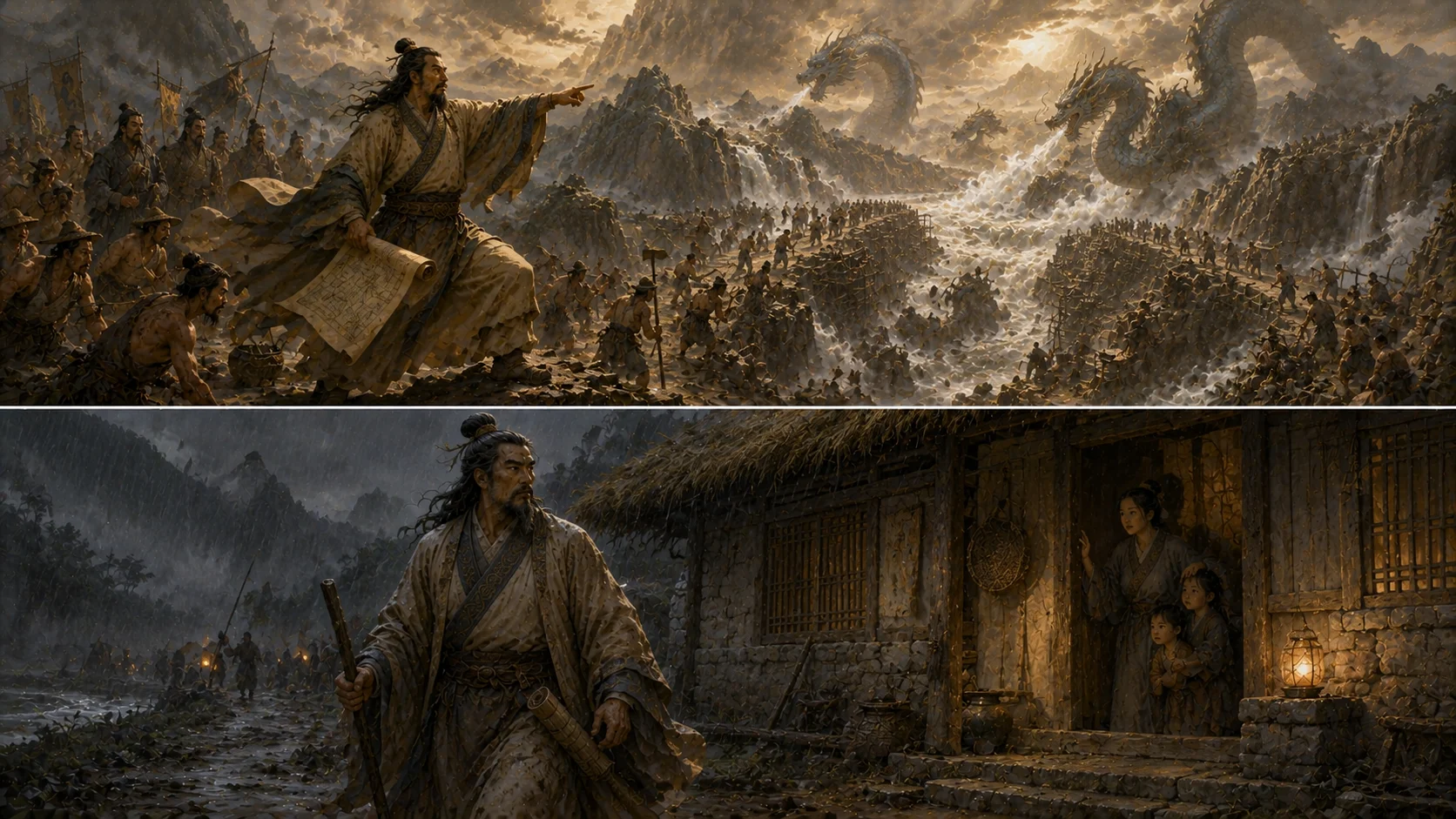
Where Gun had sought to block the water, Yu chose the opposite path: he would dredge, channel, and guide it. Rather than raising walls against the flood, Yu organized great labor forces to cut new channels through high ground, deepen and widen the natural river-courses, drain the standing marshes, and open clear paths that would carry the water onward to the sea. It was a philosophy of working with the nature of water rather than resisting it outright, letting the flood find its way downhill and outward instead of forcing it to accumulate behind a wall. Across the classical record, this contrast between Gun's containment and Yu's channeling is repeated again and again as the clearest possible lesson in adaptive, patient, land-respecting engineering, and it is this method, more than any single feat of strength, that later ages credited with actually ending the flood.
Three Times Past His Own Door
The labor took years, thirteen by the most commonly repeated count, though some texts give eight or other figures, and through those years Yu is remembered as having given himself to the work without reservation. The single detail that has carried his story furthest down the centuries, preserved in texts such as the Mencius and the Records of the Grand Historian, is this: in all that time, Yu passed by the gate of his own home three times and did not go in. Some versions add that on one of those passings he heard his newborn son crying inside, and still did not stop. It is not told as tragedy but as testimony, the paradigmatic image of a man who set the people's need above his own household, and it became, for the moral and political tradition that followed, the standard against which selfless public duty would be measured for thousands of years afterward.
Dragons, a Turtle, and a Bear in the Deep Passes
Alongside the sober historiographic account of surveying, organizing labor, and cutting channels, a more overtly mythic layer accumulated around Yu's labors in later sources, particularly the Classic of Mountains and Seas and subsequent folklore. In these tellings Yu receives aid beyond ordinary human means: a winged dragon is said to have dragged its tail along the ground to mark out the course a channel should follow, and other supernatural helpers are described assisting his passage through impossible terrain. The most striking of these later motifs holds that Yu transformed into a bear to force his way through mountains too solid for any tool, digging where no human strength could dig. Scholars treat this bear-transformation and its companion wonders as a later, more thoroughly mythologized stratum layered onto the earlier and more restrained historical tradition, but within the living legend the two layers sit together: a hero who is at once a working engineer with a spade and a figure capable of superhuman, even shape-shifting, feats when the mountains demanded it.
Nüjiao of Tushan and the Weight of Absence
During this period Yu married Nüjiao, also recorded as Tu Shan Shi, the woman of Tushan, daughter of the ruler of that domain. Their marriage is remembered less for its own narrative than for the shadow the flood-work cast over it: Yu's years-long absence, the household he did not enter even in passing, and the son born and largely raised in that absence. That son was Qi. The marriage stands in the tradition as one more measure of what the flood cost Yu personally, set against what it gained for the realm as a whole, and it is Qi, born into that gap between father and home, who would carry Yu's line forward into an entirely new form of rule.
The Land Emerges, the Nine Provinces Take Shape
At last the labor bore its result. The channels ran clear, the floodwaters drained away to the sea, the rivers settled into courses the land could sustain, and the fields and dwellings that had been lost for a generation could be reoccupied. With the water mastered, Yu turned to the work of ordering what remained: he is credited with surveying and dividing the realm into the Nine Provinces, the Jiuzhou, a geographic and administrative framework that later chapters of the Shangshu, notably the Tribute of Yu, describe in careful regional detail. The flood-tamer became, in this act, the first orderer of Chinese territory, giving the land a shape it would be understood by for centuries afterward.
The Nine Tripods and the Meaning of Sovereignty
To mark this ordering of the Nine Provinces, tradition holds that Yu had cast the Nine Bronze Tripods, the Jiuding, one for each province, as symbols of his authority over the whole. The tripods were not merely commemorative; they became, in later Chinese political culture, a recurring emblem of legitimate rule itself, objects whose possession was spoken of as proof of a ruler's rightful claim to the realm. That a flood-control engineer's crowning political act was to cast vessels representing sovereignty over a newly ordered land captures precisely how the tradition understood Yu: his authority did not rest on conquest but on demonstrated, exhausting, and successful service to the people.
From Shun's Hand to the Xia Throne
Yu's achievement placed him at the summit of the sage-emperor lineage that had begun with Yao and continued through Shun. Having served under Shun and proven himself through the flood-work, Yu received the throne in the pattern established by his predecessors, the sage-emperors' practice of yielding rule to the most virtuous and capable successor rather than to a designated heir. In taking the throne, Yu became the founder of the Xia dynasty, traditionally dated to around 2070 BCE and remembered as the first dynasty of Chinese history, the point at which the more purely legendary age of Yao and Shun gives way to a continuous royal line.
Qi and the End of Yielding
It is with Yu's own succession that the tradition marks its most consequential turn. Where Yao had yielded to Shun and Shun to Yu on grounds of virtue and merit, the practice known as abdication to the worthy, Yu's son Qi succeeded him instead, and dynastic rule by descent replaced the older pattern of yielding. Qi is traditionally credited with this transformation, converting the Xia succession from the sage-kings' meritocratic model into hereditary rule, the pattern that would define Chinese dynastic government for the millennia that followed. The irony given weight in the tradition is unmistakable: the very man whose selflessness in the flood-work made him the age's model of virtue-based rule is also the man whose lineage closed that chapter and opened the dynastic one.
Kuaiji: Where the Rites Still Return
Yu's memory was not confined to text. At Kuaiji, in what is now Shaoxing in Zhejiang province, a tomb and temple complex dedicated to him became the site of sustained sacrificial cult, honored by imperial and local rites performed across centuries. That such rites continue, in modified form, into the present is itself part of Yu's continuing significance: he is remembered not only as a figure from the deep past but as an object of living reverence, a hydraulic-engineering culture hero whose service is still marked with ceremony at the place traditionally associated with his rest.
The Tribute of Yu and the Written Record
Yu's story is carried across some of the most foundational texts of the classical tradition. The Shangshu, the Book of Documents, preserves the Tribute of Yu chapter describing his geographic and administrative labors in careful detail. The Shiji, the Records of the Grand Historian, and the Mencius both transmit the narrative of his selfless devotion, including the passing of his own door. The Classic of Mountains and Seas preserves the more overtly mythic material surrounding his labors. That Yu appears across historiography, philosophy, and myth alike, each genre drawing on him for its own purposes, reflects how thoroughly his story was woven into the intellectual fabric of the tradition rather than confined to any single kind of text.
What the Spade and the Plumb-Line Still Teach
Yu is typically depicted not in royal regalia but as a laboring sage-king, holding a chan, a spade or earth-moving tool, often shown in rough working attire that emphasizes his identity as a hands-on flood-tamer rather than a distant ruler. Some later depictions add a plumb-line and measuring instruments, marking him as the surveyor of the land he ordered into provinces. Together these images preserve the same lesson the narrative itself insists on: that Yu's authority was earned through labor, adaptive skill, and years of sacrifice rather than granted by birth or claimed by force. In a civilization historically organized around the control of its great rivers, that lesson never lost its practical edge, and the phrase invoking the spirit of Yu controlling the waters continues to be drawn on in Chinese cultural and political language as shorthand for exactly this: total, unglamorous, selfless devotion to work that serves everyone but the one who does it.