Jiang Ziya is among the most revered founding figures of Chinese tradition: the impoverished sage who fished the Wei River with a straight, baitless hook, waiting not for fish but for a king; the strategist whose counsel toppled the tyrannical Shang dynasty and raised the Zhou in its place; the first lord of the state of Qi; and, in the great novel Fengshen Yanyi, the Investiture of the Gods, the one entrusted with the sacred roster by which the worthy dead were made gods. Known also as Jiang Shang, Lü Shang, and by the honorific title Taigong Wang, he stands at the meeting point of history, statecraft, and religion — a man whose long obscurity and eventual recognition became one of the most enduring images in the Chinese moral imagination.
The Fisherman Who Angled for a King
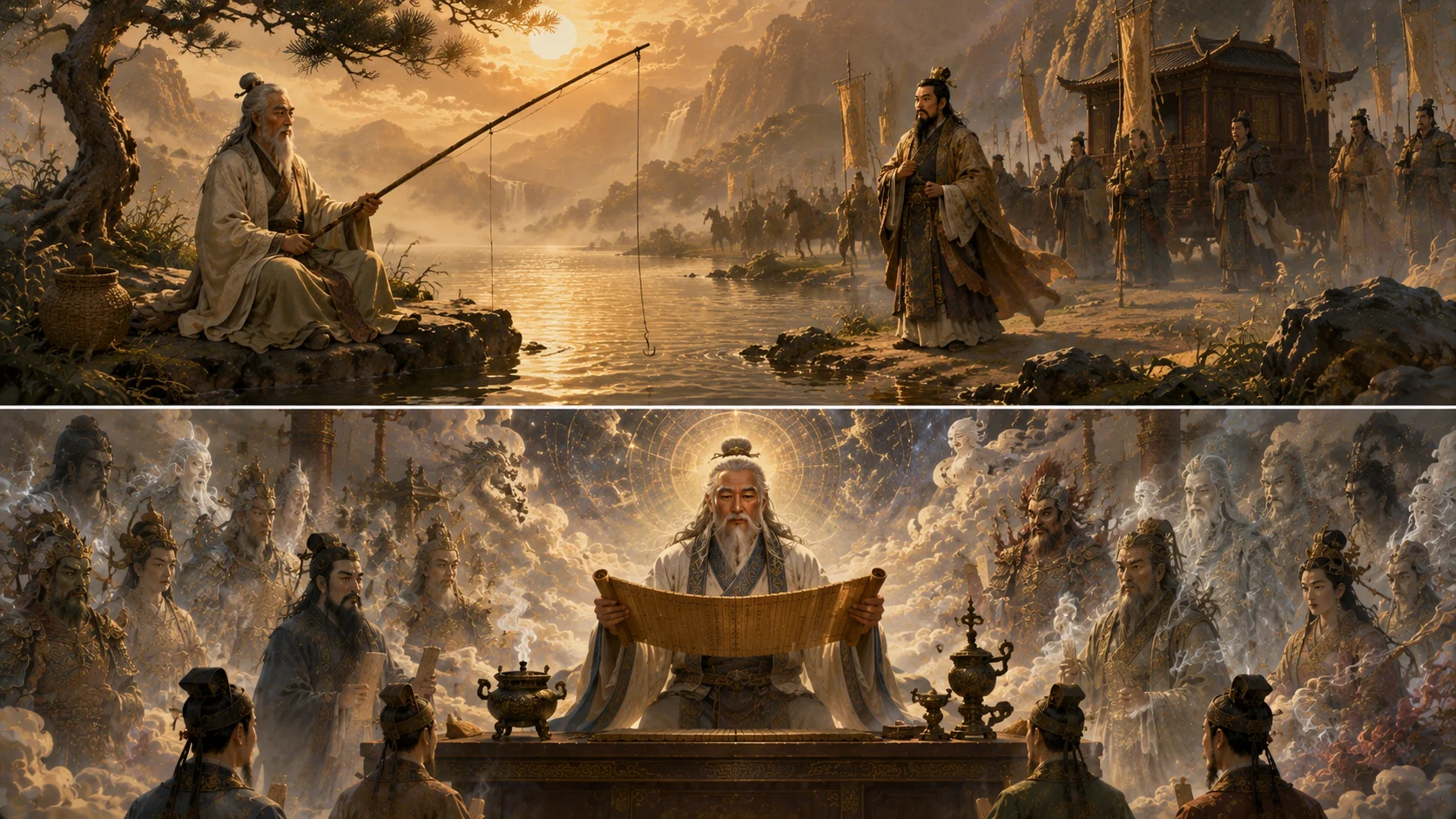
The image by which Jiang Ziya is best remembered is deceptively simple: an old man seated on the bank of the Wei River, line cast into the water, hook straight rather than curved, unbaited, and held a full three feet above the surface where no fish could ever take it. Asked why he fished in a manner that could catch nothing, he is said to have answered that he was not fishing for fish at all — he was fishing for a ruler, and only one destined to find him would do so. It was a declaration that true worth does not chase opportunity but waits, with dignity intact, for opportunity to recognise it. The saying that grew from this episode, that the willing fish takes the bait of its own accord, became a proverb in its own right: an image of an offer made without coercion, to be accepted only by one truly ready for it.
Last updated .
A Sage's Long Wait in Obscurity
Behind the famous riverbank scene lies a longer and harder story. By tradition, Jiang Ziya spent the greater part of his life without office, without renown, and without the means that his evident gifts might have been expected to bring him. Poverty and obscurity were his constant companions for decades, and nothing in his outward circumstances marked him as a man who would one day be remembered as the architect of a new dynasty. This span of quiet, unrewarded waiting is not treated in Chinese tradition as wasted time but as the necessary proving ground of character — the long apprenticeship of a man who would not compromise his worth by serving an unworthy lord, and who trusted that recognition, when it came, would come from the right source.
King Wen and the Meeting Foretold
The turn in Jiang Ziya's fortune came through King Wen of Zhou, who, according to legend, had been told through divination that his hunting expedition would bring him not game but a great sage destined to serve his house. When King Wen came upon the old fisherman at his strange, hookless line, he recognised at once that the omen had been fulfilled. The encounter is remembered as the paradigm of right recognition: a ruler attentive enough to omens and to men to see past an old man's poverty and idleness to the mind beneath, and a sage patient enough to have made himself findable only by such a ruler. It is this meeting, more than any battle or title, that Chinese tradition treats as the true beginning of Jiang Ziya's greatness.
Grand Duke Long Hoped-For
Upon meeting the old man, King Wen is said to have exclaimed that his own grandfather, Tai Gong, had long hoped for the coming of just such a sage to aid the house of Zhou. From this exclamation came the epithet by which Jiang Ziya is very often known: Taigong Wang, the Grand Duke Hoped-For. The name folds together generations of longing — an ancestor's unfulfilled wish, a grandson's fulfilment of it — into a single title, and it reflects the layered naming conventions of ancient China more broadly, in which a man might carry a clan name, a surname, a courtesy name such as Ziya, and an honorific earned through deed, each preserving a different facet of who he was and what he had done.
Chief Strategist of the Zhou Cause
From the moment of his recognition, Jiang Ziya became the chief strategist and minister first to King Wen and then, after King Wen's death, to his son King Wu of Zhou. It was under his counsel that the Zhou state, until then a subordinate power on the western fringe of the Shang realm, built the strength and the strategic patience needed to challenge the ruling dynasty outright. Tradition credits him with shaping not merely individual battles but the whole course of the Zhou campaign — reading the moment when Shang misrule had grown intolerable enough that other lords would join a rising against it, and directing the military and political preparations that made such a rising possible.
The Fall of Shang at Muye
The campaign Jiang Ziya masterminded culminated in the Battle of Muye, traditionally dated to around 1046 BCE, where the forces of Zhou met and broke the armies of the last Shang king. The defeat brought down a dynasty that Chinese tradition remembers as having fallen into cruelty and excess in its final years, and it opened the way for the founding of the Zhou dynasty, one of the most consequential transitions in the whole of Chinese history. Jiang Ziya's role as the strategist behind that victory is the historical core beneath the many legends that later gathered around him — a core that most scholars accept as reflecting a real man, even as they recognise that many of the episodes attached to his name are later legendary accretion built upon that historical foundation.
Founder of the House of Qi
In reward for his service to the Zhou cause, Jiang Ziya was enfeoffed as the first ruler of the state of Qi, established in what is now Shandong. This was no honorary title but the founding of a lasting political line: the rulers of Qi in the centuries that followed traced their descent back to him, and he is remembered as the ancestor-figure from whom that state's authority and identity flowed. In this respect Jiang Ziya's legacy is not confined to a single dramatic campaign but extends into the long institutional history of one of the important states of the Zhou political order, giving his name a place in Chinese genealogical and political memory quite apart from his fame as a strategist or sage.
Father of Chinese Strategic Thought
Jiang Ziya's association with the art of war runs deeper than the single campaign that made the Zhou dynasty possible. Later tradition attributes to him, or to a lineage of thought beginning with him, the military treatise known as the Six Secret Teachings, the Liu Tao, a work that stands among the foundational texts of Chinese strategic writing and is generally regarded as predating the more famous work of Sunzi. Whether Jiang Ziya himself set down its teachings or whether they were gathered under his name by later hands, the attribution itself speaks to how thoroughly Chinese tradition identified him as a wellspring of strategic wisdom — the figure to whom an entire tradition of thought about war, statecraft, and the handling of men under pressure could most fittingly be traced.
Guardian Against Ill Fortune
Beyond the halls of strategy and government, Jiang Ziya's name passed into the everyday protective practices of Chinese folk religion. Because he came to be venerated as a god of war and strategy and as a patron figure invoked for protection, his name was placed where protection was needed. A common practice during house construction, when conflicting geomantic influences were feared, was to inscribe a placard reading that Jiang Taigong is present and all is well, and to set it upon a beam or wall of the new building. The old fisherman who once waited quietly by a river became, in this later life as folk deity, a name spoken aloud to turn evil spirits aside — patient wisdom transformed into active guardianship.
The Disciple Sent Down to Aid Zhou
It is in the Ming-dynasty novel Fengshen Yanyi, the Investiture of the Gods, that Jiang Ziya's story takes on its fullest religious and mythological dimension. There he appears not merely as a gifted human strategist but as a disciple of the Daoist immortal Yuanshi Tianzun, sent down from the ranks of the immortals expressly to assist the Zhou cause in its struggle against the Shang. This framing recasts the historical war between two dynasties as a cosmic contest, fought not only by armies of men but by immortals, spirits, and magical forces aligned on either side, with Jiang Ziya standing at the center as the one who must guide the righteous cause to victory on both the earthly and the spiritual battlefield.
Bearer of the List of Investiture
The war between Shang and Zhou, in the telling of the novel, took a terrible toll of heroes, immortals, and spirits on both sides of the conflict, and it is at the war's end that Jiang Ziya assumes his most extraordinary role. He was given the Fengshen Bang, the sacred List of Investiture, and with it the authority to confer godhood upon the worthy dead. Standing before the assembled spirits of the fallen, he read out the roster and assigned each deserving soul to its rightful place in the celestial order — an act that transformed a wartime tragedy into the founding moment of a divine bureaucracy, and that placed Jiang Ziya, uniquely among the great figures of Chinese legend, in the position of naming the gods themselves.
Naming the Powers of Heaven and Earth
Through this act of investiture, Jiang Ziya is remembered as having populated the very pantheon that Chinese folk religion recognises: this fallen spirit made the god of thunder, that one set over a star, another given charge of a mountain or of some function of the natural or human world. It is an image of extraordinary scope — a single figure entrusted with organising the unseen government of heaven just as he had once organised the armies and strategies of an earthly war — and it is this role, as much as his fishing or his generalship, that has fixed Jiang Ziya in the religious imagination as a bridge between the world of history and the world of the gods, the mortal strategist who became the architect of the pantheon.
Companions in the War of the Gods
In the world of the Fengshen Yanyi, Jiang Ziya does not stand alone. He is linked in the novel's telling to other deified figures who fought under his direction in the war against Shang, among them Nezha and Yang Jian, known as Erlang Shen, generals and immortal warriors whose own struggles and eventual apotheoses form part of the same great narrative that Jiang Ziya's investiture brings to its close. His central relationships nonetheless remain his patrons among men, King Wen who discovered him by the river and King Wu whom he served as chief military strategist through to the Zhou triumph — the two rulers whose trust made possible everything that followed, both the historical founding of a dynasty and the legendary founding of a pantheon.
The Enduring Image of Patient Worth
Iconographically, Jiang Ziya is most often shown as an elderly, bearded fisherman with rod in hand, the straight-hook episode fixed forever in his image, or, in art drawing on the Fengshen Yanyi, as a robed strategist or official bearing a whip or a seal of military authority. Both images point to the same underlying idea: that of the humble, unrecognised talent who perseveres in quiet dignity and is at last found and elevated by a ruler wise enough to see past outward circumstance. This paradigm of the worthy minister awaiting the worthy lord has been invoked again and again in later Chinese literature and political rhetoric wherever the theme of overlooked merit and rightful recognition is raised. Sage and strategist, founding ancestor of a state, father of a tradition of strategic thought, and the figure who ordered the very heavens with a divine roster in hand, Jiang Ziya remains one of the most deeply honoured and multifaceted figures in the whole of Chinese legend.