In the marshy villages north of the Red River, where water buffalo still trace the same paths their ancestors trod through paddy fields, there lives a memory older than any written record of Vietnam: the memory of a boy who could not speak, could not stand, and could not eat like other children — until the day his country needed him, and he became something no one had words for either.
A Silence That Lasted Three Years
The story begins not with thunder or omen but with an ordinary sorrow. In the village of Phù Đổng, in the district known today as Gia Lâm, an elderly couple who had long wanted a child finally conceived a son under the reign of the sixth Hùng King. Joy gave way to worry almost immediately. The boy did not cry as infants do. He did not babble, did not reach for his mother's voice, did not turn his head at sound. Season after season passed and still he lay in his cradle, eyes open, saying nothing. He could not sit upright. He could not walk. By the time other children his age were already running through the rice stalks chasing dragonflies, this boy remained exactly as he had been on the day of his birth — mute, motionless, seemingly unfinished.
His parents did not abandon hope, though the village likely whispered the things villages whisper about a child who will not grow. They fed him, turned him, spoke to him though he never answered. Three years is a long time to wait for a single word. In the oral tradition, this silence is never treated as illness to be cured or tragedy to be mourned — it is treated as a kind of waiting, though no one, least of all his mother, could have guessed what he was waiting for.
The Herald's Drum in the Village Square
The threat that finally broke the silence came from beyond Văn Lang's borders. Invading Ân forces pressed into the kingdom's territory, and the sixth Hùng King, alarmed at the danger to his people, sent heralds through every village and hamlet with an urgent plea: whoever could defeat the invaders would be rewarded and honored above all others. It was, in essence, a kingdom-wide call to arms, carried on foot and by voice into the furthest corners of the realm, including the quiet house in Phù Đổng where a three-year-old boy lay as he always had.
When the herald's cry reached that house, something happened that overturned everything the family had believed about their son. For the first time in his life, the boy spoke. He did not ask for food or comfort. He asked for a horse of iron and a staff of iron, so that he might go and fight for his king.
A Voice Demanding Impossible Things
Imagine the herald's disbelief — or perhaps not disbelief at all, for this was an age when the extraordinary was simply part of how the world worked. The mother, astonished to hear her mute son speak at last, rushed to tell the herald what had happened. Word of the boy's request traveled back to the royal court, and the king, whether out of desperation, faith, or simple willingness to try anything against an invading army, ordered his smiths to forge exactly what the boy had asked for: an iron horse and an iron staff, sized for a warrior, not a toddler.
What makes this moment endure in memory is not merely that a child spoke after three years of silence, but what he chose to say with his first words. He did not ask to be healed. He did not ask to walk. He asked for the tools of a defender, as though his entire dormant childhood had been a kind of held breath, and the thing that finally released it was not medicine or ritual but the sound of his homeland in danger.
Grown in an Instant
The tradition does not linger over the mechanics of what happened next — it simply says that upon hearing the king's call, the boy who could not stand suddenly grew into a giant warrior. There is no lingering illness cured by degrees, no slow catching-up on three lost years of childhood. The transformation is total and immediate: one moment a mute child in a cradle, the next a towering figure ready to take up arms. Later tellings and local memory have surrounded this moment with color — villages feeding the boy, neighbors marveling at his size — but the oldest thread of the story keeps it spare, almost startling in its economy: the call came, and he grew.
That economy is itself part of the story's meaning. Nothing in the telling asks the growth to be explained, the way nothing asks his three years of silence to be explained. Both are treated as facts of the same order — a body that waits, and then does not wait at all.
The Giant Who Once Could Not Stand
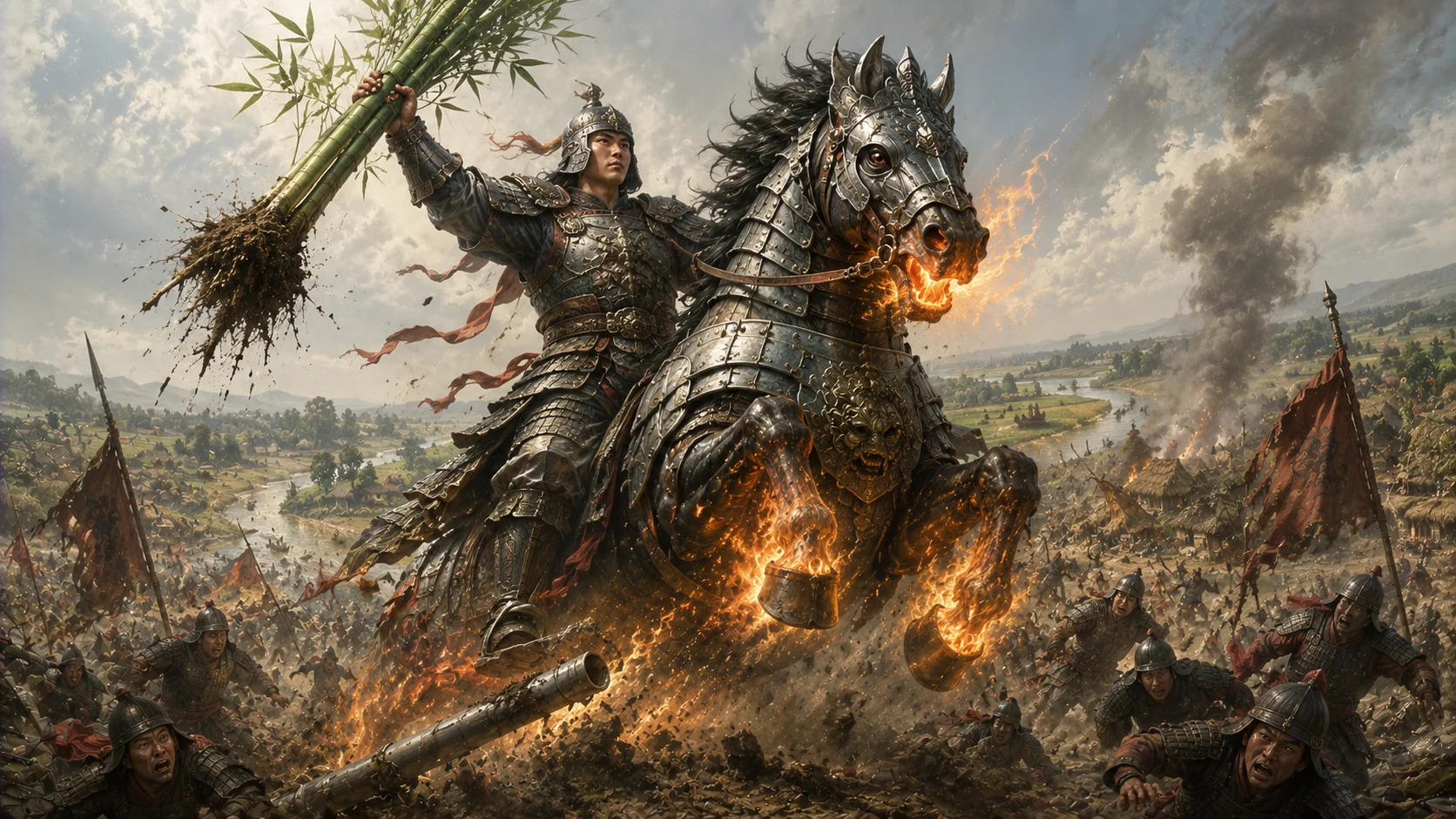
By the time the smiths delivered the iron horse and the iron staff, the boy who had once been unable to lift his own head had become a towering warrior, his frame filling the small house and then the courtyard beyond it. He rose — the same body that had lain motionless for three years now standing far above an ordinary man — and took up the iron the king had provided. He mounted the iron horse without ceremony, without a lengthy farewell, and rode out of Phù Đổng toward the invading army, the whole of Văn Lang's hope riding at his back.
When the Staff Failed and the Bamboo Answered
The battle that followed is remembered as ferocious and decisive. The giant warrior cut through the Ân ranks with a strength that matched his impossible growth, the iron horse carrying him forward, the iron staff swinging without pause. But even iron has its limits, and in the thick of the fighting, tradition holds that his staff broke — failed him at the very moment he needed it most.
Rather than retreat, he looked to what the land itself offered. Beside the battlefield grew a grove of bamboo, and in one motion he tore whole stalks from the earth, wielding the uprooted bamboo as a weapon in place of the broken staff. It is a detail beloved precisely because it is so unlike the iron gifts of a king — the final blow against the invaders was struck not with royal forge-work but with something torn straight from Vietnamese soil, as though the land itself had reached up to finish what the iron had started. The invading forces broke and scattered before him, and the threat to Văn Lang was ended.
The Ride to Sóc Sơn
Victory did not bring the warrior back to his village, back to the ordinary life a returning hero might be expected to resume. Instead, still mounted on his iron horse, he turned away from the battlefield and rode toward the mountain known as Sóc Sơn. There, at the summit, tradition says he ascended into the sky — rising out of the mortal world entirely, boy and warrior both, without ever growing old, without ever returning to speak again as he had spoken only once, to ask for the means to defend his people.
This ascension is treated in tradition not as a death but as a kind of completion. He had come into the world silent, grown in an instant when his country called, and departed from it just as suddenly once the calling was answered — a life measured not in years but in a single, complete act of purpose.
Phù Đổng Thiên Vương, Heaven's General
In the centuries since, the boy of Phù Đổng has been venerated under a grander title: Phù Đổng Thiên Vương, a name that elevates him from village legend to one of the Tứ Bất Tử, the Four Immortals of Vietnamese folk religion. He stands alongside Sơn Tinh, the mountain spirit who out-raced a rival suitor for a princess's hand; Chử Đồng Tử, the penniless fisherman's son who married a princess and became patron of trade; and Liễu Hạnh, the banished daughter of the Jade Emperor who presides as Mother of the Realm. Where the other three immortals are associated with mountains, water, or the heavenly court, this warrior-child is remembered above all as the embodiment of resistance — the instinct of an entire people to rise, however unlikely the vessel, when their land is threatened.
That he could not walk or speak for three years, and then became unstoppable in an instant, has never been treated in tradition as a contradiction to be explained away. It is, if anything, the entire point: strength, in this telling, is not something built slowly through ordinary growth. It can also be something held in reserve, waiting for the one moment worth spending it on.
The Festival That Refuses to Let Him Fade
The legend's hold on the region is clearest at the Gióng Festival, Hội Gióng, still celebrated each year at temples in Phù Đổng and at Sóc Sơn near Hanoi. Recognized by UNESCO as an Intangible Cultural Heritage of Humanity in 2010, the festival reenacts the legend through elaborate processions, ceremonial battle formations, and rituals performed by villagers who have inherited these roles across generations. It is not a museum piece revived for spectators; it is a living rite, renewed every year by the same communities whose ancestors first told this story to explain how their kingdom survived.
The persistence of the festival matters as much as the legend itself. A story that is still danced, processed, and ritually reenacted centuries later has not been reduced to folklore in the diminishing sense of that word — it remains an active part of how the region marks its identity and its history. As with much of this material, the surviving textual record — chiefly the fifteenth-century Lĩnh Nam Chích Quái — preserves the legend as legend, not as court history; what follows here stays inside that legendary frame rather than claiming it as documented event.
Children of the Dragon, Grandchildren of the Fairy
This legend does not stand alone. It belongs to a larger fabric of Vietnamese origin stories recorded in the fifteenth-century chronicle Lĩnh Nam Chích Quái, the same source that preserves the tale of Lạc Long Quân, the dragon lord of the waters, and Âu Cơ, the mountain fairy who bore a sac of one hundred eggs said to have hatched into the ancestors of the Vietnamese people. Vietnamese tradition still calls itself con Rồng cháu Tiên — children of the Dragon, grandchildren of the Fairy — in direct reference to that founding pair, whose sons are said to have split between highland and lowland, mountain and coast, and whose eldest became the first Hùng King, founder of the Văn Lang kingdom in which this very story of a mute boy turned savior takes place.
Read against that backdrop, the tale of the boy from Phù Đổng is not an isolated miracle but a continuation of the same mythic logic: a kingdom founded through extraordinary births and unions finds itself, generations later, defended by an equally extraordinary child, as though the land's founding wonder never fully receded but simply waited, dormant, for the next moment it would be needed.
An Iron Horse Still Ridden in Memory
What endures, finally, is not a tomb or a written epitaph but an image: an iron horse carrying a boy who was, days earlier, unable to lift his head, now riding at full gallop toward an army that outnumbered him, wielding a torn stalk of bamboo because even the king's iron staff had failed him first. It is an image built from contradiction — weakness and power, silence and command, a child's body and a warrior's purpose — and it is precisely that contradiction that has kept the story alive through every retelling and every festival procession at Phù Đổng and Sóc Sơn.
Sources & traditions
- EncyclopediaWikipedia — Thánh Gióng
- TraditionVietnamese folk and village traditions
Myths change from area to area and from time to time. This chronicle follows the most widely told versions; tellings in other villages, regions and eras may differ.